

Table of Contents
The US Navy has 286 battle force ships, according to the Naval Vessel Register, the Navy’s official ship inventory, as updated on November 12, 2026. That is the number the Navy, Congress and the Pentagon use when they talk about the size of the fleet.
It is also 69 ships short of the 355-ship fleet that federal law has called for since 2017. And if you have seen 237, 293 or “about 460” quoted elsewhere, none of those is a typo: each counts something different.
How Many Ships Does the US Navy Have?
As of November 12, 2026, the Navy counts 286 battle force ships. Battle force ships are the warships, submarines and support ships that contribute directly to Navy warfighting or support missions, including some non-commissioned United States Naval Ships (USNS).
The count leaves out patrol boats, unmanned surface and underwater vehicles, and support craft such as floating dry docks, tugs and barges. It also leaves out certain sealift and prepositioning ships run by Military Sealift Command.
The count at a glance
286 battle force ships (Naval Vessel Register, November 12, 2026). 237 commissioned USS ships. 11 aircraft carriers, 79 destroyers, 64 submarines, zero frigates. Legal goal: 355.
The 286 Ships, by Type
The Naval Vessel Register sorts the battle force into seven categories. Here is how the 286 break down, with the classes inside each one.
| Category | Battle force ships | What is in it |
|---|---|---|
| Surface combatants | 111 | 77 Arleigh Burke and 2 Zumwalt destroyers, 5 Ticonderoga cruisers, 27 littoral combat ships |
| Submarines | 64 | 26 Virginia, 18 Los Angeles and 3 Seawolf attack subs, 14 Ohio ballistic missile subs, 3 Ohio guided missile subs |
| Combat logistics ships | 33 | 14 dry cargo and ammunition ships, 17 oilers, 2 fast combat support ships |
| Fleet support | 32 | 11 expeditionary fast transports, 6 expeditionary sea bases, 5 surveillance ships, command ships, tenders, salvage ships and others |
| Amphibious warfare ships | 31 | 9 big-deck assault ships, 13 San Antonio transport docks, 9 dock landing ships |
| Aircraft carriers | 11 | 10 Nimitz class, 1 Gerald R. Ford class |
| Mine warfare ships | 4 | 4 Avenger mine countermeasures ships |
| Total | 286 |
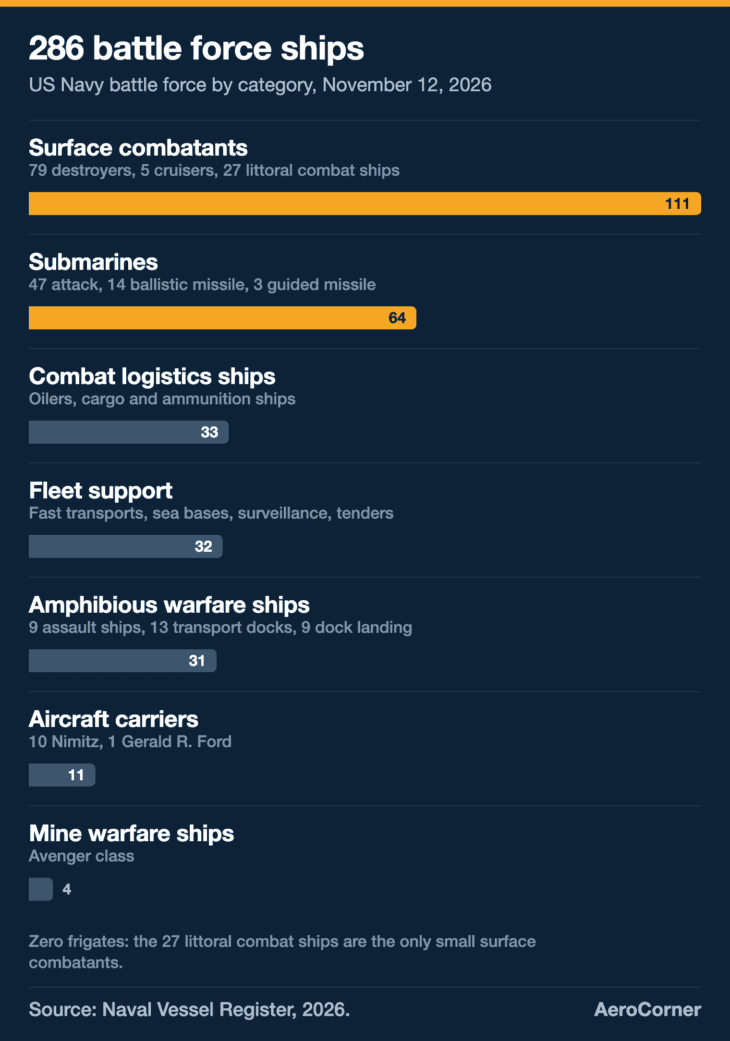
Destroyers are the backbone: 79 of them, against just 5 cruisers left in service. The Navy has no frigates at all, so the 27 littoral combat ships are its only small surface combatants. Our guide to the types of navy ships explains what each class does.
The 11 carriers match the figure in our article on how many aircraft carriers the US has. The submarine figure is the battle force count: the register lists 71 submarines in commission, but counts only 64 of them toward the battle force.
The surprise is the bottom half of the table. Sixty-five of the 286 ships are combat logistics and fleet support vessels, and none of the 33 oilers and cargo ships is a commissioned warship. They are counted because a fleet that cannot refuel at sea cannot fight far from home.
Why Other Sources Say 237, 293 or 460
Search this question and you will see at least four different numbers. They come from different definitions and different dates, not from anyone getting the arithmetic wrong.
237: commissioned ships only. The Naval Vessel Register lists 237 commissioned ships, the ones that carry the USS prefix. The gap to 286 is mostly the oilers, cargo ships and transports of the Military Sealift Command, which carry the USNS prefix and are not commissioned but still count toward the battle force.
293 and 291: earlier dates. The Congressional Research Service counted 293 battle force ships on October 1, 2025. The Navy’s May 2026 shipbuilding plan said 291. The count has fallen another five ships since May, as retirements outpace deliveries.
About 460: everything that floats. Wikipedia’s list of current US Navy ships counts roughly 460, because it includes the reserve fleet and non-battle force ships owned or leased by the Navy. That is a fair answer to a different question: how many ships the Navy owns, not how many count as its fighting fleet.
The 600-ship Navy never had 594 battle force ships
A figure of 594 ships at the end of fiscal 1987 is widely quoted as the Reagan-era peak. The Congressional Research Service says that number is the total of active ships, not battle force ships. Counted the way the Navy counts today, the late Cold War peak was 568.
How the Number Got Here, and Where It Is Going
The modern battle force count dates from the early 1980s. By its rules, the fleet peaked at 568 ships at the end of fiscal 1987, then fell to 317 by fiscal 1999 as Cold War ships retired faster than replacements were built.
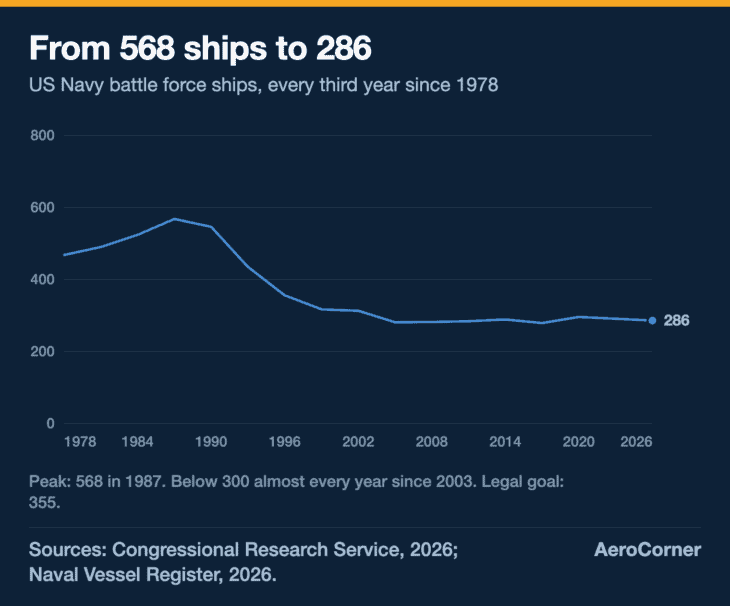
The Navy fell below 300 battle force ships in August 2003 and has stayed between 270 and 300 since. It touched 300 again only briefly, in early July 2020 and in August and September 2022.
The goals keep moving away from the fleet. A 355-ship navy became US policy in the fiscal 2018 National Defense Authorization Act, with no enforcement mechanism. In 2023 the Navy set a goal of 381 manned ships plus 134 large unmanned vessels, which the forthcoming “Golden Fleet” goal is set to replace.
The May 2026 shipbuilding plan aims for 299 battle force ships by 2031, alongside 68 auxiliary vessels and 83 unmanned vessels, and includes three Trump-class nuclear-powered battleships in its 2027 to 2031 purchases. Even on that plan, the battle force stays below 300 through 2031.
How the US Navy Compares With China’s
The US Navy is no longer the largest in the world by ship count. The Pentagon’s recent China military reports, as quoted by the Congressional Research Service in April 2025, credit China’s navy with a battle force of more than 370 ships and submarines, a figure that leaves out about 60 missile-armed Houbei-class patrol boats.
The research service adds that China passed the US in battle force ships sometime between 2015 and 2020. The Pentagon projected China’s battle force would reach 435 ships by 2030, mostly through new major surface combatants. Our profile of China’s navy covers it class by class.
Ship count is not the whole story. The US still fields 11 nuclear-powered carriers and an all-nuclear submarine force, and our ranking of the largest navies in the world compares fleets by tonnage as well as by hulls.
FAQ
Sources and references used for research and fact-checking.
- Naval Vessel Register (NAVSEA), Fleet Size
- Naval Vessel Register (NAVSEA), Ship Battle Force
- Congressional Research Service, Navy Force Structure and Shipbuilding Plans: Background and Issues for Congress (RL32665), January 20, 2026
- Congressional Research Service, China Naval Modernization: Implications for U.S. Navy Capabilities (RL33153), April 24, 2025
- Stars and Stripes, Navy details how it will realize Golden Fleet initiative, including nuclear-powered battleship
- Wikipedia, List of current ships of the United States Navy
Get the Newsletter
The latest aviation news and stories sent to your inbox.
About the Author

Tim is the owner and lead editor of AeroCorner since 2019, overseeing aviation content covering aircraft, airlines, airports, and the broader aviation industry. Through years of researching, writing, editing, and publishing aviation-focused content, he has developed extensive practical knowledge of commercial aviation and air travel. Based in Asia and a frequent traveler himself, Tim also brings firsthand passenger experience to AeroCorner’s coverage. Outside of publishing, he has also explored aviation firsthand through hands-on flight training in New Zealand.