

Table of Contents
The best destroyer in the US Navy is the Flight III Arleigh Burke, the newest version of a design first commissioned in 1991. It carries the SPY-6, a newer and more capable radar than any other Burke, built for air and ballistic missile defense, and only two are in service.
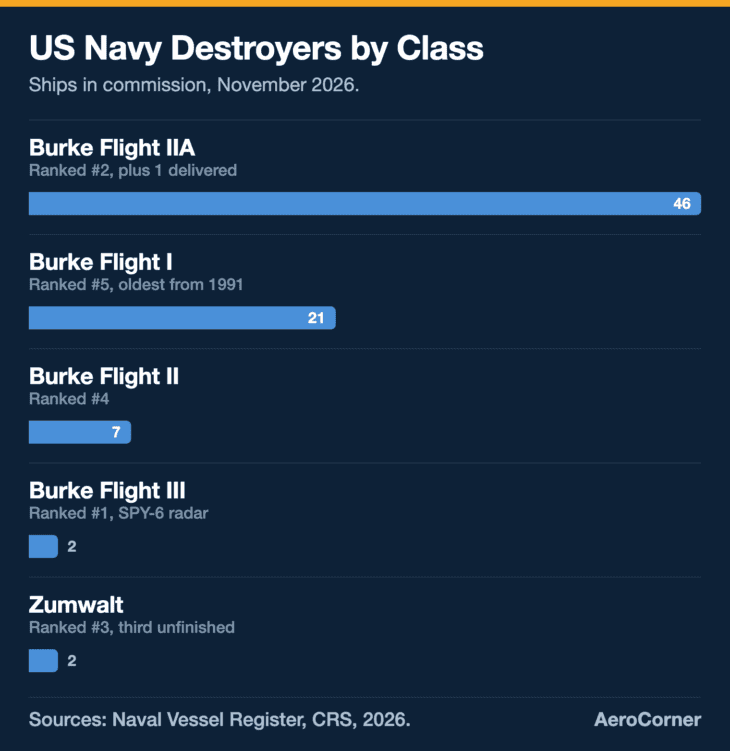
The Navy has 79 destroyers in its battle force, according to the Naval Vessel Register (NVR) updated November 12, 2026: 77 Arleigh Burkes and two Zumwalts. Seventy-eight of them are commissioned, because the newest Burke, USS Patrick Gallagher, has been delivered but not yet commissioned.
This list ranks every destroyer type the Navy sails by fighting value as of November 2026. The Arleigh Burke class is split into its four flights, because a 1991 Flight I and a 2026 Flight III are very different warships.
| Rank | Class | Hull numbers | In commission, Nov. 2026 | Length | Missile cells |
|---|---|---|---|---|---|
| 1 | Arleigh Burke Flight III | DDG 125, 126, 128 and up | 2 | 509.5 ft (155.3 m) | 96 |
| 2 | Arleigh Burke Flight IIA | DDG 79 to 124, 127 | 46, plus 1 delivered | 509.5 ft (155.3 m) | 96 |
| 3 | Zumwalt | DDG 1000 to 1002 | 2, plus 1 unfinished | 610 ft (186 m) | 80, plus 4 hypersonic tubes |
| 4 | Arleigh Burke Flight II | DDG 72 to 78 | 7 | 505 ft (154 m) | 90 |
| 5 | Arleigh Burke Flight I | DDG 51 to 71 | 21 | 505 ft (154 m) | 90 |
| Next | DDG(X) or Trump-class battleship | None yet | 0 | Not final | Not final |
How this ranking works
Each class is ranked by the fighting value it adds in November 2026: its sensors and weapons, how many the Navy has, and how long they will stay. Counts are ships in commission in the Naval Vessel Register. USS Patrick Gallagher (DDG 127) is in the battle force count but not yet commissioned, and USS Lyndon B. Johnson (DDG 1002) has not been delivered, so neither is counted in the commission column. The five remaining Ticonderoga cruisers are not destroyers and are left out.
1. Arleigh Burke Flight III: The New Radar Ship
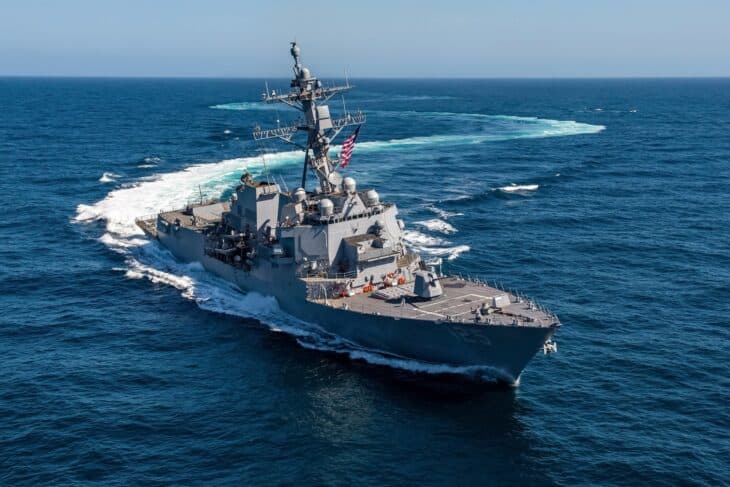

The Flight III is the Arleigh Burke the Navy is buying now. It keeps the Flight IIA hull, 509.5 feet (155.3 m) long with 96 vertical launch cells, but swaps the old SPY-1D radar for the Raytheon SPY-6(V)1, with the extra power and cooling the new radar needs.
The Navy switched production to the Flight III design in fiscal 2017. Every ship from DDG 125 onward is a Flight III, except DDG 127, which was built as the last Flight IIA.
Two are in commission. USS Jack H. Lucas, the first, was commissioned in Tampa on October 7, 2023, and is based in San Diego. USS Ted Stevens followed on October 3, 2026, in Whittier, the first Navy commissioning in Alaska since 2013, and is based in Norfolk, Virginia.
They rank first because the radar is the point of a modern destroyer: a ship that sees a missile sooner can shoot it down sooner. The weakness is how slowly they arrive. In June 2025 the Government Accountability Office found delivery delays of 8 to 41 months on the first 13 follow-on Flight III ships.
2. Arleigh Burke Flight IIA: 46 Ships, the Backbone of the Fleet
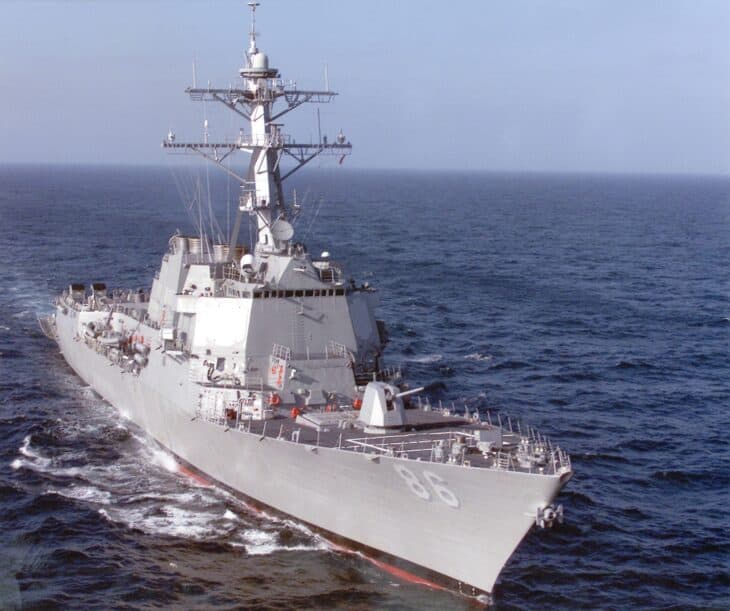

The Flight IIA is the most numerous warship type in the US Navy. Forty-seven were bought between fiscal 1994 and 2016, DDG 79 to 124 plus DDG 127, and 46 are in commission.
The big change from earlier Burkes was a helicopter hangar. Flight IIA ships have two hangars for MH-60 helicopters such as the MH-60R Seahawk, which hunts submarines far beyond the ship’s own sonar. They also grew to 96 missile cells and about 9,500 tons at full load, with a crew of about 323.
The last one, USS Patrick Gallagher, was delivered by Bath Iron Works on May 28, 2026, more than two months early, and will be based in Norfolk. Its commissioning date had not been announced in November 2026.
The Flight IIA ranks second because it does almost everything the Flight III does with an older radar, and there are 23 times as many of them. Flight IIA and III ships are rated for a 40-year service life, so the newest will sail into the 2060s.
3. Zumwalt Class: The Stealth Destroyer Turned Hypersonic Launcher
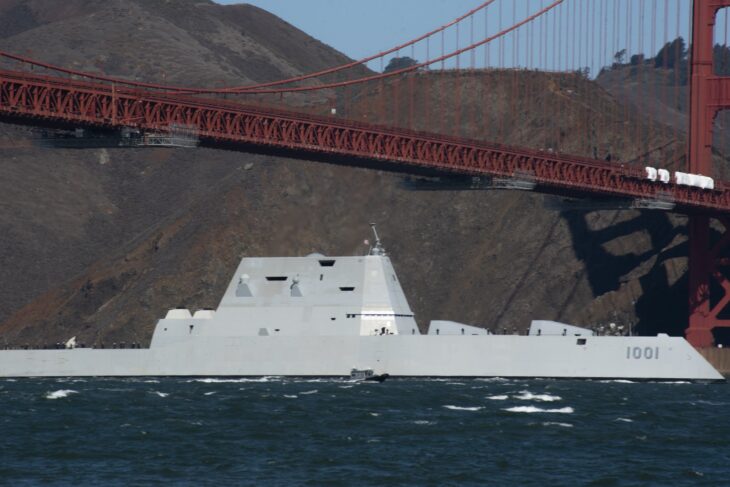

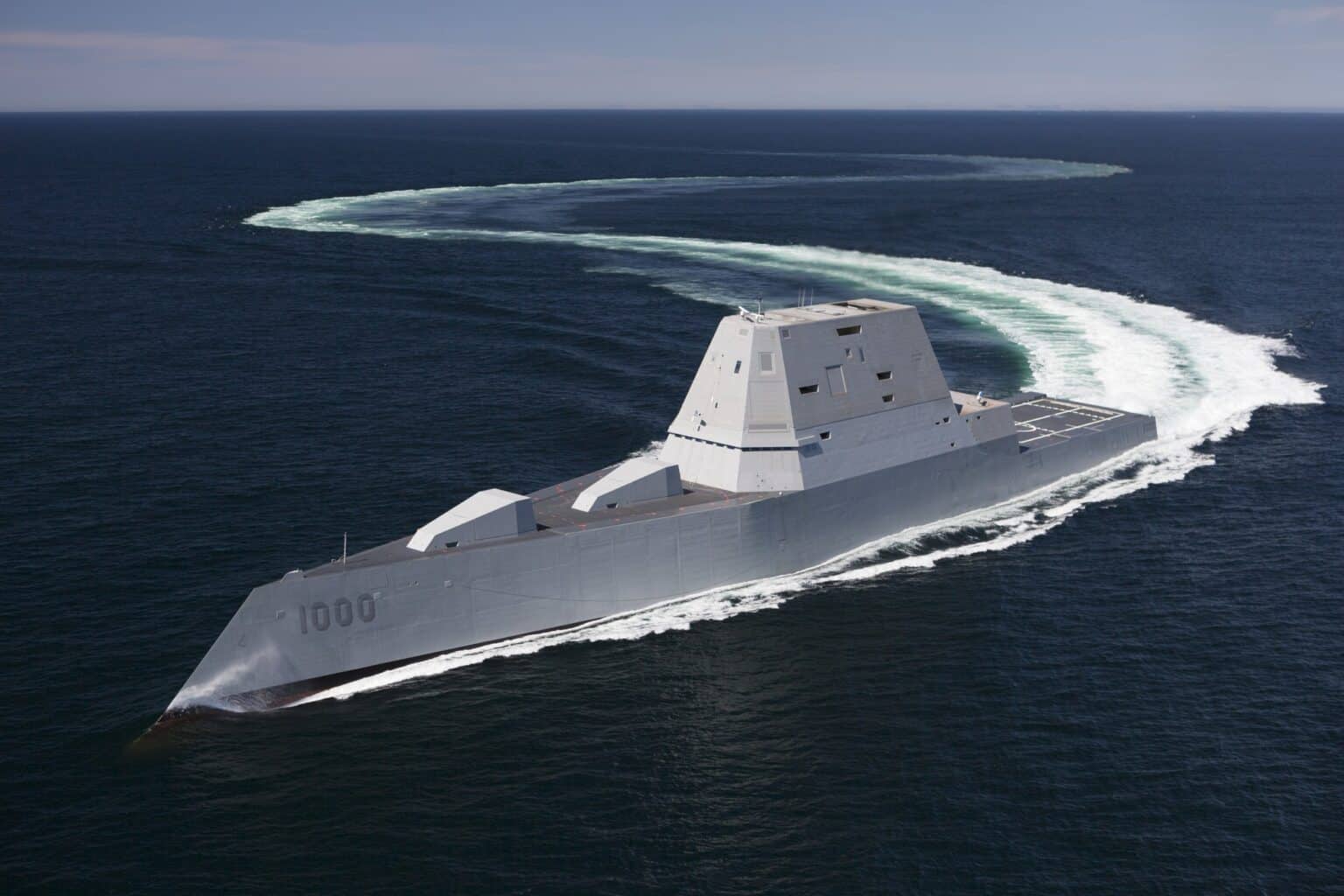
The Zumwalt is the biggest destroyer in the US fleet. It is 610 feet (186 m) long and displaces just under 16,000 tons, nearly twice an Arleigh Burke, with an angular hull shaped to shrink its radar signature.
The Navy originally planned 32 and built three. USS Zumwalt was commissioned in October 2016 and USS Michael Monsoor in January 2019, both based in San Diego. Counting research and development, the three ships cost more than $22 billion, according to a 2016 estimate.
Their main weapons never worked out. Each ship was built with two 155mm Advanced Gun Systems, but the Navy ended purchases of their special long-range shells in November 2016 because of the cost, leaving the guns with almost nothing to fire.
The fix is the Conventional Prompt Strike hypersonic missile. The guns on USS Zumwalt were replaced with four large tubes holding three missiles each, 12 per ship, alongside its 80 standard cells, and HII finished the ship’s builder’s sea trials in January 2026. The weapon itself is covered in our ranking of hypersonic missiles that actually exist.
The Zumwalt ranks third, below the Burkes it outweighs, because there are two of them and their new weapon is not yet in operational service. Once it is, the Zumwalt becomes the Navy’s first warship armed with a hypersonic missile.
No, there are not three Zumwalts in service
Most lists say the Navy has three Zumwalt-class destroyers. It has two. The third, USS Lyndon B. Johnson (DDG 1002), had its keel laid in January 2017 and was launched in December 2018, but has never been commissioned. On October 19, 2026, the Navy gave HII a $99 million contract to finish and sea-test it, with turnover to the Navy aimed for 2027.
4. Arleigh Burke Flight II: Seven Ships With Better Links
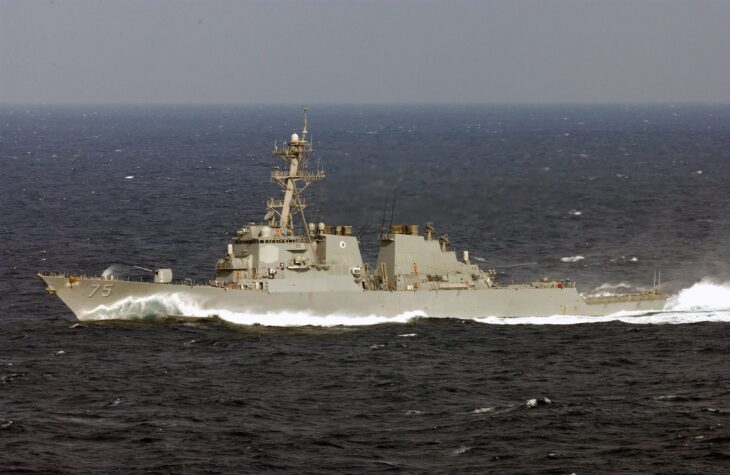

The seven Flight II ships, DDG 72 to 78, look almost identical to the Flight I. The changes are inside: Link 16 data links, an upgraded electronic warfare suite, the ability to fire the longer-range SM-2 Block IV missile and more fuel.
Like the Flight I, they are 505 feet (154 m) long with 90 missile cells, and they have a flight deck for a helicopter but no hangar to keep one aboard. They rank above the Flight I only on those small upgrades, and they face the same retirement clock.
5. Arleigh Burke Flight I: The Oldest, Still Fighting
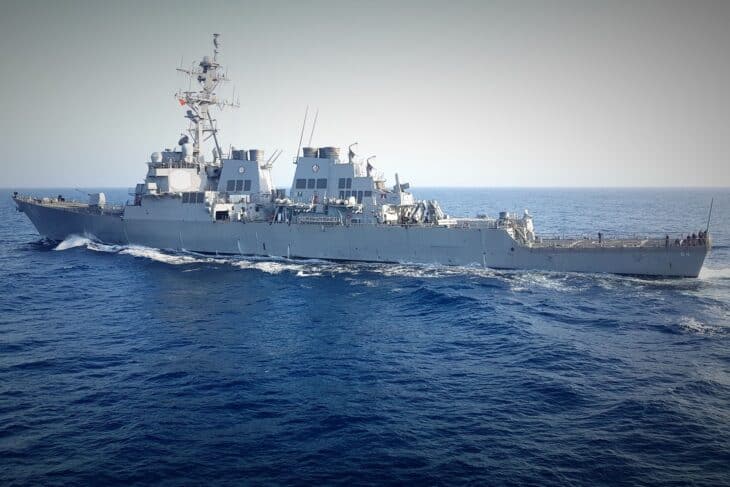

USS Arleigh Burke (DDG 51) was commissioned on July 4, 1991, and all 21 Flight I ships, DDG 51 to 71, are still in service. Each is 505 feet (154 m) long, displaces about 8,300 tons at full load and makes more than 31 knots.
The Flight I and II ships were designed for 35 years, which means retirements could start in the late 2020s, according to the Congressional Research Service. In October 2024 the Navy said it would keep 12 of the 21 Flight I ships beyond 35 years, adding 48 ship-years of service between 2028 and 2035.
They rank last on age, not on record. The Navy’s newest shipbuilding plan, released in May 2026, retires 10 destroyers and cruisers between 2027 and 2031, and the oldest Burkes are the destroyers nearest the end of their design life.
The oldest Burkes made the first SM-3 kills in combat
During Iran’s missile attack on Israel in April 2024, USS Carney (DDG 64) and USS Arleigh Burke (DDG 51), both Flight I ships, fired SM-3 interceptors and shot down at least three Iranian ballistic missiles. It was the first combat use of the SM-3. Months earlier, on October 19, 2023, Carney shot down at least three cruise missiles and eight drones over the Red Sea.
Coming Next: DDG(X) or a Battleship
The Navy has bought 97 Arleigh Burkes through fiscal 2025, at about $2.7 billion each when two are bought a year. Its May 2026 shipbuilding plan funds seven more between fiscal 2027 and 2031, while warning that the design is nearing the limits of its capacity.
The planned successor was DDG(X), a larger destroyer with room for 12 big missile cells in place of 32 standard ones, whose first ship had already slipped to fiscal 2032. On December 22, 2025, the Pentagon said the new Trump-class battleships would replace those DDG(X) plans.
The first battleship, USS Defiant (BBG 1), would displace more than 34,000 tons, and the May 2026 plan includes three of them. Analysts note that none has been funded, and in August 2026 the Congressional Budget Office put the first ship at $23.4 billion, so the Arleigh Burke is likely to stay in production for years yet.
Why the Destroyer Count Depends on Who You Ask
Sources quote 75, 76, 77, 78 or 79 destroyers, and most of them are right on their own terms. The difference is what gets counted: commissioned ships, ships delivered to the battle force, or a snapshot taken before the latest delivery.
In November 2026 the Naval Vessel Register counts 79 destroyers in the battle force, including the delivered but uncommissioned Patrick Gallagher, and 78 commissioned. How destroyers fit among carriers, submarines and support ships is in our count of how many ships the US Navy has.
Destroyers are also the escorts of every carrier strike group, alongside the five cruisers the Navy has left. What each ship type does is explained in our guide to the types of navy ships.
FAQ
Sources and references used for research and fact-checking.
- Naval Vessel Register (NAVSEA), Ship Battle Force and USS Ships in Commission, hull lists for DDG 51 and DDG 1000 (updated November 12, 2026)
- Congressional Research Service, Navy DDG-51 and DDG-1000 Destroyer Programs: Background and Issues for Congress (RL32109, December 5, 2025)
- Wikipedia, Arleigh Burke-class destroyer
- Wikipedia, Zumwalt-class destroyer
- Stars and Stripes, Navy contract for Zumwalt-class ship sea trials
- HII, HII Completes Builder's Sea Trials for USS Zumwalt (DDG 1000)
- The War Zone, USS Zumwalt returns to the water with a hypersonic missile launcher upgrade
- PEO Ships, U.S. Navy, Navy Accepts Accelerated Delivery of Future USS Patrick Gallagher
- Alaska's News Source, USS Ted Stevens gets October date for historic commissioning in Whittier
- The Defense Post, US Navy commissions USS Ted Stevens
- Wikipedia, USS Jack H. Lucas
- gCaptain, U.S. Navy extends life of battle-tested Arleigh Burke destroyers
- Stars and Stripes, Navy details how it will realize Golden Fleet initiative, including nuclear-powered battleship
- Wikipedia, DDG(X)
- Wikipedia, Trump-class battleship
- Wikipedia, Destroyer
Get the Newsletter
The latest aviation news and stories sent to your inbox.
About the Author

Tim is the owner and lead editor of AeroCorner since 2019, overseeing aviation content covering aircraft, airlines, airports, and the broader aviation industry. Through years of researching, writing, editing, and publishing aviation-focused content, he has developed extensive practical knowledge of commercial aviation and air travel. Based in Asia and a frequent traveler himself, Tim also brings firsthand passenger experience to AeroCorner’s coverage. Outside of publishing, he has also explored aviation firsthand through hands-on flight training in New Zealand.