Military Aircraft
Xian H-6
ICAO: H-6
China's secretive next-generation stealth bomber, unconfirmed to have flown as of 2026
The latest aviation news and stories sent to your inbox.
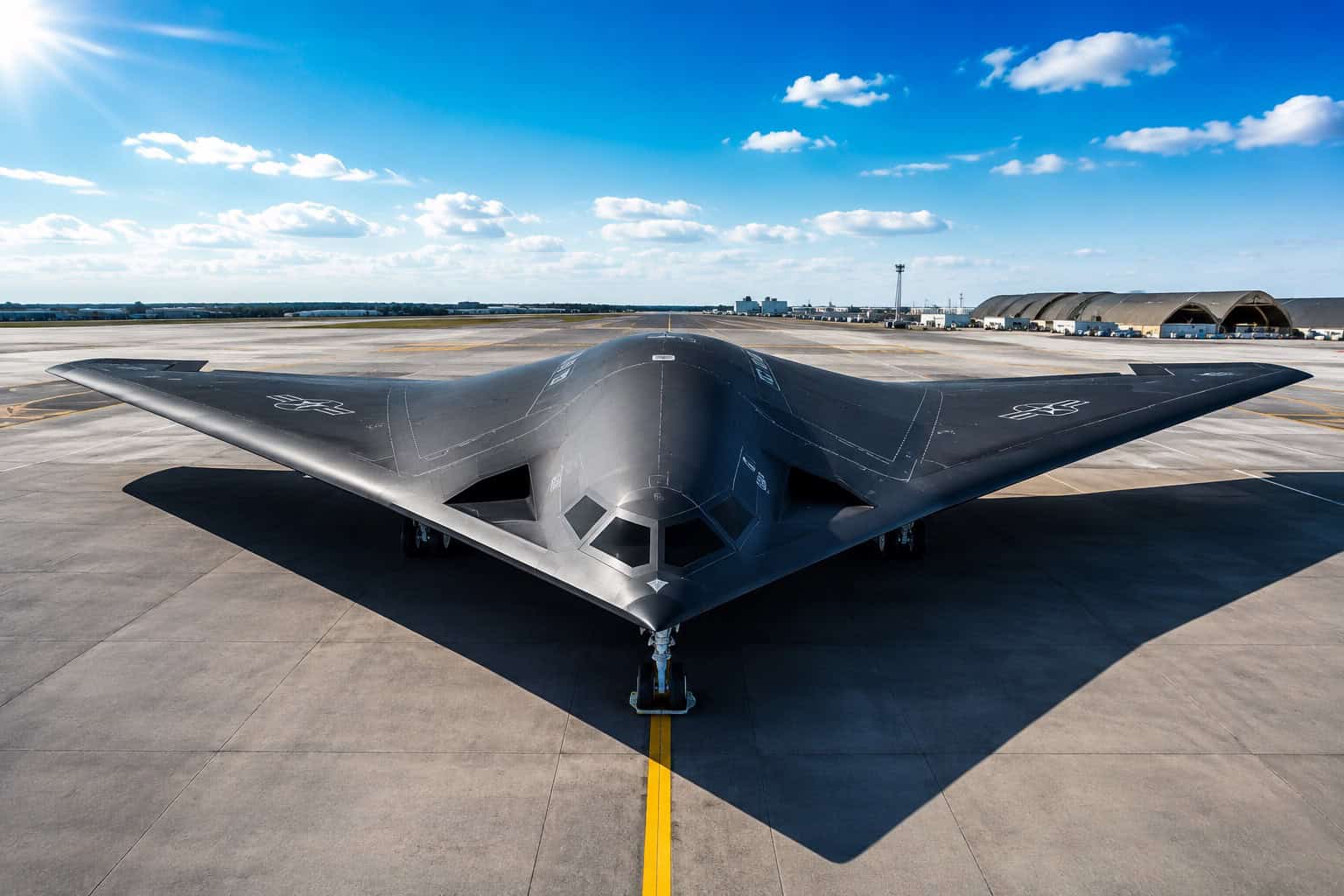
The Xi’an H-20 is China’s flying-wing stealth bomber program, meant to give the People’s Liberation Army Air Force its first true long-range strategic bomber, comparable in mission to the U.S. B-2 Spirit. Development has been publicly acknowledged since 2016, but as of mid-2026 no government has confirmed a completed airframe, a maiden flight, or any aircraft in service. U.S. intelligence assesses the program has run into serious engineering challenges and does not expect it to be operational before the 2030s.

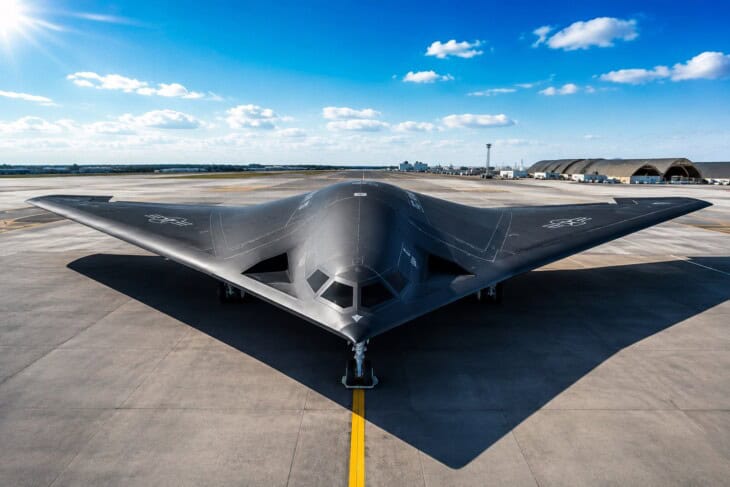
The Xi’an H-20 is China’s answer to the B-2 Spirit: a flying-wing stealth bomber meant to give the People’s Liberation Army Air Force its first true long-range strike aircraft. It has been in development since at least 2016, and as of mid-2026 no government has confirmed that it has flown.
Almost everything published about the H-20 is an estimate. Xi’an Aircraft Industrial Corporation, the state-owned manufacturer, has never released a spec sheet, a photo of a complete airframe, or a flight date. This article covers what U.S. intelligence and independent analysts believe about the aircraft, and is clear about which parts are guesswork.
Yes, in the sense that a program by that name exists. A former PLAAF general first acknowledged development in September 2016, and Chinese officials have periodically confirmed the project is active, most recently in March 2024, when a PLAAF vice commander said a public reveal would come “very soon.”
What has not happened is a confirmed flight. Grainy footage circulated on Chinese social media in January 2025 appeared to show a large flying-wing aircraft escorted by a Shenyang J-16 fighter, but the location, date, and authenticity of that footage have never been verified by any government.
China has unveiled several other next-generation programs since then, including the J-36 tailless fighter and new uncrewed platforms, without a matching reveal for the H-20. That gap is a large part of why Western analysts describe the program as opaque rather than simply slow.
The H-20 has missed at least three informal unveiling windows that Chinese officials or state media had floated: around 2019, again in 2022, and again in 2024. Each time, expectations reset without an aircraft appearing.
Every rendering, wind-tunnel model, and piece of leaked imagery associated with the H-20 shows the same basic shape: a tailless or near-tailless flying wing, the same low-observable configuration used by the B-2 Spirit and the B-21 Raider.
Recurring features across those sources include serrated, S-shaped air intakes to hide the engine compressor face from radar, a sharply swept “cranked-kite” wing planform, and foldable twin tail surfaces that can act as either horizontal stabilizers or a V-tail. A 2022 Chinese wind-tunnel model showed similar large-area tail control surfaces.
One industry official who reviewed the design compared it to Northrop’s A-12 Avenger II, a stealthy flying-wing attack aircraft the U.S. Navy canceled in 1991, scaled up and fitted with added tail surfaces. No source has published confirmed exterior dimensions.
No engine model has been officially disclosed for the H-20. Imagery from the January 2025 sighting reportedly showed a single contrail despite the aircraft appearing to be multi-engined, which is consistent with a flying-wing bomber built around twin buried turbofans, similar in concept to the B-2’s four engines or the B-21’s reported two.
Analysts widely expect a derivative of an existing Chinese turbofan, most often the WS-10 or WS-20 families that already power other PLAAF aircraft, but no manufacturer or defense-ministry source has confirmed a specific engine.
The U.S. Department of Defense’s China Military Power assessment is the most authoritative public estimate. It describes the H-20 as a low-observable strategic bomber with a range of “at least 8,500 km” (5,280 miles) and payload capacity of “at least 10 tonnes” (22,000 lb), able to carry conventional or nuclear weapons.
Other reporting cites higher, less official figures: a ferry range near 13,000 km (8,100 miles), a combat radius around 5,000 km (3,100 miles), and a bomb payload of 30 to 40 tons (66,000 to 88,000 lb). Those numbers trace back to Chinese state-media-adjacent claims rather than a Pentagon assessment, and the gap between the two sets of figures is itself a reminder of how little is actually confirmed.
| Aircraft | Status | Range (best public estimate) | Payload (best public estimate) |
|---|---|---|---|
| Xi’an H-20 | Unconfirmed, in development | At least 5,280 miles (8,500 km), per DoD | At least 22,000 lb (10 tonnes), per DoD |
| Northrop Grumman B-2 Spirit | Operational since 1997 | Roughly 6,000 nautical miles (11,100 km) unrefueled | 40,000 lb (18,100 kg) |
| Northrop Grumman B-21 Raider | In flight test, entering service 2027 | Classified; estimated in the B-2’s class | Classified; estimated 20,000 to 30,000 lb (9,100 to 13,600 kg) |
Every H-20 row in that table is an outside estimate. Speed is the one parameter analysts agree on with more confidence: like the B-2 and B-21, the H-20 is expected to be subsonic, trading top speed for a smaller radar signature.
On paper, the DoD’s conservative H-20 estimate is smaller than the B-2 on both range and payload, though the wide spread in public figures makes a confident head-to-head impossible. The B-2’s numbers are confirmed and combat-proven; the H-20’s are not.
The more important gap is maturity. The B-2 entered service in 1997 and has flown combat missions since 1999. The H-20 has never been confirmed to fly at all, let alone operate.
If China does field the H-20 in the 2030s, as U.S. intelligence currently expects, it would still be catching up to a stealth-bomber capability the United States fielded roughly four decades earlier, and would arrive around the same time the newer B-21 is reaching full production.
U.S. defense officials attribute the delays to engineering, not politics. One official assessment, cited by multiple outlets in late 2025 and early 2026, put it bluntly: “the thing with the H-20 is when you actually look at the system design, it’s probably nowhere near as good as U.S. LO platforms,” referring to low-observable, or stealth, technology.
Matching a working stealth bomber is a different problem than matching a stealth fighter. China has fielded the J-20 and the J-35, both credible stealth fighters, but a flying-wing bomber demands a harder set of trade-offs between low observability, structural weight, fuel volume, and payload across intercontinental distances.
General Stephen Davis of Air Force Global Strike Command has characterized China’s current bomber force as “a regional bomber force at best,” reflecting the view that the H-20’s delays keep China without a true long-range strategic bomber for now.
Analysts at RAND Corporation have assessed that a working H-20 would let China “reliably threaten U.S. targets within and beyond the Second Island Chain,” including major American bases on Guam and in Hawaii, extending PLAAF reach well past the reach of China’s current H-6 bomber fleet.
That is the strategic logic driving the program even through years of delay: a stealth bomber with intercontinental range would change the geography of any Pacific conflict, forcing U.S. and allied planners to defend targets that are currently out of range for China’s existing bombers.
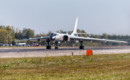
Until the H-20 arrives, if it arrives, China’s frontline bomber remains the Xi’an H-6, a license-built derivative of the 1950s Soviet Tupolev Tu-16. Newer H-6 variants carry modern cruise missiles and have been extensively upgraded, but the airframe itself is non-stealthy and more than 70 years old in basic design.
That gap between a 1950s-derived bomber and a next-generation stealth design is exactly what the H-20 is meant to close, and exactly why its repeated delays draw so much attention from U.S. defense planners.
Not yet an operational one. The Xi’an H-20 is China’s stealth bomber program, but as of mid-2026 no government has confirmed that it has flown, let alone entered service. China’s current bomber fleet, the H-6, is not stealthy.
In service today, it is the Xi’an H-6, specifically upgraded variants like the H-6K and H-6N that carry modern cruise missiles despite a 1950s-derived airframe. The H-20 is intended to eventually replace it as China’s most advanced bomber, but remains unconfirmed to have flown.
Not operationally. The H-20 is designed as China’s answer to the B-2 Spirit, a flying-wing stealth bomber with a similar mission, but it has not been confirmed to fly and U.S. intelligence does not expect it to be operational before the 2030s.
Yes. China operates the Chengdu J-20, a stealth fighter in service since 2017, and is developing the J-35 as a second stealth fighter. Those are distinct programs from the H-20, which is a bomber rather than a fighter.
None have been publicly confirmed. No government has verified a completed airframe, a maiden flight, or any aircraft in service, so any production count would be speculation.
No confirmed date exists. Chinese officials suggested a reveal was imminent as recently as March 2024, but by early 2026 U.S. officials described the program’s visible progress as frozen, with entry into service still expected in the 2030s at the earliest.
Sources and references used for research and fact-checking.