Military Propellor Planes
Vought SBU Corsair
ICAO: SBU
The gull-winged carrier fighter that outlasted every other American piston fighter in production.
Updated: by Tim de Vries

The latest aviation news and stories sent to your inbox.
The Vought F4U Corsair was a single-seat, gull-winged fighter-bomber built for the U.S. Navy and Marine Corps. It first flew in 1940, fought from Guadalcanal to Korea, and stayed in production until 1953, longer than any other American piston fighter.
Live Fleet Activity (F4U)
Fetching live data…

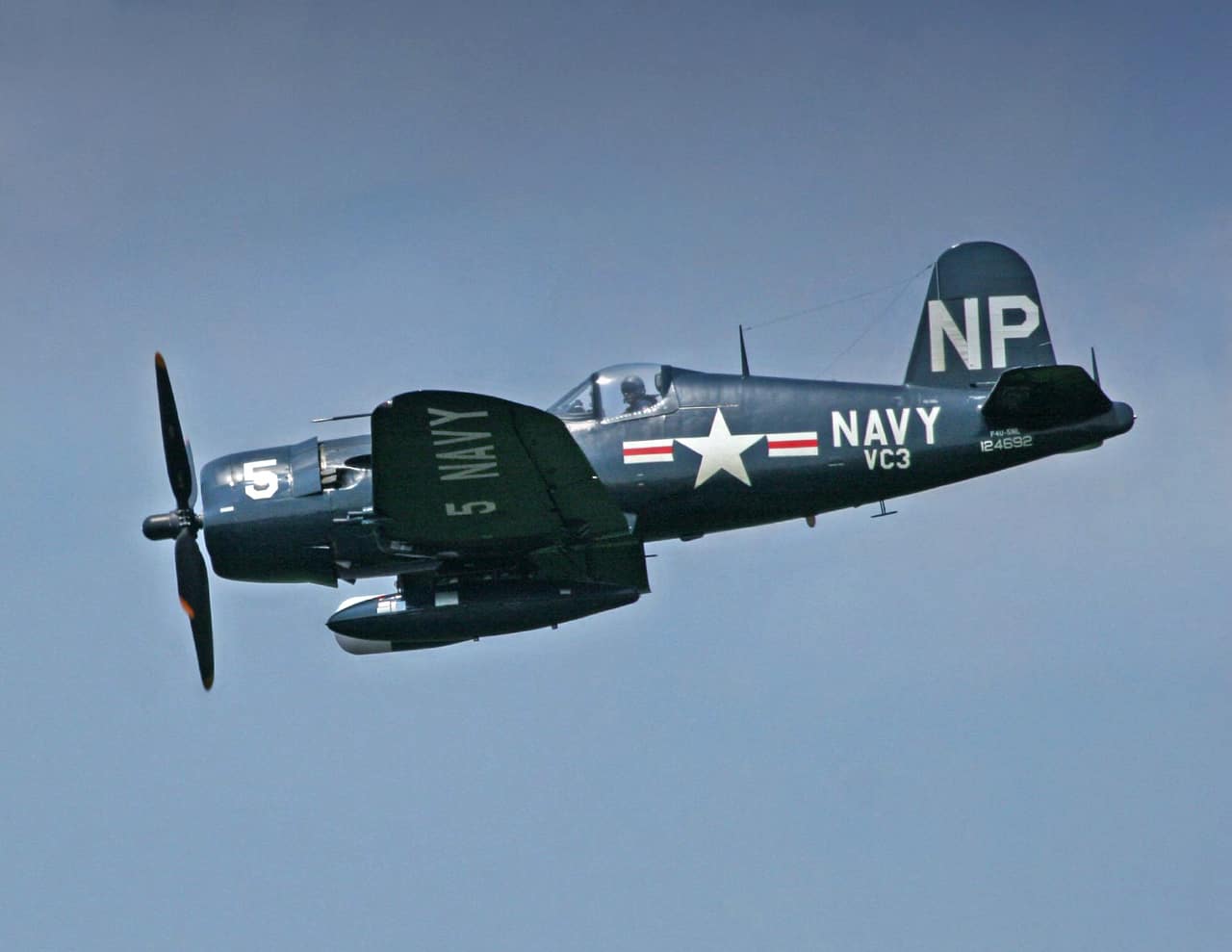


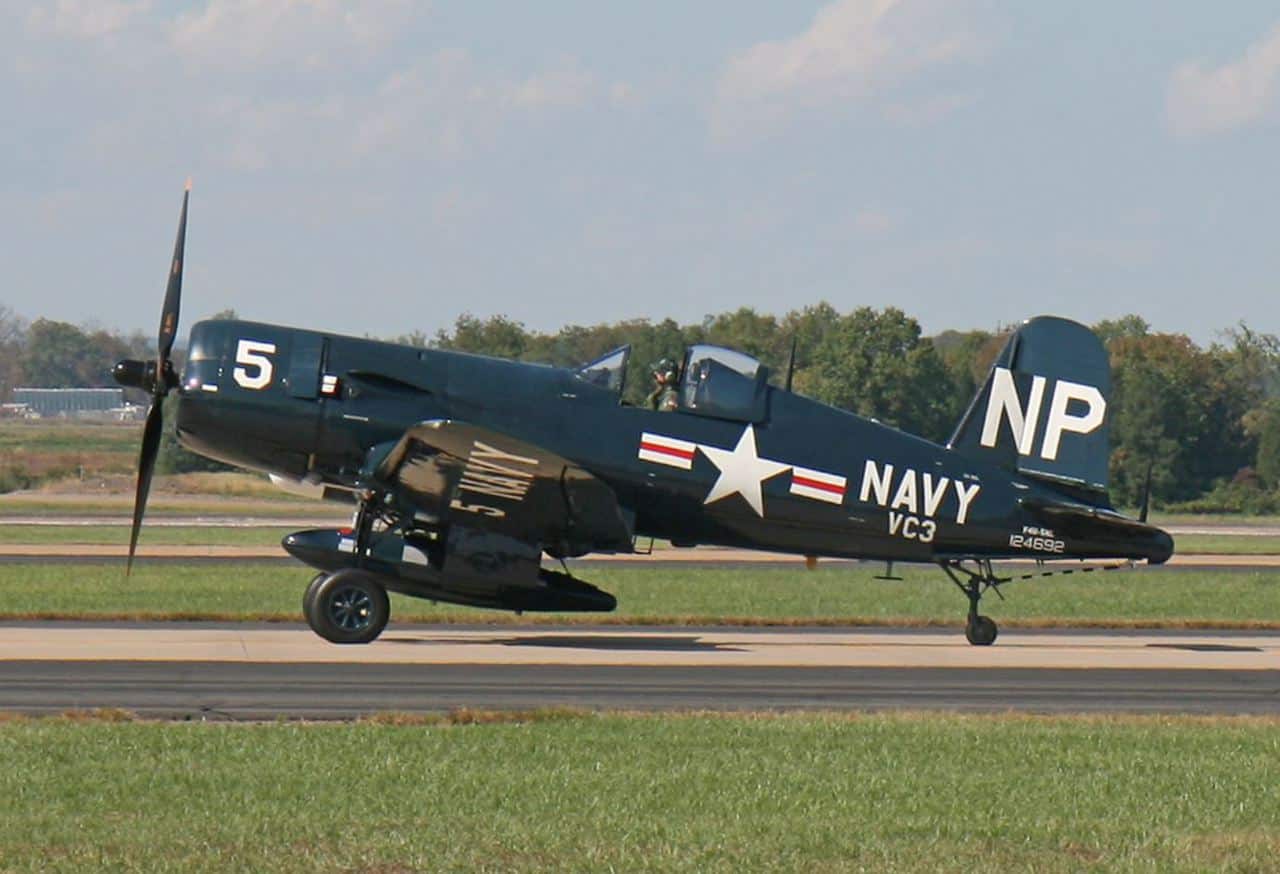

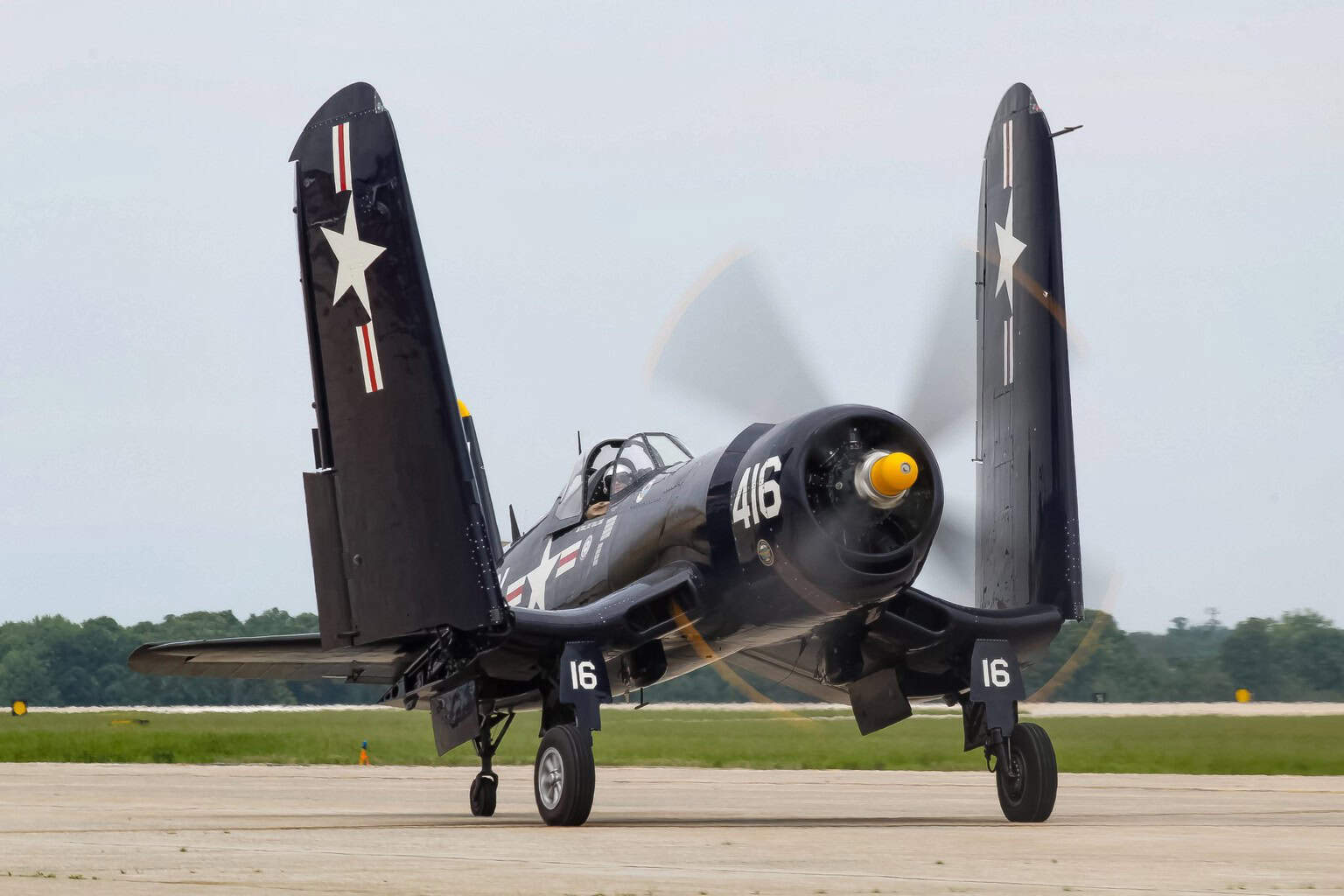


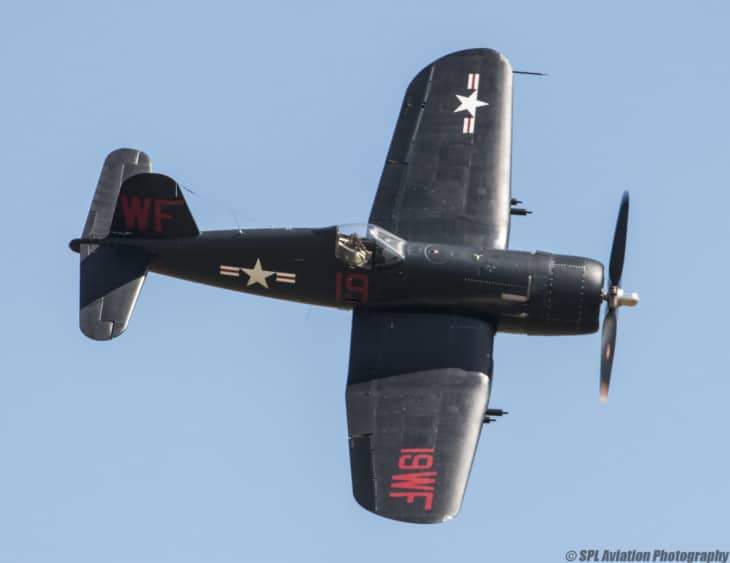
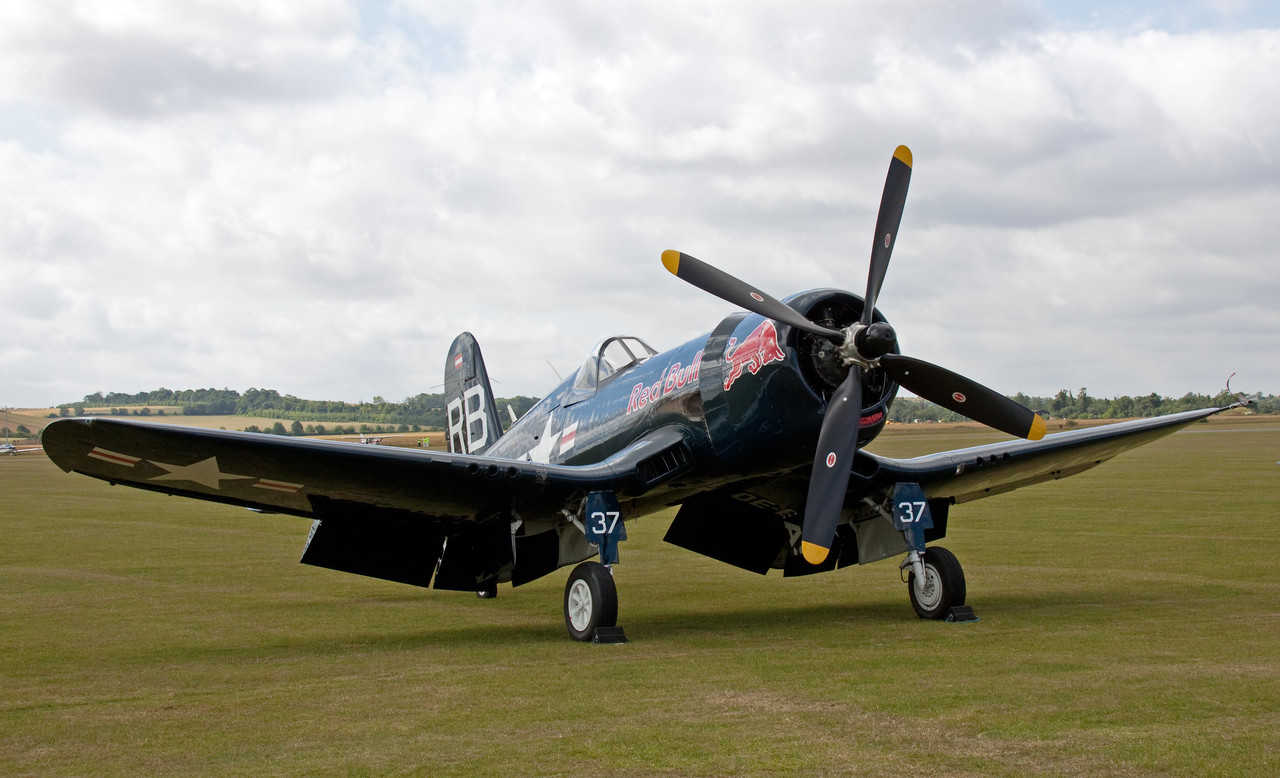
The Vought F4U Corsair was a single-seat carrier fighter with an inverted gull wing and the largest engine available at the time. It flew first on May 29, 1940, entered Navy service in 1942, and stayed in production until 1953.
In total 12,571 Corsairs were built in 16 models, the longest production run of any American piston-engined fighter. The panel on this page describes the F4U-4, the last version that fought in World War II.
Team leader Rex Beisel’s design had to swing a huge propeller, and the main landing gear needed long legs to keep it off the ground. The inverted gull wing solved both problems. It let the struts stay short while the propeller cleared the runway.
The bend also gave the Corsair its look, and its nickname: Navy and Marine aviators called it the Bent-Wing Eliminator.
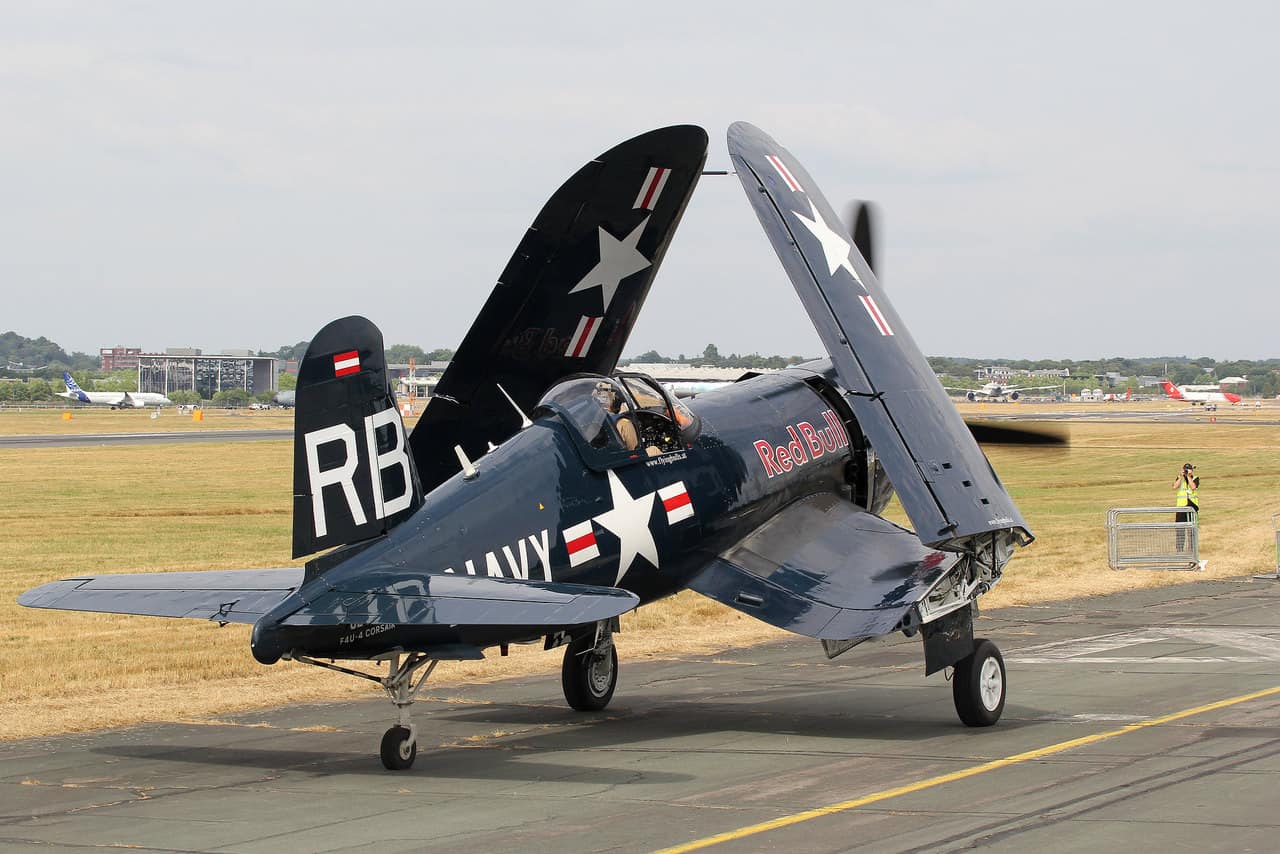
Every production Corsair used a Pratt & Whitney R-2800 Double Wasp, an 18-cylinder two-row radial. The early F4U-1 had about 2,000 hp and a three-blade propeller. The F4U-4’s R-2800-18W is rated at 2,100 hp (1,566 kW) and drives a four-blade propeller.
Water-alcohol injection could lift that to 2,450 hp for short bursts of war-emergency power. Wikipedia’s infobox gives 2,380 hp, so sources do not agree on a single number. The panel uses the 2,100 hp base rating.
The Corsair’s flight deck record is the reason it did not reach the carriers first. The left wing could stall and drop without warning at landing speed. The oleo struts rebounded poorly and let the aircraft bounce down the deck. The long nose also hid the deck from the pilot.
Fixes followed: a stall strip on the right wing, a bleed valve in the struts, and fixed top cowl flaps to stop oil spattering the windscreen. Early carrier trials in 1942 still concluded that the Corsair was an excellent carrier type, “no different than any other airplane.”
The Navy favored the Grumman F6F Hellcat as its main carrier fighter because it was simpler for inexperienced pilots to land. Most early Corsairs went to Marine squadrons flying from land bases, and only 15% of the type’s wartime sorties launched from carrier decks.
The torque of the Double Wasp made a missed landing a handful for inexperienced pilots. Early Navy pilots called the F4U the “hog”, the “hosenose” and the “bent-wing Widow Maker.” Later nicknames such as “Ensign Eliminator” reflected how many more training hours it took to master than other carrier fighters.
In the air it was a different aircraft. The Corsair outclimbed and outdove the Japanese A6M Zero and was faster, though the Zero could turn tighter at low speed. Pilots learned to keep their speed up and fight from altitude.
Deliveries of the F4U-4 began in early 1945, and the type reached the front in June 1945 for the final push against the Japanese home islands. The main changes were the two-stage supercharged engine, a four-blade propeller, an air scoop under the nose and the removal of the unarmored wing fuel tanks. Removing those tanks improved handling at the cost of range.
The F4U-4B swapped the six .50 caliber machine guns for four 20 mm cannon. Vought lists eight 5 inch rockets under the wings or up to 4,000 lb of bombs for the cannon versions, which made the type a fighter-bomber as much as a fighter.

The full specification table for the aircraft is on this page. A few figures need context.
Top speed is 388 kt, or 447 mph (719 km/h) on the panel. Vought’s own sheet and Wikipedia both round the same speed to 446 mph, which is the figure you will see in most books.
Ceiling is 41,500 ft (12,600 m), and climb rate is 4,360 ft/min (22 m/s). Climb figures vary between sources because they depend on weight and engine setting. Vought’s sheet lists a lower initial rate, and Wikipedia’s variant text says over 4,500 ft/min.
The fuel row includes drop tanks. Vought’s 534 gallon figure counts two 150-gallon external tanks, so the aircraft’s internal fuel is much lower than the row suggests.
The Corsair flew from Guadalcanal and other bases in the Solomon Islands from February 1943. By the end of the war the F4U and its Goodyear-built FG version had flown 64,051 operational sorties for the Navy and Marines, 44% of all U.S. fighter sorties. The type delivered 70% of all bombs dropped by U.S. fighters in the war, which says what it did for the infantry.
Ground troops nicknamed it the “Sweetheart of the Marianas” and the “Angel of Okinawa.” The Royal Navy’s Fleet Air Arm and the Royal New Zealand Air Force flew Corsairs too, and the British made carrier landings more practical by raising the pilot’s seat and fitting a bulged canopy.
The Korean War used the Corsair mostly in close support. Night fighter F4U-5Ns hunted trucks and trains, and the F4U-4 gave the war one of its best-known stories: Lt. Thomas Hudner, flying a VF-32 F4U-4, won the Medal of Honor for crash-landing beside Ensign Jesse Brown, one of the Navy’s first African American naval aviators, after Brown’s Corsair was shot down.

France’s Aéronavale used 163 Corsairs, 94 F4U-7s and 69 AU-1s, in Vietnam, at Suez in 1956 and in Algeria. The last were out of service by September 1964. The F4U-7, built for France, was the last Corsair ever produced.
The type’s final combat came in 1969. During the Football War between Honduras and El Salvador, Honduran Captain Fernando Soto shot down three Salvadoran aircraft in one day, in what Wikipedia calls the last combats among propeller-driven aircraft.
For a wider view of the era, see our guides to the American fighter planes of World War II and the fastest planes of World War II. The Corsair’s great rival from the Army Air Forces has its own page: the North American P-51 Mustang, compared directly in P-51 Mustang vs F4U Corsair.
Three things stacked up: a left wing that could stall suddenly in a slow approach, poor forward visibility over the long nose, and the torque of the Double Wasp engine. Early deck landings were also hurt by bouncing struts. Fixes such as a stall strip on the right wing and a bleed valve in the struts cured most of it.
On the figures on our pages, the F4U-4 is slightly faster: 447 mph against 441 mph for the P-51. The Mustang flew much farther, with a range of 1,650 mi against roughly 1,000 mi for the Corsair. Our P-51 vs Corsair comparison covers the rest.
We could not verify a total for surviving or airworthy Corsairs, and we do not quote one. One fact is sourced: of the 437 Corsairs the Royal New Zealand Air Force received, only one flies today, FG-1D ZK-COR at Masterton. Wikipedia keeps a separate list of surviving F4U Corsairs.
U.S. service ended in 1953, and France’s last Corsairs left service by September 1964. Honduras retired its last Corsairs in 1979, after the 1969 Football War.
A single Pratt & Whitney R-2800-18W Double Wasp, an 18-cylinder two-row radial rated at 2,100 hp with a two-stage supercharger and a four-blade propeller. Water injection raised power to 2,450 hp for short periods.
Sources and references used for research and fact-checking.