Mid Size Passenger Jets
McDonnell Douglas MD-90
ICAO: MD90
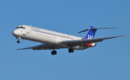
The McDonnell Douglas MD-83 was the extended-range member of the MD-80 family, built from 1983 to 1999 and flown by airlines from Alaska to TWA to Allegiant.
Updated: by Tim de Vries

The latest aviation news and stories sent to your inbox.
The McDonnell Douglas MD-83 is the long-range version of the MD-80 twin-jet. It added extra fuel tanks and more powerful JT8D-219 engines to the MD-81 and MD-82 design, and 265 were built before the last one was delivered in December 1999.
Live Fleet Activity (MD83)
Fetching live data…


The MD-83 is the extended-range version of the MD-80, a twin-engine, rear-engined airliner descended from the DC-9. McDonnell Douglas announced it on January 31, 1983, and the prototype first flew on December 17, 1984.
The full specification table for the aircraft is on this page. The sections below explain what sets the MD-83 apart and what happened to it.
The FAA certified the MD-83 on October 17, 1985, and Alaska Airlines was the launch operator. Its first four aircraft were built as MD-82s and later re-engined and re-certified as MD-83s.
The last delivery came on December 28, 1999, when an MD-83 went to Trans World Airlines (TWA). It was also the last MD-80 built.
In all, 265 MD-83s were built, out of 1,191 aircraft in the MD-80 series.
The MD-83 is built on the MD-81 and MD-82 airframe, so the two look almost identical from the ramp. The difference is range.
The MD-83 carries extra fuel in two auxiliary tanks and is fitted with Pratt & Whitney JT8D-219 engines. To handle the higher operating weights, McDonnell Douglas strengthened the landing gear, wing structure and cabin floor beams.
The trade is a heavier aircraft that can fly sectors the MD-82 could not, which suited transcontinental and charter work.
Published range depends on the load behind it. Wikipedia quotes about 2,504 nautical miles with 155 passengers. The spec panel on this page lists the manufacturer-style range for the aircraft.
Treat any single range number as one point on a payload trade, not a limit.

Most of the MD-83 fleet has been retired. The largest current operators of the MD-80 series include Aeronaves TSM, World Atlantic Airlines, LASER Airlines, Everts Air and USA Jet Airlines.
A former American Airlines MD-83, described as the last one ever built, was delivered to TezJet in Kyrgyzstan after years in storage. No reliable public count of airworthy MD-83s exists, so any figure you see for how many are still flying is an estimate.
In the US, Delta flew the last scheduled passenger service of any McDonnell Douglas airliner on June 2, 2020.

The MD-83 has been involved in several fatal accidents, none of which pointed to a single design flaw.
Atlasjet Flight 4203 (November 30, 2007). A World Focus Airlines MD-83 flying for Atlasjet hit a hill near Isparta, Turkey, killing all 57 people aboard. The final report blamed a navigation error by the crew.
Dana Air Flight 992 (June 3, 2012). Both engines lost power on approach to Lagos, Nigeria, and the aircraft hit a building. All 153 aboard and 6 people on the ground died. Investigators traced the engine failures to an improperly installed fuel manifold and criticized the crew’s handling of the emergency.
Air Algérie Flight 5017 (July 24, 2014). A Swiftair MD-83 flying for Air Algérie stalled and crashed in Mali, killing all 116 aboard. Investigators found that ice crystals likely gave false thrust readings, and the crew did not recover from the stall.
On January 31, 2000, an Alaska Airlines MD-83 lost pitch control and crashed into the Pacific Ocean. All 88 aboard, 83 passengers and 5 crew, died.
The NTSB (report NTSB/AAR-02/01) found that the jackscrew assembly that moves the horizontal stabilizer failed after its threads wore away. The probable cause was inadequate maintenance, including insufficient lubrication and extended maintenance intervals.
Several other MD-83 events were survivable. A Swiftair aircraft struck a wingtip landing at Kandahar in 2012, an American Jet Charter MD-83 slid off the runway at Willow Run in 2017 on a rejected takeoff, and a Caspian Airlines MD-83 overran the runway at Mahshahr in 2020. These are included for completeness.

The MD-80 is a family of twin-engine, rear-engined narrowbody airliners developed from the DC-9. A total of 1,191 were built, and the MD-83 was the longer-range variant.
The MD-83 adds auxiliary fuel tanks and JT8D-219 engines, plus structural strengthening for higher weights. That gives it more range than the MD-82.
265 MD-83s were built. The last was delivered to TWA on December 28, 1999.
No authoritative public count exists. A small number still operate with carriers such as World Atlantic Airlines, LASER Airlines and Aeronaves TSM.
A worn jackscrew assembly in the horizontal stabilizer trim system failed. The NTSB found the cause was inadequate maintenance, including insufficient lubrication.
Sources and references used for research and fact-checking.