

Table of Contents
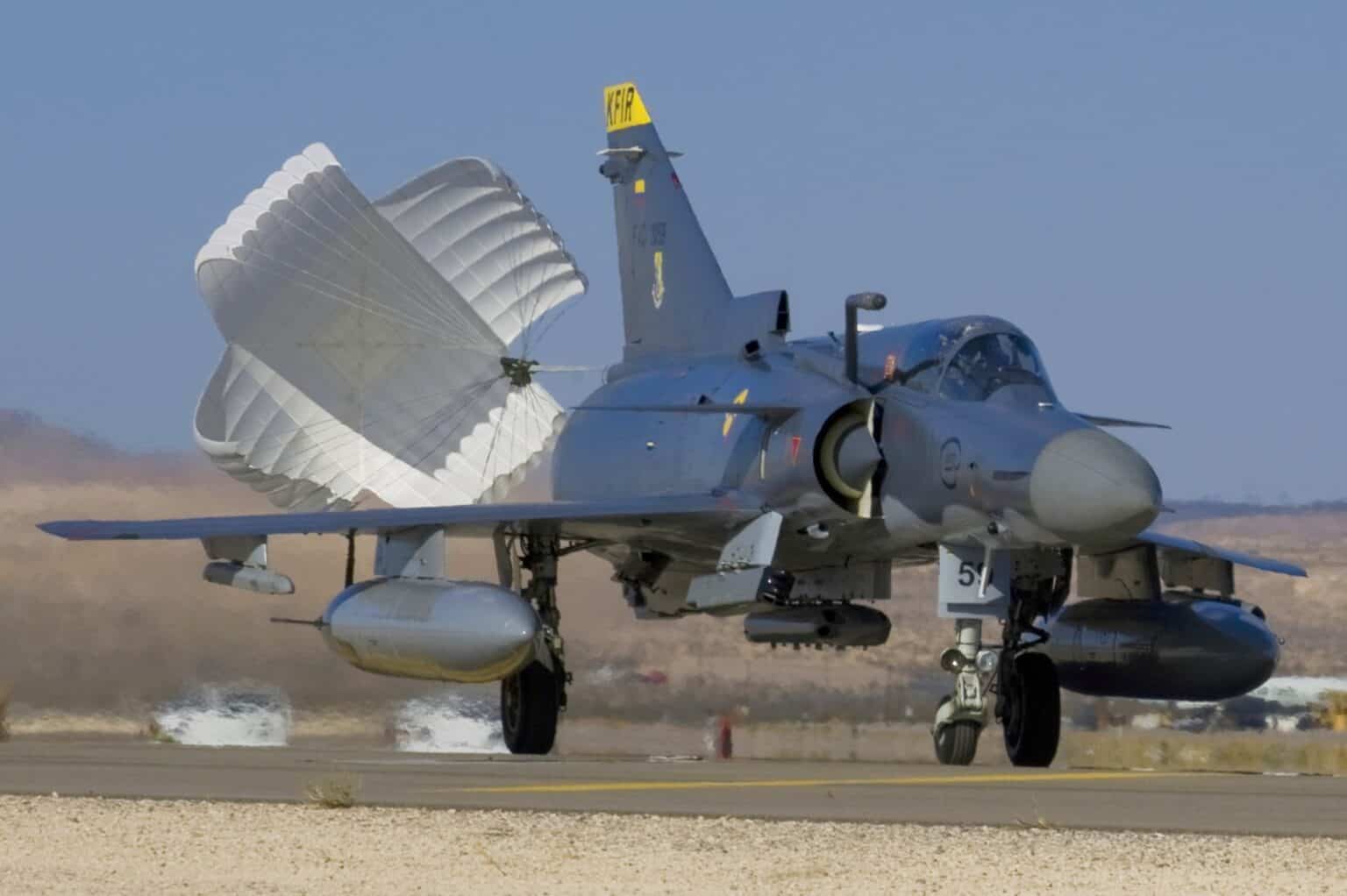
Colombia’s only supersonic fighter is the Israeli-built Kfir, and it is running out of time. Janes reported in November 2026 that just five Kfirs were airworthy, with the fleet due to stop flying by October 2027.
The replacement is the Saab Gripen E/F: 17 were ordered in November 2025 for €3.1 billion, but the first is not expected before 2027. Until then, the real workhorse is the Embraer A-29 Super Tucano, a turboprop built to hunt guerrillas in the jungle.
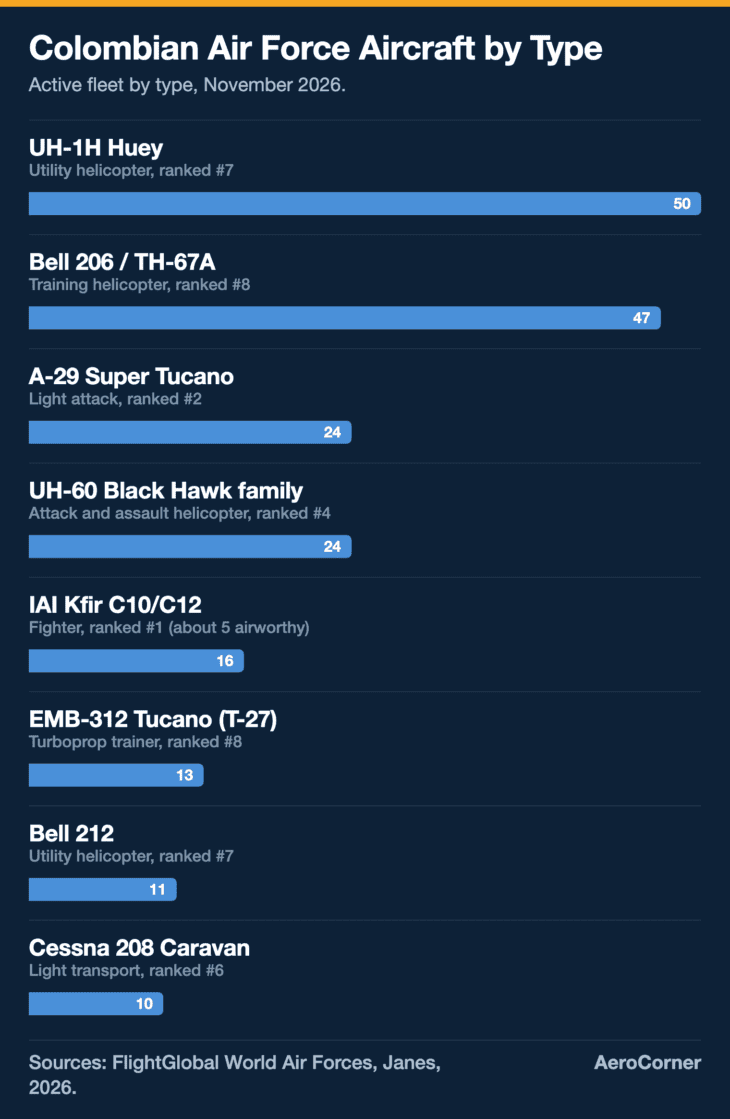
This guide ranks every aircraft type the Colombian Air Force flies by its weight in Colombian air power as of November 2026. By our count of FlightGlobal’s 2026 directory, the force flies about 270 aircraft, and more than half of them are helicopters and trainers.
| Rank | Aircraft | Role | In use | Status |
|---|---|---|---|---|
| 1 | IAI Kfir C10/C12 | Fighter | 16 (plus 3 two-seat trainers) | About 5 airworthy; retiring by October 2027 |
| 2 | Embraer A-29 Super Tucano | Light attack | 24 | 25 bought; first delivered December 2006 |
| 3 | AC-47T Fantasma (Basler BT-67) | Gunship | 6 | Turboprop DC-3 conversions |
| 4 | UH-60 Black Hawk and AH-60 Arpía | Attack and assault helicopters | 24 | In service since 1990 |
| 5 | KC-767 Júpiter and special mission aircraft | Tanker, reconnaissance, electronic warfare | 1 tanker, 15 special mission | In service |
| 6 | C-130H Hercules and transports | Airlift | 6 C-130H before March 2026; 47 transports in all | 2 KC-390s ordered for 2029 and 2030 |
| 7 | UH-1H Huey and Bell 212 | Utility helicopters | 50 and 11 | In service |
| 8 | T-6C, T-27 Tucano and TH-67 | Trainers | 9, 13 and 47 | More T-6Cs on order |
| 9 | Hermes and ScanEagle drones | Surveillance drones | About 14 | In service |
| Next | Saab Gripen E/F | Multirole fighter | 0 (17 ordered) | Deliveries 2027 to 2032 |
How this ranking works
Aircraft are ranked by their weight in Colombian air power in November 2026: the fighter first, then the armed aircraft that fight Colombia’s internal war, then helicopters, support aircraft, trainers and drones. Counts come from FlightGlobal’s World Air Forces 2026 directory, which lists only aircraft in day-to-day use, drawn on October 1, 2025. The Gripen is covered after the Kfir but not ranked, because none has been delivered. Army and Navy aircraft fly in separate air arms and are covered below.
1. IAI Kfir C10/C12: The Last Supersonic Fighter
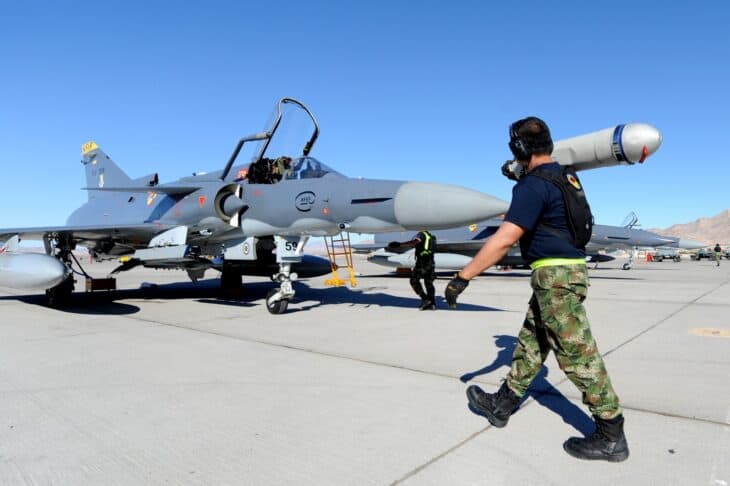

The Kfir is Colombia’s only fighter that can intercept a fast jet. The first ex-Israeli Kfir C2s arrived in 1989, and Colombia had 12 single-seaters and a two-seat TC2 by 1990, according to Migflug.
Later deals and upgrades brought the fleet to the C10 and C12 standards. FlightGlobal’s 2026 directory lists 16 Kfirs as combat aircraft and three more as trainers, all flying from Palanquero air base, home of Combat Air Command No. 1.
Far fewer can fly. Janes reported on November 4, 2026 that five were airworthy, a number expected to fall to three by the end of 2026, mostly because of engine problems.
The whole fleet was grounded for a time in October 2026 while engineers from Israel Aerospace Industries inspected and overhauled the engines. Even so, Kfirs were ordered onto patrols over northern Colombia that September.
A fighter fleet retired by its ejection seats
The Kfir’s hard deadline is October 2027, and it is set by the seats, not the airframes. Janes reports that Martin-Baker’s technical support for the Kfir’s Mk6 ejection seats ends that month, and Colombia plans to stop flying the jet when it does.
Next: Saab Gripen E/F, 17 on Order
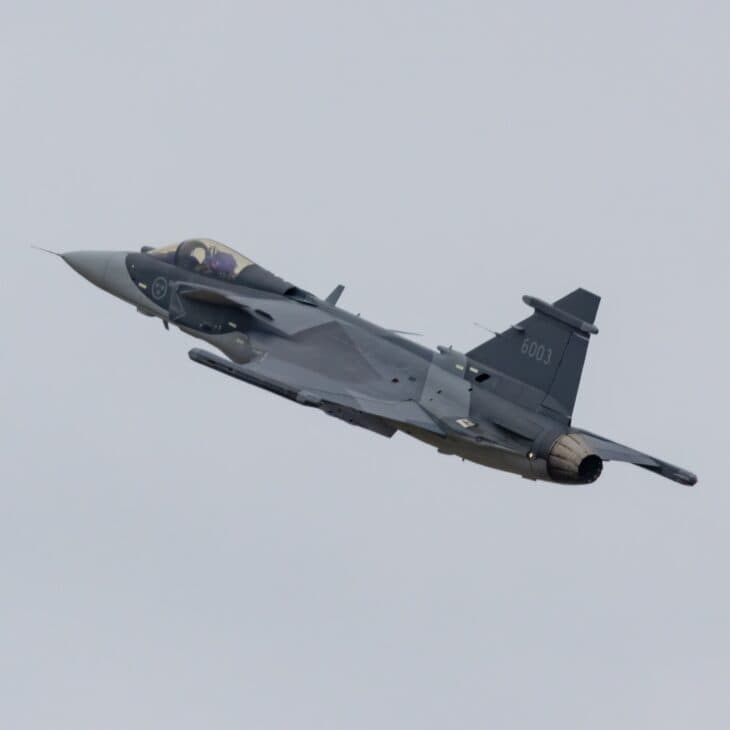

Saab announced on November 15, 2025 that Colombia had signed for 15 single-seat Gripen Es and two two-seat Gripen Fs, with weapons, training and support, for €3.1 billion. President Gustavo Petro had picked the Gripen in April 2025, after talks that went back to 2022 with both Saab and Dassault, maker of the Rafale.
Saab gives the delivery window as 2026 to 2032, but later reports put the first jet in 2027, and Janes expects the Gripen to be integrated into service in late 2028. A $91 million rebuild of Palanquero for the new fighter is due to finish by November 30, 2028.
That leaves a gap. If the Kfirs stop in October 2027 and the Gripens are not combat-ready until late 2028, Colombia could spend a year with no supersonic fighter at all.
Colombia will join Brazil’s air force, which already flies the Gripen E, as the type’s second South American customer. Our two-seat Saab Gripen page covers the family’s specs.
Did Colombia's new government cancel the Gripen deal?
No. Abelardo de la Espriella, president since August 7, 2026, is reviewing the contract, but it has not been canceled. In October 2026 the air force commander, Gen. Juan Jaime Martínez Ossa, said the contract is signed and under evaluation, and that the delivery commitments stand. Reports say the review centers on the offset package agreed under Petro, not the 17 jets.
2. Embraer A-29 Super Tucano: The Real Workhorse
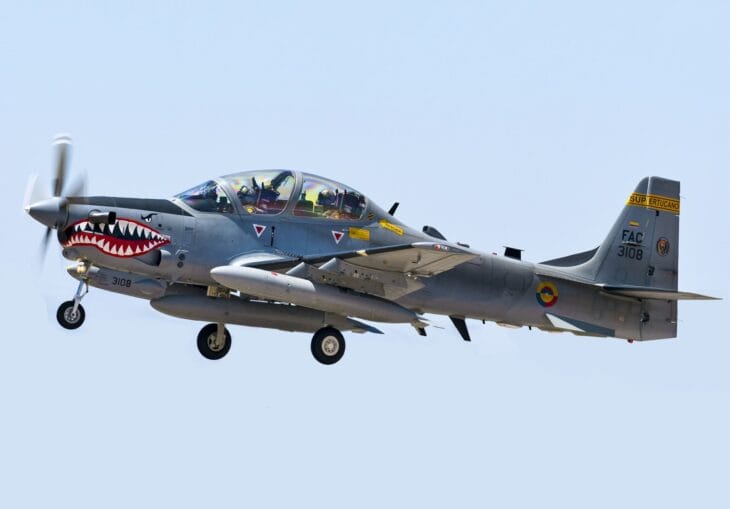

Colombia was the first export customer for the Embraer Super Tucano. FlightGlobal reported in December 2005 that it had ordered 25 in a $235 million deal that included a flight simulator.
The first three landed at CATAM, the air force’s base at Bogotá’s El Dorado airport, on December 14, 2006, and the type flew its first combat mission on January 18, 2007, Migflug records. FlightGlobal counts 24 in use.
It is an armed single-engine turboprop, cheap to fly and slow enough to work close to troops on the ground. In a country whose air war has been fought against guerrillas rather than other air forces, that matters more than speed.
3. AC-47T Fantasma: The Gunship Built From a DC-3
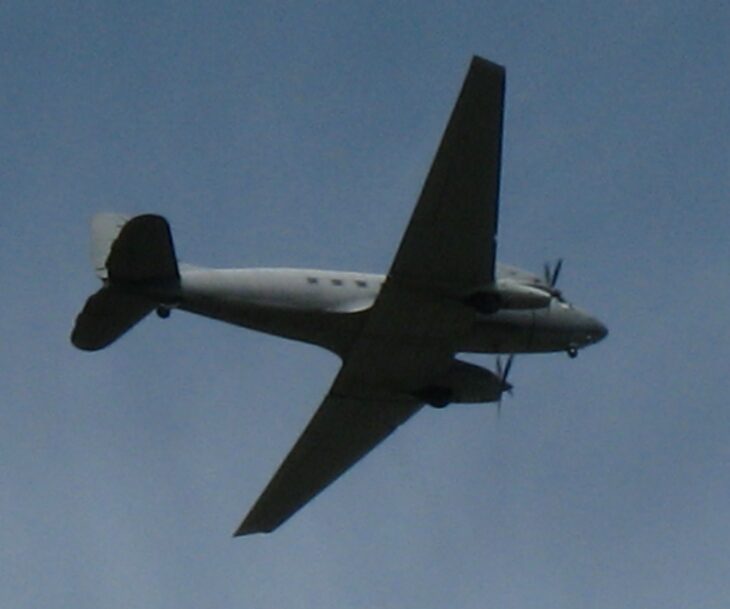

The AC-47T Fantasma is a Douglas DC-3 rebuilt by Basler as the BT-67, with turboprop engines in place of the original pistons and mounted guns. FlightGlobal lists six of the Basler airframes.
Colombia has flown armed DC-3s since 1986, according to Migflug, following the same idea as the US Air Force’s Vietnam-era AC-47 Spooky gunship.
4. UH-60 Black Hawk and AH-60 Arpía
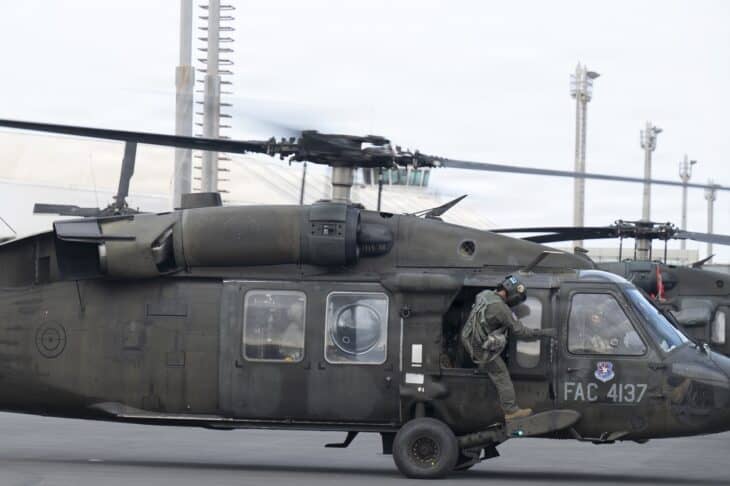

The air force has flown the Black Hawk since 1990. FlightGlobal counts 24 across the S-70, AH-60, MH-60 and UH-60L versions.
The most important is the AH-60L Arpía IV, an armed Black Hawk that Colombia uses as its attack helicopter. Infodefensa counted 10 in September 2026, with plans reported to grow the fleet to 18.
5. KC-767 Júpiter and the Spy Planes
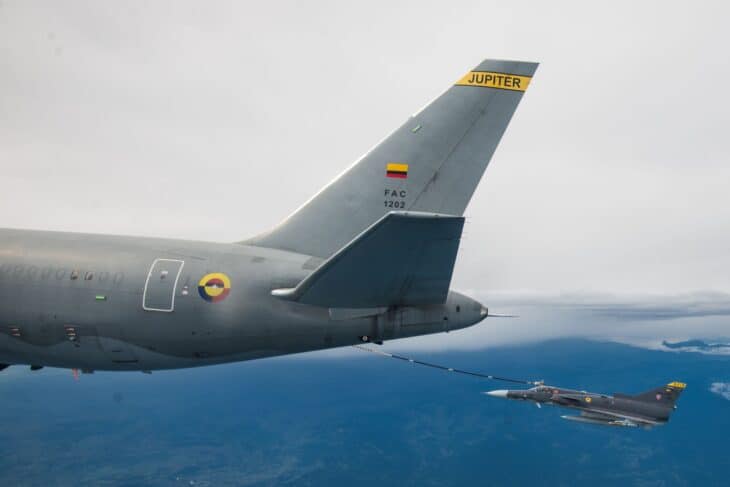

Colombia’s only big aerial tanker is a single Boeing 767, FAC-1202, delivered in November 2010 after Israel Aerospace Industries converted it into a tanker-transport.
Fifteen smaller aircraft watch from above. FlightGlobal lists six reconnaissance Cessna 208s, five Citation Ultras, one CN235 and three King Air 350s fitted for electronic warfare.
6. C-130H Hercules and the Transport Fleet
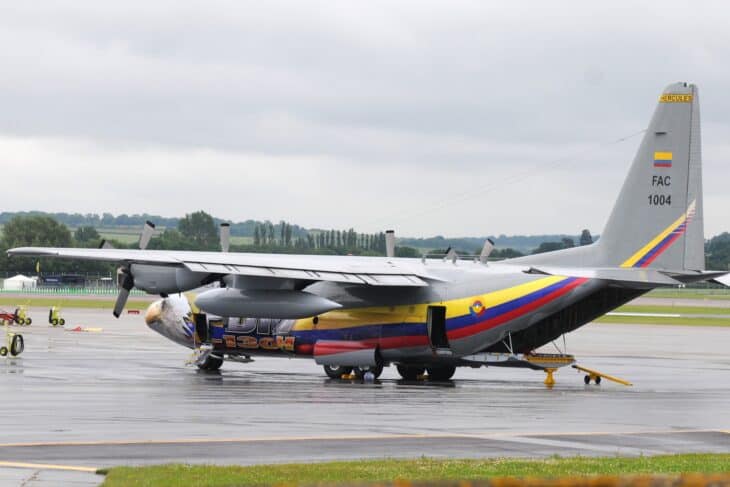

FlightGlobal counted six C-130H Hercules in October 2025. The rest of the 47 transports are smaller: five Boeing 737s, seven C295 and CN235 twins, three C212s, 10 Cessna 208 Caravans and nine King Airs, plus executive jets.
One of those Hercules is gone. On March 23, 2026, C-130H FAC 1016 crashed seconds after taking off from Puerto Leguízamo, in Putumayo, bound for Puerto Asís with 126 people aboard, according to the final toll from Colombia’s military command reported by EFE.
Sixty-nine people died and 57 were injured, most of them Army soldiers. Defense Minister Pedro Sánchez said there was no sign of an attack, and the cause had not been determined when the search ended.
Colombia ordered two Embraer KC-390s on August 4, 2026, for roughly $366 million, Breaking Defense reported. The first is due in 2029 and the second in 2030, and the air force says they can work with the incoming Gripens.
7. UH-1H Huey and Bell 212: The Biggest Fleet
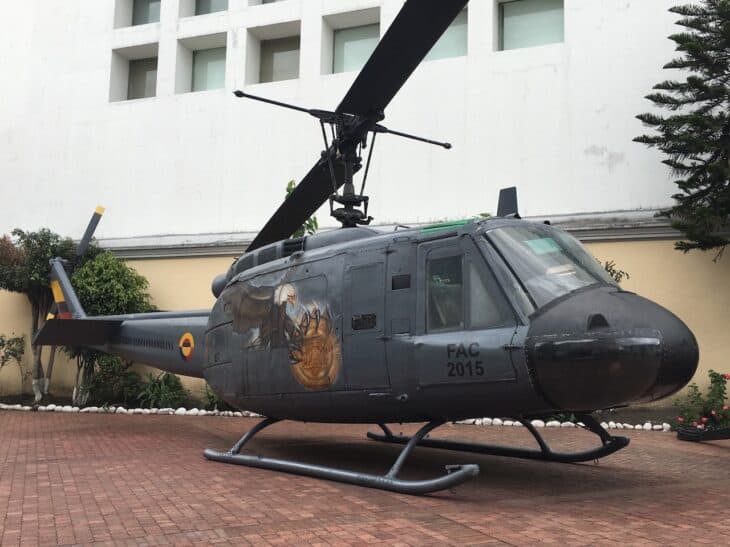

Colombia’s largest single fleet is the Huey. FlightGlobal counts 50 UH-1Hs, plus 11 Bell 212 twins, two Bell 205s and four MD500/530F light helicopters.
8. T-6C, T-27 Tucano and TH-67: Where Pilots Start
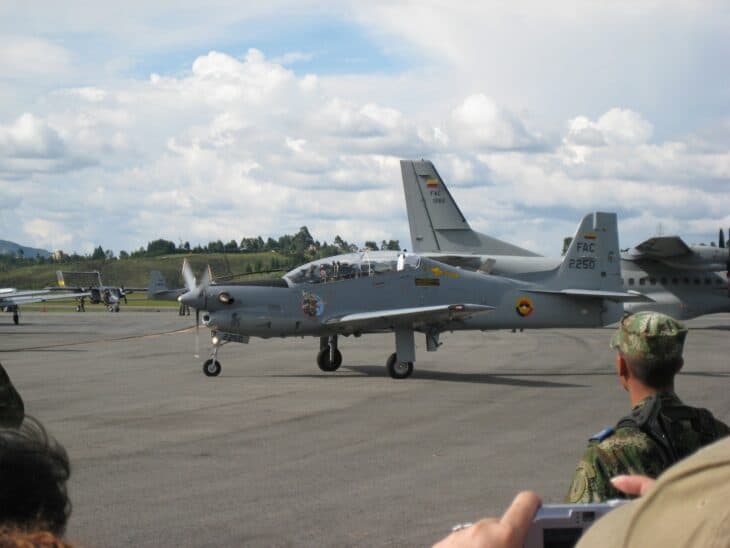

New fixed-wing pilots move up to nine Beechcraft T-6C turboprops, with more on order, and 13 older EMB-312 Tucanos, the T-27. The three two-seat Kfirs serve as the fighter trainers.
Helicopter pilots train on 47 Bell 206s and TH-67As, the military version of the Bell 206 JetRanger, the second-largest fleet in the force.
9. Hermes and ScanEagle Drones
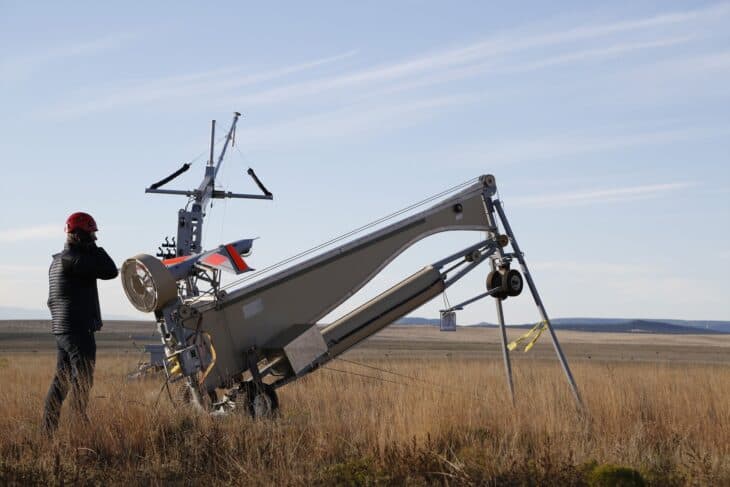

Colombia’s surveillance drones come from Israel and the United States. Migflug lists six Elbit Hermes 450s, two larger Hermes 900s and six Boeing Insitu ScanEagles.
FlightGlobal does not count drones, and the air force does not publish a total. Our ranking of the best military drones in the world shows where the Hermes family sits.
What about the Army and Navy aircraft?
They are not in the air force count. Colombia’s Army runs its own aviation, with 50 S-70i and UH-60L Black Hawks, 17 Mi-17s and 34 UH-1H/N Hueys in FlightGlobal’s 2026 directory. The Navy flies two CN235 maritime patrol aircraft plus a mix of transports and helicopters.
Air Force or Aerospace Force? The Name Keeps Changing
For most of its history the service was the Fuerza Aérea Colombiana, or FAC. Law 2302 of 2023 renamed it the Fuerza Aeroespacial Colombiana, the Colombian Aerospace Force, keeping the same initials.
Colombia’s Constitutional Court struck that law down in 2024, and Congress then wrote the new name into the constitution in November 2024, Migflug records.
On August 20, 2026, presenting his new military chiefs, De la Espriella announced that the force “will return to its original name: Fuerza Aérea.” As of November 2026 we found no published decree or reform making the change official.
From the Leticia War to the FARC: A Short History
Colombian military aviation was created by Law 126 of December 31, 1919. Its first flying school opened at Flandes, Tolima, on February 15, 1921.
Its first war came when Peruvians seized the Amazon town of Leticia on September 1, 1932. Colombia ordered 30 Curtiss Hawk II fighters and other aircraft, flew combat missions in early 1933, and a ceasefire followed on May 24, 1933.
In recent decades its main fight has been inside the country, against the FARC and other armed groups. On March 1, 2008, Colombian aircraft bombed the camp of FARC commander Raúl Reyes at Angostura, about 1.1 miles (1.8 km) inside Ecuador, killing Reyes and setting off a diplomatic crisis.
How Strong Is the Colombian Air Force?
For fighting guerrillas, it is well equipped, with 24 Super Tucanos, armed Black Hawks and AC-47T gunships. For fighting another air force, it is weak today: about five working Kfirs.
Readiness is the wider problem. A transition report handed to the incoming government in July 2026 found only 227 of 510 aircraft across Colombia’s Army, Navy and air force able to operate, El Colombiano reported.
Its neighbor is in worse shape. The Venezuelan Air Force lists 21 Su-30s but can fly far fewer. Our rankings of the largest air forces in the world and the best air forces in the world show how far size and strength can drift apart.
FAQ
Sources and references used for research and fact-checking.
- FlightGlobal, World Air Forces 2026 directory
- Janes, Colombia to keep Kfir fighter jets operational until October 2027
- Saab, Saab signs contract for Gripen E/F with Colombia
- The Aviationist, Colombia Signs Gripen E/F Contract
- Defense Express, Colombia spends three years and $90M building infrastructure for Gripen E
- Militarnyi, Colombia's New Government Seeks to Review JAS 39 Gripen Contract
- Infobae, El millonario contrato con la empresa sueca Saab para comprar 17 aviones Gripen
- Breaking Defense, Colombia buys 2 KC-390s from Embraer
- FlightGlobal, Colombia becomes first export customer for Super Tucano
- Metro Puerto Rico (EFE), Accidente de avión militar colombiano dejó 69 muertos y 57 heridos
- CBS News, Colombia military plane crash
- Pulzo, Abelardo de la Espriella cambió el nombre de la Fuerza Aeroespacial de Colombia
- El Colombiano, Informe de empalme revela crisis en la flota aérea de las Fuerzas Militares y Policía
- Migflug, Colombian Aerospace Force
- Wikipedia, Colombian Aerospace Force
Get the Newsletter
The latest aviation news and stories sent to your inbox.
About the Author

Tim is the owner and lead editor of AeroCorner since 2019, overseeing aviation content covering aircraft, airlines, airports, and the broader aviation industry. Through years of researching, writing, editing, and publishing aviation-focused content, he has developed extensive practical knowledge of commercial aviation and air travel. Based in Asia and a frequent traveler himself, Tim also brings firsthand passenger experience to AeroCorner’s coverage. Outside of publishing, he has also explored aviation firsthand through hands-on flight training in New Zealand.