

Light Passenger Jets
Tupolev Tu-134
ICAO: T134
Certified in 2003, cancelled in 2009, and only two ever flew
Updated: by Tim de Vries
The latest aviation news and stories sent to your inbox.
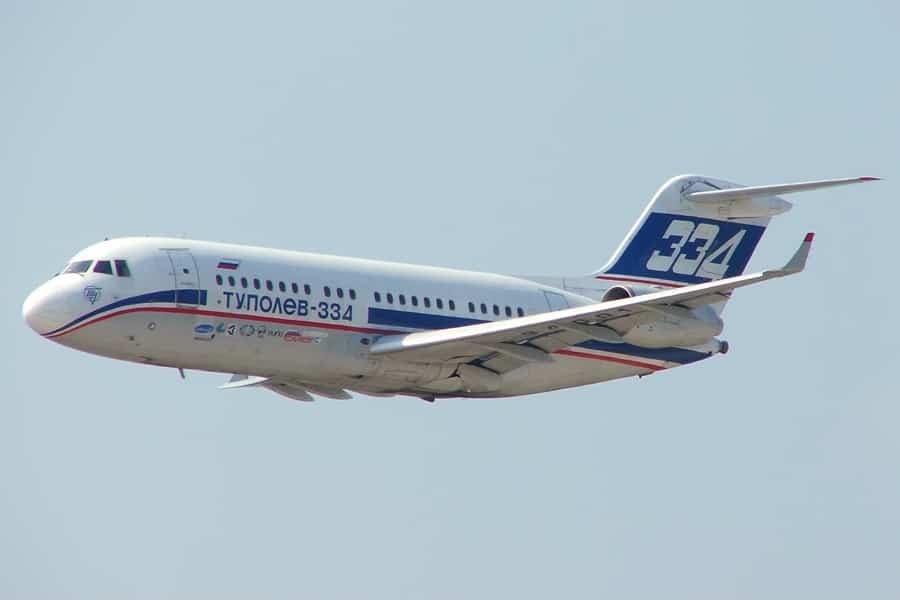
The Tupolev Tu-334 was a Russian twin-engine regional airliner built to replace the Tu-134 and early Yak-42 on short routes, seating up to 102 passengers behind two rear-mounted Ivchenko-Progress D-436T1 turbofans. It first flew in February 1999, eight years behind the original schedule, and earned a Russian type certificate on 30 December 2003. Series production never followed: the 2009 formation of United Aircraft Corporation settled the contest in favor of the Sukhoi Superjet 100, and only two Tu-334s ever left the ground.
Live Fleet Activity (T334)
Fetching live data…


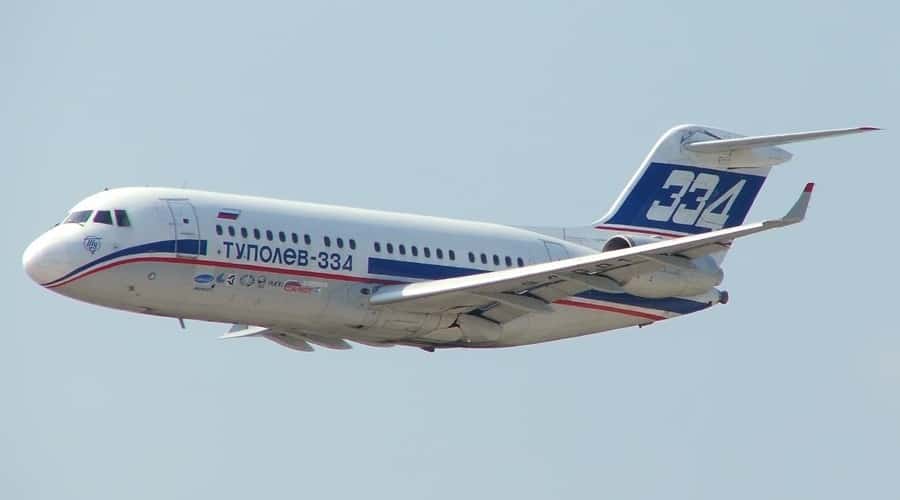
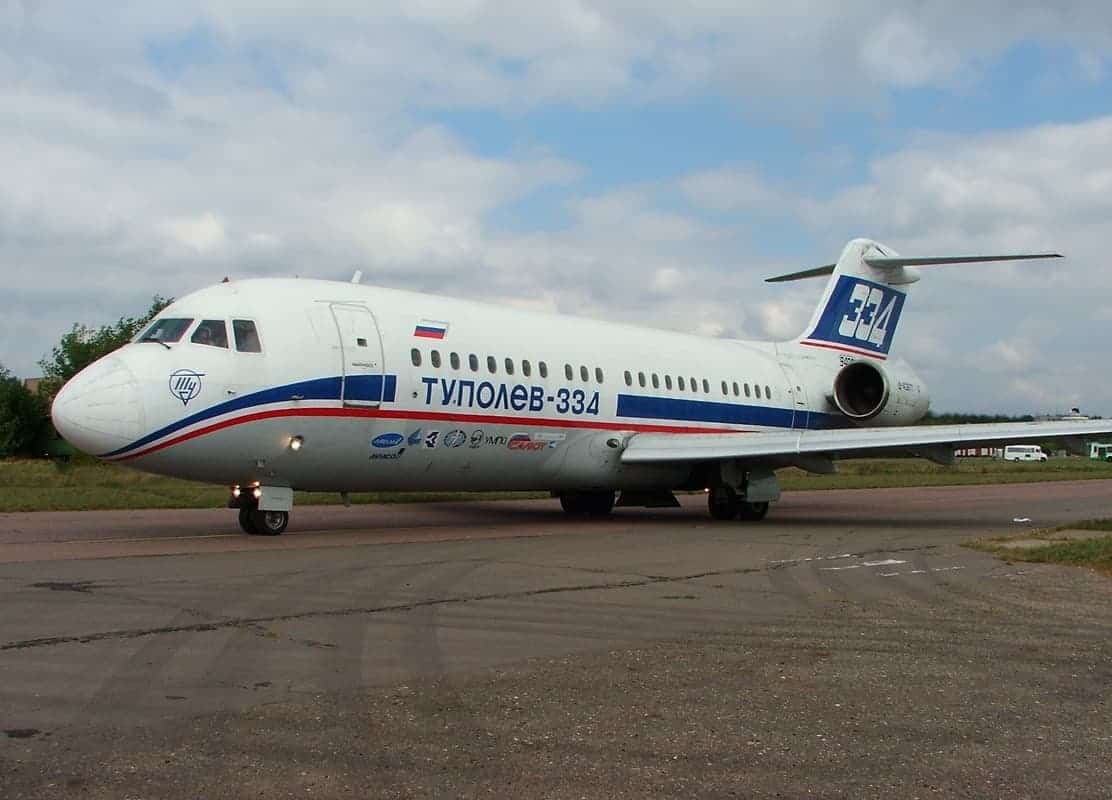
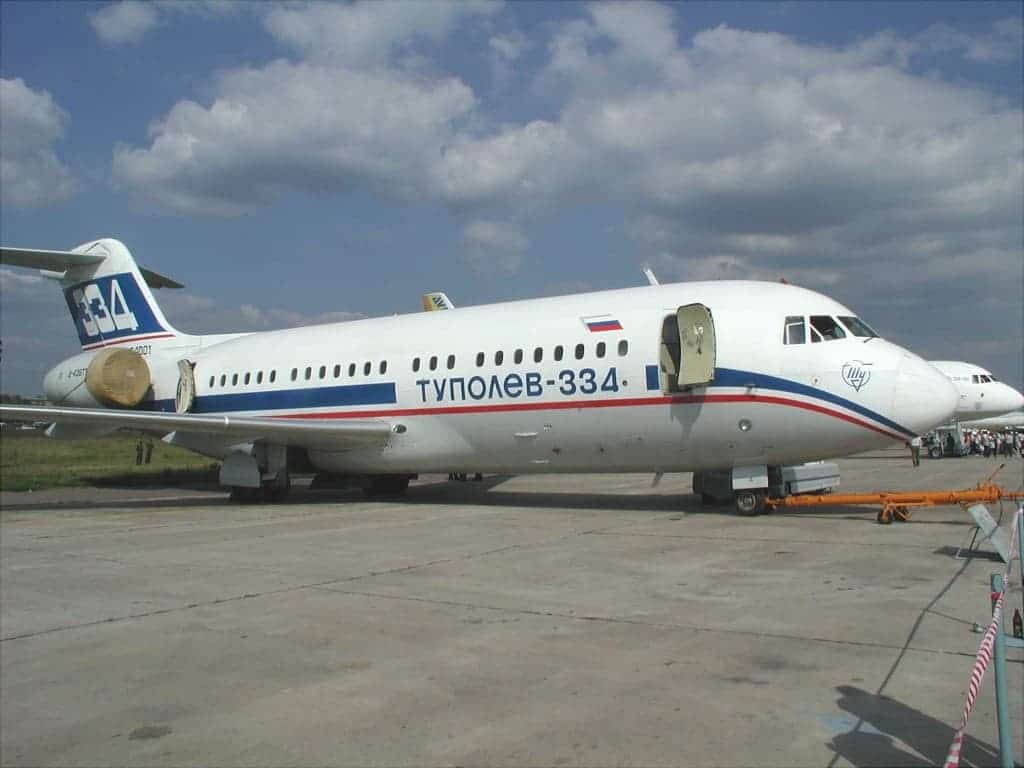
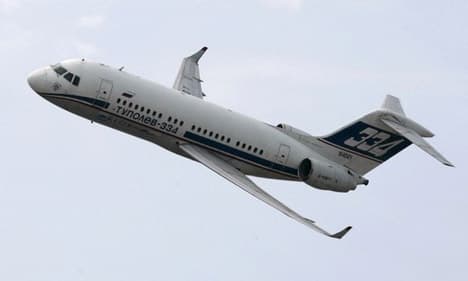
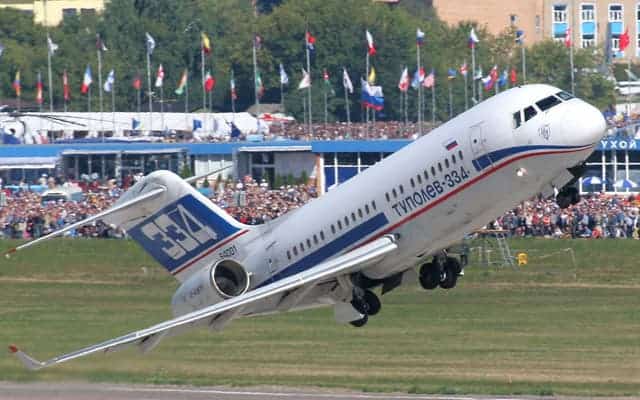

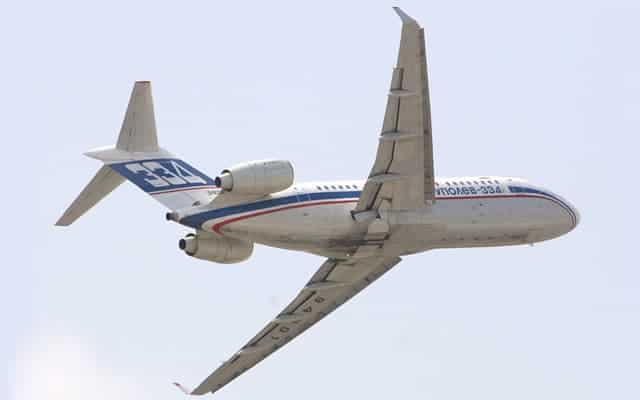
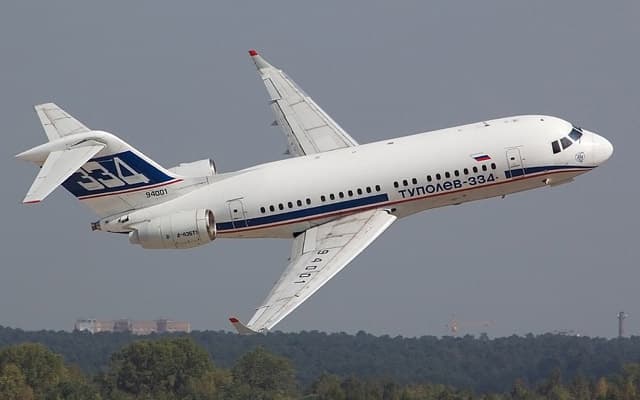
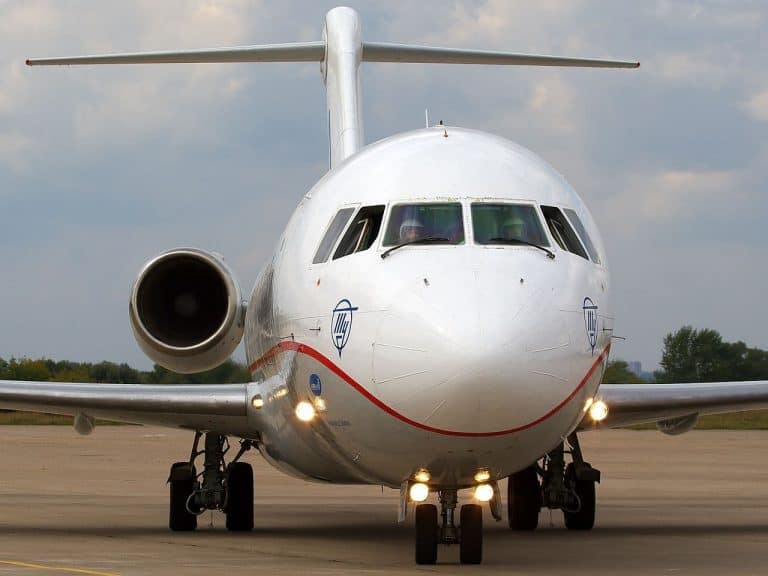
The Tupolev Tu-334 is a Russian twin-engine regional airliner that was designed, flown, certified, ordered by airlines, and then cancelled without a single production aircraft ever being built.
It is an unusually complete failure. Most abandoned airliner programs die at the drawing board or during flight test. The Tu-334 got all the way to a Russian type certificate on 30 December 2003 and still ended with two flyable airframes and nothing else.
The aircraft was meant to replace the Tupolev Tu-134 and early Yakovlev Yak-42 on short Russian routes, carrying about 100 passengers with two rear-mounted turbofans and a T-tail.
What killed it was not the airplane. It was a decade of funding drought, an engine built in a country that was no longer part of the same state, and a competing program with better political and industrial backing.
Jane’s dates the program launch to 1986, with a chief designer named Igor Kaligin and a plan that called for a first flight in 1991 and airline service by 1995.
The requirement was straightforward. Soviet and later CIS airlines were flying large fleets of Tu-134s and Yak-42s that were noisy, thirsty, and headed for retirement, and there was no domestic replacement in the 100-seat class.
The original 1989 concept looked at propfan engines, with a target specific fuel consumption of 13 g/kN/s against the 18 g/kN/s of the turbofan the aircraft eventually flew. The propfan work stayed in the study phase.
By the time the Soviet Union dissolved in 1991, the schedule was already gone. The first flight target slipped by eight years.
The first airframe, registration 94001, was built in late 1993 at Tupolev’s own Opyt facility. It was rolled out at Zhukovsky during the MAKS-95 air show on 25 August 1995, but Jane’s noted at the time that it had few systems installed.
It sat, essentially, waiting for money. The first flight finally came on 8 February 1999, with Tupolev test pilot A. N. Soldatenkov in the left seat.
The flight-test program then moved at the same pace as the build. By April 2002, Jane’s recorded only 144 flights totaling roughly 180 hours, which is a fraction of what a certification campaign normally consumes in three years.
The Russian type certificate, ST231-Tu-334-100, was issued on 30 December 2003. A second flying prototype, 94005, had made its first flight just under six weeks earlier, on 21 November 2003, and its construction says a lot about the era: it was laid down at RSK MiG and completed at Aviant in Kyiv.

The Tu-334 was not designed from a blank sheet. Tupolev deliberately built it around the larger Tu-204 to cut development cost and shorten certification, and Russian references put the airframe commonality at about 60 percent.
The clearest inheritance is the fuselage. The Tu-334 uses the same circular cross-section as the Tu-204’s fuselage, simply cut shorter, which is why a 100-seat regional jet ended up with a six-abreast cabin rather than the five-abreast tube most aircraft in its class use.
The wing is its own design: swept 24 degrees, supercritical in section, with winglets, full-span leading-edge slats in four sections, two-section single-slotted trailing-edge flaps, spoilers and two-section airbrakes.
Structurally it was modern for a Russian airliner of its generation. Jane’s records composites and other lightweight materials at 20 percent of structural weight, a riveted metal-alloy fuselage, two-spar metal wings with composite leading edges, and a 60,000-hour design service life.
Flight controls were fly-by-wire with a standby electrical channel, plus hydraulic and mechanical backup on everything except the ailerons. Landing gear was a retractable tricycle arrangement with twin wheels on each unit.
The Tu-334’s defining feature is the one that dates it most. Both engines hang off the rear fuselage and the tailplane sits on top of the fin, a layout that was standard practice when the Tu-134 was drawn and rare by the time the Tu-334 flew.
There were real reasons for it. Engines mounted high and aft swallow far less debris from rough or unpaved runways, which matters on the regional Russian airfields this aircraft was aimed at, and a clean wing is aerodynamically efficient.
The costs are just as real. Russian engineering commentary on the program lists the usual objections: a T-tail’s vulnerability to deep stall, awkward engine access for line maintenance, and a rearward center of gravity that complicates loading when the aircraft flies light.
The layout was not extinct when the Tu-334 flew. The Embraer ERJ 145 and the Bombardier CRJs also carried their engines on the rear fuselage, and the Boeing 717 was in production.
What changed was the 100-seat class specifically. Embraer launched the underwing-engined E-Jet family at the Paris Air Show on 14 June 1999, four months after the Tu-334’s first flight, and that aircraft took the segment the Tu-334 had been built for.
Each Tu-334-100 is powered by two Ivchenko-Progress D-436T1 turbofans, a three-spool high-bypass engine with a bypass ratio of about 4.95.
The problem is where it comes from. The D-436 was designed by Ivchenko-Progress and built by Motor Sich, both in Zaporizhzhia, which stopped being a Soviet city and became a Ukrainian one in 1991.
That left a Russian flagship airliner dependent on a foreign supplier, with intellectual-property and production-location disputes attached. The same engine family powers the Antonov An-148 and the Beriev Be-200, and each of those programs inherited the same exposure.
Tupolev’s answer was to offer alternatives. The Tu-334-100D was to use the more powerful D-436T2, and the Tu-334-120 was offered with Rolls-Royce BR715-55 engines for export customers, but neither was ever built.
By 2016, Russian analysts writing about a possible revival identified the engine as the blocker: substituting the Superjet’s SaM-146 would have required extensive redesign. The question closed for good in May 2022, when the Motor Sich plant was destroyed during the Russian invasion of Ukraine.
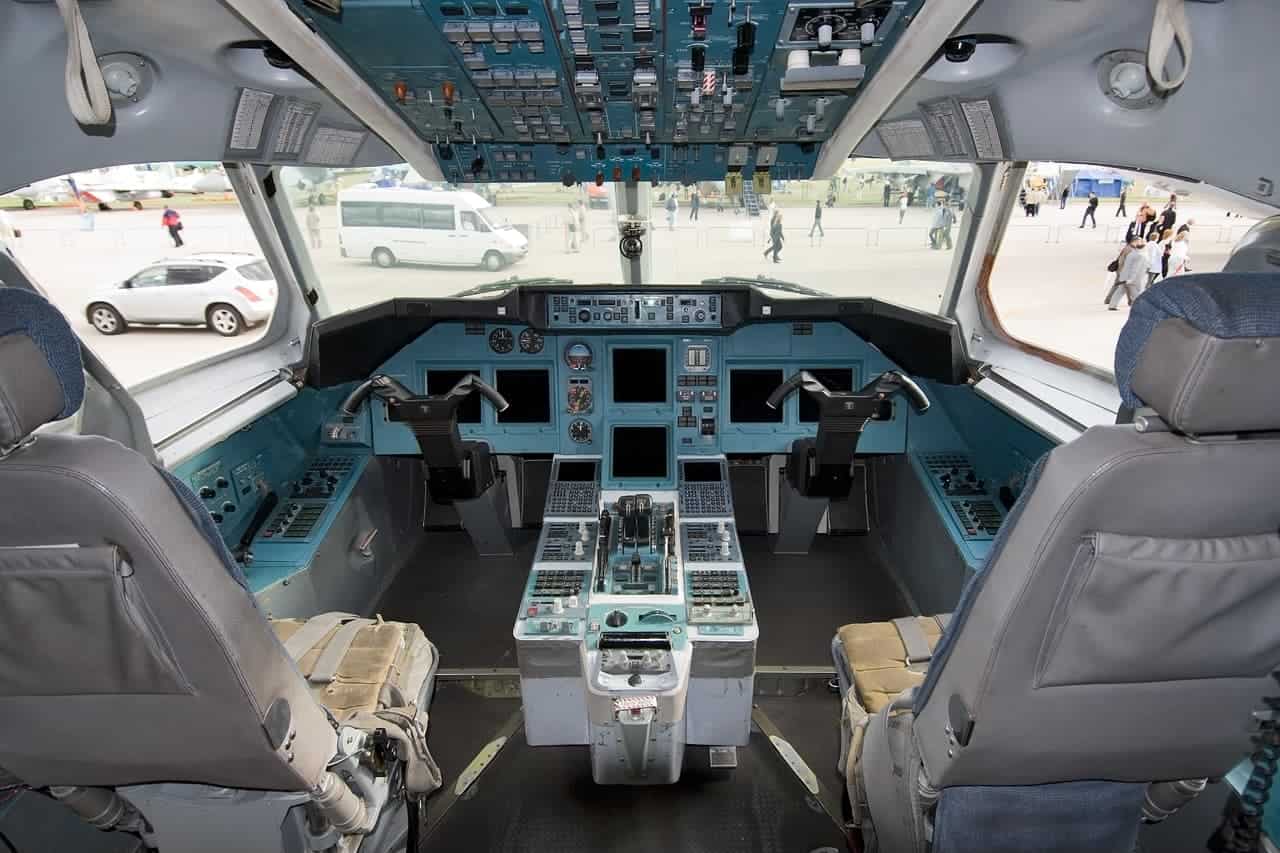
The Tu-334’s flight deck was one of its genuine selling arguments. It was built around an EFIS layout with six cathode-ray-tube displays, a nose-mounted weather radar and provision for satellite communications.
That let the aircraft be flown by two pilots, a move away from the larger flight crews of the Tu-134 and Tu-154 it was replacing, with an optional third seat and a fourth position for an instructor or observer.
The aircraft was equipped for automatic landings in ICAO Category IIIa conditions, and was designed to meet the ICAO noise standards that governed access to Western European airports. Both were prerequisites for the export sales the program needed and never got.

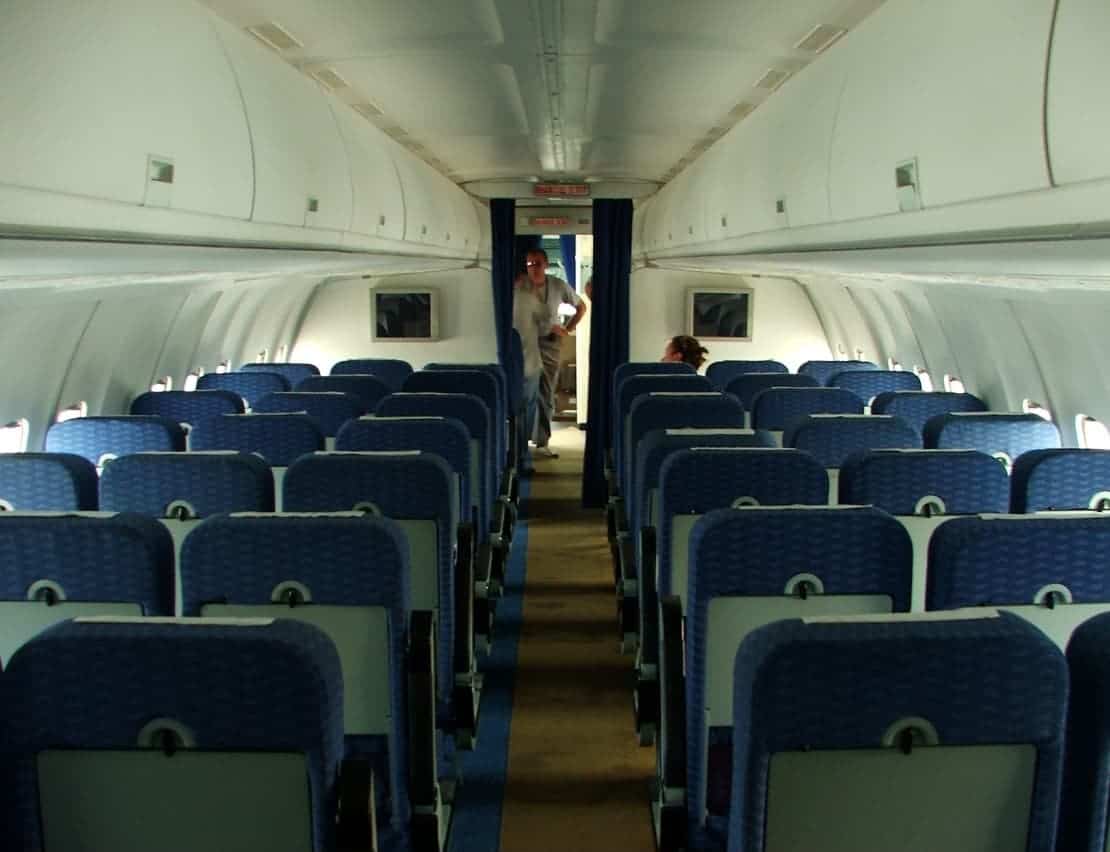
Because the fuselage came from the Tu-204, the Tu-334’s cabin is wider than its seat count suggests. Passengers sit six abreast in the all-economy layout at a 32-inch (81 cm) pitch.
Three configurations were offered: 72 seats in a two-class arrangement, 74 in a business and economy split, or 102 in single-class tourist trim. A galley, coat compartment and lavatory sat immediately behind the flight deck.
Tupolev put real effort into cabin noise, which is the standard weak point of a rear-engined design because the engines sit beside the aft rows rather than out on the wing. Sound-absorbing materials and interior design were promoted as a competitive advantage.

The Tu-334 was not short of paper demand. Provisional orders for about 40 aircraft came in as early as 1995 from Rossiya, Bashkirian, Tyumen and Tatarstan Airlines.
Aeroflot signed a memorandum of understanding for 20 Tu-334-120s in June 2000. The first firm orders followed in August 2003: five aircraft each from Aerofraht and Atlant-Soyuz Airlines, with Atlant-Soyuz deliveries to start in 2005.
By December 2006 seven airlines held firm orders, with letters of intent from another 24 airlines covering 297 more aircraft. Tupolev said in 2008 that around 100 airlines had expressed interest.
Iran’s Aviation Industries Organization went furthest of all, negotiating a kit assembly line at Esfahan for 100 aircraft over 15 years, with Iranian carriers committing to buy 50 of them.
None of it converted. Production was supposed to begin no later than January 2009 and no progress was reported, which is the point at which airline interest in an aircraft nobody has delivered stops being an asset.

In April 2005 the Russian government issued a decree to organize series production of the Tu-334 at the Gorbunov plant in Kazan, the facility usually referred to as KAPO.
The decree did not produce aircraft. By mid-2007 five airframes existed in total: two that flew, two used for static and fatigue testing, and no production run behind them.
Then the industry reorganized. The formation of United Aircraft Corporation consolidated Russia’s design bureaus and forced a choice between competing regional jets, and in mid-2009 the decision went against the Tu-334 in favor of the Sukhoi Superjet 100, the An-148 and the Irkut MC-21.
The reasoning was about partners rather than airframes. The Superjet was built with broad international cooperation and Western-certified components, which made it exportable in a way the Tu-334 was not, and it attracted the funding and the political backing that followed from that.
There is a coda worth noting. The Kazan plant that was supposed to build the Tu-334 is now the plant building the Tu-214: Russia’s industry and trade ministry said in December 2025 that it expected eight in 2026, twelve in 2027 and twenty a year from 2028.
Only the baseline Tu-334-100 was ever built and flown. Everything else in the family existed as a proposal.
The Tu-334-100D was a stretch, with the fuselage extended by 1 ft 9 in (54 cm), a wider 107 ft (32.61 m) wingspan and the more powerful D-436T2 engines. The Tu-334-100C was a passenger and freight combi, and the Tu-334C a dedicated cargo version.
The Tu-334-120 and Tu-334-120D were the Rolls-Royce BR715-55 powered export versions, rated at 19,995 lbf (88.9 kN) per engine against 16,500 lbf (73 kN) for the D-436T1.
Two proposals went further afield. The Tu-336 was to burn liquefied natural gas from cryogenic tanks mounted above the cabin, and the Tu-354, originally the Tu-334-200, was a 12 ft 10 in (3.90 m) stretch seating up to 126 passengers on four-wheel main bogies.
The full specification table for the aircraft is on this page. A few of its figures get quoted against each other in Tu-334 coverage, and they are worth separating.
Range is the first. The 1,700 nm figure is the light-payload case. Russian sources publish 1,960 miles (3,150 km) with 102 passengers or about 7 tonnes of load, 1,243 miles (2,000 km) at 9.25 tonnes, and only about 746 miles (1,200 km) at maximum payload.
RIA Novosti’s 2008 spec sheet puts the full commercial load case at 1,268 miles (2,040 km), so how far this aircraft goes depends heavily on how full it is.
Speed is the second. Cruise is consistently published as 510 mph (820 km/h), which is the 443 knots the panel carries, and ICAO Doc 8643 independently lists an optimum cruise of Mach 0.76.
A separate maximum of 590 mph (950 km/h) appears on Russian Wikipedia and nowhere else. The maximum-speed row is left blank rather than carrying a figure one source asserts and no other supports.
Empty weight needs the same caution. Two reference sites publish 84,569 lb (38,360 kg), which cannot be right: add the aircraft’s own 22,267 lb (10,100 kg) fuel load and the total exceeds the 105,500 lb (47,900 kg) maximum takeoff weight before a single passenger boards.
The figures that survive that arithmetic cluster near the 63,824 lb (28,950 kg) the panel carries, and the airframe card for prototype 94005 records an operating empty weight of 63,272 lb (28.7 tonnes).
Fuel is published in Russian sources as a mass, 22,267 lb (10,100 kg), rather than a volume, so the tank figure in the panel is an equivalent capacity rather than a quoted specification.
Takeoff and landing distances are quoted two different ways. The panel carries the published ground rolls, starting with a 6,250 ft (1,900 m) takeoff run. The landing roll is 3,300 ft (1,000 m).
ICAO Doc 8643 instead lists 7,218 ft (2,200 m), which is the takeoff distance over an obstacle rather than the roll. The two are not interchangeable, and mixing them is the most common error in Tu-334 spec tables.
One figure the panel deliberately does not carry is a price. List prices for the Tu-334 circulate in Russian aviation commentary, usually next to a Superjet comparison, but the aircraft never reached series production, so no flyaway cost was ever established.
Both flying Tu-334s still exist, and neither has flown in over a decade.
The first aircraft, 94001, flew the type’s whole public career: Dubai in 1999 and the MAKS shows of 1999, 2001, 2003, 2005, 2007 and 2009. It went into storage at the Gromov Flight Research Institute at Zhukovsky around 2010, was used as a parts donor, and lost its engines around 2012. It is now preserved there as a monument.
The second aircraft, 94005, named Aleksandr Kharlov, appeared at MAKS in 2005, 2007 and 2009 and at shows in Zurich, Zhuhai and Iran. It ferried to Tatarstan in June 2010 for operational trials that went nowhere, and was last photographed at Kazan-Borisoglebskoye in 2013. It remains at the Kazan plant as a monument.
In February 2026 a story spread through Russian aviation channels that workers at the Kazan plant had been told to prepare a long-stored Tu-334, tail number 94001, for repainting in Rossiya airline colors, framed as a homegrown answer to Superjet parts shortages.
Vechernyaya Kazan, the Kazan paper that carried the report, then added that its own sources had identified the accompanying photograph as artificially generated. The channel that first posted it deleted both the image and the claim.
The story failed on its own details as well. Airframe 94001 is a monument at Zhukovsky, roughly 450 miles (720 km) from Kazan, and has had no engines for well over a decade.
Nothing in 2026 suggests the program is coming back. Russia’s regional and narrowbody effort runs through the Superjet, the MC-21 and the Tu-214, and the engine that made the Tu-334 fly has not been in production since its factory was destroyed in 2022.
No. It received a Russian type certificate on 30 December 2003 but was never series produced, and no airline ever operated it on a revenue flight. Every Tu-334 flight was a test, demonstration or air show flight.
Two flying aircraft, registrations 94001 and 94005. Russian sources record five airframes in total by mid-2007, the other three being static and fatigue test articles and an incomplete airframe on the line.
Three reasons compounded. Funding shortages after 1991 stretched the program from a planned 1991 first flight to 1999, the engines were built in Ukraine by a supplier that was now foreign, and the 2009 formation of United Aircraft Corporation forced a choice in which the Superjet’s international partnerships and export-ready certification won.
Two Ivchenko-Progress D-436T1 turbofans, designed in Zaporizhzhia and built by Motor Sich, each rated at 16,500 lbf (73 kN). Variants with the more powerful D-436T2 and with Rolls-Royce BR715-55 engines were offered but never built.
It is very unlikely. Russian analysts concluded in 2016 that swapping the Ukrainian D-436 for the Superjet’s SaM-146 would mean redesigning the rear fuselage, and the Motor Sich plant that built the original engine was destroyed in May 2022. A February 2026 revival story turned out to rest on an AI-generated photograph.
Yes, though far fewer than before. The last Tu-154 in Russian civil aviation flew its final passenger service on 28 October 2020, an Alrosa flight from Mirny to Novosibirsk, but the Tu-204 and Tu-214 family is back in production at Kazan, and the Tu-95, Tu-22M and Tu-160 remain in military service.
The record varies enormously by type and era, so the brand is the wrong unit of measurement. The Tu-154, the most numerous Tupolev airliner with 1,025 built, recorded 110 serious incidents including 73 hull losses and 2,911 fatalities between 1970 and December 2016.
That record belongs to an aircraft that spent decades flying from unpaved and Arctic airfields where other airliners could not operate, which is not the same population Western types were flown in. The Tu-334 has no service record at all: it never carried a fare-paying passenger, and it was built to meet ICAO noise standards and equipped for Category IIIa automatic landings.
On paper, yes. The Tu-144D had a maximum speed of Mach 2.15 against Concorde’s Mach 2.04, and it beat Concorde to first flight on 31 December 1968 and to Mach 2 on 26 May 1970. Concorde recorded a higher one-off test figure of Mach 2.23 but was limited to Mach 2.02 in service to protect airframe life.
The biggest Tupolev that was actually built and flown is the Tu-160 Blackjack, a supersonic strategic bomber with a maximum takeoff weight of 606,271 lb (275,000 kg), a length of 177 ft 6 in (54.1 m) and a spread wingspan of 182 ft 9 in (55.7 m). Guinness World Records lists it as the largest operational bomber by weight.
Sources and references used for research and fact-checking.
_RP447.jpg)