

Table of Contents
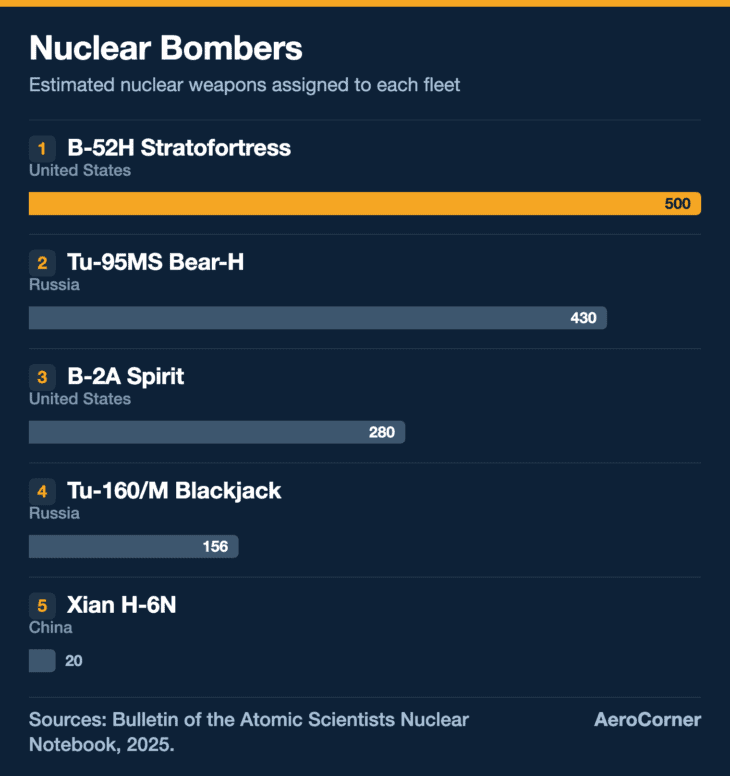
Only three countries fly nuclear bombers today: the United States, Russia and China. The biggest nuclear bomber force by far is the American B-52H Stratofortress, with an estimated 500 weapons assigned to its 46 nuclear-capable aircraft.
This list ranks every bomber with a nuclear mission as of November 2026 by that measure: how many nuclear weapons are estimated to be assigned to each fleet. The figures come from the Nuclear Notebook, the annual country-by-country estimates published in the Bulletin of the Atomic Scientists.
Bombers are only part of the answer, though. Several countries put their nuclear weapons on fighters instead, so the second half of this page covers every fighter that carries the bomb, from the F-35A to France’s Rafale.
| Rank | Bomber | Country | Nuclear-capable aircraft | Weapons assigned (est.) | Nuclear weapon |
|---|---|---|---|---|---|
| 1 | B-52H Stratofortress | United States | 46 of 76 | 500 | AGM-86B cruise missile |
| 2 | Tu-95MS Bear-H | Russia | 52 before June 2025 losses | 430 | Kh-55 and Kh-102 cruise missiles |
| 3 | B-2A Spirit | United States | 19 | 280 | B61 gravity bombs |
| 4 | Tu-160/M Blackjack | Russia | 15 | 156 | Kh-55 and Kh-102 cruise missiles |
| 5 | Xian H-6N | China | About 20 | 20 | Air-launched ballistic missile |
| 6 | Tu-22M3 Backfire | Russia | Not published | Not broken out | Kh-22 and Kh-32 missiles |
| 7 | B-21 Raider | United States | In flight test | None yet | B61-12, B61-13, LRSO (planned) |
How this ranking works
Bombers are ranked by the number of nuclear weapons the Nuclear Notebook estimates are assigned to each fleet, from its 2025 tables for the United States, Russia and China. These are informed estimates, not official counts: no government publishes weapons per aircraft type. Only bombers with a nuclear mission today are ranked. The B-1B is left out because it was converted to conventional-only missions, and fighters are covered separately below.
1. B-52H Stratofortress (United States)
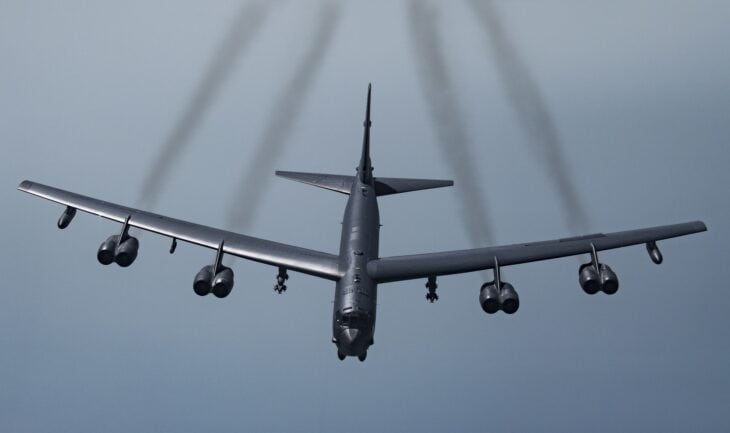

The oldest bomber on the list carries the most nuclear weapons. The Nuclear Notebook estimates 500 weapons are assigned to the B-52H fleet, all of them AGM-86B air-launched cruise missiles armed with the W80-1 warhead.
Each B-52H can carry up to 20 of those missiles. The Air Force has 76 B-52Hs, and 46 of them are nuclear-capable. The rest were converted to conventional-only missions under the New START treaty with Russia, which expired in February 2026.
The B-52 can fly 8,800 miles (14,160 km) without refueling and carry 70,000 pounds (31,750 kg) of weapons, according to the Congressional Research Service. Boeing built 744 B-52s and delivered the last H model in 1962.
The nuclear B-52s fly from Minot Air Force Base in North Dakota and Barksdale Air Force Base in Louisiana. About 200 cruise missiles are thought to be stored at Minot, with the rest of the fleet’s weapons in central storage.
The B-52 no longer drops nuclear bombs
The most famous nuclear bomber does not carry nuclear bombs anymore. According to the Nuclear Notebook, B-52H aircraft are no longer tasked with delivering gravity bombs: their nuclear role is cruise missiles launched from far outside enemy air defenses.
The fleet is being rebuilt to stay in service into the 2050s. The re-engined B-52J gets Rolls-Royce F130 engines, and the AGM-86B is due to be replaced by the new AGM-181 Long-Range Standoff missile in 2030.
Congress has also given the Air Force room to grow the nuclear fleet. The 2025 defense authorization act allows conventional-only B-52s to be converted back to nuclear missions.
2. Tu-95MS Bear-H (Russia)
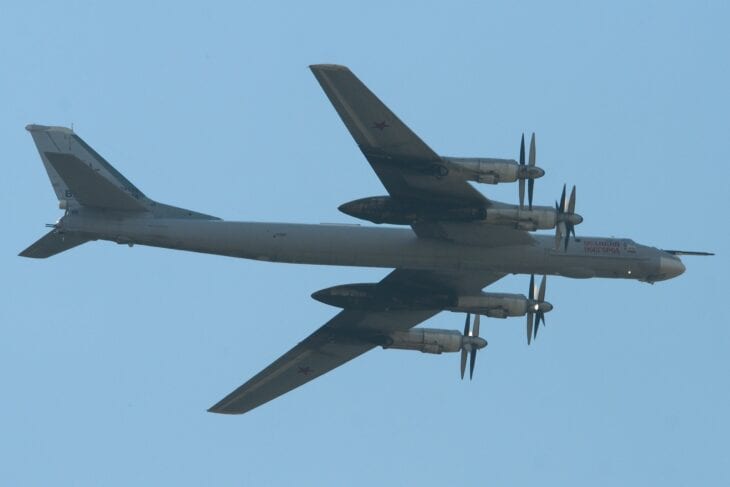

Russia’s propeller-driven Tu-95MS is the closest rival to the B-52, with an estimated 430 weapons assigned. Like the B-52, it is an old long-range bomber turned into a cruise missile carrier.
Each Tu-95MS carries 6 to 14 cruise missiles, depending on its version. Older aircraft hold six Kh-55 missiles inside the fuselage, while the modernized Tu-95MSM adds wing pylons for eight of the newer Kh-102.
The 430 figure dates from early 2025, when the Nuclear Notebook counted 52 Tu-95MS bombers. On June 1, 2025, Ukrainian drones destroyed seven Tu-95s at Olenya and Belaya air bases, according to the 2026 edition of the Notebook.
The Tu-95MS is expected to be retired before 2035, if Russia’s new-build Tu-160M program delivers. More on Russia’s whole bomber fleet is in our guide to Russian bombers.
3. B-2A Spirit (United States)
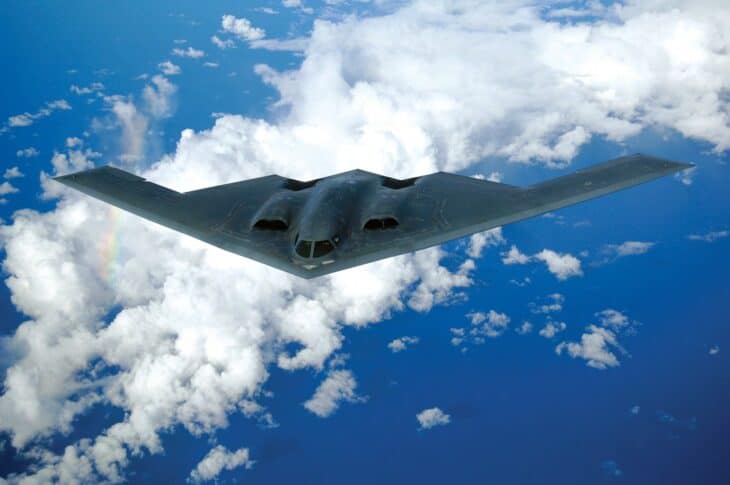

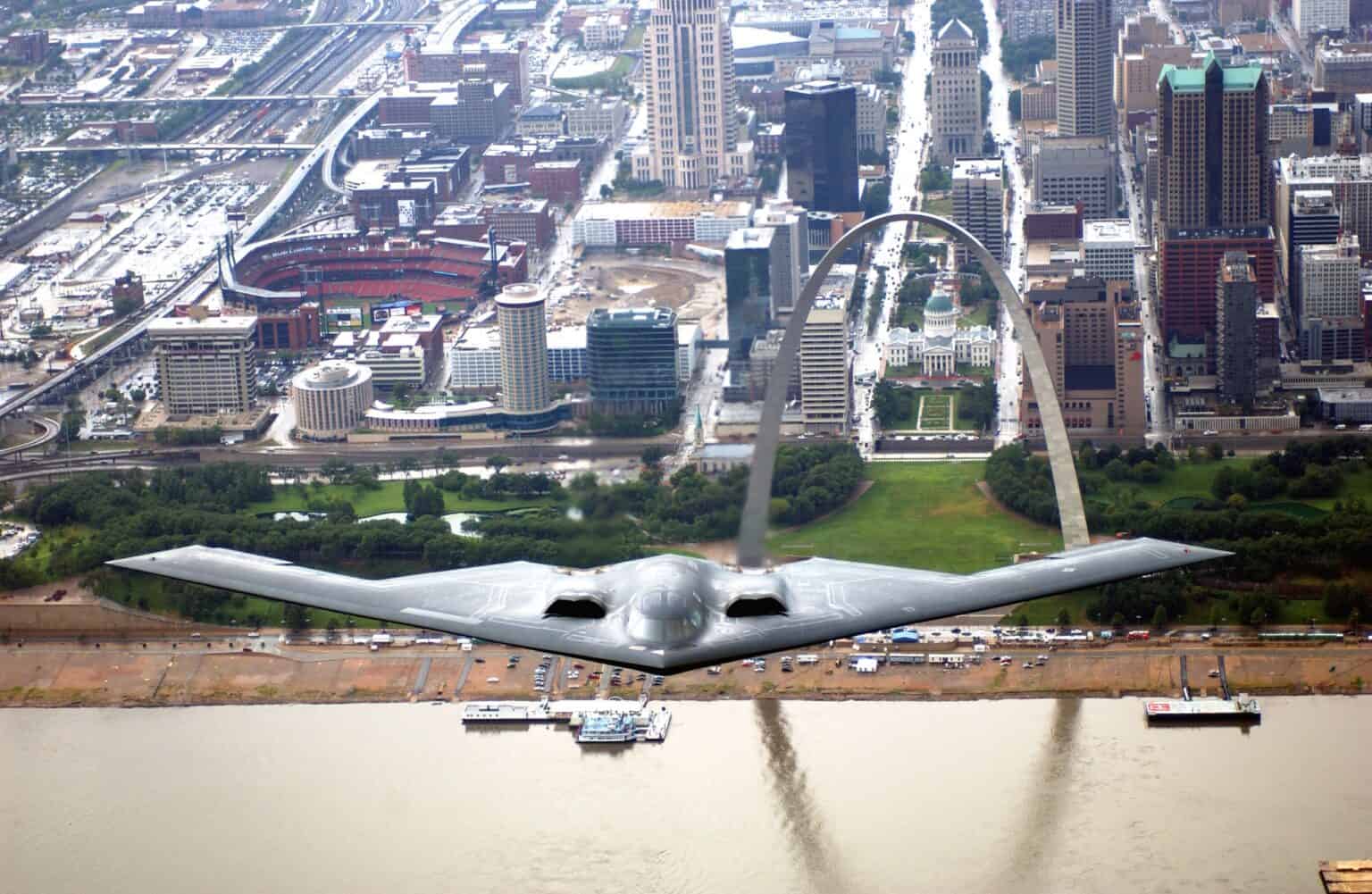
The B-2A Spirit is the only stealth bomber in service, built to fly through enemy air defenses and drop its nuclear bombs directly on a target. The Nuclear Notebook estimates 280 weapons are assigned to the fleet.
Each B-2 can carry up to 16 nuclear bombs, the B61-7, B61-11 and B61-12. It cannot carry nuclear cruise missiles. Its total payload is 40,000 pounds (18,140 kg).
Only 19 B-2s remain operational out of 21 built, and every one is nuclear-capable. One crashed on Guam in 2008, and the Air Force decided in 2024 to retire a second aircraft damaged at Whiteman in 2022. The full story is in how many B-2 bombers are left.
About 12 to 14 B-2s are available for missions at any given time, with the rest in heavy maintenance or flight testing. All of them fly from Whiteman Air Force Base in Missouri, where about 100 bombs are thought to be stored.
4. Tu-160/M Blackjack (Russia)
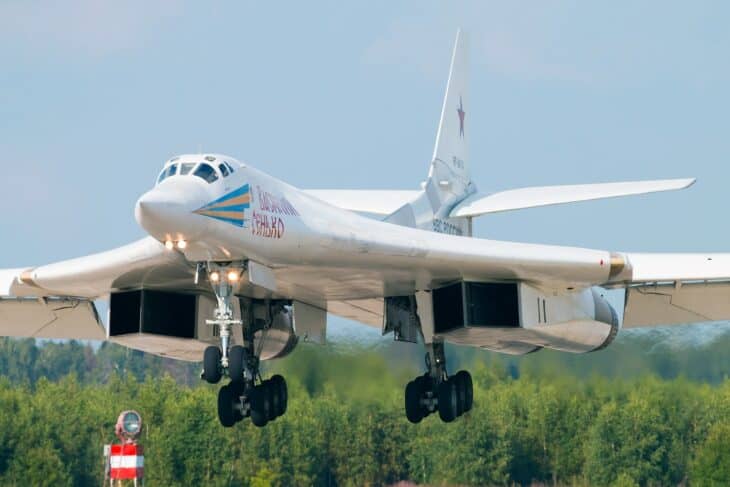

The Tu-160 is Russia’s most capable strategic bomber, but it has only 15 of them. The Nuclear Notebook assigns the fleet 156 weapons.
Each Tu-160 can carry up to 40 metric tons (88,000 pounds) of weapons, including 12 cruise missiles carried internally. Like the Tu-95, it carries the Kh-55 and is being equipped for the Kh-102.
Russia restarted production in Kazan and has talked of building as many as 50 new Tu-160M bombers. Progress is slow: the 2026 Nuclear Notebook says just two had been transferred to the air force as of early January 2026, against four scheduled for 2025.
The Tu-160M is a bridge to the PAK DA, Russia’s next-generation subsonic bomber with a reduced radar signature. As of March 2026, the first prototype was still being assembled for ground testing.
5. Xian H-6N (China)
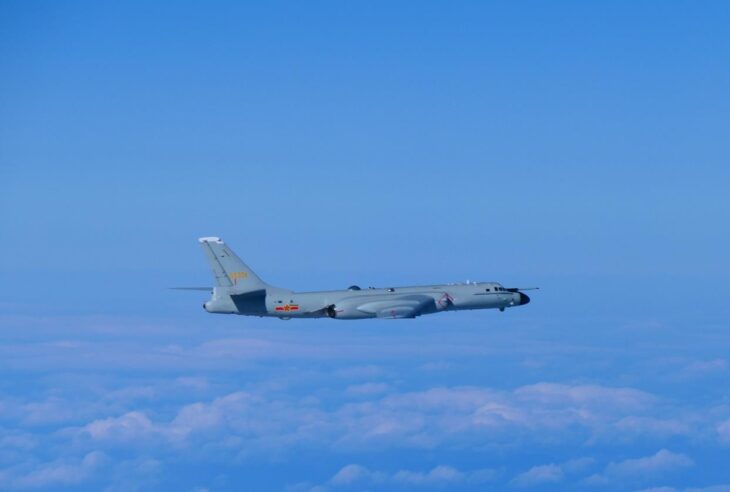

China has hundreds of H-6 bombers in more than eight versions, but only one version is assessed to be nuclear-capable: the H-6N. The Nuclear Notebook cautiously estimates 20 aircraft assigned up to 20 missiles.
The H-6N’s weapon is an air-launched ballistic missile carried under the fuselage, designated CH-AS-X-13 by the US. The Defense Intelligence Agency assessed in August 2024 that it had been deployed.
The H-6N differs from other H-6s in two ways that matter. It has a nose-mounted refueling probe, which lets it fly much farther, and its bomb bay was removed, which suggests China’s old nuclear gravity bomb mission has ended.
Only one Chinese air force unit is publicly known to have a nuclear mission: the 106th Brigade at Neixiang Air Base in Henan province, where large tunnels have been dug into a mountain wide enough for the H-6N. Our guide to Chinese bombers covers the rest of the fleet.
6. Tu-22M3 Backfire (Russia)
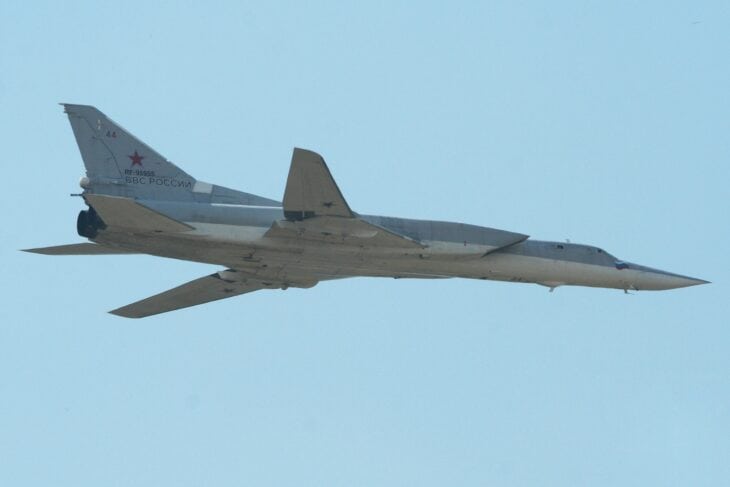

The Tu-22M3 is Russia’s intermediate-range bomber, so it does not count as a strategic bomber. It still has a nuclear role: the Nuclear Notebook lists it among the aircraft that deliver Russia’s nonstrategic nuclear weapons.
It ranks below the H-6N only because its share cannot be counted. The Notebook estimates roughly 330 nonstrategic weapons for the Russian Air Force, but splits them across the Tu-22M3, the Su-24M, the Su-34 and the MiG-31K.
The Tu-22M3 carries the Kh-22 missile, which is being replaced by the upgraded Kh-32. The fleet has flown conventional strikes against Ukraine, and four Tu-22M3s were likely destroyed in the June 2025 drone attack, according to the Arms Control Association.
7. B-21 Raider (United States)
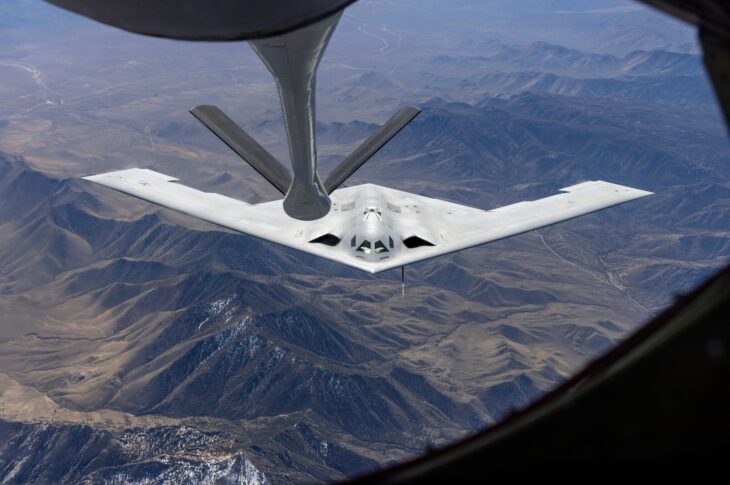

The B-21 Raider has no nuclear weapons yet, but it is the only new nuclear bomber anywhere close to service. Test aircraft have flown since late 2023, and the first B-21s are scheduled to arrive at Ellsworth Air Force Base in South Dakota by 2027.
It is built to carry the B61-12 and B61-13 guided nuclear bombs and the future LRSO cruise missile. That makes it the first US stealth bomber that will carry a nuclear cruise missile.
The Air Force plans to buy at least 100 B-21s to replace both the B-2 and the non-nuclear B-1B. Since every B-21 is planned to be dual-capable, the number of US nuclear-capable bombers is expected to grow significantly. Our list of every stealth bomber ever built shows how it compares with the B-2.
What about the B-1B Lancer?
The B-1B was designed as a nuclear bomber, and it still carries the largest conventional payload in the Air Force, 75,000 pounds. But the United States converted it to conventional-only missions in the 1990s under the START treaty, so none of the 44 remaining B-1Bs can carry a nuclear weapon today. The House version of the 2027 defense authorization bill would require an Air Force report on whether that capability could be restored.
The fighters that carry the bomb
Bombers are not the only aircraft with a nuclear role. Several countries assign nuclear weapons to fighters, and some carry them for allies under NATO’s nuclear sharing arrangement.
F-15E, F-16 and F-35A (United States and NATO)
The United States assigns its B61 bombs to three fighters. The F-15E Strike Eagle can carry up to five B61s, and the F-16 and F-35A can carry up to two each.
An estimated 100 B61 bombs are deployed in Europe at six bases: Aviano and Ghedi in Italy, Büchel in Germany, Kleine Brogel in Belgium, Volkel in the Netherlands and Incirlik in Turkey. About 60 are earmarked for allied aircraft.
Belgium and the Netherlands fly that mission with the F-16, and Germany and Italy with the Panavia Tornado. All four are moving to the F-35A, which RAF Lakenheath in England received first among US bases in Europe.
F-35A (United Kingdom)
Britain is rejoining the air-delivered nuclear mission. On June 24, 2025, the UK government announced it would buy 12 F-35As, based at RAF Marham, and join NATO’s nuclear mission.
Rafale B and Rafale M (France)
France flies its own nuclear-armed fighters. About 50 two-seat Rafale B jets at Saint-Dizier, Istres and Avord carry the ASMP-A, a ramjet missile with a 300-kiloton warhead and a range of about 310 miles (500 km).
The navy’s Rafale M can launch the same missile from the carrier Charles de Gaulle. In March 2025, President Macron announced two new nuclear Rafale squadrons at Luxeuil from 2032, armed with the future ASN4G hypersonic missile. More on the fleet is in our guide to the French Air Force.
Mirage 2000H and Jaguar IS (India)
India’s air-delivered nuclear weapons are bombs for 32 Mirage 2000H and 16 Jaguar IS aircraft, according to the 2024 Nuclear Notebook. India’s Rafales could take over that role, but there was no official confirmation as of July 2024.
Mirage III/V (Pakistan)
Pakistan assigns its air-delivered nuclear weapons to 36 Mirage III and Mirage V aircraft, which can carry a bomb or the Ra’ad cruise missile. Reports that some Pakistani F-16s were modified for the role are unconfirmed, and a JF-17 was photographed with a Ra’ad-I in March 2023.
Su-24M, Su-34 and MiG-31K (Russia)
Russia shares its nonstrategic air force weapons between the Tu-22M3 and three fighter types: the Su-24M, the Su-34 and the MiG-31K, which carries the Kinzhal missile. The Su-57 is being added to that force.
Israel, which the Federation of American Scientists estimates holds about 90 warheads, is left out of this list because nothing about its delivery aircraft is on the public record. If you want the conventional view, our ranking of the best bombers in the world scores every bomber on capability, nuclear or not.
FAQ
Sources and references used for research and fact-checking.
- Bulletin of the Atomic Scientists / Federation of American Scientists, United States nuclear weapons, 2025 (Nuclear Notebook)
- Bulletin of the Atomic Scientists / Federation of American Scientists, Russian nuclear weapons, 2025 (Nuclear Notebook)
- Bulletin of the Atomic Scientists, Russian nuclear weapons, 2026 (Nuclear Notebook)
- Bulletin of the Atomic Scientists / Federation of American Scientists, Chinese nuclear weapons, 2025 (Nuclear Notebook)
- Bulletin of the Atomic Scientists / Federation of American Scientists, Indian nuclear weapons, 2024 (Nuclear Notebook)
- Bulletin of the Atomic Scientists / Federation of American Scientists, Pakistan nuclear weapons, 2023 (Nuclear Notebook)
- Congressional Research Service, U.S. Strategic Bombers (IF12945)
- Arms Control Association, Russian Strategic Forces Suffer Twin Setbacks
- GOV.UK, UK to purchase F-35As and join NATO nuclear mission
- The Aviationist, France to Expand Nuclear Deterrent Amidst Europe's Uncertain Future
- Federation of American Scientists, Status of World Nuclear Forces
Get the Newsletter
The latest aviation news and stories sent to your inbox.
About the Author

Tim is the owner and lead editor of AeroCorner since 2019, overseeing aviation content covering aircraft, airlines, airports, and the broader aviation industry. Through years of researching, writing, editing, and publishing aviation-focused content, he has developed extensive practical knowledge of commercial aviation and air travel. Based in Asia and a frequent traveler himself, Tim also brings firsthand passenger experience to AeroCorner’s coverage. Outside of publishing, he has also explored aviation firsthand through hands-on flight training in New Zealand.