

Table of Contents
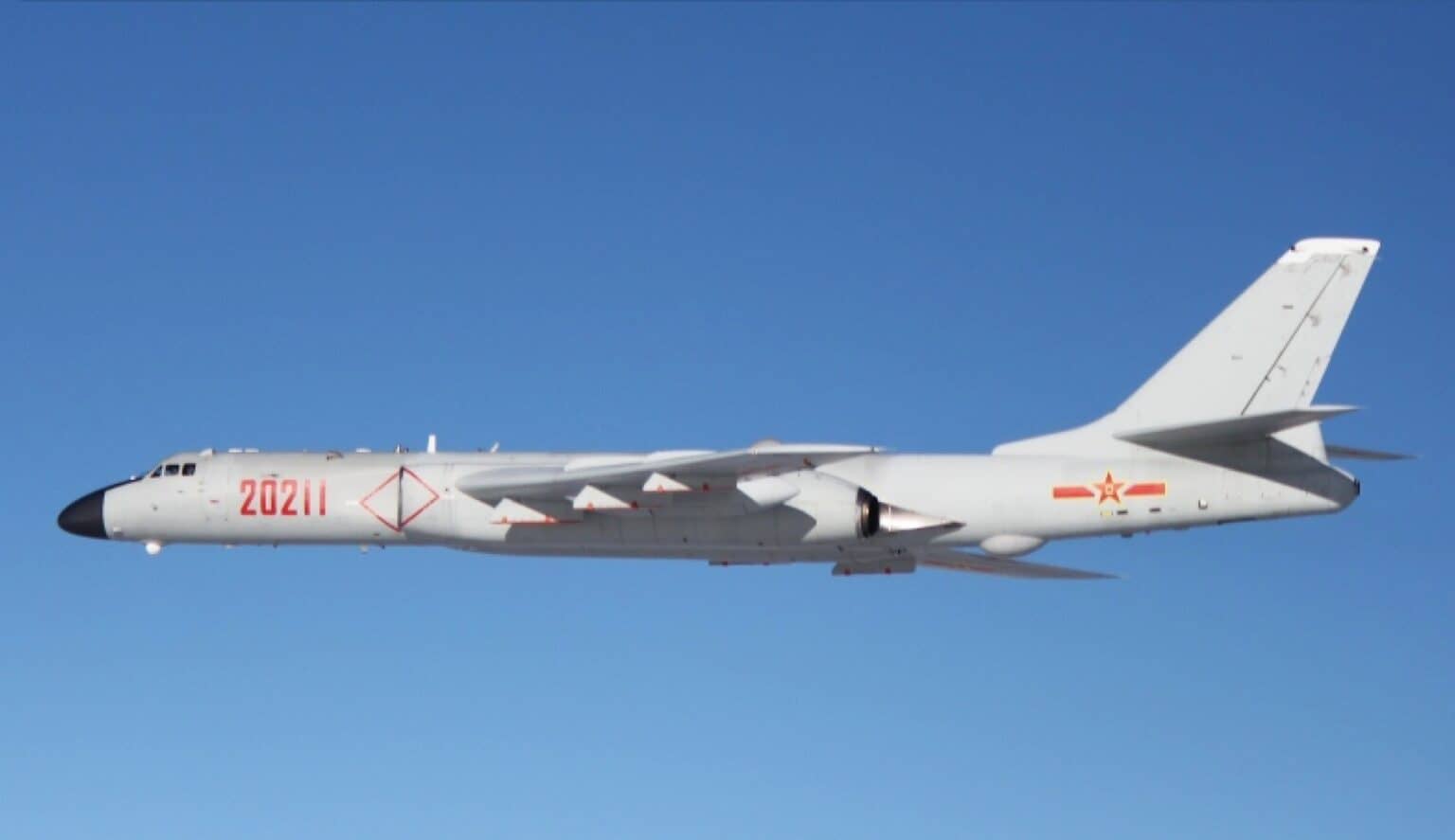
China’s bomber force in November 2026 is still built on one airframe: the Xi’an H-6, a license-built copy of the 1950s Soviet Tu-16. The modern H-6K carries the conventional strike mission, and the H-6N is China’s only nuclear-capable bomber.
The H-20 stealth bomber that is meant to replace them was announced in 2016. A decade later, China has not shown one or confirmed a first flight.
Below is every bomber the People’s Liberation Army has flown, in the order each entered Chinese service, from the Soviet hand-me-downs of the 1950s to the H-20. Each entry says what it was for, what it changed, and whether it still flies.
| # | Bomber | Type | In Chinese service | Status (Nov. 2026) |
|---|---|---|---|---|
| 1 | Il-28 / Harbin H-5 | Light jet bomber | 1952 to 2000 | Retired |
| 2 | Tupolev Tu-4 | Heavy piston bomber (B-29 copy) | 1953 to 1988 | Retired |
| 3 | Xi’an H-6 and H-6A | Medium jet bomber (Tu-16) | 1969 to today | Family in service |
| 4 | H-6D and H-6J | Naval missile carrier | Early 1980s to today | H-6J in service |
| 5 | Xi’an JH-7 and JH-7A | Two-seat fighter-bomber | 1994 to today | In service |
| 6 | Xi’an H-6K | Long-range cruise missile carrier | 2009 to today | In service, the backbone |
| 7 | Xi’an H-6N | Air-refuelable nuclear bomber | 2020 to today | In service, about 20 |
| 8 | Xi’an H-20 | Stealth flying-wing bomber | Not yet | In development, no confirmed flight |
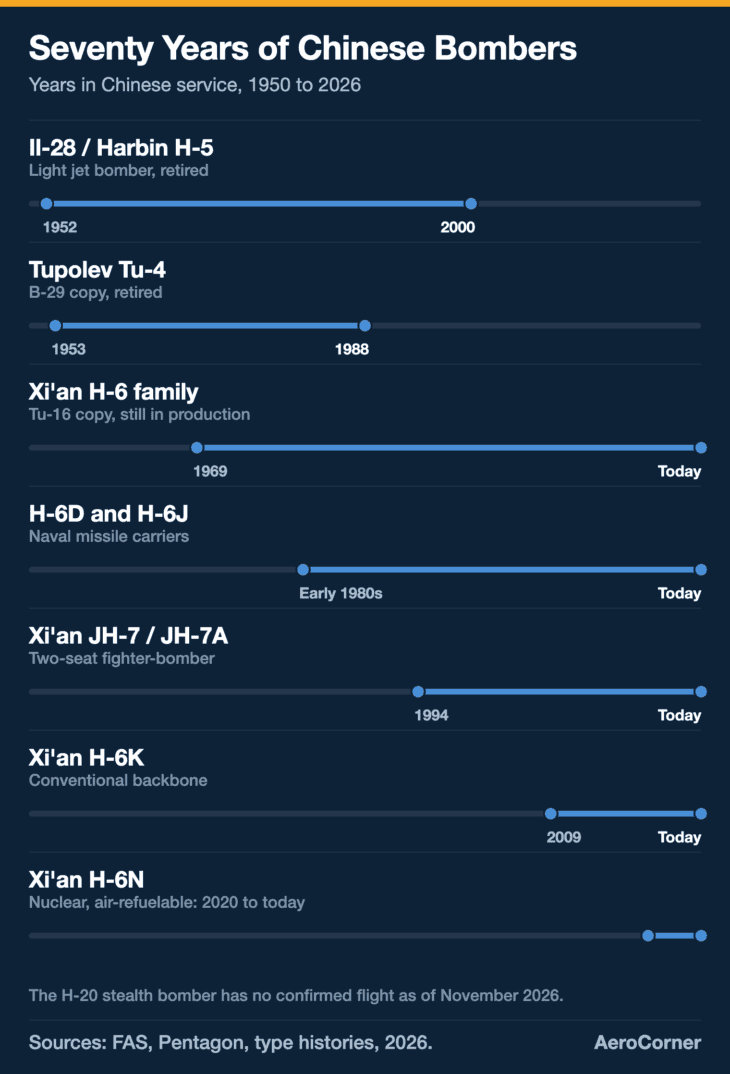
How this list works
This is every aircraft the PLA Air Force or Navy flew as a bomber, in the order it entered Chinese service. The H-6 family gets more than one entry because its variants do different jobs: a 1969 H-6 and a 2020 H-6N share a fuselage and little else. Attack jets such as the Q-5 are left out, and the JH-7 is in because China designates it a fighter-bomber. Status is as of November 2026.
1. Il-28 and Harbin H-5: The First Jet Bombers
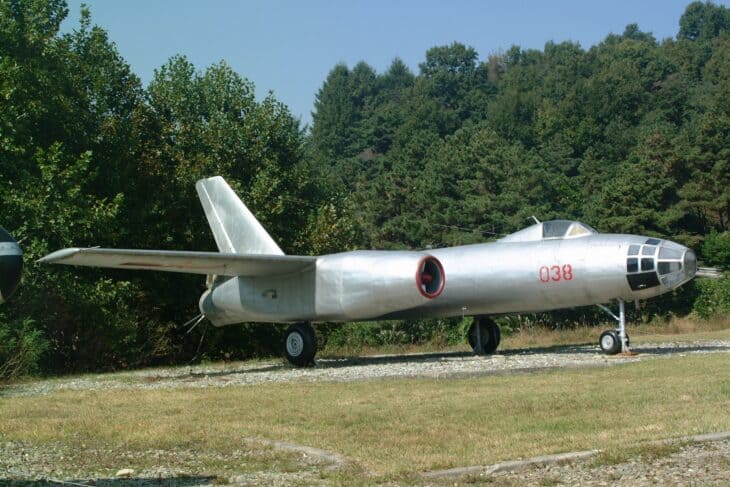

China’s jet bomber force began with Soviet aircraft. From 1952, the Soviet Union delivered more than 250 Ilyushin Il-28 light bombers, a twin-jet with a top speed of about 560 mph (902 km/h).
After the Sino-Soviet split, China built its own copy, the Harbin H-5, without a license. Full production was running by 1965, and more than 319 H-5s were built, plus 187 HJ-5 trainers.
The Il-28 carried a nuclear role in Chinese service into the 1990s, and the PLA Air Force retired the last of the type around 2000. North Korea still had about 80 Il-28s and H-5s in 2023, according to published estimates.
2. Tupolev Tu-4: Stalin’s Gift, a Copied B-29
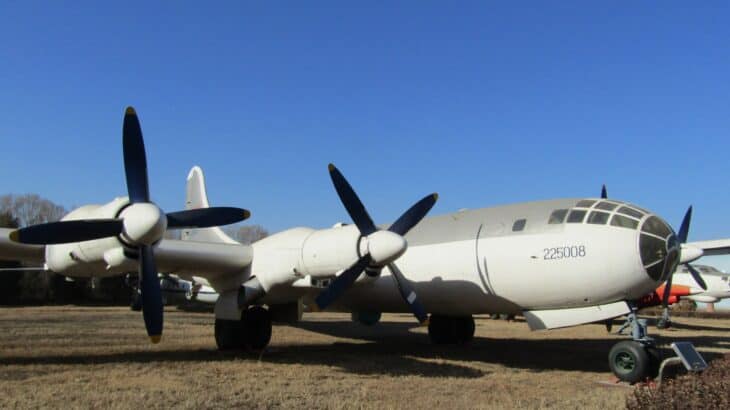

The Tu-4 was the Soviet Union’s reverse-engineered Boeing B-29, copied from three American bombers that landed in Soviet territory in 1944. On February 28, 1953, Stalin gave China ten of them, and two more arrived as navigation trainers in 1960.
Their only combat came in 1956, when two Tu-4s bombed monasteries held by Tibetan rebels in Sichuan. Between 1970 and 1973, China re-engined eleven of them with AI-20K turboprops.
One became the KJ-1, China’s first airborne early warning aircraft, a 1969 project canceled in 1979. The last Tu-4 left PLA Air Force service in 1988, and the KJ-1 prototype survives in a Chinese museum.
3. Xi’an H-6 and H-6A: China’s Nuclear Bomber Is Born
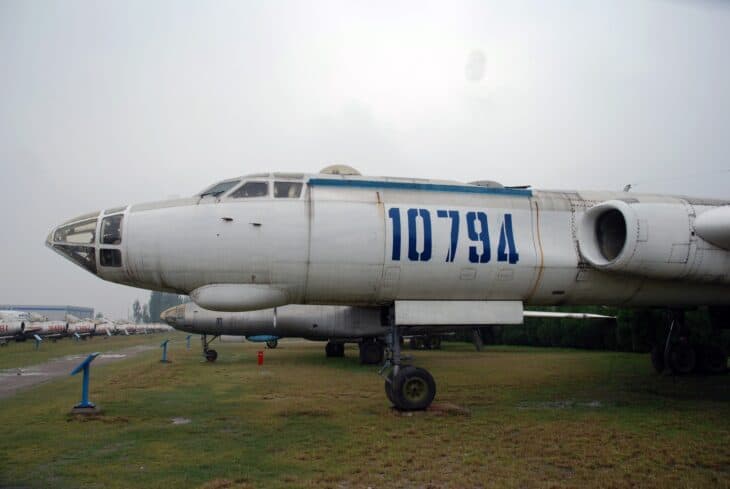

The Xi’an H-6 is China’s version of the Tupolev Tu-16 “Badger.” The first Chinese-assembled example, built from Soviet kits, flew on September 27, 1959, and the first fully domestic H-6 flew on December 24, 1968.
It entered service in 1969 with a top speed of about 652 mph (1,050 km/h), a crew of four and up to about 26,500 pounds (12,000 kg) of free-fall bombs. More than 230 have been built, and the type is still in production.
The H-6A was China’s first nuclear bomber. Aircraft delivered at least 12 of the nuclear devices China set off in its test program between 1965 and 1979, according to the Federation of American Scientists, beginning with an air-dropped test at Lop Nur on May 14, 1965.
A 1950s design with a 2020s job
The H-6 entered Chinese service in 1969 and is still in production 57 years later. The Tu-16 shape that dropped nuclear test devices over Lop Nur is the same basic shape that carries China’s nuclear missile today.
4. H-6D and H-6J: The Navy’s Ship Killers
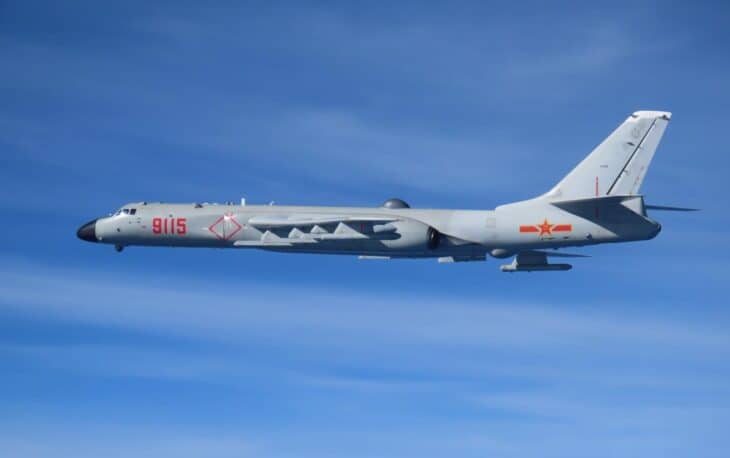

The H-6D of the early 1980s turned the bomber into a maritime strike aircraft armed with C-601 anti-ship missiles. It was the H-6 China exported: Iraq received four H-6Ds in 1987, and Egypt flew the type until 2000.
Iraq’s bombers had a short life. One was shot down by an Iranian F-14, and the other three were destroyed on the ground by US bombing in the 1991 Gulf War.
Today the PLA Navy’s aviation branch flies the H-6J, a newer maritime strike version that replaced the older H-6G in the anti-ship role.
5. Xi’an JH-7 and JH-7A: The Flying Leopard
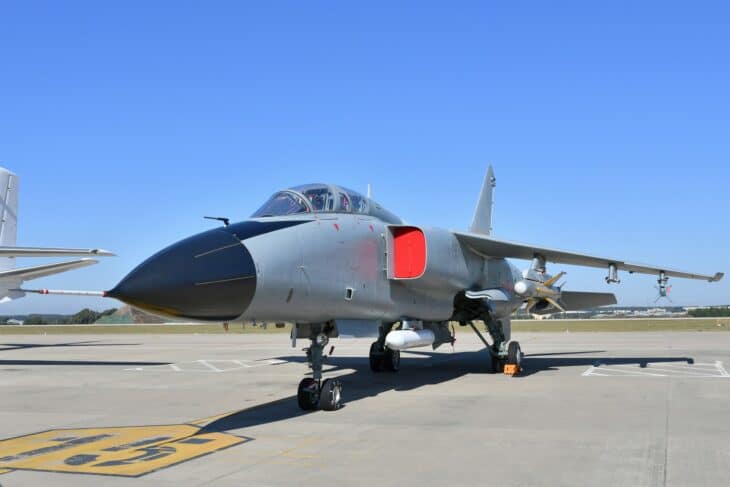

The Xi’an JH-7 is a supersonic, twin-engine, two-seat fighter-bomber. It first flew on December 14, 1988, and entered PLA Navy service in 1994.
Its engines are the WS-9, a Chinese license-built Rolls-Royce Spey. Top speed is about 1,123 mph (1,808 km/h), or Mach 1.52, and nine hardpoints carry up to about 20,000 pounds (9,000 kg) of weapons and fuel tanks.
The improved JH-7A joined the Air Force in 2004. Production ran from 1988 to 2017, with 270 built, and the type is still listed as operational with the Air Force.
6. Xi’an H-6K: The Backbone
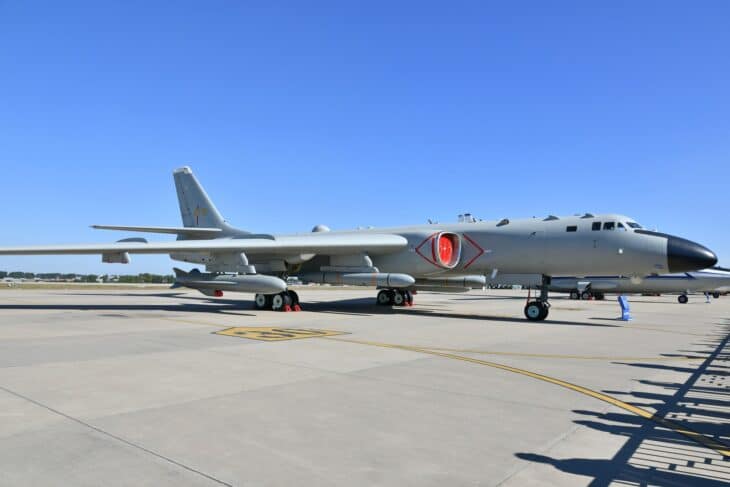

The H-6K is the bomber that matters most today. It first flew on January 5, 2007, entered service in October 2009, and is effectively a new aircraft inside the old shape.
It swaps the old engines for two Soloviev D-30KP-2 turbofans of 27,000 pounds of thrust (118 kN) each. Its claimed combat radius is about 2,175 miles (3,500 km), and it carries up to six YJ-12 anti-ship missiles or six to seven land-attack cruise missiles.
The H-6K is the jet that flies with Russia. On July 24, 2024, NORAD intercepted two H-6s and two Russian Tu-95s in the Alaska air defense identification zone, and Russia’s defense ministry named the Chinese aircraft as H-6Ks.
H-6Ks flew again in the 11th joint China-Russia strategic patrol on June 27, 2026, over the Sea of Japan, the East China Sea and the western Pacific. The full Chinese air order of battle is in our guide to China’s air force fleet.
7. Xi’an H-6N: China’s Only Nuclear Bomber
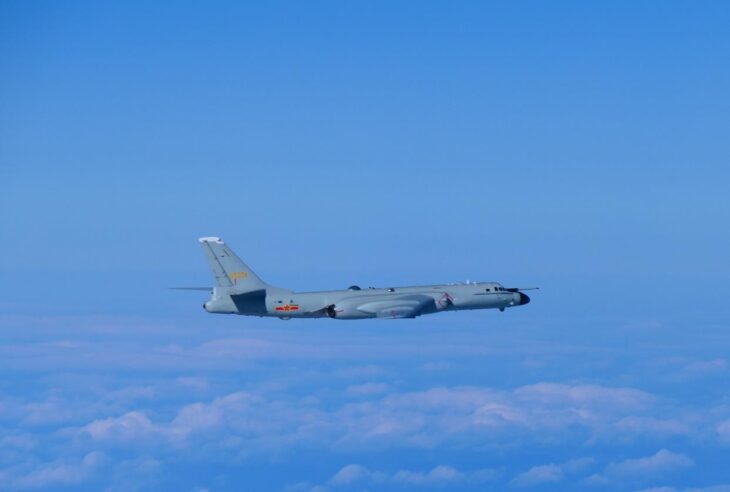

The H-6N gave China an air leg for its nuclear forces again. Three flew over Tiananmen Square at the October 1, 2019, National Day parade, and the Pentagon says the type became operational in 2020.
Two changes set it apart. A refueling probe on the nose lets it take fuel in flight, and its bomb bay was removed so the fuselage can carry an air-launched ballistic missile.
That missile, the JL-1, was shown in public at the September 3, 2025, Victory Day parade in Beijing. The Pentagon’s 2024 report says it likely can conduct nuclear precision strikes in the Indo-Pacific.
The Federation of American Scientists cautiously estimates 20 H-6Ns assigned up to 20 missiles, with the 106th Brigade at Neixiang Air Base in Henan province. In November 2024, the H-6N joined a joint air drill with Russia for the first time.
8. Xi’an H-20: The Stealth Bomber Nobody Has Seen
The Xi’an H-20 is meant to retire the H-6. In September 2016, PLA Air Force commander Ma Xiaotian said China was building a new long-range bomber, and US assessments expect a flying wing like the B-2.
The Pentagon’s 2024 report put its range at more than 6,200 miles (10,000 km), and the Pentagon has said aerial refueling could give it intercontinental reach. Earlier reports credited it with up to 10 tons of weapons, nuclear or conventional.
What exists in public is a 2021 recruiting-video teaser and promises. In March 2024, PLA Air Force deputy commander Wang Wei said it would be shown soon, and an unverified Weibo video of a supposed first flight surfaced in January 2025.
US officials are unimpressed. “They’re just not there yet,” Air Force Global Strike Command’s Gen. Stephen Davis told TWZ in early 2026, calling China “a regional bomber force at best,” and a June 2026 China Aerospace Studies Institute assessment put service at 2030 or later.
As of November 2026, there is no confirmed H-20 flight, test unit or public unveiling. How it compares with the B-2 and B-21 is in our ranking of every stealth bomber ever built.
Does China have a stealth bomber?
Not one anyone has seen. Viral images of an H-20 are renders or unverified, and the Pentagon’s December 2025 China report did not mention the H-20 at all. China’s long-range strike still rests on the H-6K and H-6N, which are not stealthy and depend on cruise and ballistic missiles to stay out of air defense range.
How China’s Bombers Stack Up
China has a large bomber fleet but not a strategic bomber in the American or Russian sense. The Federation of American Scientists counts hundreds of H-6s in more than eight variants, and only the H-6N is assessed as nuclear-capable.
That is why the H-6 matters despite its age: it is a missile truck, and the missiles do the reaching. Against a B-2 or B-21, it sits in a different class, which our ranking of the best bombers in the world sets out.
The aircraft to watch is the H-20. RAND has said it would let China threaten US targets within and beyond the Second Island Chain; if it slips past 2030, the H-6 will pass 60 years in Chinese service first.
FAQ
Sources and references used for research and fact-checking.
- Federation of American Scientists (Bulletin of the Atomic Scientists Nuclear Notebook), Chinese nuclear weapons, 2025
- Wikipedia, Xi'an H-6
- Wikipedia, Xi'an H-20
- Wikipedia, Xi'an JH-7
- Wikipedia, Harbin H-5
- Wikipedia, Tupolev Tu-4
- TWZ, China's JL-1 Air-Launched Ballistic Missile's Official Debut Is A Big Deal
- TWZ, China 'Just Not There Yet' On H-20 Stealth Bomber
- 19FortyFive, China Announced the H-20 Stealth Bomber in 2016. A Decade Later There Is No Confirmed Aircraft and No First Flight
- 19FortyFive, China's New Flying Wing Xi'an H-20 Stealth Bomber Is Now Frozen in a Development Doom Loop
- Global Times, China unveils new H-6N bomber with extended range, extra capabilities
- The Aviationist, US, Canadian Fighters Intercept Russian, Chinese Bombers Off Alaska
- China Daily (via Henan Provincial Government), Chinese and Russian air forces carry out joint patrol
Get the Newsletter
The latest aviation news and stories sent to your inbox.
About the Author

Tim is the owner and lead editor of AeroCorner since 2019, overseeing aviation content covering aircraft, airlines, airports, and the broader aviation industry. Through years of researching, writing, editing, and publishing aviation-focused content, he has developed extensive practical knowledge of commercial aviation and air travel. Based in Asia and a frequent traveler himself, Tim also brings firsthand passenger experience to AeroCorner’s coverage. Outside of publishing, he has also explored aviation firsthand through hands-on flight training in New Zealand.