

Table of Contents
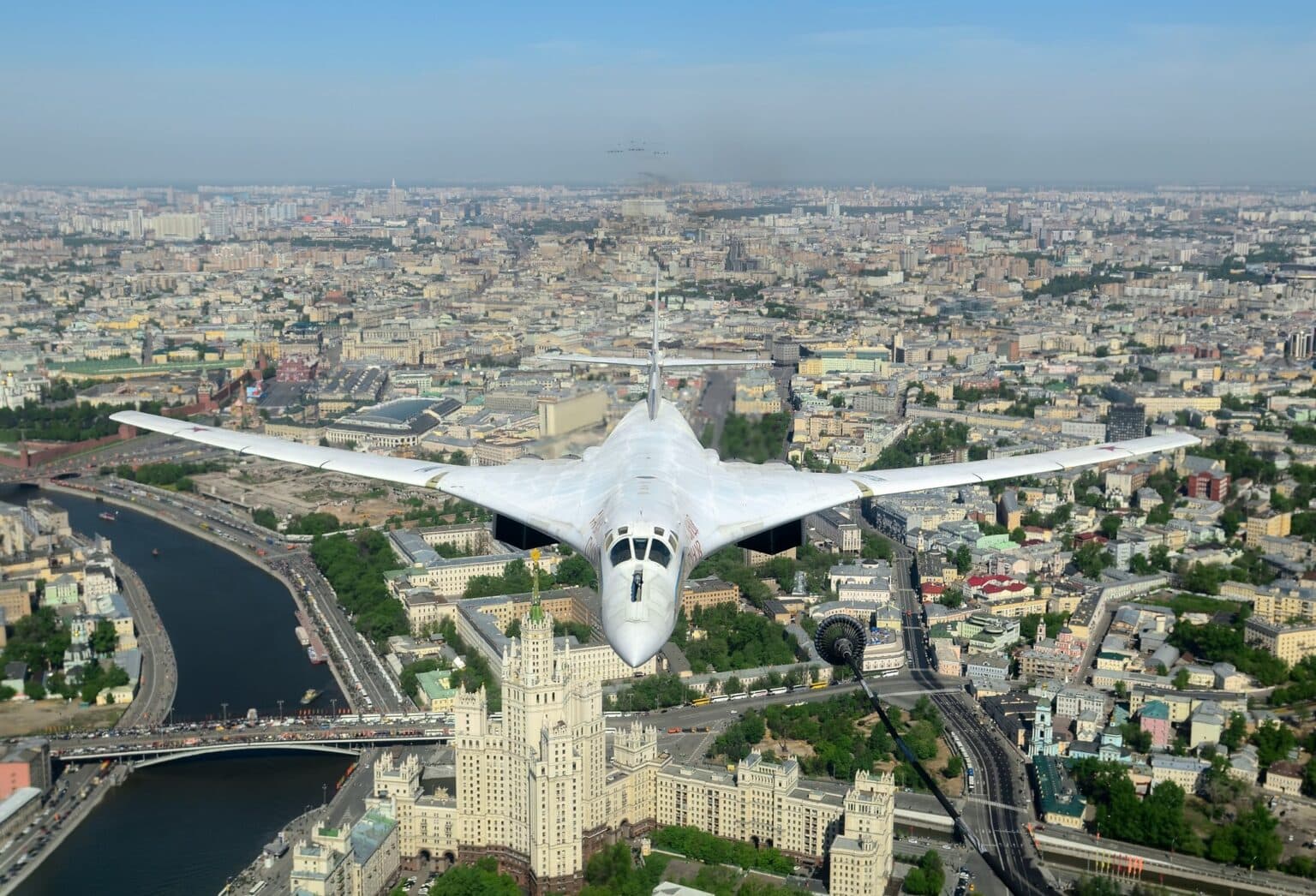
Russia has 115 long-range bombers. That is FlightGlobal’s count in its World Air Forces 2026 directory: 56 Tu-22M3s, 44 Tu-95s and 15 Tu-160s.
Only 60 of them are strategic bombers, the Tu-95s and Tu-160s that carry Russia’s nuclear cruise missiles, by the Federation of American Scientists’ count in May 2026. And Oryx has photo or video proof of 24 Russian bombers destroyed or damaged since February 2022.
How Many Bombers Does Russia Have?
115, in FlightGlobal’s 2026 directory. The figure covers Russia’s Long-Range Aviation, the branch of the Aerospace Forces that flies the big Tupolev bombers, and it counts aircraft listed as active.
It leaves out the Su-34 and Su-24, which Russia calls frontline bombers but which are two-seat strike jets. FlightGlobal lists them apart from the bombers, and they are broken down in our count of how many fighter jets Russia has.
The count at a glance
115 long-range bombers (FlightGlobal World Air Forces 2026): 56 Tu-22M3, 44 Tu-95, 15 Tu-160. 60 strategic bombers, about 54 of them operational (Federation of American Scientists, May 2026). 24 destroyed or damaged since February 2022, all Tu-22M3s and Tu-95s (Oryx). Not counted: Su-34 and Su-24 frontline bombers.
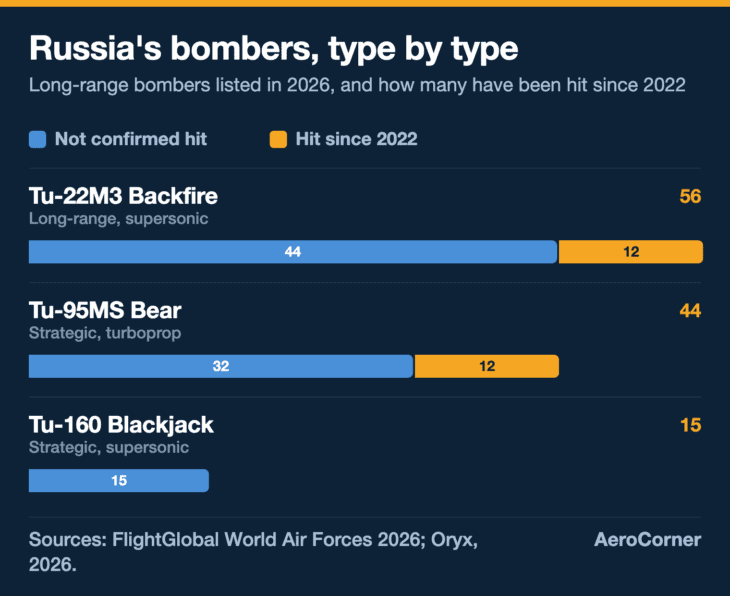
Russia’s bombers, type by type
Russia publishes no fleet figures of its own, so every count comes from outside researchers. The table sets the two main ones side by side with the losses that have been confirmed.
| Bomber | Role | FlightGlobal 2026 | FAS 2026 | Hit since 2022 (Oryx) |
|---|---|---|---|---|
| Tu-22M3 Backfire | Long-range, supersonic | 56 | Not counted | 12 |
| Tu-95MS Bear | Strategic, turboprop | 44 | 45 | 12 |
| Tu-160 Blackjack | Strategic, supersonic | 15 | 15 | 0 |
| Total | 115 | 60 | 24 |
The Tu-95 is the workhorse of the strategic force. It flies on four turboprops, and FAS estimates that about 25 of its 45 have been upgraded to the Tu-95MSM, which adds four pylons for eight Kh-101 or Kh-102 cruise missiles.


The Tu-160 is the smallest line and the only one with a clean sheet: Oryx has confirmed no Tu-160 loss in the war. The Tu-22M3 is not a strategic bomber at all in arms-control terms, which is why FAS lists it with Russia’s nonstrategic aircraft.

How the three compare on size, speed and payload, along with the two frontline bombers, is in our ranking of every Russian bomber in service.
Why the numbers differ
Search this question and you will see answers from about 54 to 115, and far higher when strike jets are added. They are not really disagreements. Each source draws the line around a different set of aircraft.
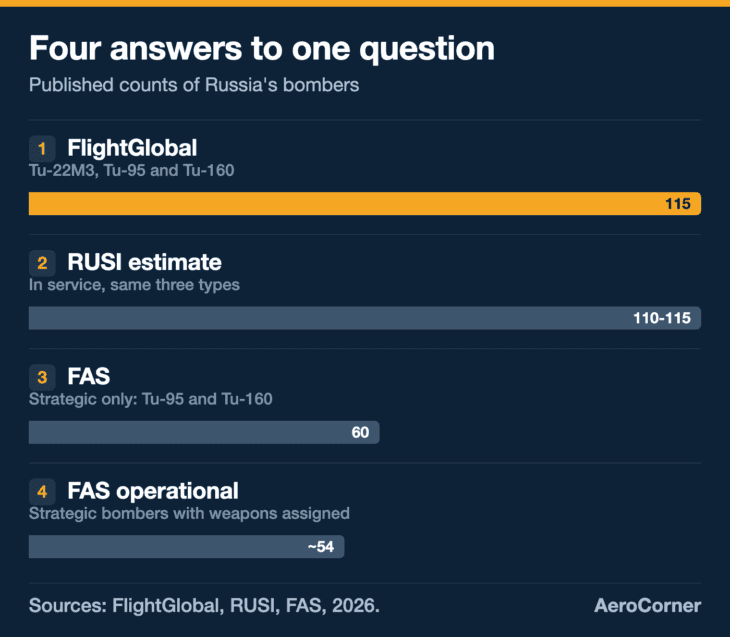
110 to 115 is the estimate of RUSI’s Justin Bronk for strategic bombers in service, as reported by Aerospace Global News in February 2026. It sits right on FlightGlobal’s total because it counts the same three types.
60 is the FAS count of heavy bombers, the Tu-95s and Tu-160s that arms-control treaties track. FAS believes about 54 of them are operational, with some in upgrade work, and it estimates weapons are assigned only to those 54.
The gap between 115 and 60 is the 56 Tu-22M3s. FAS puts the Backfire in its nonstrategic table instead, in one line with the Su-24, Su-34 and MiG-31K, a group it counts as 292 nuclear-capable aircraft.
That is why the 60 shows up in nuclear-forces reporting and the 115 in air force directories. Both are right about what they count.
The Su-34 is not in the count
Russia calls the Su-34 and Su-24 frontline bombers, and some counts add them in. They are two-seat strike jets built for shorter-range missions. The aircraft that carry Russia’s long-range cruise missiles number 115 at most, and the strategic force is about 60.
The fourth problem is the war. FlightGlobal itself cautions that its Russian figures are likely to be higher than reality, because losses inside a conflict zone cannot be verified, so a bomber destroyed on the ground may still be listed.
How the war has changed the count
The biggest single blow came on June 1, 2025. In Operation Spiderweb, Ukraine launched drones from trucks parked near five Russian air bases, from Olenya near Murmansk to Belaya in Siberia.
FAS believes seven Tu-95s were destroyed, four at Olenya and three at Belaya, and one more was damaged. Four Tu-22M3s were destroyed at Belaya. Two US officials told Reuters that about 20 aircraft were hit and about 10 destroyed.
The losses kept coming. Oryx now counts 12 Tu-22M3s (nine destroyed, three damaged) and 12 Tu-95MSs (nine destroyed, three damaged), and since the attack most of the Tu-95 fleet has moved to Ukrainka in the Far East, according to FAS.
Replacements are slow. Russia was scheduled to receive four Tu-160Ms in 2025, FAS reports, but by early January 2026 only two had been handed over. The planned PAK DA stealth bomber has not been shown flying, so the whole force is still made of Soviet-era designs.
That is when the number should move next. FAS expects the Tu-95MS to be retired before 2035, and says Russia appears to plan as many as 50 new Tu-160Ms, a target it doubts will be reached.
If the Bears go before the new Blackjacks arrive, Russia’s strategic force shrinks to the 15 Tu-160s plus whatever new ones have been delivered. If the factory delivers, the force ends up smaller, faster and entirely supersonic.
How does Russia’s bomber fleet compare to the US and China?
On FlightGlobal’s 2026 numbers, Russia’s 115 is close to the US total of 132: 72 B-52Hs, 40 B-1Bs and 20 B-2s. China lists about 150, all of them H-6 variants.
The US numbers move by definition too. The Air Force owns 19 B-2s, as our count of how many B-2 bombers are left explains, and its B-1 fleet is down to 45 airframes, shown in our B-1 bomber count.
Numbers are not the whole picture. Russia has no stealth bomber, while the US flies the B-2 and is testing the B-21, and how all of them rank is in our list of the best bombers in the world.
FAQ
Sources and references used for research and fact-checking.
- Bulletin of the Atomic Scientists / Federation of American Scientists, Russian nuclear weapons, 2026 (Table 1 and text)
- Bulletin of the Atomic Scientists, Russian nuclear weapons, 2026
- MiGFlug, Strategic bomber fleets, 2026 (FlightGlobal World Air Forces 2026 figures)
- Aerospace Global News, The air forces with the most combat fighter jets in 2026
- Oryx, List Of Aircraft Losses During The Russian Invasion Of Ukraine
- Wikipedia, Operation Spiderweb
- Wikipedia, Tupolev Tu-22M
- Wikipedia, Tupolev PAK DA
- 19FortyFive, Russia promised its stealth bomber would be flying by 2021. It is now 2026
Get the Newsletter
The latest aviation news and stories sent to your inbox.
About the Author

Tim is the owner and lead editor of AeroCorner since 2019, overseeing aviation content covering aircraft, airlines, airports, and the broader aviation industry. Through years of researching, writing, editing, and publishing aviation-focused content, he has developed extensive practical knowledge of commercial aviation and air travel. Based in Asia and a frequent traveler himself, Tim also brings firsthand passenger experience to AeroCorner’s coverage. Outside of publishing, he has also explored aviation firsthand through hands-on flight training in New Zealand.