

Table of Contents
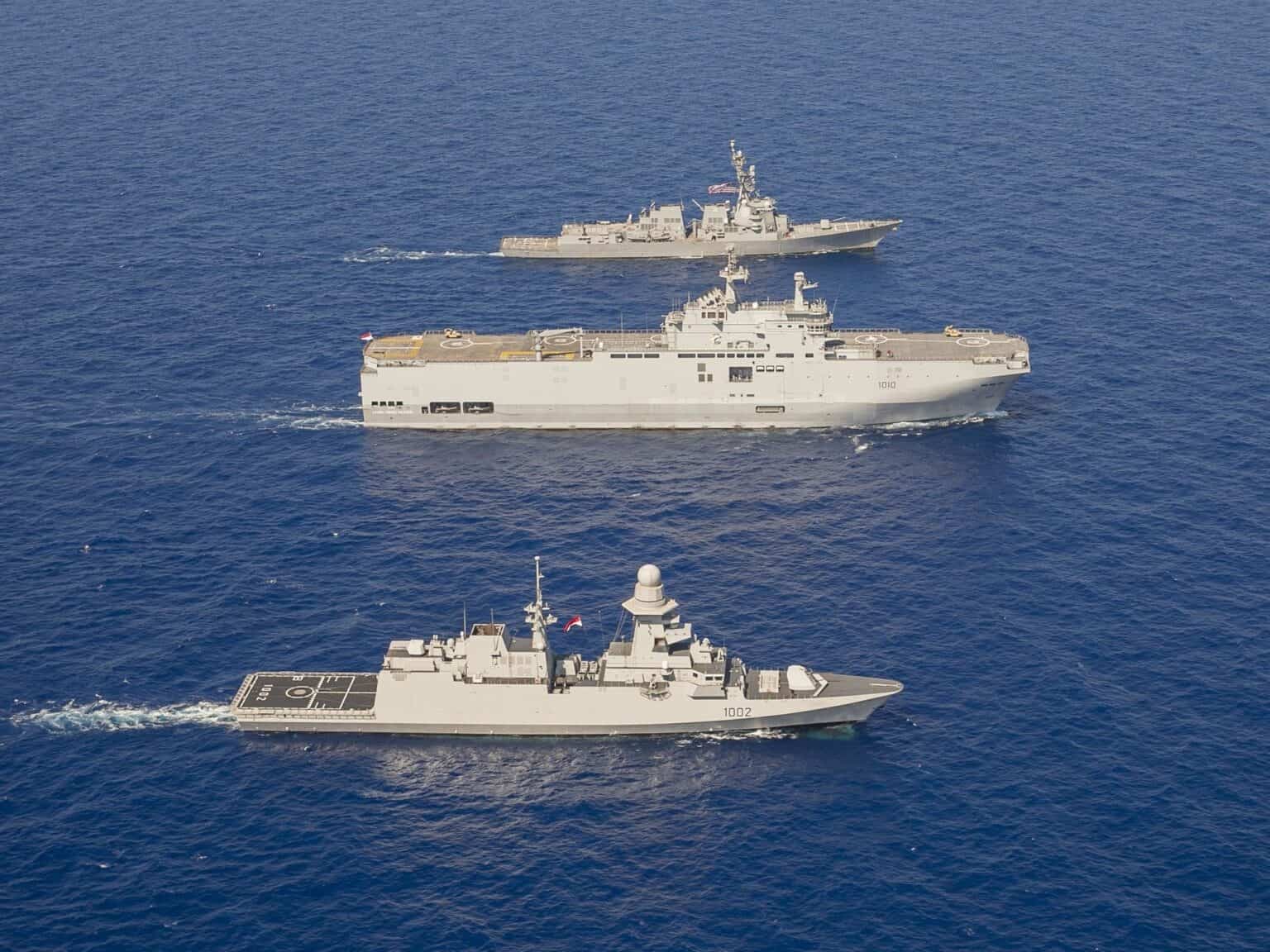
The Egyptian Navy is led by three FREMM frigates, the largest surface combatants in its fleet, and two French-built Mistral helicopter carriers, the largest ships in its fleet.
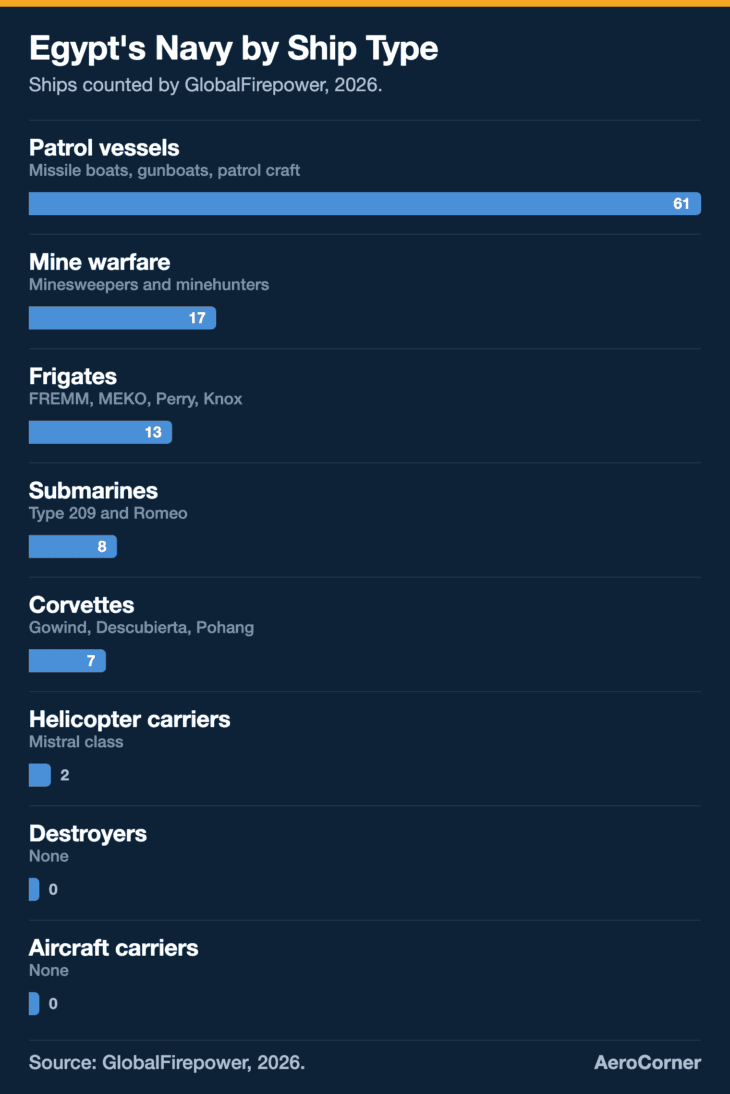
GlobalFirepower’s 2026 index counts 149 naval assets for Egypt, including two helicopter carriers, 13 frigates, seven corvettes and eight submarines. It lists zero destroyers and zero aircraft carriers.
This guide ranks every major class Egypt sails by fighting value as of November 2026, with hull counts, the year each joined, the helicopters that work with the fleet, and the frigates and submarines Cairo is shopping for next.
| Rank | Class | Type | Hulls | Origin |
|---|---|---|---|---|
| 1 | FREMM (Tahya Misr, Al-Galala) | Frigate | 3 | France, Italy |
| 2 | Mistral (Gamal Abdel Nasser) | Helicopter carrier | 2 | France, built for Russia |
| 3 | Type 209/1400mod | Attack submarine | 4 | Germany |
| 4 | MEKO A-200EN (Al-Aziz) | Frigate | 3, fourth fitting out | Germany, fourth built in Egypt |
| 5 | Gowind 2500 (El Fateh) | Corvette | 4 | France, three built in Egypt |
| 6 | Oliver Hazard Perry | Frigate | 4 | United States |
| 7 | Ambassador Mk III (Ezzat) | Fast missile craft | 4 | United States |
| 8 | Knox (Damyat) | Frigate | 2 | United States |
| 9 | Romeo (Type 033) | Attack submarine | 4 | China |
| 10 | Descubierta and Pohang | Corvette | 3 | Spain, South Korea |
How this ranking works
Classes are ranked by fighting value in November 2026: how modern each one is, what it carries, and how much it changes what the fleet can do. A single FREMM frigate ranks above a dozen missile boats. Hull counts come from open-source lists checked against GlobalFirepower’s 2026 index and delivery reports. Patrol craft, minesweepers, survey ships, landing craft and auxiliaries are counted in the chart but left out of the ranking.
1. FREMM Class: Tahya Misr, Al-Galala and Bernees
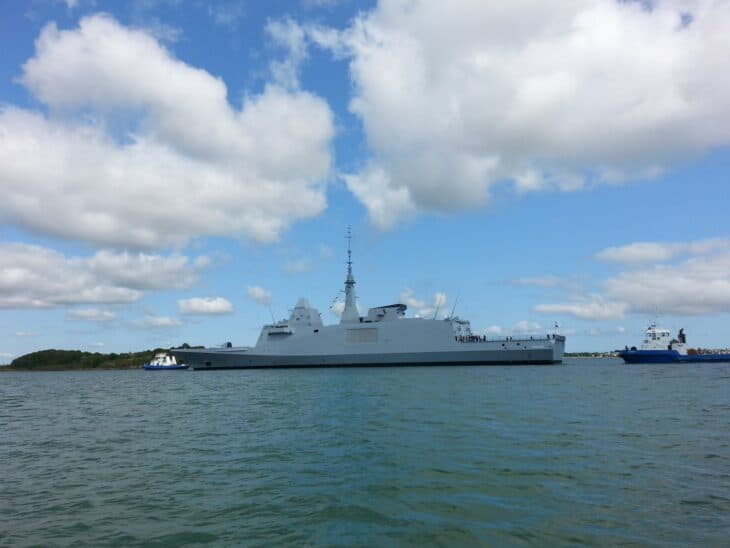

Egypt’s three FREMM multipurpose frigates are its most capable warships. The French version is about 466 feet (142 m) long and displaces about 6,000 tons.
Tahya Misr (“Long Live Egypt”) was built as the French Navy’s Normandie. Egypt ordered a FREMM in February 2015 in a €5.2 billion package that also bought 24 Rafale fighters, and France handed over Normandie on June 23, 2015, so it could lead the fleet at the opening of the New Suez Canal that August.
Al-Galala and Bernees came from Italy, built as Spartaco Schergat and Emilio Bianchi for the Italian Navy. Al-Galala reached Alexandria on December 31, 2020, and Bernees was delivered in April 2021, in a deal reported at €1.2 billion.
The Italian pair carry the Aster 30 air defense missile, while Tahya Misr carries the shorter-range Aster 15. Some sensitive jamming and satellite equipment was removed from all three before export.
2. Mistral Class: The Helicopter Carriers Built for Russia
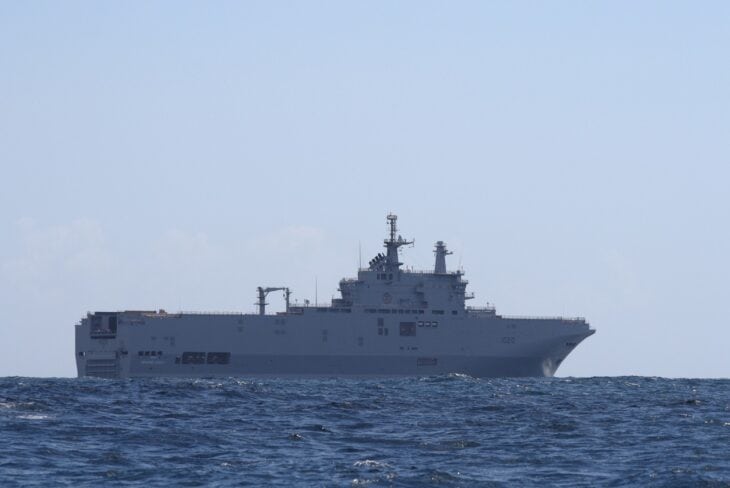

ENS Gamal Abdel Nasser and ENS Anwar El Sadat are Mistral-class landing helicopter docks, 653 feet (199 m) long. Each can carry 16 helicopters, four landing craft, up to 70 vehicles and 450 troops, and has a 69-bed hospital.
Egypt's carriers were built for Russia
Both ships were built in France for the Russian Navy, and Gamal Abdel Nasser was launched as Vladivostok. During the 2014 Russia-Ukraine crisis, France held back the delivery and in 2015 agreed to refund Moscow, and Egypt bought both ships for roughly 950 million euros, including crew training. Gamal Abdel Nasser was handed over on June 2, 2016, and Anwar El Sadat on September 16, 2016.
The ships give Egypt something rare outside the big naval powers: a way to land troops and vehicles by sea and air, or to run a disaster relief or evacuation operation far from home. Gamal Abdel Nasser is based at Safaga on the Red Sea and Anwar El Sadat at Alexandria, so each of Egypt’s two fleets has one.
Egypt also bought the Russian helicopters that had been planned for the ships. Russia confirmed a sale of Ka-52 attack helicopters to Egypt in December 2015, a deal that included the Ka-52K version designed for the Mistrals.
3. Type 209/1400mod: The German Submarines
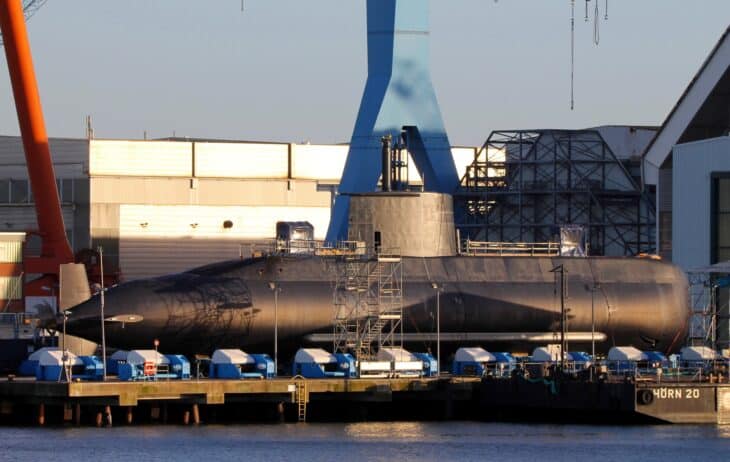

Egypt’s four modern submarines are German Type 209/1400mod boats from ThyssenKrupp Marine Systems in Kiel. Egypt ordered two in 2011 and two more in 2014.
The first, S41, was handed over in December 2016 and entered service in Alexandria in April 2017, and the last of the four arrived in 2021. Each boat displaces about 1,600 tons and has eight 21-inch torpedo tubes.
They can carry up to 14 torpedoes and missiles, including the SeaHake mod 4 torpedo and the submarine-launched Harpoon Block II anti-ship missile, and they can also lay mines.
4. MEKO A-200EN: The Al-Aziz Class Frigates
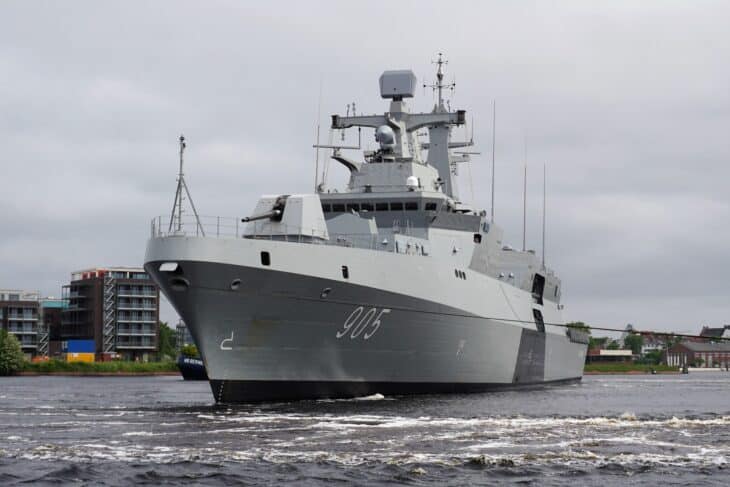

The Al-Aziz class is Egypt’s version of the German MEKO A-200 frigate. Each ship is about 387 feet (118 m) long, displaces 3,700 tons fully loaded, reaches 28 knots and has a range of 7,200 nautical miles at 16 knots.
Egypt signed for four in November 2018. TKMS handed over Al-Aziz on October 14, 2022, followed by Al-Qahhar and, in December 2023, Al-Qadeer.
Each carries 32 vertical-launch cells for MICA NG air defense missiles, eight Exocet MM40 Block 3 anti-ship missiles, a 127 mm gun and torpedoes.
The fourth ship, Al-Jabbar, was built at Alexandria Shipyard under license from TKMS, the only ship of the class built in Egypt. It was launched on December 4, 2023. In February 2026, Army Recognition reported it was still in the last stages of outfitting.
5. Gowind 2500: The El Fateh Corvettes
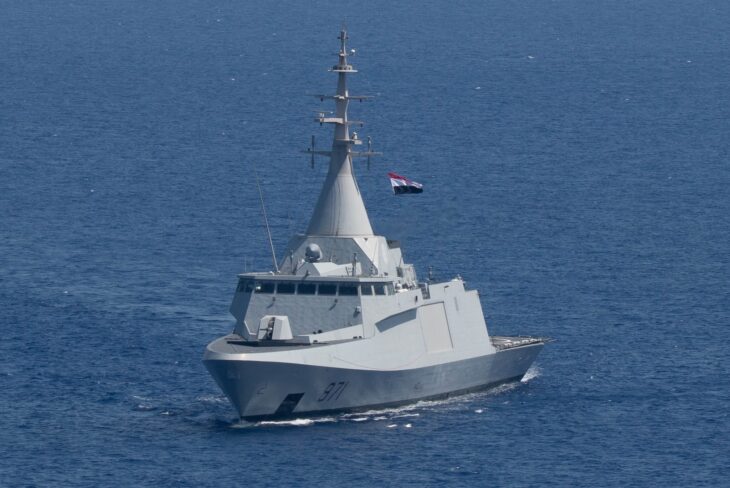

Egypt signed a €1 billion contract with Naval Group in 2014 for four Gowind corvettes of about 2,500 tons and 335 feet (102 m). They carry MICA vertical-launch air defense missiles and Exocet MM40 Block 3 anti-ship missiles.
El Fateh was built in Lorient, France, and delivered in September 2017. The other three, Port Said, El Moez and Luxor, were built by Alexandria Shipyard with French help, and Port Said was handed over in January 2021 as the first corvette built in Egypt.
Together with Al-Jabbar, the Gowinds are how Egypt learned to build modern warships at home, and it is asking for local construction again in its newest talks.
6. Oliver Hazard Perry Class: The American Frigates
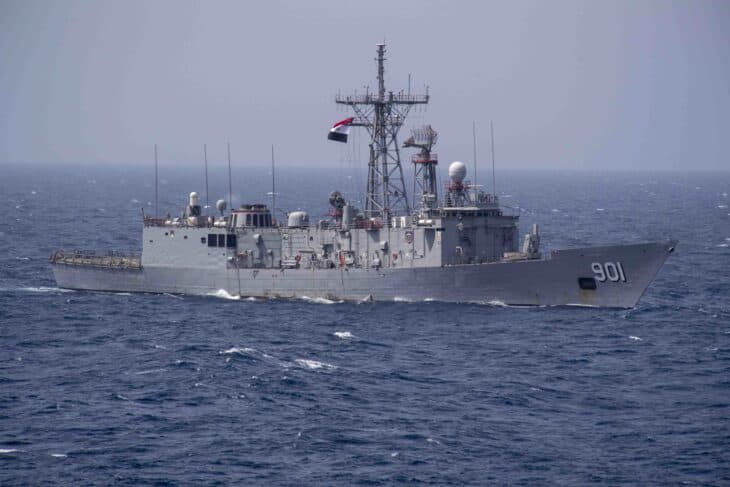

Four former US Navy Oliver Hazard Perry-class frigates were transferred to Egypt between 1996 and 1999: Sharm El-Sheikh, Toushka, Alexandria and Taba.
They were designed in the 1970s as affordable escorts and carry RIM-66 Standard air defense missiles and Harpoon anti-ship missiles. They are dated, but still give Egypt real air defense and helicopter-carrying hulls alongside the newer European ships.
7. Ambassador Mk III: The Ezzat Class Missile Boats
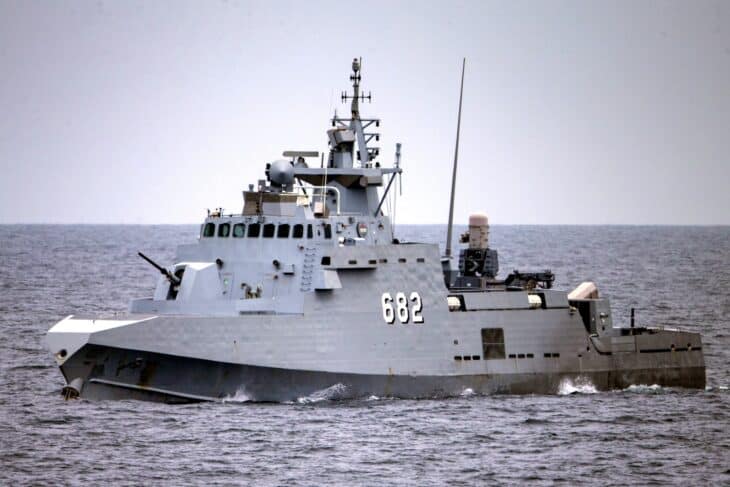

The four Ezzat-class boats are small but costly. VT Halter Marine built them in the United States under a US Navy program whose cost rose to $1.29 billion for four boats.
Each displaces about 600 tons, was designed with Lockheed Martin’s help to be hard to see on radar, and carries Harpoon anti-ship missiles and a RAM launcher for self-defense. The first, S. Ezzat, was handed over in November 2013.
8. Knox Class: Damyat and Rasheed
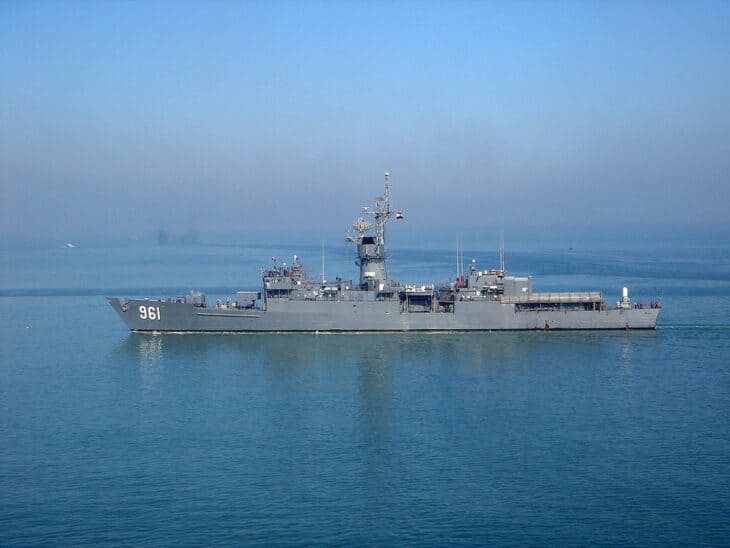

Egypt’s two Knox-class frigates, Damyat and Rasheed, are former US Navy anti-submarine ships, from a class the US Navy had fully retired by 1994.
They displace about 4,130 tons and carry Harpoon missiles. They are the oldest frigates in the fleet and the obvious first candidates for replacement as new frigates arrive.
9. Romeo Class: The Upgraded Chinese Submarines
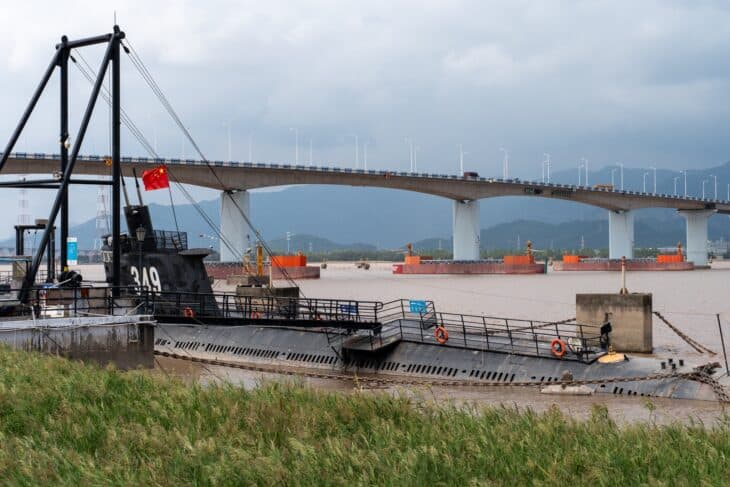

Egypt still runs four of an original eight Romeo-class submarines, Chinese versions of a Soviet design first built in 1957, sold to Egypt in the 1980s.
They have been heavily rebuilt with Western periscopes, sonar, GPS and a fire control system that lets them fire Harpoon missiles. That keeps them useful as a second-line force behind the Type 209s.
10. Descubierta and Pohang: The Older Corvettes
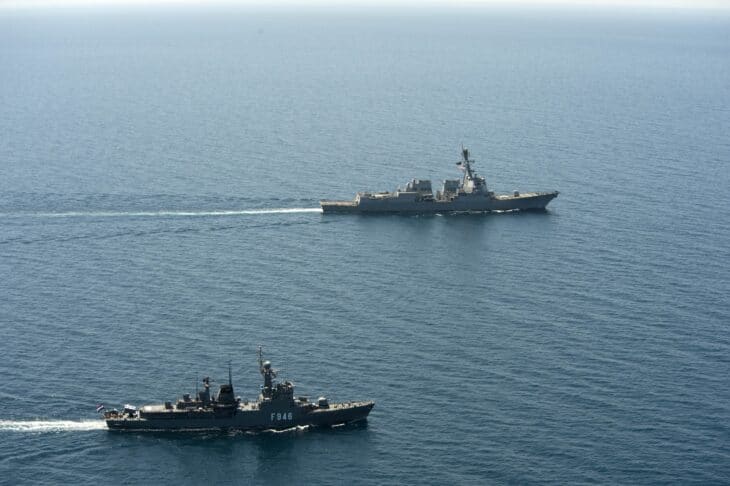

Two Spanish-designed Descubierta-class corvettes, Abu Qir and El Suez, still serve, at about 1,480 tons each. They are armed with Harpoon anti-ship missiles and RIM-7 Sea Sparrow air defense missiles.
Beside them sails ENS Shabab Misr, the former South Korean Pohang-class corvette ROKS Jinju, which arrived in Alexandria as a gift from South Korea on October 26, 2017. With the four Gowinds, that makes seven corvettes.
The Small Boats and Mine Force
Below the ranked classes sits a large and mostly old fleet of fast attack craft: Osa, Ramadan, October and Hegu missile boats, Hainan submarine chasers and Shershen torpedo boats, plus US-built Swiftships patrol craft assembled in Alexandria.
GlobalFirepower counts 61 patrol vessels and 17 mine warfare ships, a mine force that ranks sixth in the world by number. Ten new 141-foot (43 m) PV43 patrol vessels are being built in Egypt with Germany’s NVL, with the first due in 2026.
Egypt fired the first ship-killing missile
On October 21, 1967, Egyptian Komar-class missile boats in Port Said harbor fired Soviet Styx missiles at the Israeli destroyer Eilat. Three of four hit, the ship sank, and 47 of its crew of 199 were killed or missing. It was the first time a ship had been sunk by a missile fired from another ship, and it set navies around the world working on small, fast missile boats.
The Aircraft That Fly for the Navy
Egypt’s navy has historically depended on the air force for its aircraft. The main shipborne type is the Kaman SH-2G Super Seasprite, with 10 in service armed with anti-submarine torpedoes, alongside older Sea Kings.
In April 2019 the Egyptian Navy ordered 24 AgustaWestland AW149 helicopters. For maritime patrol, the air force flies E-2C Hawkeye radar planes and Beechcraft 1900C surveillance aircraft, all covered in our guide to the Egyptian Air Force.
Bases, Fleets and Command
The navy is split into a Mediterranean fleet and a Red Sea fleet. Its headquarters and main base is Alexandria, with Mediterranean bases at Port Said, Garoub and Mersa Matruh, and Red Sea bases at Hurghada, Safaga, Berenice and Suez.
The July 3 base at Garoub, west of Alexandria, was inaugurated by President Abdel Fattah al-Sisi in 2021. Mahmoud Adel Fawzy has commanded the navy since July 2025.
What Egypt Is Shopping For: F110 Frigates and New Submarines
In January 2026, Army Recognition reported that Egypt had opened talks with Spain’s Navantia on the F110-class frigate, a ship of about 6,100 tonnes. No contract, number or delivery date had been confirmed, and Egypt wants the ships partly built in Alexandria.
Submarines are the other priority. Egypt has been evaluating Spain’s S-80 Plus after the submarine Isaac Peral visited Alexandria in November 2025, while talks on a French Barracuda-based boat have reportedly slowed over production rights. Nothing had been signed as of the latest reports.
Egypt’s buying spree since 2015 is part of why it now ranks among the region’s leading naval powers, as our list of the largest navies in the world shows. Israel, its neighbor across Sinai, has taken a different path, covered in our guide to the Israeli Navy.
Does Egypt have an aircraft carrier?
No. The two Mistrals are often called carriers, but they are helicopter carriers: amphibious ships with a flat deck for helicopters and a well deck for landing craft. They have no catapults, arresting wires or ski jump, and cannot fly fighter jets. GlobalFirepower’s 2026 index lists Egypt with two helicopter carriers, zero aircraft carriers and zero destroyers.
For the ships that do launch fighters, see our ranking of the best aircraft carriers in the world.
FAQ
Sources and references used for research and fact-checking.
- Wikipedia, List of ships of the Egyptian Navy
- GlobalFirepower, Egypt Military Strength 2026
- Wikipedia, Egyptian Navy
- Wikipedia, FREMM multipurpose frigate
- Wikipedia, ENS Tahya Misr
- Wikipedia, ENS Al-Galala
- Wikipedia, ENS Bernees
- Wikipedia, Mistral-class landing helicopter dock
- Wikipedia, ENS Gamal Abdel Nasser
- Wikipedia, Type 209 submarine
- Wikipedia, ENS Al-Aziz
- Wikipedia, ENS Al-Jabbar
- Wikipedia, MEKO 200
- Wikipedia, Gowind-class design
- Daily News Egypt, Egyptian Navy receives locally manufactured stealth frigate
- Wikipedia, Oliver Hazard Perry-class frigate
- Wikipedia, Knox-class frigate
- Wikipedia, Ambassador MK III missile boat
- Wikipedia, Romeo-class submarine
- Wikipedia, ROKS Jinju
- Wikipedia, HMS Zealous (R39), later INS Eilat
- Army Recognition, Egypt opens talks with Spain on F110-class frigate acquisition
- Army Recognition, Egypt's 2026 plan for submarines and naval drones
- Army Recognition, WDS 2026: Egypt confirms PV43 patrol vessel as construction begins
- Africa Defense Forum, Egyptian subsidiary produces patrol vessels
Get the Newsletter
The latest aviation news and stories sent to your inbox.
About the Author

Tim is the owner and lead editor of AeroCorner since 2019, overseeing aviation content covering aircraft, airlines, airports, and the broader aviation industry. Through years of researching, writing, editing, and publishing aviation-focused content, he has developed extensive practical knowledge of commercial aviation and air travel. Based in Asia and a frequent traveler himself, Tim also brings firsthand passenger experience to AeroCorner’s coverage. Outside of publishing, he has also explored aviation firsthand through hands-on flight training in New Zealand.