

Table of Contents
China’s longest-range missile is the DF-41, a road-mobile ICBM that the CSIS Missile Defense Project credits with up to 9,320 miles (15,000 km). That is far enough to reach the United States from launch sites inside China.
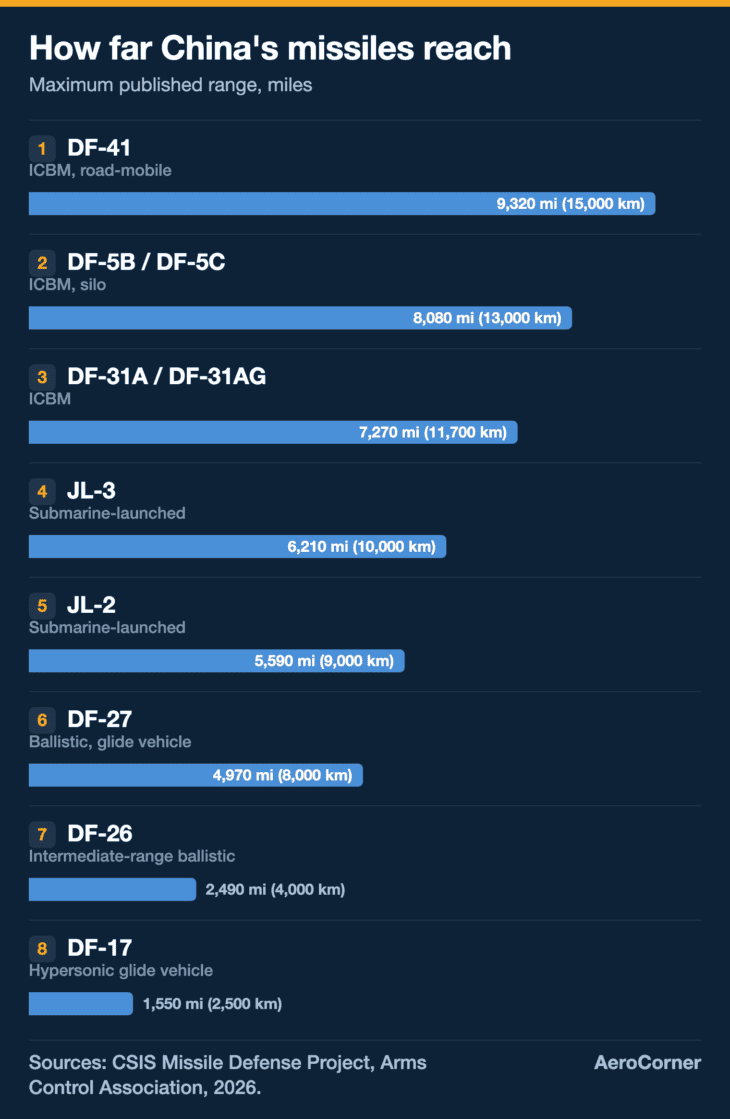
This list ranks the 15 Chinese missiles that matter most by one measure: maximum published range, using the CSIS figure wherever CSIS lists the missile. It runs from intercontinental nuclear missiles down to the anti-ship missiles carried by Chinese destroyers and bombers.
Range is only half the story. The missiles that worry US planners most, the DF-21D, DF-26 and DF-17, sit in the middle of this list, because they are built to hit ships and bases across the western Pacific, not cities. Figures are as of November 2026.
| Rank | Missile | Type | Maximum range | Status (Nov 2026) |
|---|---|---|---|---|
| 1 | DF-41 | ICBM, road-mobile | 9,320 miles (15,000 km) | Deployed, road-mobile |
| 2 | DF-5B / DF-5C | ICBM, silo, liquid-fueled | 8,080 miles (13,000 km) | DF-5B in service since 2015 |
| 3 | DF-31A / DF-31AG | ICBM, road-mobile and silo | 7,270 miles (11,700 km) | In service; loaded in new silos |
| 4 | JL-3 | Submarine-launched ballistic missile | 6,210 miles (10,000 km) | Likely deployed since 2022 |
| 5 | JL-2 | Submarine-launched ballistic missile | 5,590 miles (9,000 km) | In service since 2015 |
| 6 | DF-27 | Long-range ballistic missile with glide vehicle | 4,970 miles (8,000 km) | New; status unconfirmed |
| 7 | DF-26 | Intermediate-range ballistic missile | 2,490 miles (4,000 km) | In service since 2016 |
| 8 | DF-17 | Hypersonic glide vehicle on a ballistic missile | 1,550 miles (2,500 km) | Shown in service since 2019 |
| 9 | DF-100 (CJ-100) | Supersonic land-attack cruise missile | 1,240 miles (2,000 km) | In service since about 2019 |
| 10 | CJ-10 / CJ-20 | Subsonic land-attack cruise missile | 1,240+ miles (2,000+ km), CJ-20 | In service |
| 11 | DF-21D | Anti-ship ballistic missile | 960 miles (1,550 km) | In service since 2006 |
| 12 | DF-16 | Short-range ballistic missile | 620 miles (1,000 km) | In service since 2011-2012 |
| 13 | DF-15 | Short-range ballistic missile | 560 miles (900 km) | In service since 1990-1991 |
| 14 | YJ-18 | Anti-ship cruise missile | 340 miles (540 km) | In service since 2014 |
| 15 | YJ-12 | Supersonic anti-ship cruise missile | 310 miles (500 km) | In service by 2015 |
How this ranking works
Missiles are ranked by maximum range, the top of the published estimate. China does not release verified figures, so the CSIS Missile Defense Project is used wherever it lists a missile, and Arms Control Association, IISS and US government estimates where it does not. Where two missiles share a figure, the faster one ranks first. Missiles with no credible range figure yet, such as the DF-61 and YJ-21, get their own section at the end. Air-defense interceptors and air-to-air missiles are not included.
1. DF-41
The DF-41 is China’s newest operational ICBM and its longest-reaching weapon. CSIS gives it a range of 7,460 to 9,320 miles (12,000 to 15,000 km), a launch weight of about 176,000 pounds (80,000 kg) and three solid-fuel stages.
Chinese state media claim it can carry up to 10 warheads. Western estimates are lower: the Bulletin of the Atomic Scientists suggested in 2018 that it most likely carries three, along with decoys meant to confuse missile defenses.
The program dates to 1986, and the first flight test came on July 24, 2012. China unveiled 16 launchers at its October 1, 2019 parade. The Pentagon’s 2024 report described it as deployed only as a road-mobile missile in a few brigades, with silo and rail basing possible later. Our guide to ballistic missiles explains how ICBMs like this one fly.
2. DF-5B / DF-5C
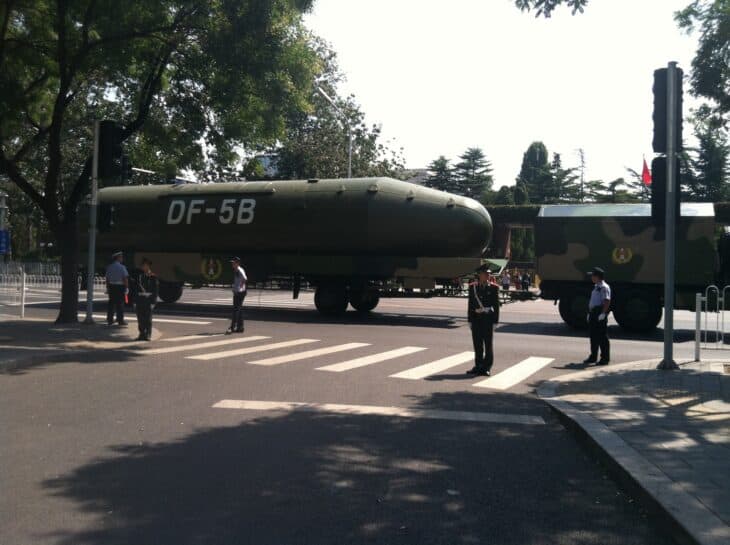

The DF-5 is China’s oldest ICBM and its heaviest. It is 107 feet (32.6 m) long, weighs about 403,000 pounds (183,000 kg) at launch, and runs on liquid fuel from hardened silos in central China, with a CSIS range of 8,080 miles (13,000 km).
The original entered service in 1981. The DF-5B, operational since 2015, added multiple warheads, and CSIS reports a 2017 test of a DF-5C with 10. The DF-5C appeared in public for the first time at the September 2025 Victory Day parade, though whether it has been deployed is not known.
Liquid fuel is the DF-5’s weakness: loading its fuel takes 30 to 60 minutes, a long time for a missile that may be targeted first. China is still adding DF-5 silos, which the Pentagon’s 2024 report expected to reach about 50.
3. DF-31A / DF-31AG
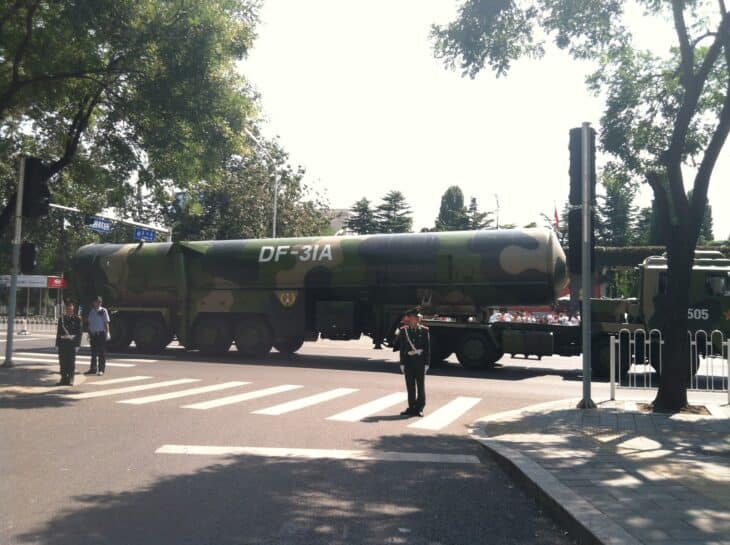

The DF-31 family is the backbone of China’s ICBM force. CSIS credits the improved versions with up to 7,270 miles (11,700 km), carrying a single 200 to 300 kiloton warhead on three solid-fuel stages.
The DF-31A entered service in 2007, and the DF-31AG, shown in 2017, rides on an off-road launcher that can leave paved roads. The Pentagon’s 2025 report confirmed that both carry the same missile.
It is also the missile filling China’s new silo fields. The 2025 report says China has “likely loaded more than 100” silos at its three northern fields with DF-31-class ICBMs. On September 25, 2024, a DF-31B flew from Hainan Island into the Pacific, China’s first ICBM test into open ocean since 1980.
More ICBM launchers than the United States
The Pentagon’s 2024 report listed 550 Chinese ICBM launchers with 400 missiles. That is more launchers than the US fields, though the Federation of American Scientists notes the count includes every finished silo, armed or not.
4. JL-3
The JL-3 is China’s newest submarine-launched ballistic missile, and the first that can reach most of the continental United States from waters near China. The Arms Control Association puts its likely range at 6,210 miles (10,000 km).
Its first test flight came on November 24, 2018, in the Bohai Sea. It may have been fitted to China’s Type 094 submarines by 2022, and it made its public debut at the September 2025 parade. CSIS reports a likely payload of three warheads.
On July 6, 2026, a Chinese submarine-launched missile flew about 4,350 miles (7,000 km) from the South China Sea into the South Pacific between Kiribati and Tuvalu. Analysts split on whether it was a JL-3 or a JL-2, and a senior Taiwanese intelligence official told lawmakers it was a JL-2.
5. JL-2
The JL-2 gave China its first credible sea-based nuclear deterrent. CSIS lists a range of 4,970 to 5,590 miles (8,000 to 9,000 km) and a single 1-megaton warhead, or possibly three to eight smaller ones.
It entered service in 2015 aboard the Type 094 Jin-class submarines, which carry 12 each. As of 2019, CSIS counted 48 JL-2 launchers across four boats. Its shorter reach is why the JL-3 matters: only the newer missile can cover most of the US mainland from waters near China.
6. DF-27
The DF-27 is the least known missile on this list. US estimates give it a range of 3,110 to 4,970 miles (5,000 to 8,000 km), with a hypersonic glide vehicle as its warhead.
The Pentagon describes it as dual-capable, able to carry nuclear or conventional warheads, and mainly intended for conventional strikes at intermediate range. Its service status has not been confirmed in public sources.
7. DF-26
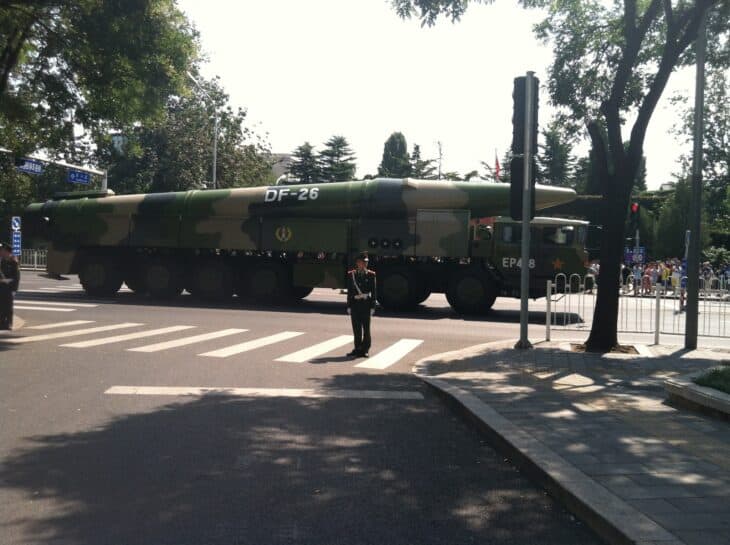

The DF-26 is the missile behind the “Guam killer” nickname. CSIS credits it with 2,490 miles (4,000 km), enough to reach Guam from mainland China, and Chinese sources claim more than 3,100 miles (5,000 km).
Its warheads swap in the field between nuclear and conventional, which makes it hard for an opponent to know what is coming. An anti-ship version, the DF-26B, was fired into the South China Sea in August 2020, and a DF-26D appeared at the 2025 parade.
The Pentagon’s 2024 report counted 250 intermediate-range launchers with 500 missiles, a force that apparently consists entirely of DF-26s. The 2025 report called it a weapon “well suited for delivering a low-yield nuclear weapon.”
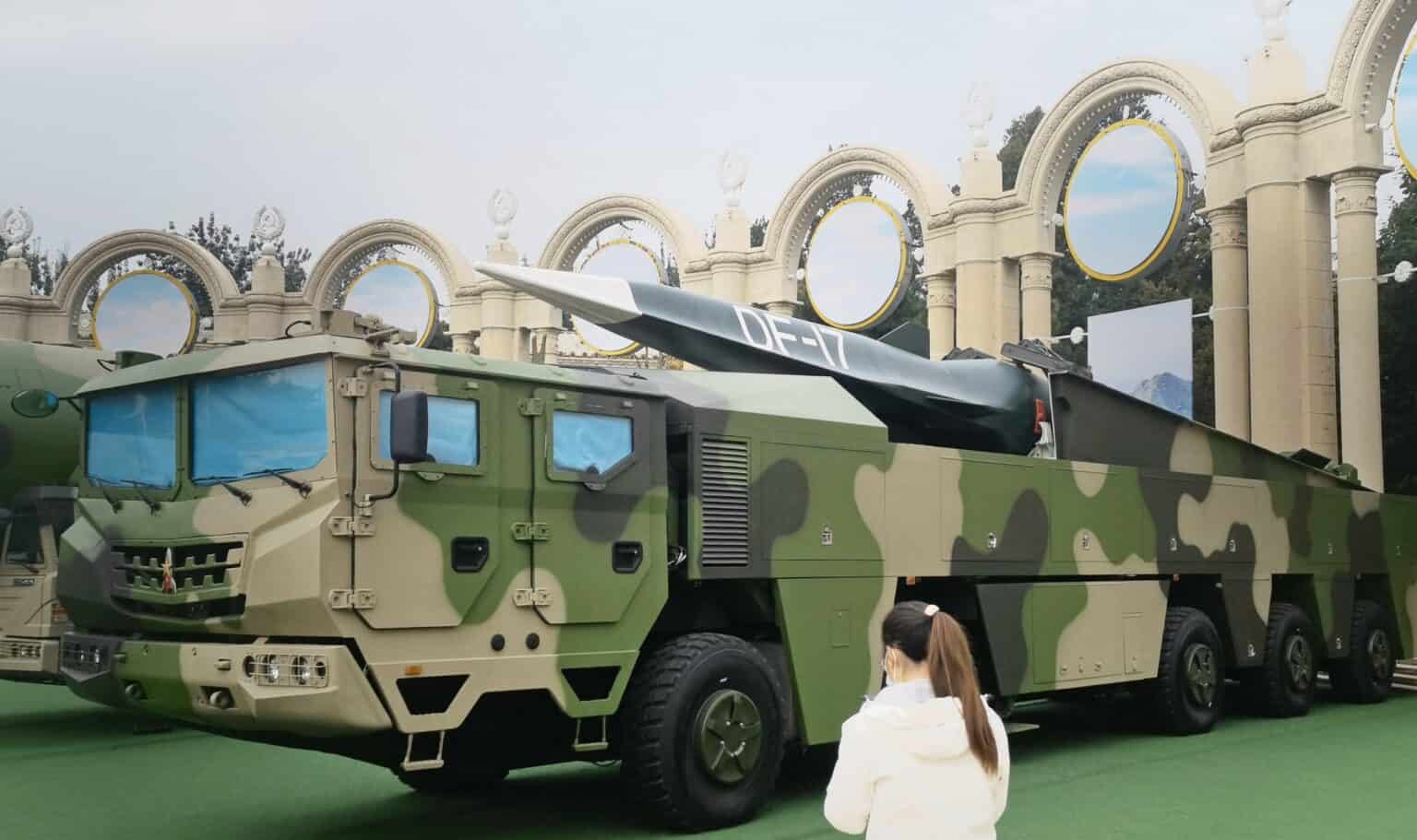
8. DF-17
A 2020 US Air Force study called the DF-17 the first tactical ballistic missile with a hypersonic glide vehicle believed to be in operational deployment. A booster lifts the DF-ZF glider, which then flies at Mach 5 to 10 at low altitude, with a CSIS range of 1,120 to 1,550 miles (1,800 to 2,500 km).
China flew at least nine tests between January 2014 and November 2017 and showed the missile at the 2019 parade. Its gliding, maneuvering flight path is harder to track than a ballistic arc. Our list of hypersonic missiles that actually exist compares it with Russia’s Avangard and the US programs.
9. DF-100 (CJ-100)
The DF-100 is a cruise missile that is supersonic for nearly its whole flight, which sets it apart from subsonic weapons like the Tomahawk. The IISS put its range at 1,240 miles (2,000 km) in 2022.
The US Air Force’s China Aerospace Studies Institute reported that at least one Rocket Force unit began receiving it in 2019. Chinese reports say the H-6K bomber may also carry it.
10. CJ-10 / CJ-20
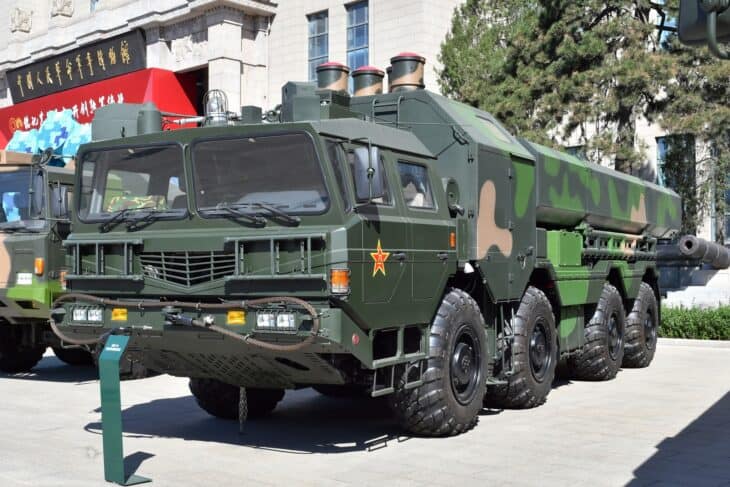

The CJ-10 is China’s equivalent of the Tomahawk: a subsonic land-attack cruise missile derived from the Soviet Kh-55. US estimates since 2013 give it a range of more than 930 miles (1,500 km).
The air-launched CJ-20 reaches further, more than 1,240 miles (2,000 km), and the Xian H-6 bomber may carry four externally. An updated CJ-20A rolled through the 2025 parade. Our guide to Chinese bombers covers the aircraft that launch it.
11. DF-21D
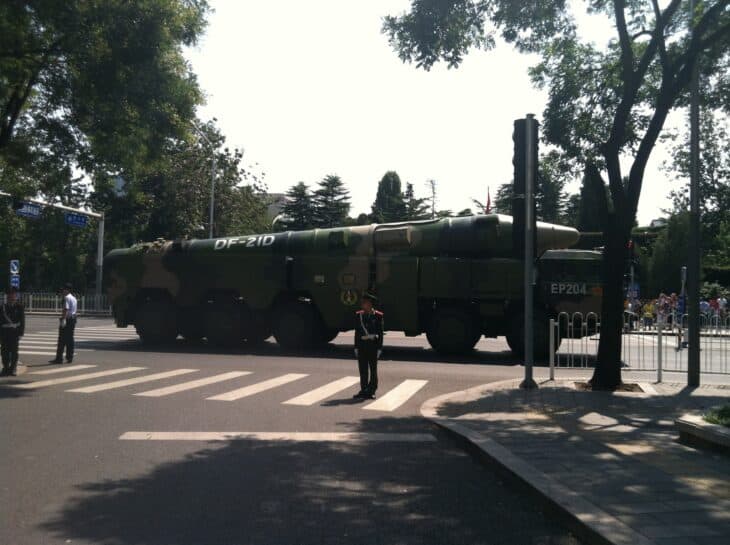

The DF-21D is the original “carrier killer,” widely described as the world’s first anti-ship ballistic missile. US reports cited by CSIS give it a range of 900 to 960 miles (1,450 to 1,550 km) and a maneuvering warhead that may land within about 66 feet (20 m) of its aim point.
It entered service in 2006. In 2013 it was tested against a target about the size of a US aircraft carrier, and in August 2020 it was fired into the South China Sea alongside a DF-26B. Its ability to find and hit a moving carrier in wartime has not been tested in combat.
A carrier fleet built on land
China has built full-scale mock-ups of a Ford-class aircraft carrier and Arleigh Burke-class destroyers in the Taklamakan Desert as targets for its anti-ship ballistic missiles. Some of the targets are mounted on rails so they can move.
12. DF-16
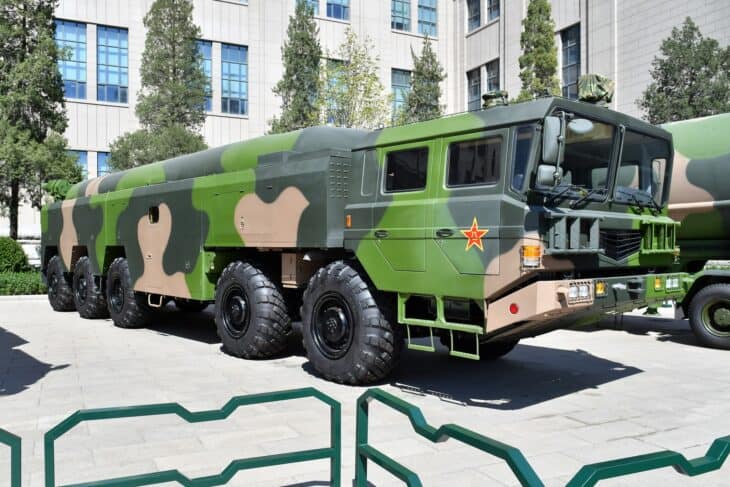

The DF-16 is a heavier, longer-reaching replacement for the DF-15, with a CSIS range of 500 to 620 miles (800 to 1,000 km). Its booster also serves as the first stage of the DF-17.
It likely entered service in 2011 or 2012 and was shown in public in September 2015. It is based in Guangdong Province, within range of Taiwan and Vietnam, and CSIS counted 36 launchers by 2021.
13. DF-15
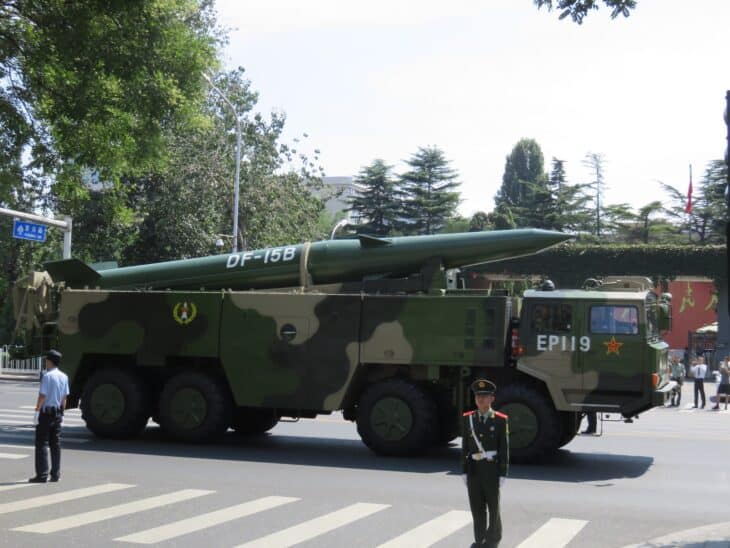

The DF-15 is the short-range missile that made Taiwan’s missile threat real. CSIS lists a range of 370 to 560 miles (600 to 900 km), with warheads for precision strike, bunker busting and runway cratering.
In 1995, China test-fired six DF-15s into the sea near Taiwan, and it fired four more toward the island in 1996, during the Taiwan Strait crisis. CSIS reports 350 to 400 missiles were operational in 2009, with at least 30 built every year since.
14. YJ-18
The YJ-18 is the main ship-killing missile of China’s newest destroyers, the Type 052D and the Type 055. CSIS gives it a range of up to 340 miles (540 km).
It cruises at Mach 0.8, then sprints at Mach 2.5 to 3.0 for the final stretch, a two-speed profile the US believes copies Russia’s 3M-54 Klub. Our guide to China’s navy covers the ships that carry it.
15. YJ-12
The YJ-12 is a supersonic sea-skimmer launched from bombers, ships and shore batteries. US figures put the air- and ship-launched versions at 270 nautical miles (310 miles, 500 km), with reported speeds of Mach 2.5 to 4.
According to War on the Rocks, a ship has about 45 seconds to engage one once it appears over the horizon. A land-based version was reportedly deployed to the Spratly Islands around April 2018. Our ranking of anti-ship missiles shows how it compares with its rivals.
The missiles with no credible range yet
The September 3, 2025 Victory Day parade showed several missiles nobody outside China can yet put a number on. The biggest surprise was the DF-61, a road-mobile ICBM on what looks like the DF-41’s launcher. Reported ranges run from about 7,500 miles (12,100 km) to 11,180 miles (18,000 km).
The YJ-21 is a hypersonic anti-ship ballistic missile fired from the Type 055 destroyer and the H-6 bomber. A 2023 Chinese military article claimed a cruise speed of Mach 6 and a terminal speed of Mach 10, but no reliable range has been published.
The same parade introduced the JL-1 air-launched ballistic missile, the CJ-1000 and the YJ-15, YJ-17, YJ-19 and YJ-20 anti-ship missiles. They will join this ranking once credible figures exist.
Does China have more nuclear missiles than the US?
No. China has more ICBM launchers on paper, but far fewer warheads. The Pentagon’s 2025 report says China’s stockpile stayed in the low 600s through 2024 and is on track to pass 1,000 by 2030, still several thousand fewer than either the United States or Russia, according to the Federation of American Scientists. Many of the new silos may also still be empty.
For how China’s arsenal compares with its main rival in the region, see our ranking of Russian missiles by range, built on the same CSIS figures.
FAQ
Sources and references used for research and fact-checking.
- CSIS Missile Defense Project, Missiles of China
- CSIS Missile Defense Project, DF-41 (Dong Feng-41 / CSS-X-20)
- Wikipedia, DF-41
- CSIS Missile Defense Project, DF-5
- Wikipedia, DF-5 (missile)
- CSIS Missile Defense Project, DF-31 (Dong Feng-31 / CSS-10)
- Federation of American Scientists, The Pentagon's (Slimmed Down) 2025 China Military Power Report
- Federation of American Scientists, The 2024 DOD China Military Power Report
- Wikipedia, People's Liberation Army Rocket Force
- Wikipedia, JL-3
- Arms Control Association, China Tests Submarine-Launched Missile in Pacific
- CSIS Missile Defense Project, JL-2
- Wikipedia, Dongfeng (missile)
- CSIS Missile Defense Project, Dong Feng-26 (DF-26)
- Wikipedia, DF-26
- CSIS Missile Defense Project, DF-17
- Wikipedia, DF-17
- Wikipedia, CJ-100
- CSIS Missile Defense Project, Hong Niao
- Wikipedia, CJ-10 (missile)
- CSIS Missile Defense Project, DF-21
- CSIS Missile Defense Project, DF-16 (CSS-11)
- CSIS Missile Defense Project, DF-15 (CSS-6)
- CSIS Missile Defense Project, YJ-18
- Wikipedia, YJ-18
- Wikipedia, YJ-12
- Wikipedia, YJ-21
- Wikipedia, DF-61
- Wikipedia, 2025 China Victory Day Parade
Get the Newsletter
The latest aviation news and stories sent to your inbox.
About the Author

Tim is the owner and lead editor of AeroCorner since 2019, overseeing aviation content covering aircraft, airlines, airports, and the broader aviation industry. Through years of researching, writing, editing, and publishing aviation-focused content, he has developed extensive practical knowledge of commercial aviation and air travel. Based in Asia and a frequent traveler himself, Tim also brings firsthand passenger experience to AeroCorner’s coverage. Outside of publishing, he has also explored aviation firsthand through hands-on flight training in New Zealand.