

Table of Contents
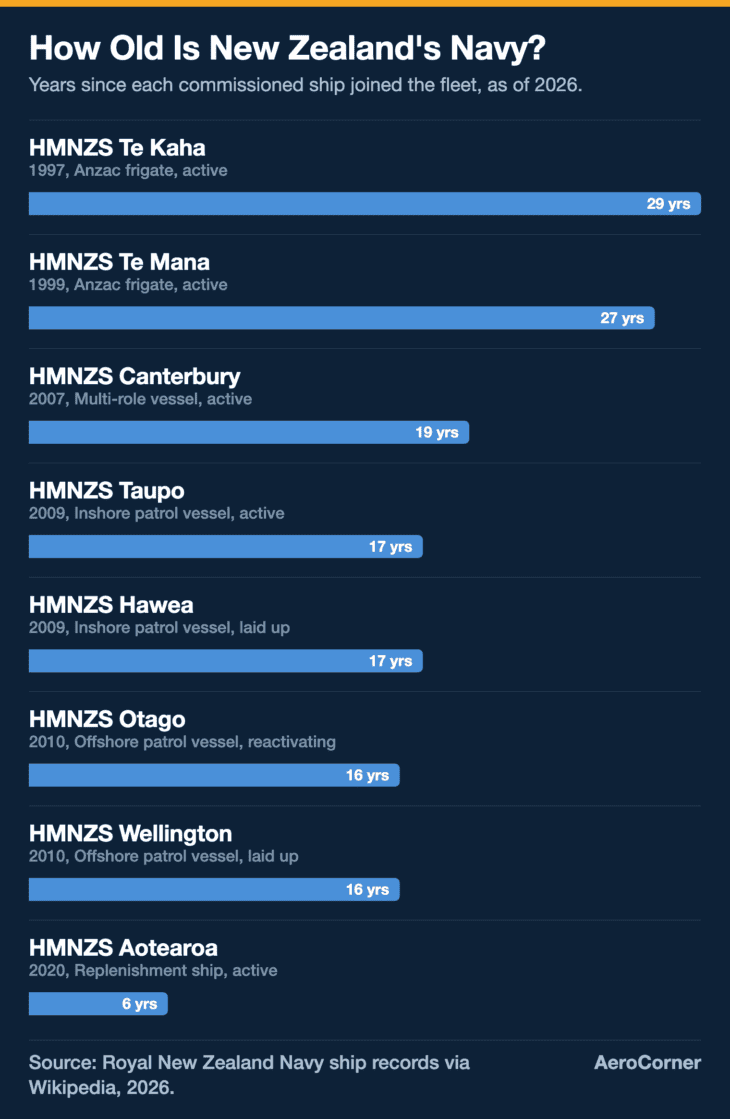
The Royal New Zealand Navy (RNZN) has eight commissioned ships in 2026, and its only warships are two Anzac-class frigates, HMNZS Te Kaha and HMNZS Te Mana. Everything else is a support ship or a patrol vessel.
Eight is the number on paper. As of November 2026, three of those ships are not sailing: two were laid up in 2021 and 2022 for lack of crews, and the third, HMNZS Otago, lost its authority to go to sea after a fuel system failure during its return to service.
This guide ranks every class by fighting value, with the status of each hull, the helicopters that fly from them, the ship New Zealand lost off Samoa in 2024 and the frigate decision due by the end of 2027.
| Rank | Class or ship | Type | Commissioned ships | Status, November 2026 |
|---|---|---|---|---|
| 1 | Anzac | Frigate | 2 | Both active |
| 2 | HMNZS Aotearoa | Replenishment ship | 1 | Active |
| 3 | HMNZS Canterbury | Multi-role vessel | 1 | Active |
| 4 | Protector | Offshore patrol vessel | 2 | Otago reactivating, Wellington laid up |
| 5 | Protector (Lake class) | Inshore patrol vessel | 2 | Taupo active, Hawea laid up |
How this ranking works
Classes are ranked by fighting value in November 2026: what each one carries, how far it can reach, and how much New Zealand would lose without it. Ship counts are commissioned hulls, including the two that are laid up, because that is how the navy and most fleet lists count them. Each entry says which ships can actually sail. Small boats, uncrewed vessels and ships under study are left out and covered at the end.
1. Anzac Class: New Zealand’s Only Warships
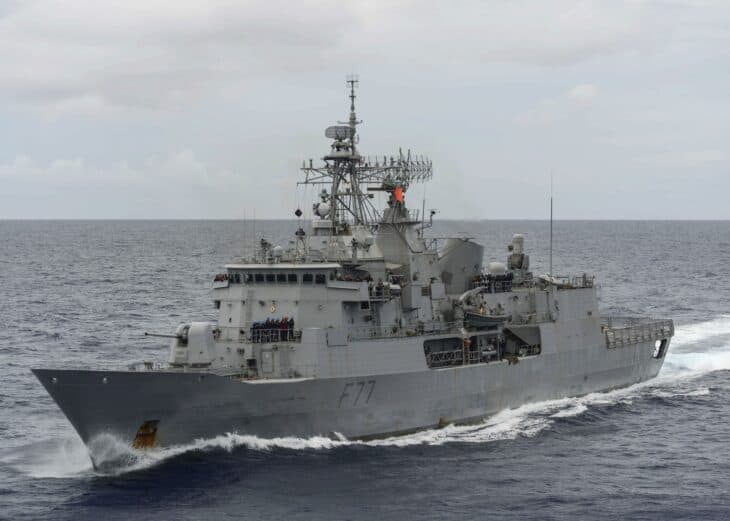

HMNZS Te Kaha (F77) and HMNZS Te Mana (F111) are the navy’s combat force. Te Kaha was commissioned on July 22, 1997, and Te Mana on December 10, 1999, at Tauranga.
Both are German MEKO 200 designs built in Australia alongside that navy’s Anzacs. Each is 387 feet (118 m) long, displaces 3,600 tonnes at full load and makes 27 knots, with a range of 6,000 nautical miles at 18 knots.
They rank first because they are the only ships New Zealand has that can defend themselves against aircraft and missiles. A Frigate Systems Upgrade in Canada, expected to cost NZ$639 million for both ships, gave them a Thales SMART-S Mk2 radar, a Lockheed Martin Canada CMS-330 combat system and a 20-cell launcher for Sea Ceptor (CAMM) air-defense missiles, plus a Phalanx close-in gun.
Te Kaha finished the work first, starting sea trials in September 2020, and Te Mana sailed home with its upgrade in May 2022. Each carries one Kaman SH-2G Super Seasprite helicopter for submarine hunting and surface strike.
Both are busy. Te Kaha left New Zealand on February 12, 2025, for a deployment to the Middle East, and Te Mana finished a maintenance period of more than 21 months in 2026.
New Zealand once planned four frigates
Two more Anzacs were planned for New Zealand and then cancelled after the 1980s breakdown of military relations under ANZUS, and a later debate over a third and fourth ship ended without a decision. Two hulls means that when one is in refit, the country has a single warship.
For how two frigates compare with the fleets around the Pacific, see our ranking of the largest navies in the world.
2. HMNZS Aotearoa: The Biggest Ship the Navy Has Ever Had
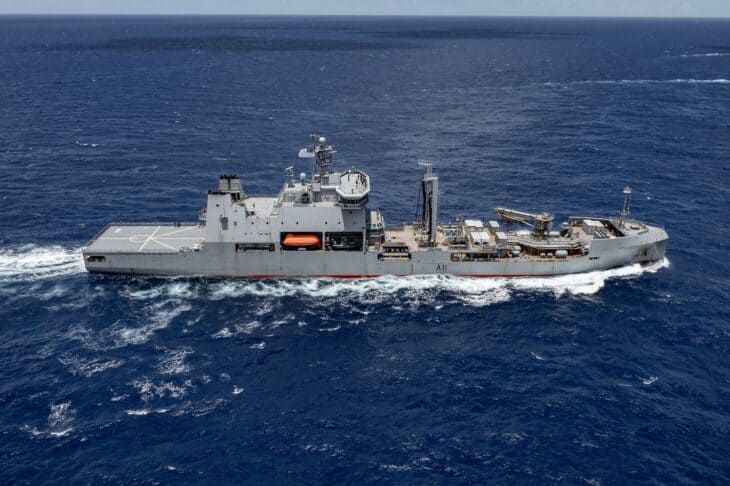

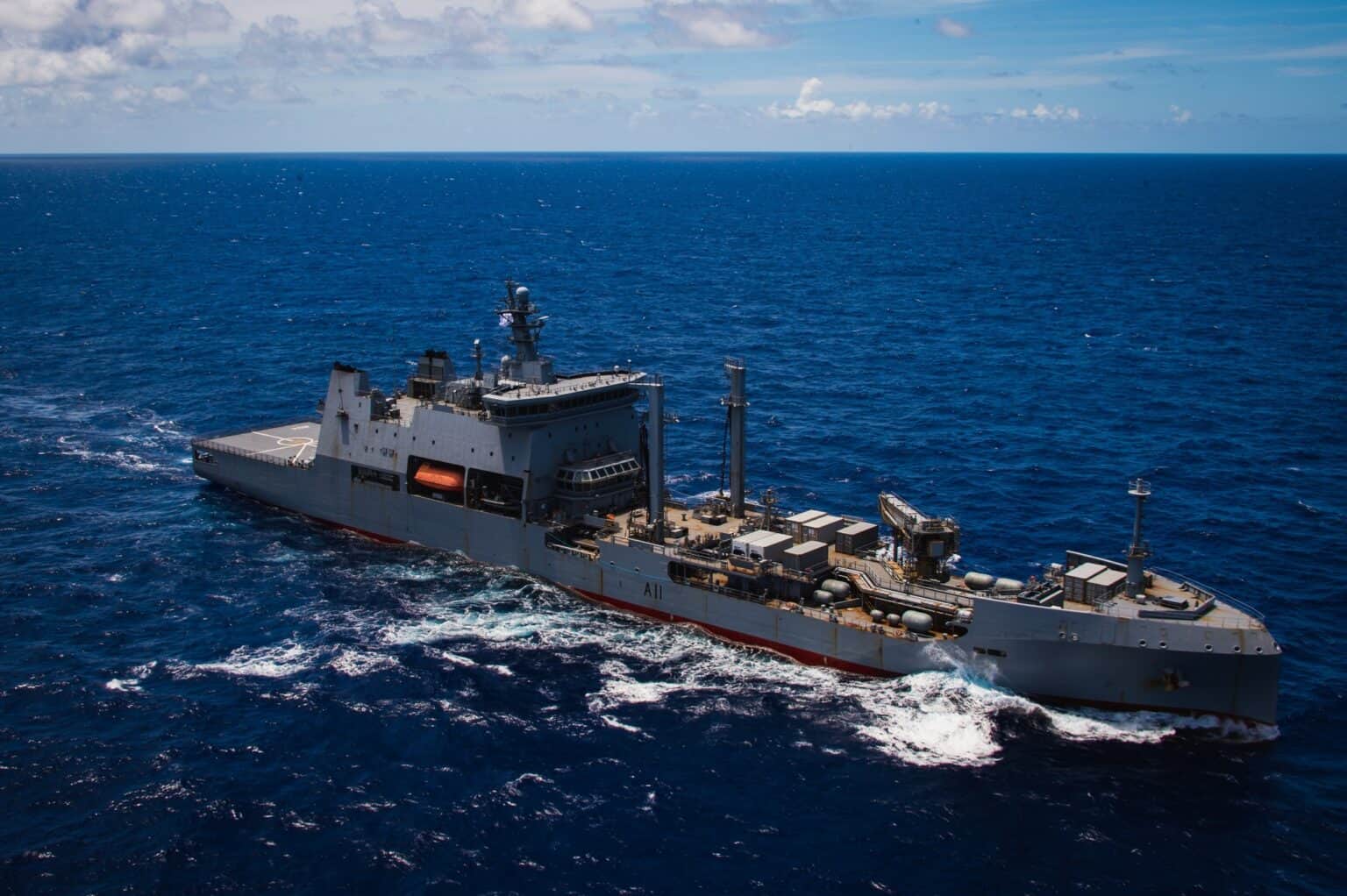
HMNZS Aotearoa (A11) is a replenishment ship, a floating fuel and supply depot that keeps the frigates and other navies’ ships at sea. Hyundai Heavy Industries built it in South Korea, and it was commissioned on July 29, 2020.
At 568 feet (173.2 m) and 26,000 tonnes, it is the largest ship the Royal New Zealand Navy has operated. Its 2016 budget was NZ$493 million.
It ranks second because it is the only ship that lets New Zealand operate far from home, for itself or for allies. It is also built for the far south: ice-strengthened to Polar Class 6 and winterized, it resupplied McMurdo Station and Scott Base in Antarctica in early 2022.
It is also the youngest ship in the fleet by a decade, and the only one Defence does not expect to reach the end of its life by the mid-2030s.
3. HMNZS Canterbury: The Sealift and Disaster Relief Ship
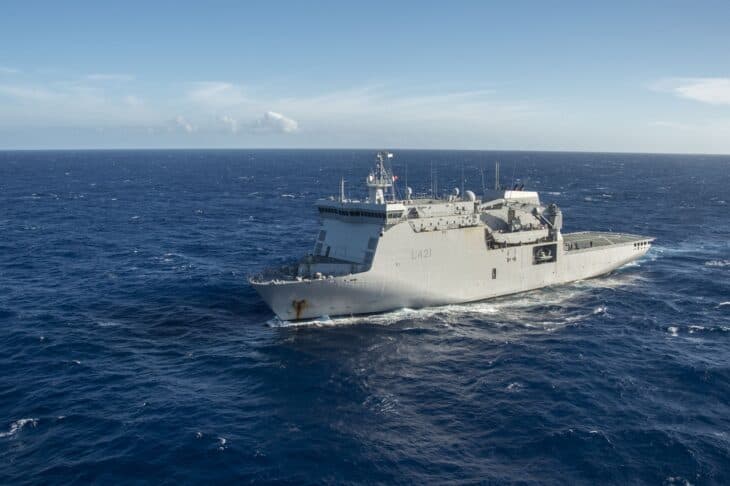

HMNZS Canterbury (L421) is a multi-role vessel: part troop transport, part vehicle ferry, part helicopter platform. It was commissioned on June 12, 2007, in Port Melbourne, and cost NZ$130 million to build.
It is 430 feet (131 m) long and displaces 9,000 tonnes at full load. It carries up to 243 troops, armored vehicles and trucks, two landing craft, and two Seasprites or up to four NH90 helicopters.
Its real job is the Pacific: carrying troops, aid and equipment to islands with no port big enough for anything else. In mid-February 2026 it carried Governor-General Cindy Kiro to Tokelau.
Canterbury has no armament worth ranking, which is why it sits below Aotearoa. But in a cyclone season, it is the ship New Zealand’s neighbors are most likely to see.
4. Protector Class: Two Offshore Patrol Ships, Neither on Patrol
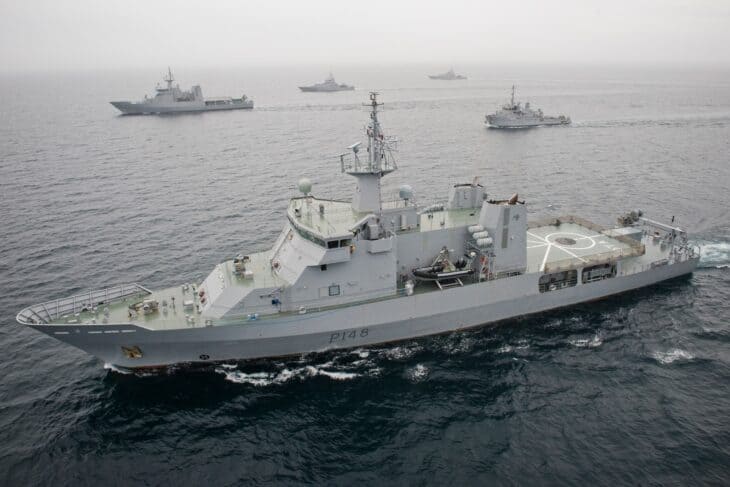

HMNZS Otago (P148) and HMNZS Wellington (P55) are offshore patrol vessels built under Project Protector for New Zealand’s waters, the Southern Ocean and the Pacific. Otago was accepted on February 18, 2010, and Wellington on May 6, 2010.
Each is 279 feet (85 m) long and 1,900 tonnes, with a 25 mm Typhoon gun, two .50-caliber machine guns and a flight deck and hangar for a Seasprite. Ice strengthening to Lloyd’s class 1C lets them patrol in thin first-year ice, and they can stay out for 21 days with a range of 6,000 nautical miles at 15 knots.
Neither was at sea for years. Both were among three ships idled in 2021 and 2022 because the navy did not have enough qualified sailors, and Wellington remains under a care and custody arrangement at Devonport.
Otago was brought back to replace the sunken Manawanui, in a refit budgeted at NZ$35 million. It went back to sea on August 15, 2026, and the navy said it would deploy from late October.
Back on the blue, then back at the wharf
On November 12, 2026, The Post reported that a fuel system failure during Otago’s regeneration had postponed its first deployment, and that until it is fixed the ship has lost its authority to operate at sea. The navy said no confirmed timeframe could be given for the repair.
5. Lake Class: The Inshore Patrol Vessels
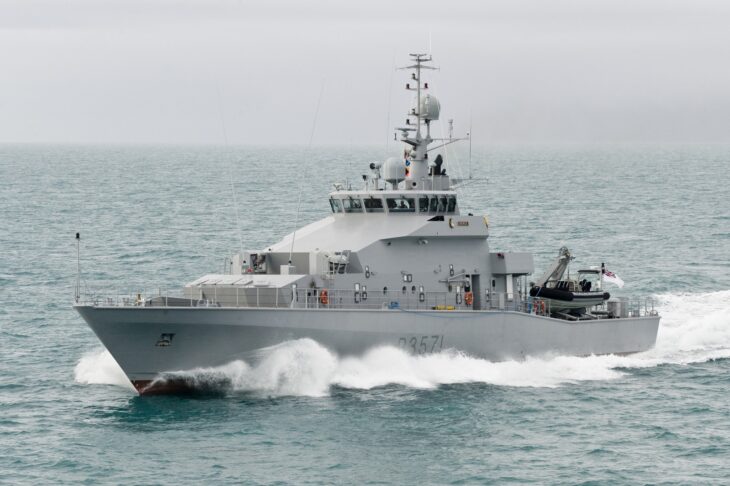

HMNZS Taupo (P3570) and HMNZS Hawea (P3571) are 180-foot (55 m), 340-tonne inshore patrol vessels, armed with three 12.7 mm machine guns. Hawea was commissioned on May 1, 2009, and Taupo on May 29, 2009.
They work fisheries, customs and search-and-rescue patrols close to the coast, often with officers from other government agencies aboard. Taupo is active; Hawea was the third ship laid up in 2021 and 2022.
New Zealand once had four. Rotoiti and Pukaki were decommissioned on October 17, 2019, and sold to Ireland for €26 million, where they were commissioned on September 4, 2024, as LÉ Aoibhinn and LÉ Gobnait.
The Ship New Zealand Lost: HMNZS Manawanui
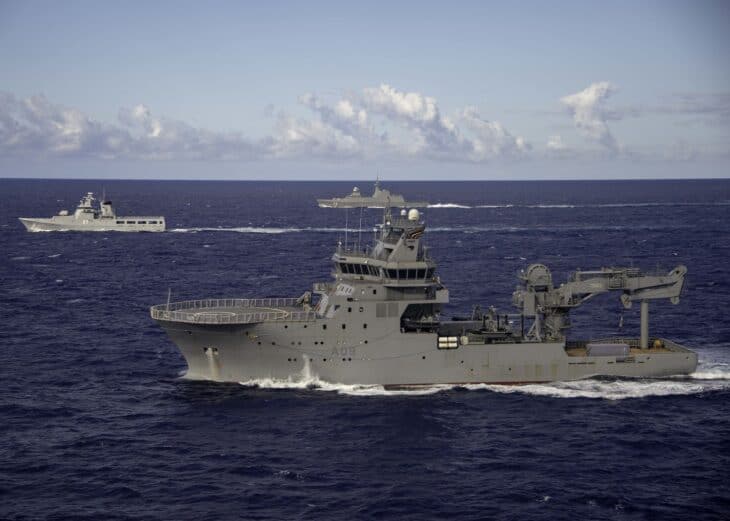

Until October 2024 the fleet had a ninth ship, the dive and hydrographic vessel HMNZS Manawanui. It ran aground on the evening of October 5, 2024, about one nautical mile off Siumu on the south coast of Upolu, Samoa, while surveying a reef, and capsized and sank by about 9 a.m. the next day.
All 75 people aboard were rescued. It was the first New Zealand naval vessel to be unintentionally sunk since World War II, and the first lost in peacetime.
A naval court of inquiry, reporting in April 2025, found the sinking was the result of human error, with the ship left in autopilot as it approached the reef. Charges were laid against three officers, including the former captain, in February 2026. The navy is not replacing the ship; Otago is meant to cover part of its role instead.
The Helicopters: Eight Seasprites, Five Seahawks Coming
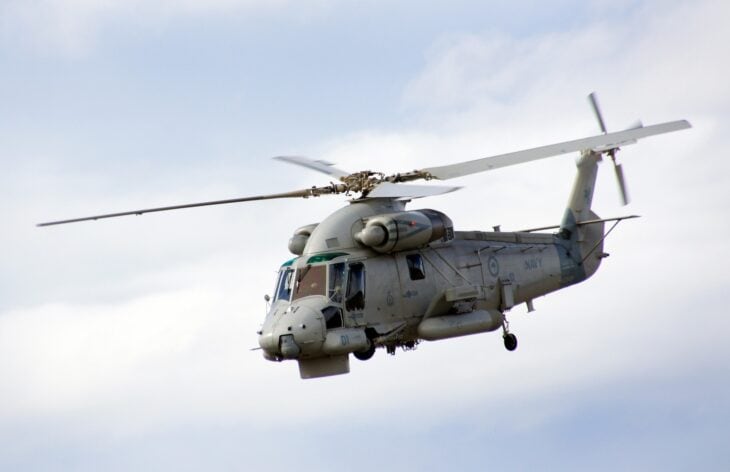

The navy’s helicopters belong to the air force. Eight Kaman SH-2G(I) Super Seasprites are flown by No. 6 Squadron RNZAF from Whenuapai, near Auckland, and are assigned to the frigates, Canterbury and the patrol ships as needed.
They were rebuilt from airframes ordered for Australia, which cancelled its program in 2008. New Zealand bought ten in 2013 for NZ$242 million, eight to fly and two for spares, and all were in service by 2016.
Their replacement is the Sikorsky MH-60R Seahawk. On October 16, 2026, the Ministry of Defence announced the purchase of five through the US Foreign Military Sales program, a project carrying NZ$1.648 billion in capital investment, with deliveries from 2030.
Five helicopters replacing eight means fewer airframes but a much more capable one: the same submarine-hunting helicopter the Australian and US navies fly.
What Comes Next: Mogami or Type 31

The 2025 Defence Capability Plan says most of the fleet will reach the end of its life by the mid-2030s, and the Maritime Fleet Renewal program is working out what replaces it. No decisions have been made on the shape of that fleet.
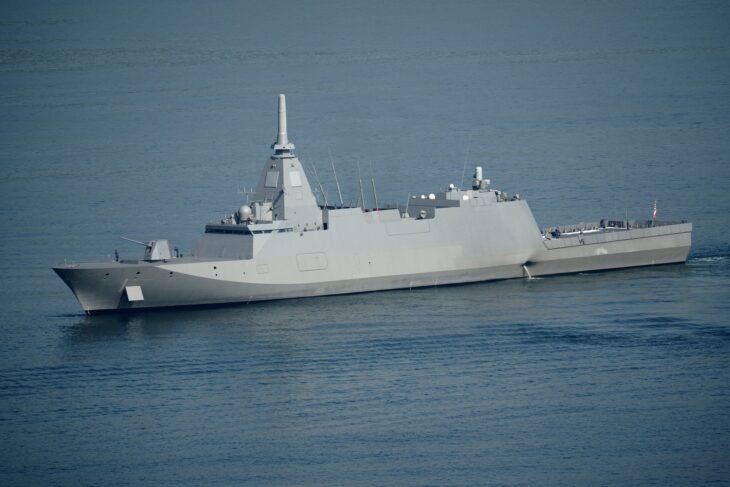
The frigates come first. In May 2026, Defence Minister Chris Penk said New Zealand had begun talks with Australia and Britain, and that the government is weighing Japan’s Mogami class, which Australia chose, and Britain’s Type 31 as replacements for Te Kaha and Te Mana.
Advice on a preferred option is due to Cabinet by the end of 2027, and the replacement is listed as an indicative investment for 2029 to 2039. Until then, work continues on keeping the two Anzacs running.
How Australia is doing the same job, with Mogami frigates on order, is in our guide to the Royal Australian Navy’s ship classes.
FAQ
Sources and references used for research and fact-checking.
- Wikipedia, List of active Royal New Zealand Navy ships
- Wikipedia, Royal New Zealand Navy
- Wikipedia, Anzac-class frigate
- Wikipedia, HMNZS Te Kaha
- Wikipedia, HMNZS Te Mana
- Wikipedia, HMNZS Aotearoa
- Wikipedia, HMNZS Canterbury (L421)
- Wikipedia, Protector-class patrol vessel
- Wikipedia, Lake-class inshore patrol vessel
- Wikipedia, HMNZS Manawanui (2019)
- Wikipedia, Kaman SH-2G Super Seasprite
- Wikipedia, Disbandment of the RNZAF air combat force
- Defence Industry Europe, New Zealand orders five MH-60R Seahawk helicopters from United States to replace Seasprite fleet
- New Zealand Ministry of Defence, Maritime Fleet Renewal
- Reuters via The Star, New Zealand begins discussion with Australia, Britain on replacing frigates
- Reuters via MarineLink, New Zealand's Offshore Patrol Vessel Otago to Resume Operations in 2026
- The Post (reposted by RNZN Gunners), Navy's $35m fleet fix hits rocks as ship breaks down before returning to service
Get the Newsletter
The latest aviation news and stories sent to your inbox.
About the Author

Tim is the owner and lead editor of AeroCorner since 2019, overseeing aviation content covering aircraft, airlines, airports, and the broader aviation industry. Through years of researching, writing, editing, and publishing aviation-focused content, he has developed extensive practical knowledge of commercial aviation and air travel. Based in Asia and a frequent traveler himself, Tim also brings firsthand passenger experience to AeroCorner’s coverage. Outside of publishing, he has also explored aviation firsthand through hands-on flight training in New Zealand.