

Table of Contents
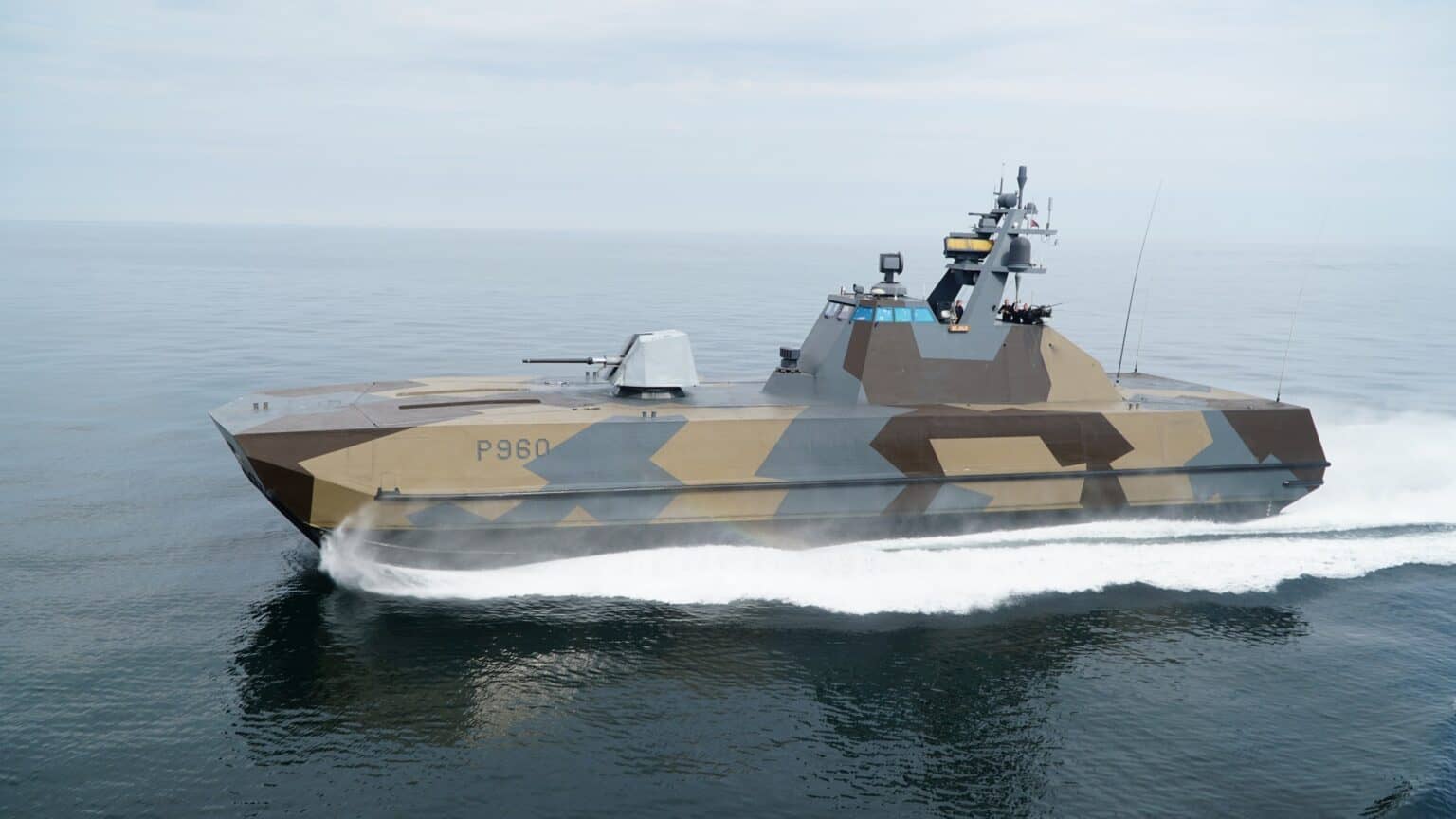
The most important ships in the Royal Norwegian Navy are its six Ula-class submarines. Behind them come four Fridtjof Nansen-class frigates and six Skjold-class stealth corvettes that can reach 60 knots, about 69 mph (111 km/h).
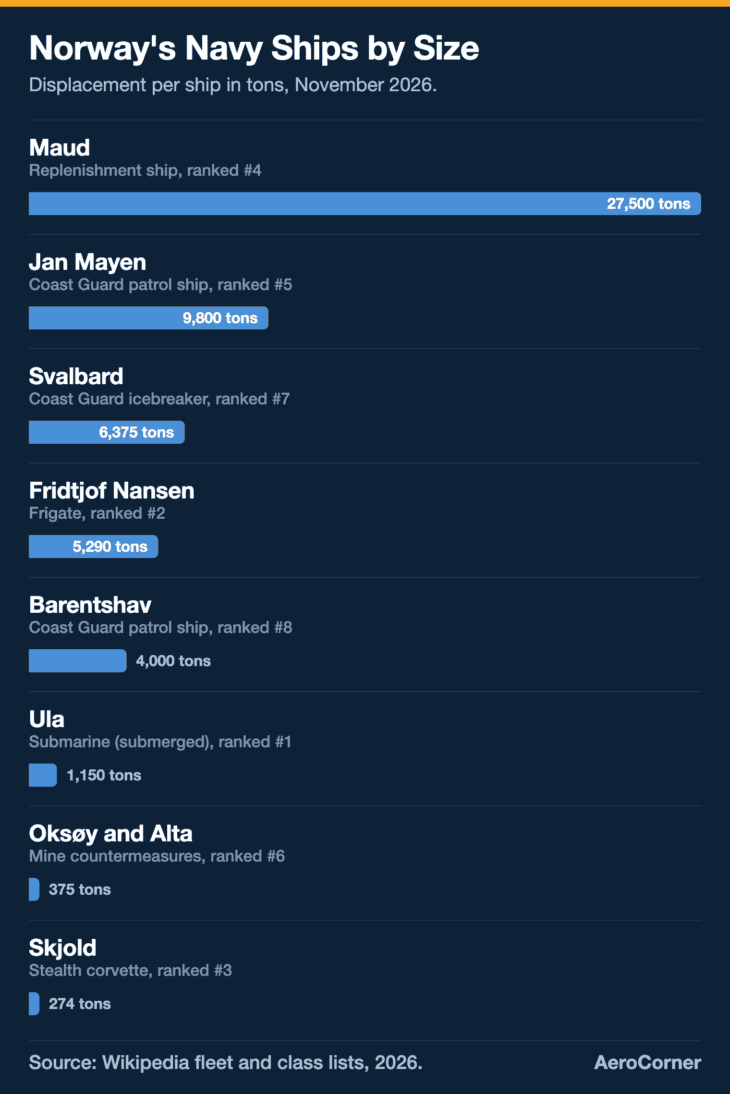
The navy, called Sjøforsvaret in Norwegian, also includes the Coast Guard. That gives it an unusual shape: its three newest Coast Guard ships each displace far more than any of its frigates.
This guide ranks every major class by its value to Norway’s defense as of November 2026. It also covers the submarines and British-designed frigates on order, the helicopters, the bases and the frigate Norway lost in 2018.
| Rank | Class | Type | In service | Tons, each | Since |
|---|---|---|---|---|---|
| 1 | Ula | Attack submarine | 6 | 1,150 | 1989 |
| 2 | Fridtjof Nansen | Frigate | 4 | 5,290 | 2006 |
| 3 | Skjold | Stealth corvette | 6 | 274 | 1999 |
| 4 | Maud | Replenishment ship | 1 | 27,500 | 2019 |
| 5 | Jan Mayen | Coast Guard patrol ship | 3 | 9,800 | 2023 |
| 6 | Oksøy and Alta | Mine countermeasures | 4 | 375 | 1995 |
| 7 | Svalbard | Coast Guard icebreaker | 1 | 6,375 | 2002 |
| 8 | Barentshav | Coast Guard patrol ship | 3 | 4,000 | 2009 |
| 9 | Combat Boat 90N | Assault craft | 6 | 20 | 1996 |
| 10 | Nornen | Coast Guard inshore patrol | 5 | 675 | 2007 |
How this ranking works
Classes are ranked by what they add to Norway’s defense in November 2026: combat power first, then how much the fleet depends on them. Size alone doesn’t count, and that is why a 1,150-ton submarine sits above a 9,800-ton patrol ship. Coast Guard classes are included because the Coast Guard is part of the navy. Small craft, the royal yacht and ships still on order are left out of the ranking.
1. Ula Class: The Submarines That Deter
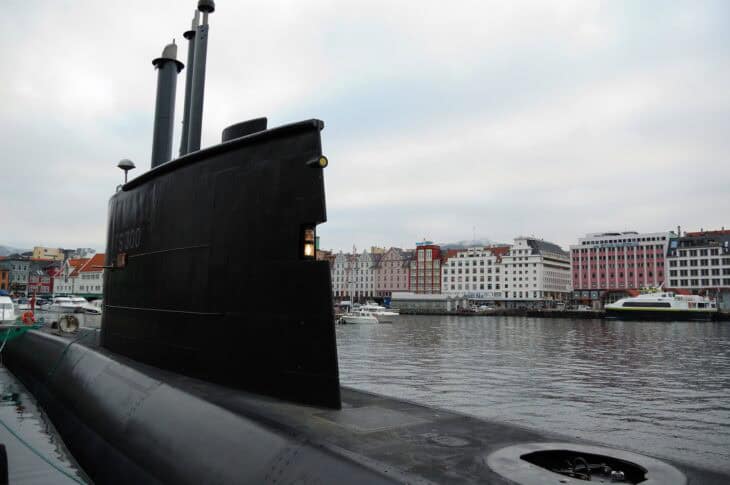

Norway’s defense procurement agency calls the submarine one of the country’s two strategic weapons, along with the fighter jet. The navy has six: Ula, Utsira, Utstein, Utvær, Uthaug and Uredd, commissioned between 1989 and 1992.
Each is 194 feet (59 m) long, displaces 1,150 tons submerged and has a crew of 21. They make 23 knots underwater and carry 14 heavyweight torpedoes for eight bow tubes.
They rank above the frigates because they are so hard to find. A small, quiet diesel-electric boat in a fjord forces any attacker to slow down and search, even if the submarine never fires.
The first Norwegian submarines with a shower
When the Ula class entered service, these were the first Norwegian submarines with a bunk for every crew member, and the first with a shower. They were designed for a 30-year life, which all six have now passed.
Constant upgrades, including combat system work and new periscope and mast systems, are meant to keep them going until their German-built replacements arrive. Our ranking of the largest submarines in the world shows how small they are next to nuclear boats.
2. Fridtjof Nansen Class: Four Aegis Frigates
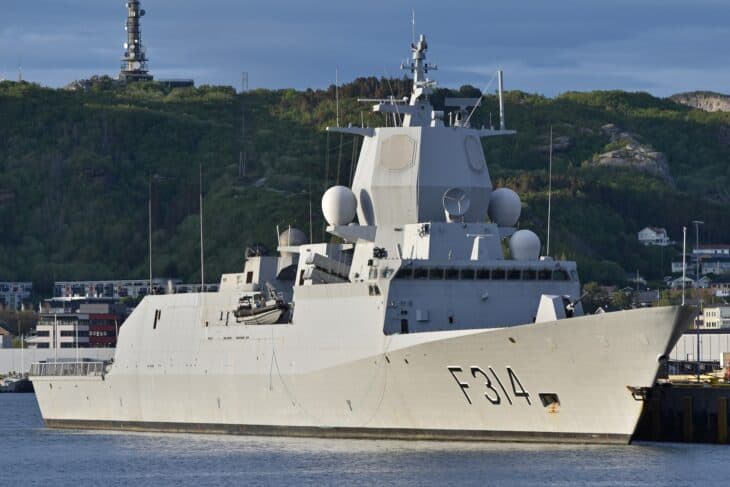

Fridtjof Nansen, Roald Amundsen, Otto Sverdrup and Thor Heyerdahl are the fleet’s main surface warships. Navantia built them in Spain, and they were commissioned between 2006 and 2011, all named for Norwegian explorers.
Each is 440 feet (134 m) long, displaces 5,290 tons and makes more than 27 knots. The class pairs the American Aegis combat system and SPY-1F radar with up to 32 ESSM air defense missiles, eight Naval Strike Missiles and Sting Ray torpedoes.
Their main job is hunting submarines in the open ocean, using hull and towed sonars. Fridtjof Nansen sailed with Britain’s carrier strike group in the fall 2026 phase of its High North deployment.
They rank second because there are so few, and because they have lacked their intended helicopter since Norway gave up on the NH90 in 2022. The class will be upgraded and then phased out gradually by 2040.
3. Skjold Class: 60-Knot Stealth Corvettes
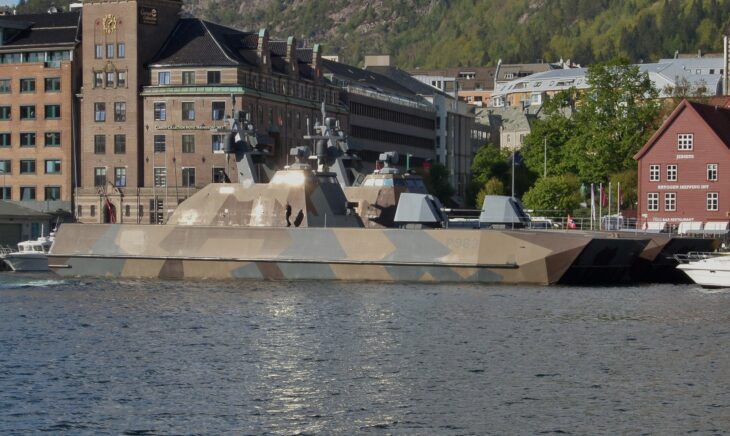

The six Skjolds are the strangest warships in the fleet, and the Norwegian Armed Forces call them the fastest naval vessels in the world. In calm water they can do 60 knots, about 69 mph (111 km/h).
Each is a surface effect ship: two rigid hulls with a fan-blown air cushion between them. The 156-foot (47.5 m), 274-ton hull is built of fiberglass and carbon composite, with radar-absorbing material built into the structure.
A crew of 15 or 16 operates eight Naval Strike Missiles, stored inside the hull, and a 76 mm gun. The missile, made by Norway’s Kongsberg, can fly around land and skim the sea, as our ranking of anti-ship missiles explains.
The US Navy borrowed one
The US Navy was interested enough in the design to lease the first ship, Skjold, for a year from 2001 to 2002. It operated out of Little Creek, Virginia, with a 14-person Norwegian crew.
The weakness is endurance and air defense. Range is 800 nautical miles at 40 knots, and the only surface-to-air missiles are portable Mistrals.
A 2020 plan expected replacements around 2030, yet the class is still being modernized. In February 2026 Norway gave Kongsberg a contract worth about NOK 400 million to upgrade the combat systems on all six.
4. HNoMS Maud: The Ship That Keeps the Fleet at Sea
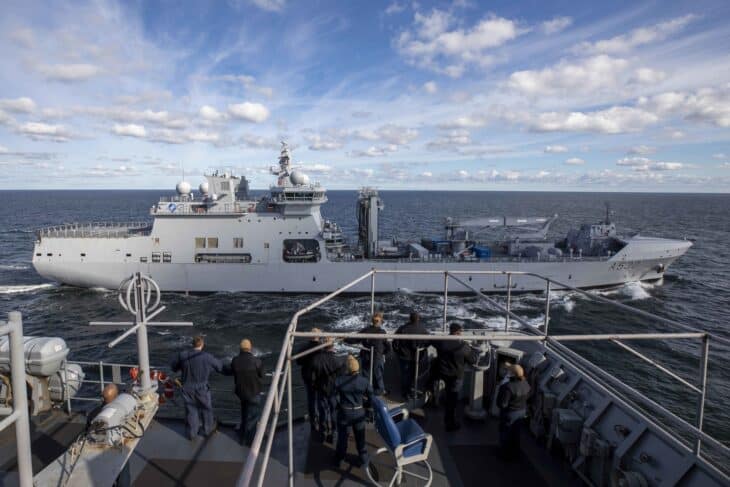

Maud is the largest ship the Royal Norwegian Navy has ever operated, at 600 feet (183 m) and 27,500 tons. Built in South Korea to a variant of Britain’s Tide-class tanker design and commissioned in May 2019, it carries fuel, ammunition and stores.
It has hangar space for two helicopters, a 48-bed hospital and a range of 10,000 nautical miles. That reach is the reason it ranks fourth, because without it the frigates depend on allies or ports.
Maud had a bad start. In December 2019 it was barred from sailing after the classification society DNV GL found safety hazards, and it did not return to sea until September 2020.
It has since proved useful well beyond Norway. It accompanied Roald Amundsen on the British carrier group’s 2025 Indo-Pacific deployment and supported the group again for NATO’s Neptune Strike exercise in fall 2026.
5. Jan Mayen Class: The Coast Guard’s Giants
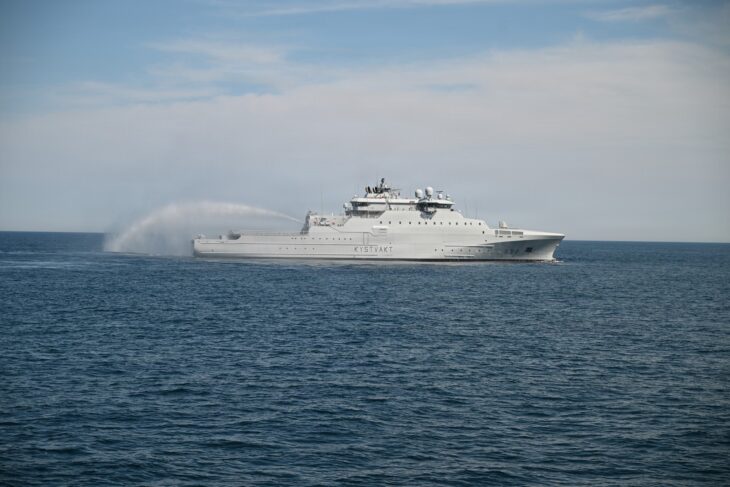

Jan Mayen, Bjørnøya and Hopen were delivered between 2023 and 2024 to replace the 1980s Nordkapp class. Each is 447 feet (136.4 m) long and 9,800 tons, which is about 85% more than the figure for a Nansen-class frigate.
The hulls were built in Romania and fitted out in Norway. They are strengthened for ice, can stay out for more than 60 days with a crew of up to 100, and have a hangar for two helicopters.
Size doesn’t make them warships. The main weapon is a single 57 mm gun, so they rank below Maud and every missile ship despite being some of the most modern vessels Norway has.
6. Oksøy and Alta Classes: The Mine Hunters
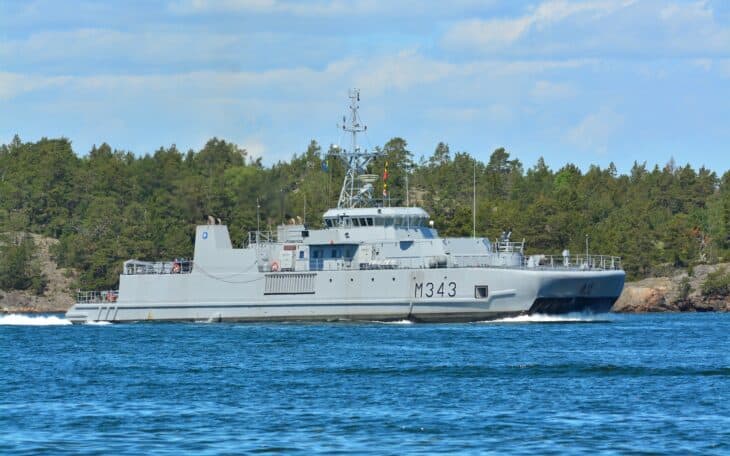

Måløy and Hinnøy are Oksøy-class minehunters, and Otra and Rauma are Alta-class minesweepers. They are the four survivors of nine near-identical ships built in the mid-1990s, one of which, Orkla, was destroyed by fire in 2002.
Like the Skjolds, they ride on an air cushion between twin hulls. The 181-foot (55.2 m) composite hull has a very low magnetic signature, and because little of it sits in the water, it is less exposed to the shock of an exploding mine.
The squadron also has two containerized Hugin autonomous underwater systems. The former Coast Guard ship Nordkapp, commissioned in the early 1980s, moved to the navy in 2022 as the mine warfare command ship.
7. NoCGV Svalbard: The Arctic Icebreaker
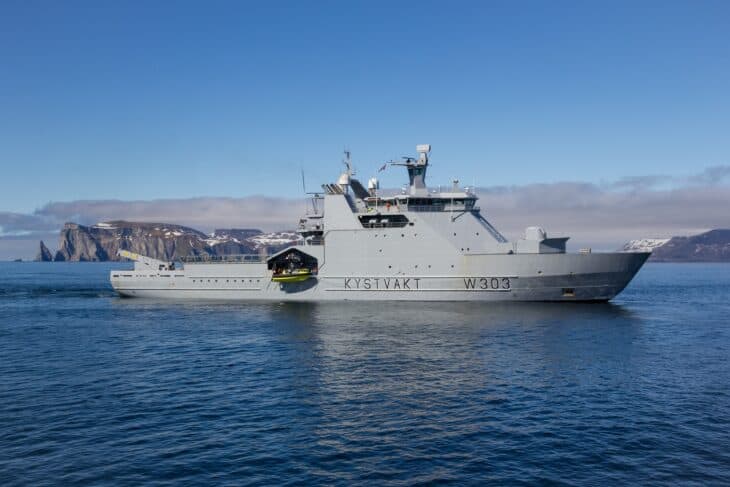

Svalbard entered service in 2002 and works from Sortland into the Barents Sea and around the Svalbard islands. The 340-foot (103.7 m), 6,375-ton ship can break ice going forward or backward and carries a 57 mm gun and two helicopters.
On August 21, 2019, it became the first Norwegian ship to reach the North Pole. Its design was also good enough to export: Canada based its Harry DeWolf-class Arctic patrol ships on it.
8. Barentshav Class: Gas-Powered Patrol Ships
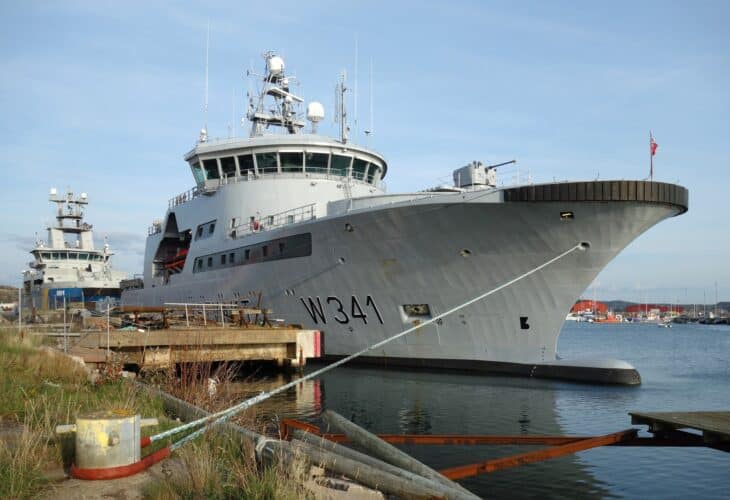

Barentshav, Bergen and Sortland joined the Coast Guard in 2009 and 2010. They are 308 feet (94 m) long, displace 4,000 tons, carry a crew of 40 and run on liquefied natural gas.
These are working ships more than fighting ships, fitted for towing, firefighting and cleaning up oil spills. In a country that lives on fish, oil and gas, those are central jobs.
9. Combat Boat 90N: Transport for the Coastal Rangers
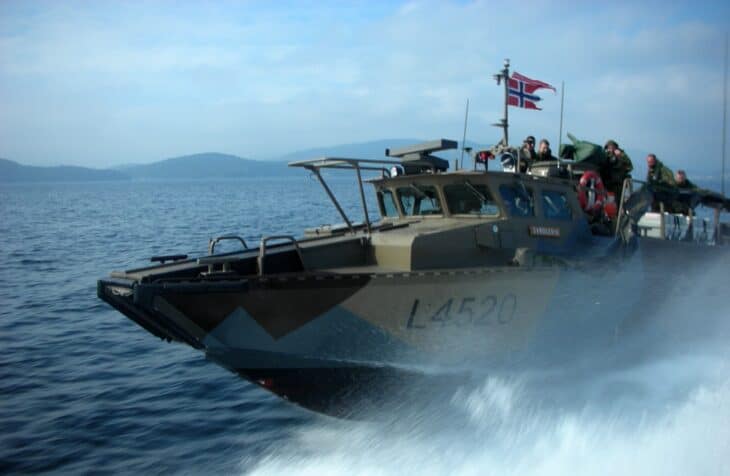

The Swedish-designed Combat Boat 90N carries the Kystjegerkommandoen, Norway’s coastal rangers, through islands and fjords and lands them directly on the shore. Norway bought 20 and six are still listed in service, upgraded in 2014 with new engines and a remote-controlled machine gun.
The rangers are based at Trondenes near Harstad. Their value is as scouts, finding targets with drones and small teams for the missiles on frigates and corvettes.
10. Nornen Class: The Inner Coast Guard
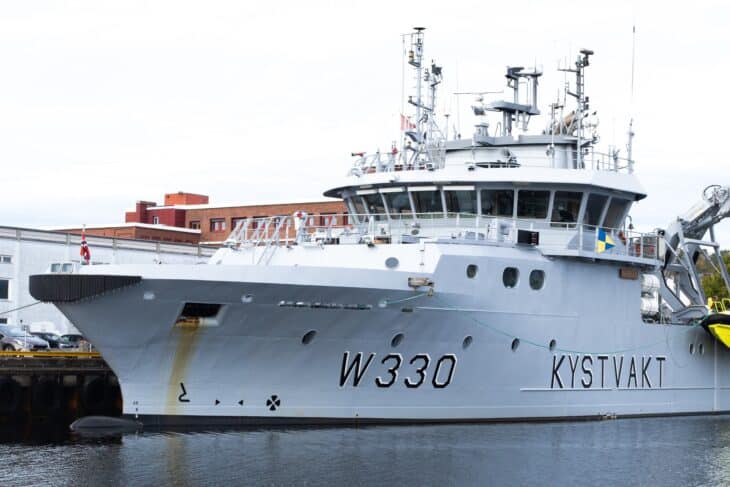

Nornen, Farm, Heimdal, Njord and Tor entered service in 2007 to police the coast and fjords. The Polish-built ships are 155 feet (47.2 m) long, about 675 tons, and make 16 knots.
They carry a 12.7 mm machine gun and spend their days on fishery inspections, border control and rescues. That light armament puts them last on this list, even though the work they do is constant.
The Rest of the Fleet
Two former Coast Guard vessels, Olav Tryggvason and Magnus Lagabøte, serve as logistics and command ships. The navy also runs the royal yacht Norge, which is owned by the king.
The Coast Guard adds the 3,130-ton patrol and towing ship Harstad and two leased emergency towing vessels, Bison and Jarl. Our guide to types of navy ships explains how all these roles differ.
What happened to Norway's fifth frigate?
HNoMS Helge Ingstad collided with the tanker Sola TS in the Hjeltefjord at 4:01 a.m. on November 8, 2018. The bridge team had taken the tanker’s lights for a stationary object. All 137 people on the frigate got off, seven with minor injuries. Investigators later found that doors and hatches were left open at evacuation and that the right measures could have helped control the flooding, though the crew lacked the training and tools to see that. The frigate sank, was raised and was scrapped.
On Order: Six Type 212CD Submarines
Norway and Germany are buying identical Type 212CD submarines from TKMS, six for each navy. Norway’s first four were contracted in 2021, and it signed for two more on January 30, 2026, after parliament raised the project budget by NOK 46 billion.
The new boats are 240 feet (73 m) long and 2,800 tons submerged, more than twice the displacement of an Ula. They have a diamond-shaped hull to weaken sonar returns, fuel cells for air-independent propulsion and six torpedo tubes.
The first is due to be delivered in 2029. Germany’s side of the program is covered in our guide to the German Navy.
On Order: At Least Five Type 26 Frigates
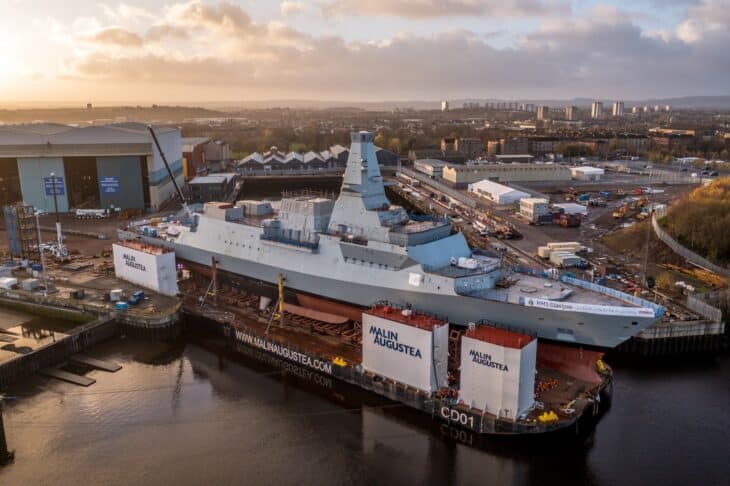

On August 31, 2025, Norway picked Britain’s Type 26 to replace the Nansens, in a deal the UK valued at £10 billion (about $13.5 billion). The plan is for at least five ships from BAE Systems, identical to the British ones, with deliveries from about 2030.
The order survived a budget scare. Reports in early 2026 said the government was weighing fewer ships, but its revised defense plan in March kept at least five, and a later deal among all nine parties in parliament backed buying the first two faster.
That speed has a price for Britain. On October 22, 2026, the UK Parliament’s Defence Committee warned that if two frigates now being built for the Royal Navy go to Norway, Britain will not have its full eight sub-hunting frigates until 2037.
Each Type 26 has a crew of about 166, a range of more than 7,000 nautical miles, a large helicopter deck and a mission bay for drones or boats. The final contracts and Norway’s choice of helicopter are still being worked out.
Next: A Family of Standardized Ships
Norway’s 2024 defense plan calls for up to 10 large and 18 smaller standardized vessels to take over many navy and Coast Guard jobs. The motto is as civilian as possible, as military as necessary, with modules and drones adding the military part.
Salt Ship Design and Kongsberg won the design contract in 2026, and the first ship is planned for 2030. Norway also intends to sell the design to allies.
Norwegian Navy Aircraft and Helicopters
The navy has no aircraft of its own today, although it ran an air service from 1912 to 1944. The Royal Norwegian Air Force does the flying, including P-8 Poseidon maritime patrol aircraft that support the Coast Guard.
To replace the NH90, Norway ordered six MH-60R Seahawks in 2023, intended first for Coast Guard work. For the Type 26 frigates, the Seahawk and the AW101 Merlin are both in contention.
The fighters that share the strategic role with the submarines are covered in our guide to the Norwegian Air Force.
Where the Royal Norwegian Navy Is Based
Haakonsvern, about 9 miles (15 km) southwest of central Bergen, has been the main base since 1963. It is the largest naval base in the Nordic region, with around 5,400 people and an underground dock big enough for a frigate.
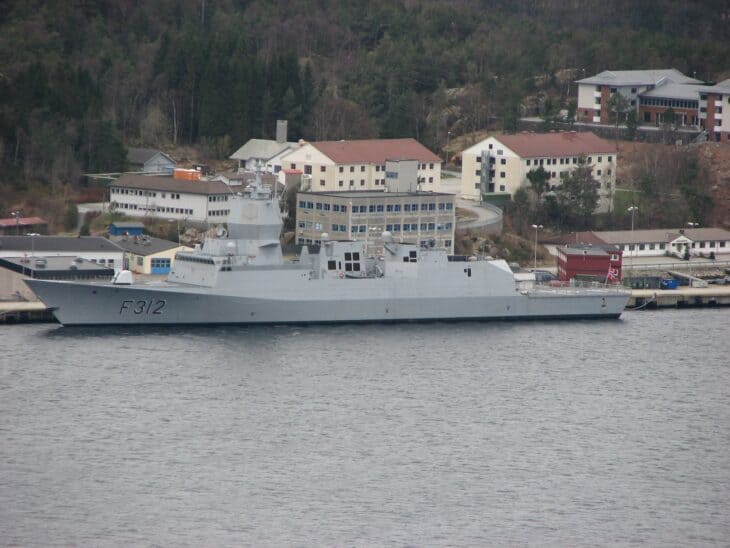

In the north, Ramsund is home to the Marinejegerkommandoen naval special forces, and Trondenes to the coastal rangers. The Coast Guard is headquartered at Sortland, while recruits train at KNM Harald Haarfagre in Stavanger.
A Navy With Roots in the Year 955
Norway traces organized naval defense to the leidang, a ship levy set up by King Håkon the Good in 955. It shared a fleet with Denmark from 1509, and the modern navy was founded on April 12, 1814.
When Germany invaded in April 1940, the obsolete coastal defense ships Eidsvold and Norge were torpedoed and sunk at Narvik. On June 7, 13 vessels and 500 sailors followed King Haakon VII to Britain, and the navy kept fighting from there.
Ten of its ships joined the Normandy invasion in 1944, and 933 of its sailors died in the war. Today it is a small force with a very large sea to watch, as our ranking of the world’s largest navies makes clear.
FAQ
Sources and references used for research and fact-checking.
- Norwegian Armed Forces, Marinen
- Norwegian Armed Forces, Sjøforsvaret
- Norwegian Defence Materiel Agency, Prosjekt nye ubåter
- Norwegian Defence Materiel Agency, Forsvarsmateriell inngår kontrakt om to ekstra ubåter
- Norwegian Defence Materiel Agency, Nye fregatter med maritime helikoptre
- Norwegian Defence Materiel Agency, Forsvarsmateriell tildeler kontrakt for design av fremtidens standardiserte fartøy
- ABC Nyheter, VG: Norge vurderer å kjøpe færre fregatter
- Forsvarets forum, Oppdaterer langtidsplanen
- Norges offisersforbund, Stortinget enige om oppdatert langtidsplan for Forsvaret
- UK Defence Journal, British submarine hunters delayed by Norway frigate sale
- The Maritime Executive, Norway orders five anti-submarine frigates from UK for $13.5 billion
- Navy Lookout, Norway wants its Type 26 frigates to be interchangeable with the Royal Navy's
- Maritime News, Maritime News, 19 November 2026
- Army Recognition, Kongsberg upgrades Norway's Skjold-class corvettes
- Norwegian Safety Investigation Authority, Part one report on the collision between HNoMS Helge Ingstad and Sola TS
- Norwegian Safety Investigation Authority, Part two report on the collision between HNoMS Helge Ingstad and Sola TS
- Wikipedia, Royal Norwegian Navy
- Wikipedia, List of active Royal Norwegian Navy ships
- Wikipedia, Ula-class submarine
- Wikipedia, Fridtjof Nansen-class frigate
- Wikipedia, Skjold-class corvette
- Wikipedia, Naval Strike Missile
- Wikipedia, HNoMS Maud
- Wikipedia, Jan Mayen-class patrol vessel
- Wikipedia, Nordkapp-class patrol vessel
- Wikipedia, Alta-class minesweeper
- Wikipedia, Oksøy-class mine hunter
- Wikipedia, NoCGV Svalbard
- Wikipedia, Norwegian Coast Guard
- Wikipedia, Type 212CD submarine
- Wikipedia, Haakonsvern Naval Base
- Wikipedia, Kystjegerkommandoen
- Wikipedia, Marinejegerkommandoen
Get the Newsletter
The latest aviation news and stories sent to your inbox.
About the Author

Tim is the owner and lead editor of AeroCorner since 2019, overseeing aviation content covering aircraft, airlines, airports, and the broader aviation industry. Through years of researching, writing, editing, and publishing aviation-focused content, he has developed extensive practical knowledge of commercial aviation and air travel. Based in Asia and a frequent traveler himself, Tim also brings firsthand passenger experience to AeroCorner’s coverage. Outside of publishing, he has also explored aviation firsthand through hands-on flight training in New Zealand.