

Table of Contents
Israel’s most capable military drone is the Heron TP, known in Israeli service as the Eitan. Built by Israel Aerospace Industries (IAI), it weighs up to 12,500 pounds (5,670 kg), carries as much as 5,952 pounds (2,700 kg) and can stay airborne for more than 30 hours.
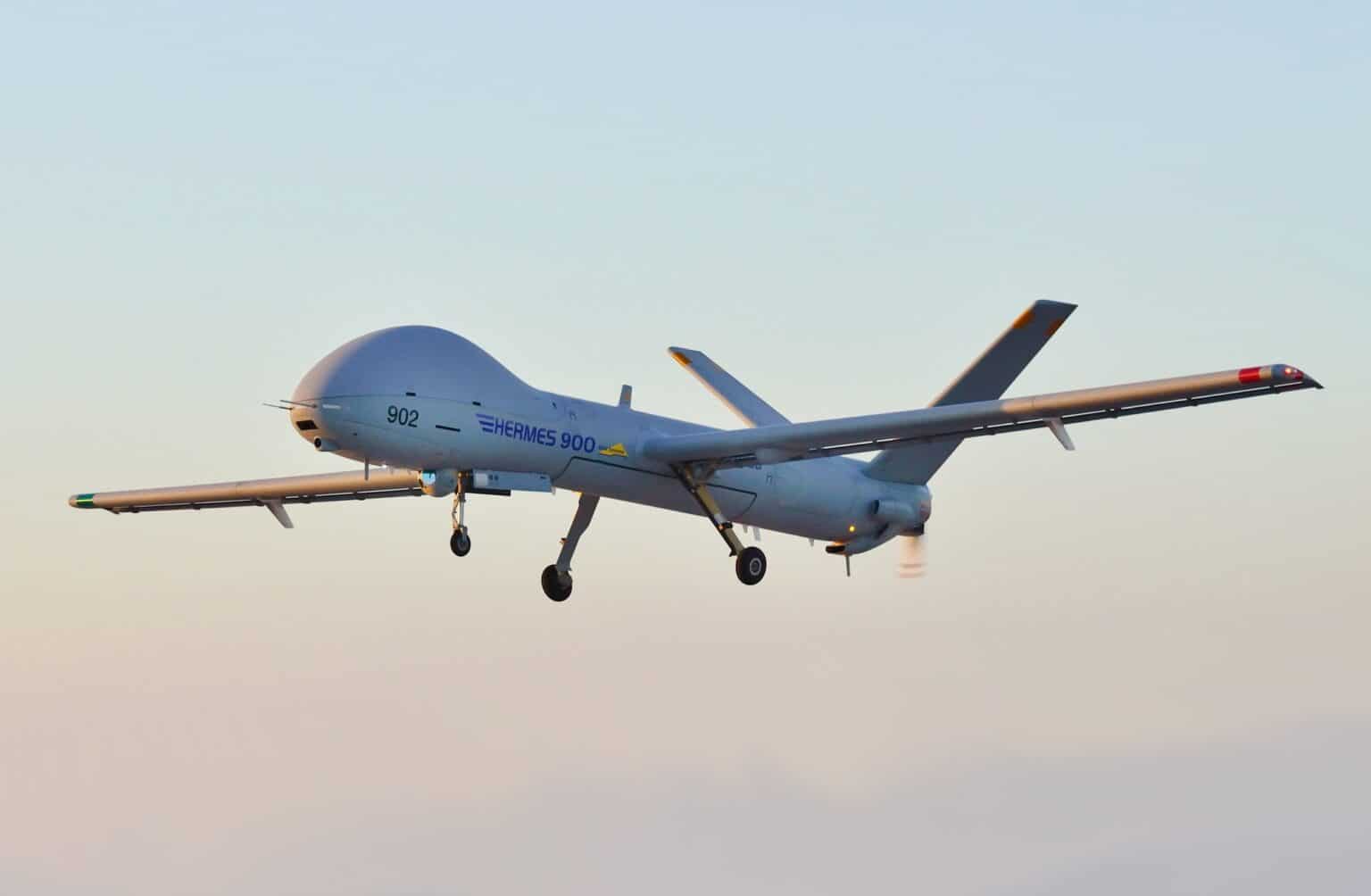
The Elbit Hermes 900 is second and the long-endurance Heron Mk II third. This list ranks 11 major Israeli military drone types by combat value: what each can carry, how far and how long it can fly, and what it has demonstrably done in service.
Figures are current to November 2026. Israel doesn’t publish its drone inventory and it censored reporting on armed drones until July 2022, so manufacturer claims, military statements and disputed figures are labeled as such.
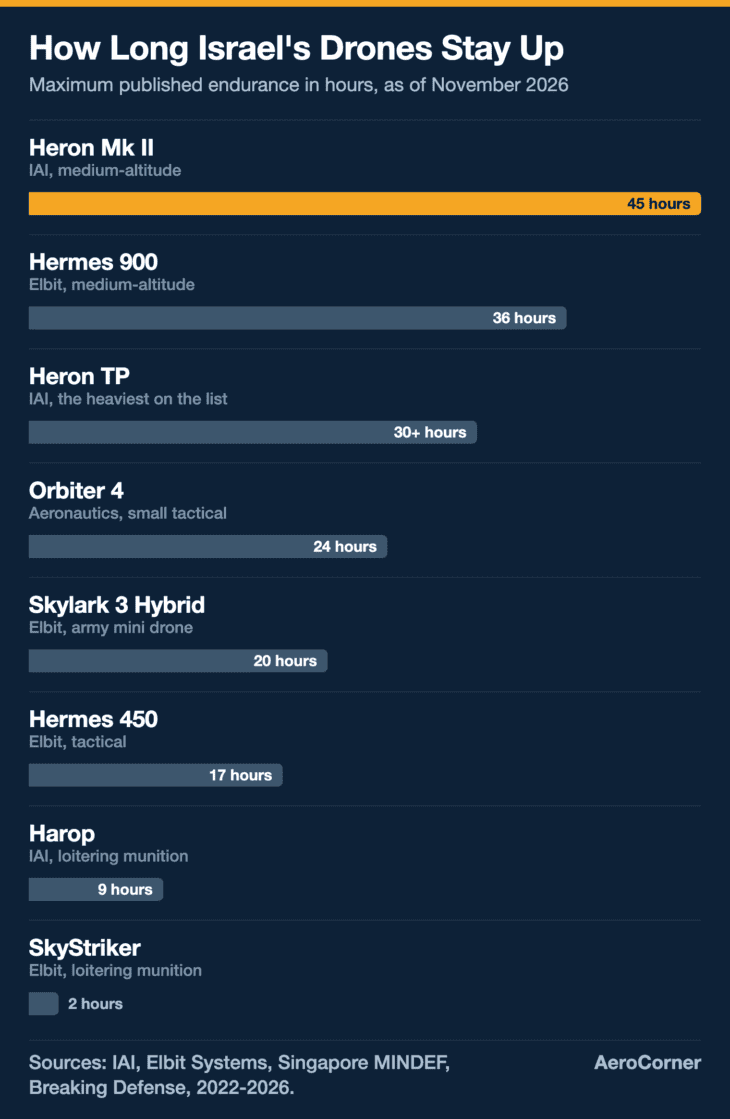
| Rank | Drone | Role | Max endurance | Payload or warhead | Status |
|---|---|---|---|---|---|
| 1 | Heron TP (Eitan) | Long-range surveillance and strike | 30+ hours | 5,952 lb (2,700 kg) payload | In Israeli service |
| 2 | Hermes 900 (Kochav) | Surveillance and strike | 36 hours | 772 lb (350 kg) payload | In Israeli service |
| 3 | Heron and Heron Mk II (Shoval) | Long-endurance surveillance and strike | 45 hours | Up to 1,080 lb (490 kg) payload | In service, fleet growing |
| 4 | Hermes 450 (Zik) | Tactical surveillance and strike | 17 hours | 397 lb (180 kg) payload | In service, to be replaced |
| 5 | Harop | Loitering munition | 9 hours | 51 lb (23 kg) warhead | In service, exported |
| 6 | Orbiter 4 (Nitzotz) | Small tactical drone | 24 hours | 26 lb (12 kg) payload | In Israeli service |
| 7 | Harpy and Mini Harpy | Radar-hunting munition | 1 hour (Mini) | 71 lb (32 kg) warhead, 15 lb (7 kg) on Mini | In service, exported |
| 8 | Skylark family | Army reconnaissance | 20 hours (Skylark 3 Hybrid) | 22 lb (10 kg) payload (Skylark 3) | In Israeli service |
| 9 | SkyStriker | Loitering munition | 2 hours | 11 or 22 lb (5 or 10 kg) warhead | Produced, exported |
| 10 | Hero-120 | Anti-tank loitering munition | 1 hour | 10 lb (4.5 kg) warhead | Produced, exported |
| 11 | XTEND FPV | One-way attack quadcopter | Not published | 5.5 lb (2.5 kg) payload | 5,000 ordered in 2025 |
How this ranking works
The measure is combat value, judged on three things: payload, reach and endurance, and the documented service record. It is a judgment, so the numbers behind it are in the table. Drones that return to base generally rank above single-use munitions. Export-only variants, civilian drones, retired types and aircraft Israel has never acknowledged are not ranked.
1. IAI Heron TP (Eitan)
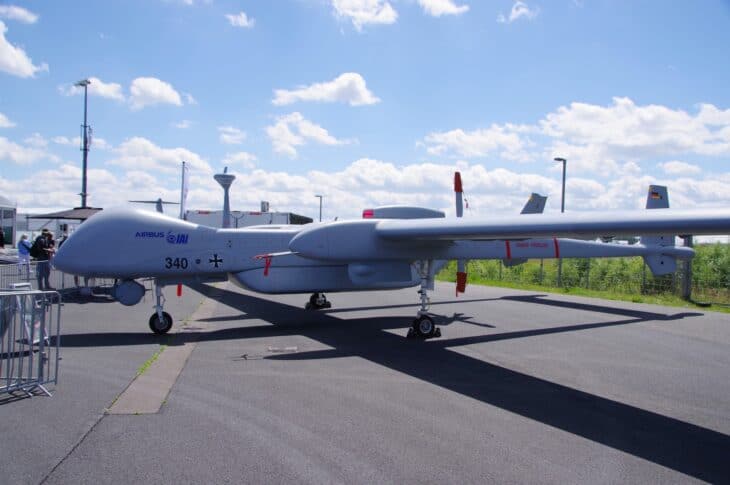

The Heron TP is the heavyweight of the Israeli fleet. It has an 85-foot (26 m) wingspan and a 1,200-horsepower PT6 turboprop, and IAI lists a ceiling above 45,000 feet (13,700 m) and a top speed of 253 mph (407 km/h).
Payload decides first place. At 5,952 pounds (2,700 kg), it lifts more than seven times the Hermes 900’s published load, which leaves room for radar, signals intelligence and weapons that smaller drones must choose between.
IAI gives a mission radius of more than 621 miles (1,000 km) over satellite link. That is a floor: Tel Aviv to Tehran is about 980 miles (1,580 km) in a straight line, and the Air Force has sent Eitan squadrons on operations against Iran.
Israel unveiled the Eitan in October 2007 and formed its first squadron, 210 Squadron at Tel Nof, in December 2010. Germany flies its own version from Jagel, and in November 2026 the Bundestag approved precision missiles to arm it.
2. Elbit Hermes 900 (Kochav)
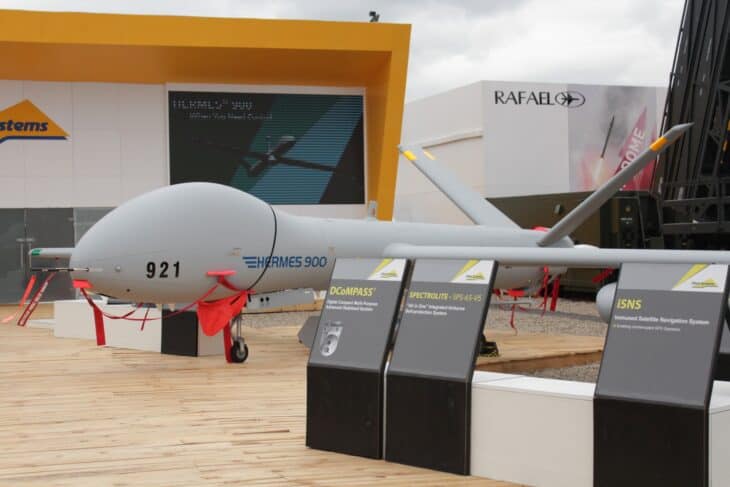

The Hermes 900 is less than a quarter of the Eitan’s weight and has arguably the bigger public combat record. Elbit lists a 2,601-pound (1,180 kg) takeoff weight, a 30,000-foot (9,100 m) ceiling and up to 36 hours of endurance.
It first flew on December 9, 2009, and went to war early, in July 2014 over Gaza, while still in testing. Elbit says it helped find dozens of concealed Iranian missile launchers in June 2025 and took part in strikes on air defenses and radars.
It has paid for that exposure. Hezbollah shot one down over Lebanon in April 2024, and on June 18, 2025, Israel confirmed that one had been downed over Iran, followed by at least one more on June 23.
Elbit announced the order for its 120th Hermes 900 in March 2023 and said more than 20 customers had chosen it. Not all come from Israel: Shephard reported in 2024 that an Adani-Elbit plant in Hyderabad, India, had delivered more than 20 to Israel.
It ranks below the Eitan because it carries far less. Elbit’s current page lists 772 pounds (350 kg), although its 2023 announcement claimed 992 pounds (450 kg).
3. IAI Heron and Heron Mk II (Shoval)
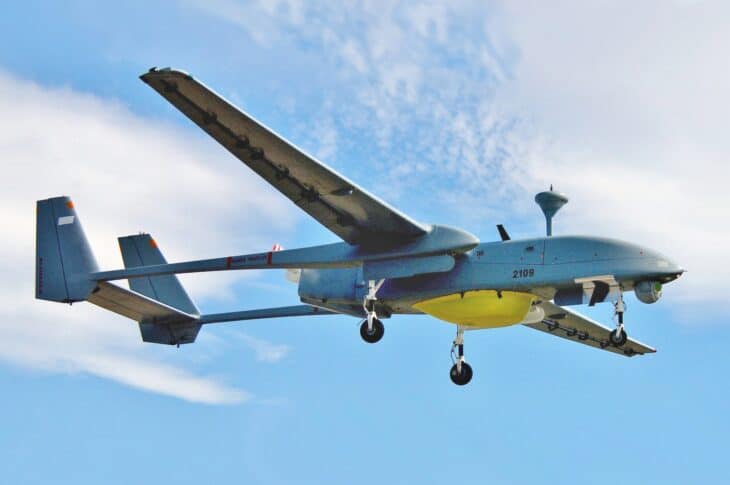

The Heron is Israel’s endurance specialist. The original first flew in 1994 and serves Israel as the Shoval, while the current Mk II can stay up for as long as 45 hours at loiter speeds of 69 to 92 mph (111 to 148 km/h).
The Mk II has a 54.5-foot (16.6 m) wingspan, a 3,153-pound (1,430 kg) maximum takeoff weight and up to 1,080 pounds (490 kg) of payload. IAI says the Heron line serves more than 22 customers and has flown hundreds of thousands of hours.
In April 2026 the Air Force said it was forming another Heron Mk II squadron at Hatzor, with about 20 aircraft reportedly on order. Calcalist put the base price near $10 million each, before payloads that can add several million dollars.
Its toughness earned a story of its own. The Air Force says a missile burst near a Shoval during operations against Iran and punctured its fuel tank and wings. It still landed at Hatzor, and was flying again about a week and a half later.
Half the strikes, no pilots aboard
Israel’s Defense Ministry says drones flew more than 500 precision strikes over Iran during the 12-day war of June 2025. The head of the Air Force’s drone department later said that was about half of all the aerial attacks Israel made there. Counting the Gaza campaign as well, the ministry said drones flew 60 percent of the Air Force’s flight hours.
4. Elbit Hermes 450 (Zik)
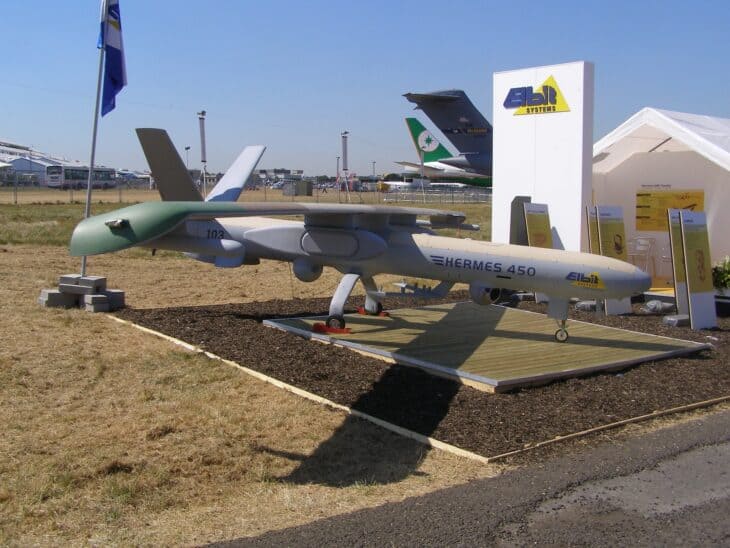

The Hermes 450 is the drone that did much of Israel’s armed work while officially doing none of it. In service since 1998, it has passed 300,000 operational flight hours by Elbit’s count, and Elbit calls it the IDF’s main counterterrorism platform.
It weighs 1,213 pounds (550 kg), carries 397 pounds (180 kg) and flies for 17 hours at up to 18,000 feet (5,500 m). Squadron 161, the Black Snake, flies armed Zik missions from Palmachim, as Breaking Defense saw on a 2023 visit.
Its Wankel rotary engine is loud enough that targets have heard it coming. The squadron tried mufflers, found they cost too much power and took them off.
The Zik also flew in one of the most condemned strikes of the Gaza war. On April 1, 2024, Israeli drone strikes killed seven World Central Kitchen aid workers, and the military’s own inquiry called it a grave mistake caused by mistaken identification and broken procedures. Two officers were dismissed, and the charity demanded an independent investigation.
The Air Force later adapted the Zik for long-range missions against Iran. Its successor, the Hermes 650 Spark, is the main reason it doesn’t rank higher.
5. IAI Harop
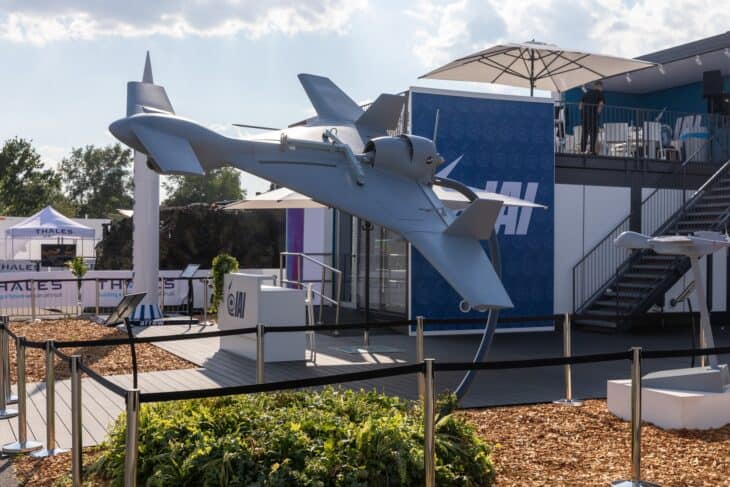

The Harop is the best of Israel’s single-use drones, and one of the best kamikaze drones in the world. It launches from a canister on a truck or ship, searches with an electro-optical seeker and dives on what it finds, with an operator able to abort.
IAI claims nine hours of endurance and immunity to satellite-navigation jamming. Range is murkier: the company’s brochure gives none, Airforce Technology lists 620 miles (1,000 km), and other references say 124 miles (200 km).
Azerbaijan used Harops in Nagorno-Karabakh in 2016 and 2020. India was reported to have fired them at targets in Pakistan in May 2025, and Pakistan claimed it destroyed most of the drones sent.
It beats the smaller munitions below on warhead and time over target. It ranks below the Zik because each one can attack only once.
6. Aeronautics Orbiter 4 (Nitzotz)
The Orbiter 4 delivers close to a full day of endurance without a runway. Singapore’s defense ministry, which also flies it, lists a 17.7-foot (5.4 m) wingspan, a 110-pound (50 kg) takeoff weight and a range of up to 93 miles (150 km).
In Israel it is the Nitzotz, or Spark, not to be confused with Elbit’s Hermes 650 Spark. The 144th Squadron at Hatzor was re-formed for it in 2022, and the Air Force has used it in Gaza for intelligence and to direct strikes.
An April 2026 report said the squadron had not yet been used over Iran. Iran’s army said on November 15 that it had shot down an Orbiter 4 in the country’s west, a claim that has not been independently confirmed.
7. IAI Harpy and Mini Harpy
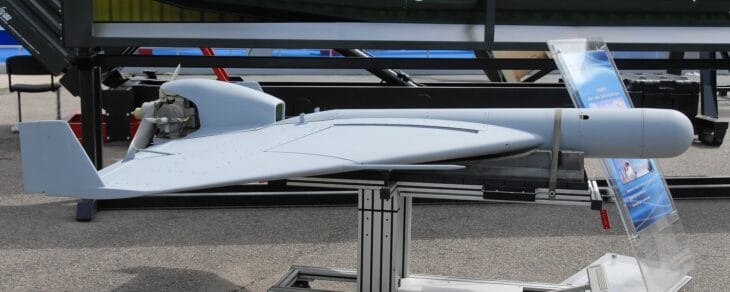

The Harpy is the Harop’s father, first tested in 1989. It was built to circle until an enemy radar switched on, then fly down the beam with a 71-pound (32 kg) warhead.
It also caused a diplomatic row. Israel sold Harpys to China in 1994, and when they came back for upgrades in 2004 Washington demanded Israel keep them, so they were returned in 2005 without the work done.
The Mini Harpy updates the idea with both a radar-homing and a camera seeker. IAI lists a 110-pound (50 kg) weight, a 15-pound (7 kg) warhead, one hour of endurance, a 62-mile (100 km) range and a 230 mph (370 km/h) speed.
The original ranks below the Harop for a simple reason: it needs an emitting radar to hunt. The Harop can go after a target that stays silent.
8. Elbit Skylark
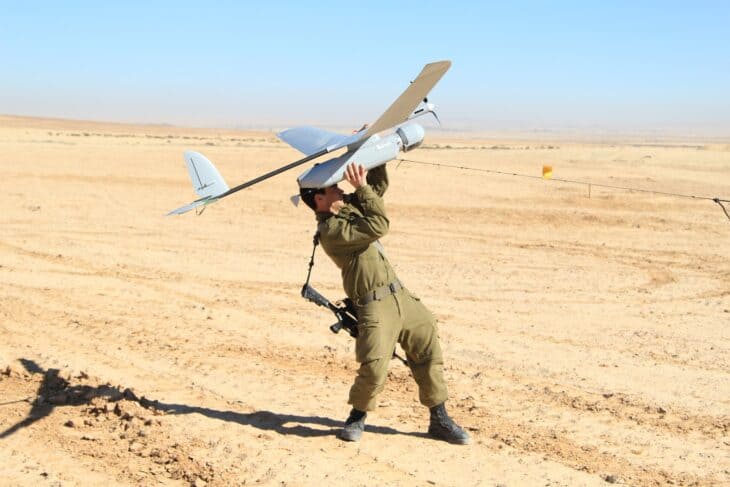

The Skylark gave Israeli ground commanders a drone of their own. The hand-launched Skylark I entered service in 2008, and by the 2014 Gaza war every active and reserve brigade received at least two aircraft.
The family has grown since. Skylark 3, revealed in 2016, has a 15.7-foot (4.8 m) wingspan, weighs 99 pounds (45 kg) and carries 22 pounds (10 kg), and Elbit claims up to 20 hours for the Hybrid version.
That version flies out on a combustion engine, then switches to electric power to watch quietly. It can’t match the Orbiter’s reach, but Elbit counts more than 30 export customers and 100,000 operational hours for the family.
9. Elbit SkyStriker
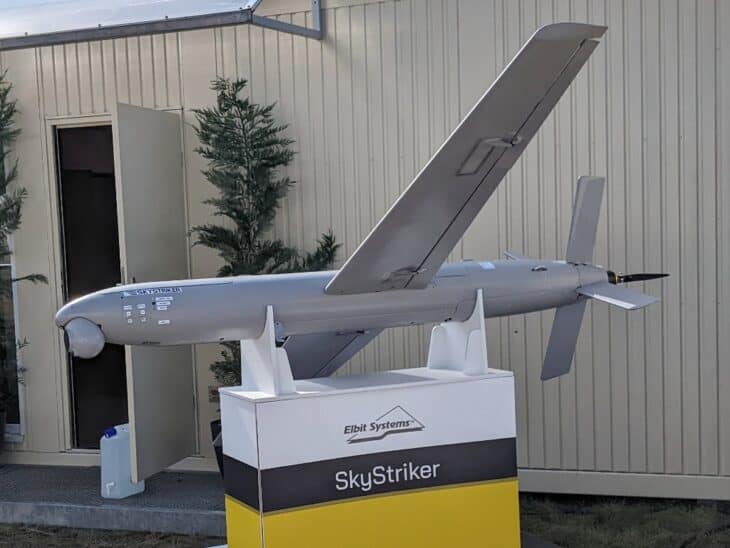

SkyStriker is the smaller, quieter alternative to a Harop. Its electric motor keeps noise and heat low, and Elbit says it can be 12 miles (20 km) away within 10 minutes of launch.
The buyer picks the trade-off. An 11-pound (5 kg) warhead allows two hours of loitering, while the 22-pound (10 kg) warhead halves that to one, and either can end in a dive at up to 345 mph (556 km/h).
India ordered 100 in 2021 and an unnamed European country signed for several hundred in a $95 million deal in 2023. Elbit and Germany’s Diehl demonstrated it again in September 2026 as they push for German production.
It ranks above the Hero-120 for the longer loiter and the heavier warhead option.
10. UVision Hero-120
The Hero-120 is an anti-tank weapon with a drone’s patience. The 53-pound (24 kg) round carries a 10-pound (4.5 kg) warhead up to 37 miles (60 km), waits for as long as an hour and attacks from nearly straight above, where armor is thinnest.
It can be launched by infantry or from vehicles, vessels and helicopters. The US Marine Corps picked it in 2021, US Special Operations Command signed a $73.5 million contract in 2024, and Germany’s Rheinmetall is UVision’s partner in Europe.
It sits this low because export success is easier to document than Israeli use. As a piece of engineering it would place higher.
11. XTEND FPV attack drones
First-person-view (FPV) quadcopters are where Israel came late. In 2025 the Defense Ministry picked XTEND to supply 5,000 10-inch attack drones to the ground forces, each carrying 5.5 pounds (2.5 kg) and costing a reported 3,500 shekels, about $1,000.
The next round looks very different. Israeli reports in April 2026 described a planned order of up to 12,000 drones at $6,000 to $7,500 each, with night capability and fewer Chinese electronics.
The urgency comes from Lebanon, where Hezbollah used fiber-optic FPVs that radio jamming cannot stop and that reportedly cost $300 to $400. It is the same shift that had already reshaped the war in Ukraine.
What comes next: Hermes 650 and the drones Israel won’t discuss
The Hermes 650 Spark, unveiled in February 2024, is the next confirmed arrival. Elbit lists up to 24 hours of endurance, a 573-pound (260 kg) useful load and eight payload stations, and an Israeli colonel said in April 2026 that the Air Force would bring it in during 2027.
IAI is also selling the Tactical Heron, a 1,323-pound (600 kg) version that carries 397 pounds (180 kg) for 24 hours from unpaved strips. It is left off the ranking until Israeli service is documented.
What about Israel's secret stealth drone?
Posts in March 2026 claimed a flying-wing drone called RA-01 had been seen over Iran. Neither the aircraft nor the sightings have been officially confirmed, and no verified specification exists, so it is not ranked. If Israel ever acknowledges such a drone, it could change the top of this list.
How good are Israeli drones against real air defenses?
Good enough to work over Iran, and not good enough to do it for free. The Air Force acknowledged losing nearly 10 drones in the June 2025 campaign and blamed enemy fire, not technical failures.
It gave no figure for the fighting that began on February 28, 2026. The Jerusalem Post reported a rumored total of more than a dozen that April, while the Air Force’s drone chief said only that losses remained low.
None of the large types here is a stealth design. Over Iran they relied on new Elbit self-protection suites and on air superiority won alongside Israeli fighter jets, against an opponent with its own air defenses and a large family of Iranian drones.
The argument for accepting those losses is that no aircrew is lost with them. Col. K, who heads the drone department, said in April 2026 that the Air Force would rather send a drone than a crewed aircraft if it can do the same job.
How Israel built the drone industry
Israel’s place among the makers of the best military drones in the world began with two small piston-engine scouts, the Tadiran Mastiff and the IAI Scout.
1973
Mastiff flies. Tadiran’s drone sends live video to the ground, and some historians call it the first modern surveillance drone.
1982
Lebanon proves the idea. Mastiff and Scout imagery helps Israel destroy Syrian missile batteries in the Bekaa Valley.
1984
The US buys in. IAI and Tadiran form Mazlat, which develops the Pioneer. The US Navy receives its first in June 1986.
1991
A surrender to a drone. Iraqi soldiers on Faylaka Island wave white flags at a Pioneer flown from the battleship Wisconsin.
July 2022
The secret ends. Israel’s military censor allows reporting that the armed forces use strike drones, after a ban of about 20 years.
June 2025
Drones reach Iran in force. Israeli drones fly thousands of hours and more than 500 strikes over Iran.
April 2026
The fleet grows. The Air Force announces a new Heron Mk II squadron and plans for the Hermes 650.
The Smithsonian, which holds that Pioneer, calls the 1991 episode the first time enemy soldiers ever surrendered to an uncrewed aircraft. The Pioneer was an Israeli design, developed for the US with the American firm AAI, and the drones on this list are its descendants in spirit.
FAQ
Sources and references used for research and fact-checking.
- Israel Aerospace Industries, Heron TP data sheet
- Israel Aerospace Industries, Heron Mk II data sheet
- Israel Aerospace Industries, Tactical Heron data sheet
- Israel Aerospace Industries, Harop brochure
- Israel Aerospace Industries, Mini Harpy brochure
- Elbit Systems, Hermes 900
- Elbit Systems, Elbit Systems Receives Order for the 120th Hermes 900
- Elbit Systems, Hermes 450
- Elbit Systems, Hermes 650 Spark
- Elbit Systems, Skylark 3 Hybrid
- Elbit Systems, SkyStriker brochure
- UVision, Hero 120 brochure
- Singapore Ministry of Defence, Fact Sheet: Orbiter 4 Unmanned Aerial Vehicle
- Bundeswehr, Die German Heron TP
- Janes, Luftwaffe Heron TP makes public flying debut
- Ynetnews, How Israel achieved air superiority over Iran
- The Jerusalem Post, After Operation Roaring Lion, IDF readies UAV fleet for next war with Iran
- CTech by Calcalist, Eyes on Iran: Israel expands drone fleet for the next war
- Ynetnews, Israeli Air Force to launch new Heron drone squadron
- Army Technology, SkyStriker Tactical Loitering Munition
- Army Technology, Hero Family of Loitering Munition Systems
- Iran International, Drones helped locate Iran missile launchers during June war, Israeli firm says
- Breaking Defense, Israel's Black Snake armed drone squadron comes out of the shadows
- Ynetnews, Israel admits to use of attack drones after years of ambiguity
- Breaking Defense, Israel's air force officially receives new, secretive Spark UAV
- Defence Industry Europe, Israeli Air Force deploys Spark UAV in operations against Hamas in Gaza
- Mehr News Agency, Iran air defense shoots down Orbiter 4 drone in west
- CBS News, Israeli military fires 2 officers as probe blames World Central Kitchen deaths on mistaken identification
- Shephard, India sends newly assembled MALE UAVs to Israel
- Airforce Technology, Harop Loitering Munitions UCAV System
- The Defense Post, Elbit, Diehl Demonstrate SkyStriker
- Defense Mirror, Israel Chooses Xtend to Supply 5,000 Combat Drones
- GCIRD, Israel's Drone Industrial Rebuild and the Contest for the Low-Cost Battlefield
- Smithsonian National Air and Space Museum, Pioneer RQ-2A UAV
- Wikipedia, IAI Eitan
- Wikipedia, Elbit Hermes 900
- Wikipedia, Elbit Hermes 450
- Wikipedia, IAI Heron
- Wikipedia, IAI Harop
- Wikipedia, IAI Harpy
- Wikipedia, Elbit Skylark
- Wikipedia, IAI Scout
- Wikipedia, Tadiran Mastiff
Get the Newsletter
The latest aviation news and stories sent to your inbox.
About the Author

Tim is the owner and lead editor of AeroCorner since 2019, overseeing aviation content covering aircraft, airlines, airports, and the broader aviation industry. Through years of researching, writing, editing, and publishing aviation-focused content, he has developed extensive practical knowledge of commercial aviation and air travel. Based in Asia and a frequent traveler himself, Tim also brings firsthand passenger experience to AeroCorner’s coverage. Outside of publishing, he has also explored aviation firsthand through hands-on flight training in New Zealand.