

Table of Contents
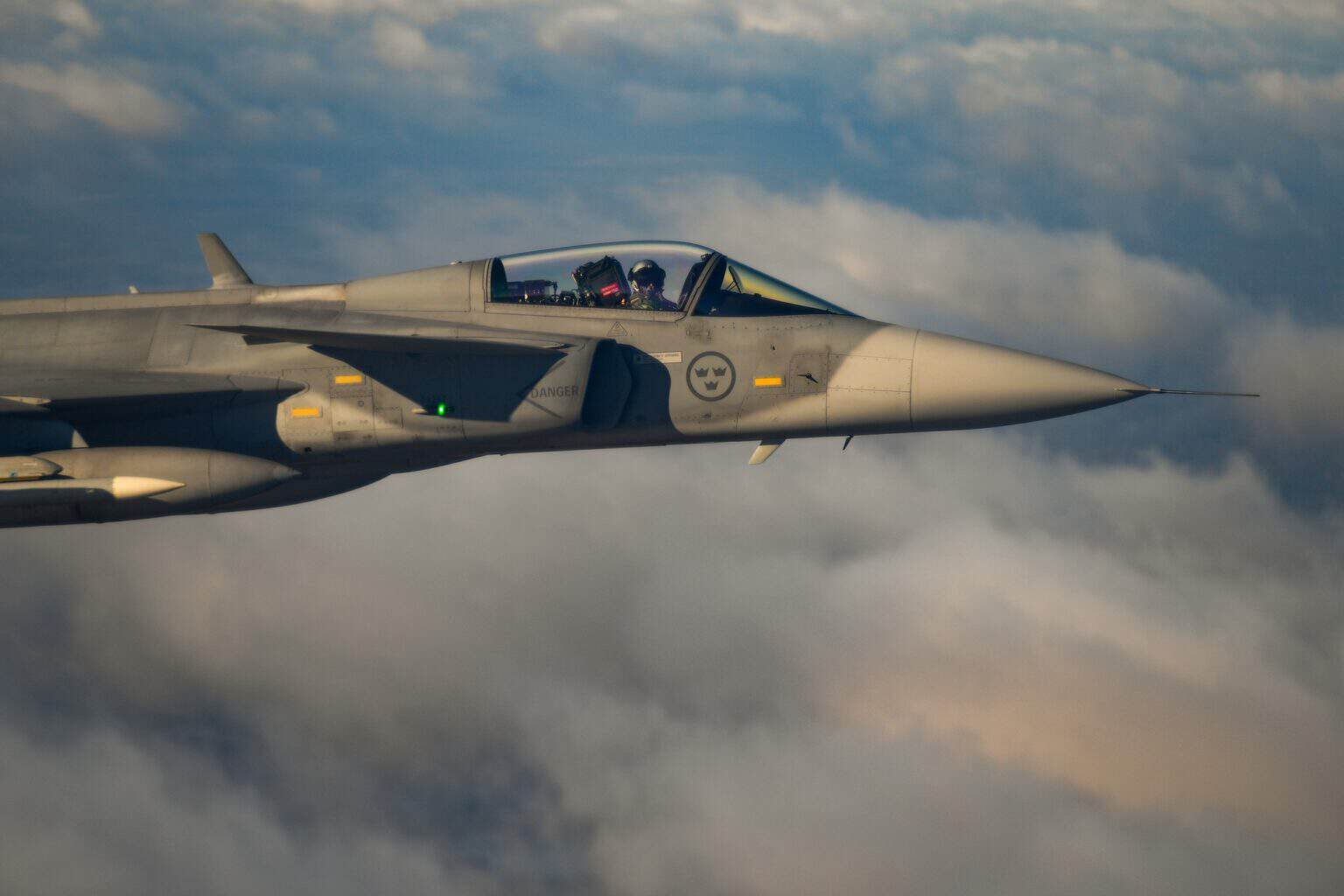
The best Swedish fighter jet is the Saab JAS 39E Gripen, the new-generation Gripen that Sweden accepted its first example of in October 2025. It keeps the old Gripen’s road-base toughness and adds a new AESA radar, a bigger GE F414 engine and up to seven Meteor long-range missiles.
Behind it come the earlier Gripens and the JA 37 Viggen, the Cold War jet whose pilots tracked American SR-71 Blackbirds over the Baltic. Every jet fighter Sweden has put into production came from one company, Saab: seven designs since 1947.
We ranked all seven on three things: how capable each was against the fighters of its own era, its operational and export record, and how much it moved fighter design forward. Figures are current as of November 2026.
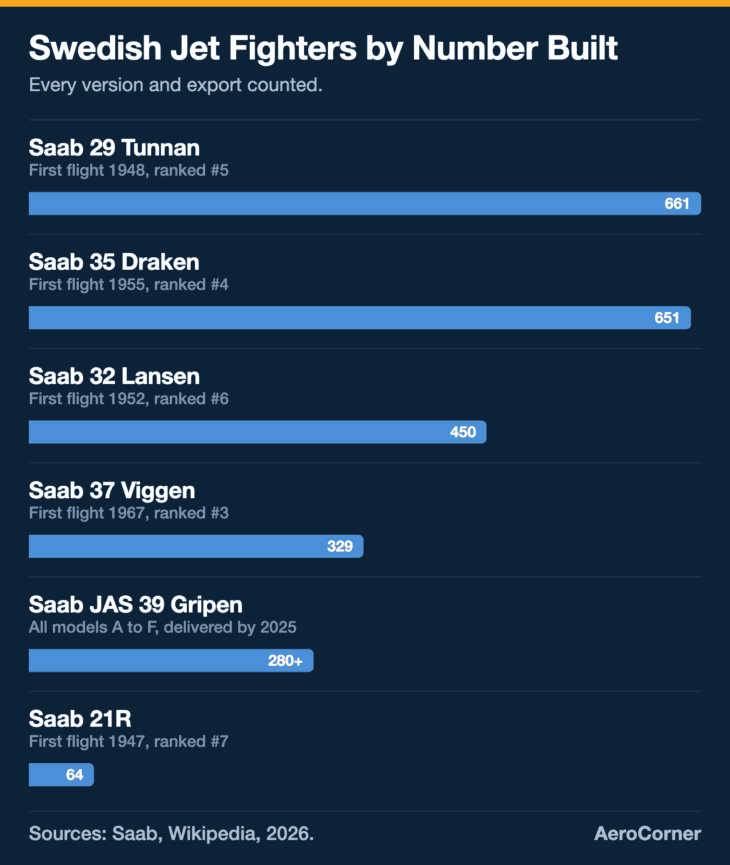
| Rank | Jet | First flight | Number built | Top speed | Swedish service |
|---|---|---|---|---|---|
| 1 | Saab JAS 39E/F Gripen | 2017 | 133 ordered | Mach 2 | 2025 to today |
| 2 | Saab JAS 39A-D Gripen | 1988 | More than 280 (all Gripens, A to F) | Mach 2 | 1996 to today |
| 3 | Saab 37 Viggen | 1967 | 329 | Mach 2.1 | 1971 to 2005 |
| 4 | Saab 35 Draken | 1955 | 651 | Mach 2 | 1960 to 1999 |
| 5 | Saab 29 Tunnan | 1948 | 661 | 660 mph (1,060 km/h) | 1951 to 1976 |
| 6 | Saab 32 Lansen | 1952 | 450 | 750 mph (1,200 km/h) | 1956 to 1997 |
| 7 | Saab 21R | 1947 | 64 | 500 mph (800 km/h) | 1950 to 1956 |
How this ranking works
The list covers every jet fighter and multirole combat jet designed in Sweden. Each is ranked on capability against the fighters of its own era, its combat and export record, and its influence on later designs. Trainers such as the Saab 105, prototypes such as the Saab 210 test jet, and foreign jets Sweden bought, such as the de Havilland Vampire and Hawker Hunter, are covered at the end.
Why every Swedish fighter jet is a Saab
Sweden stayed neutral through the Second World War, and few countries would sell a small neutral state modern fighters. So the government asked Saab to design its own, and that policy has outlasted the war by more than 80 years.
The result is a family with a clear thread. Since the Viggen, Saab fighters have been built to fly from short strips and stretches of public road, so an enemy cannot destroy the air force by bombing its bases. Today that air force flies only Gripens, as our guide to the Swedish Air Force fleet in 2026 shows.
1. Saab JAS 39E/F Gripen
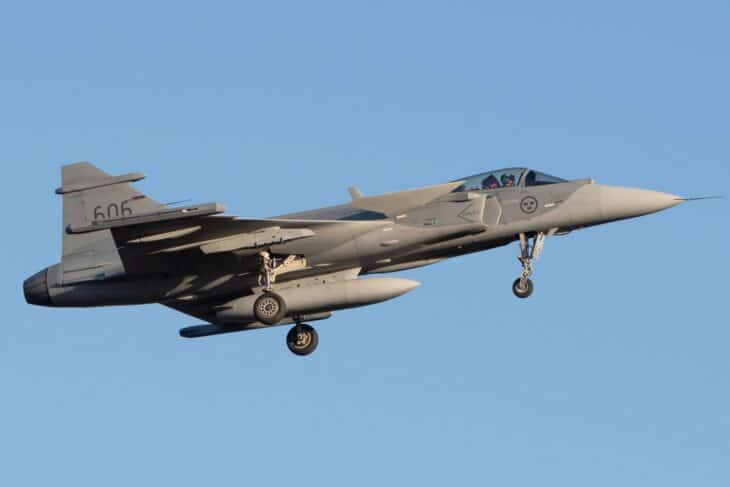

The Gripen E first flew on June 15, 2017, and the first one was handed to the Skaraborg Wing (F 7) at Såtenäs on October 20, 2025. Sweden has 60 on order, and the Swedish Armed Forces call it a largely new aircraft rather than an upgrade.
Compared with the Gripen C, it has a longer fuselage with about 40% more internal fuel, a General Electric F414 engine of about 22,000 pounds (98 kN) of thrust with afterburner, and two extra hardpoints for ten in total. Saab says it can carry up to seven Meteor beyond-visual-range missiles and two IRIS-T short-range missiles.
The sensors are the bigger change: a Raven ES-05 AESA radar, an infrared search and track system and a new electronic warfare suite. Brazil flies the type as the F-39E and builds it at a line Saab and Embraer opened in 2023.
It ranks first because it is the only Swedish fighter built for today’s threats, and export customers agree. Colombia signed for 17 in November 2025, and on June 30, 2026 Saab signed a contract with Sweden’s procurement agency for 16 Gripen Es for Ukraine, worth about SEK 24.6 billion, with deliveries in 2029 and 2030.
2. Saab JAS 39A-D Gripen
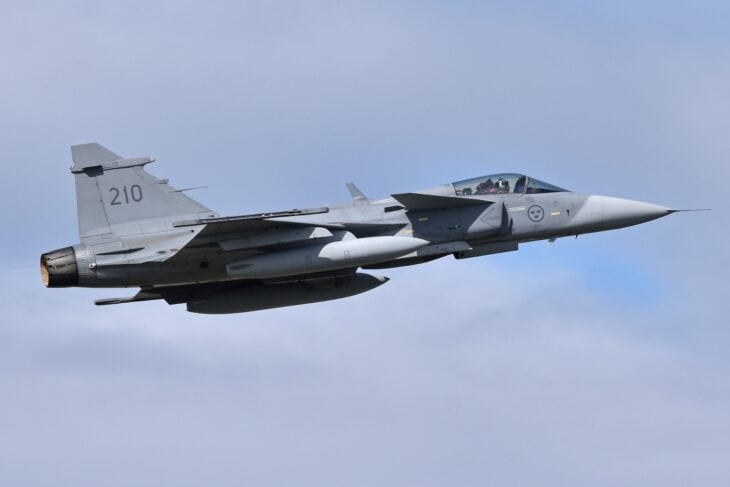
The original Gripen flew on December 9, 1988 and entered Swedish service on June 9, 1996. JAS stands for jakt, attack and spaning: fighter, attack and reconnaissance in one airframe, able to switch roles during the same mission.
It is small and cheap to run by design, with a delta wing, canards and a Volvo RM12 engine derived from the GE F404. It reaches Mach 2 at altitude and was designed to operate from snow-covered strips only 500 meters (1,640 feet) long.
Ten minutes, six people
Sweden designed the Gripen so that one technician and five conscripts could rearm, refuel and service it between air-to-air missions in about ten minutes, working from a road base. An air-to-ground turnaround takes about twenty.
It sold where Saab’s earlier jets never did: the Czech Republic, Hungary, South Africa and Thailand all bought or leased C/D models. More than 280 Gripens of all models had been delivered by 2025.
It also flew Sweden’s first combat deployment since the Congo in the 1960s, when eight Gripens supported the UN no-fly zone over Libya in 2011 without flying ground attack missions. In July 2025, reports said Thai Gripens had struck Cambodian positions in the border conflict, the first time Thailand’s Gripens were reported in combat.
FlightGlobal’s World Air Forces 2026 directory counts 71 Gripen C and 23 Gripen D fighters in Swedish service, and up to 16 of them are due to go to Ukraine from 2027. It sits second only because the E does everything it does, with better sensors and more reach. Read how it stacks up against France’s best in our Rafale vs Gripen comparison.
3. Saab 37 Viggen
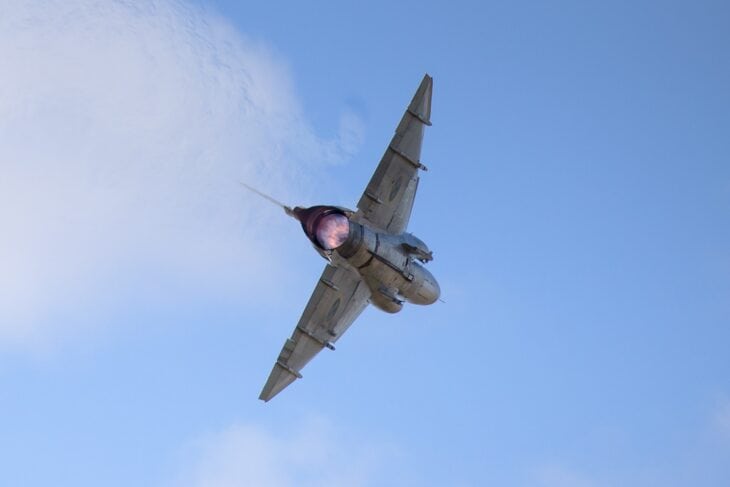

The Saab 37 Viggen first flew on February 8, 1967 and was the first canard aircraft built in quantity. It was also the first combat aircraft with an airborne digital central computer built on integrated circuits, doing work that other jets of its day needed a second crew member for.
Its Volvo RM8 engine was a heavily reworked, licence-built Pratt & Whitney JT8D airliner engine with an afterburner and a thrust reverser added. That reverser let the Viggen land on strips of about 500 meters (1,640 feet), and the JA 37 fighter version reached Mach 2.1.
The Viggen that locked onto a Blackbird
By the mid-1980s, Swedish JA 37 pilots had worked out the routine routes of American SR-71 reconnaissance flights over the Baltic Sea and achieved radar lock-on with them on numerous occasions, despite the SR-71’s heavy jamming.
Saab built 329, and the Viggen served only Sweden: a planned sale to India in 1978 died when the United States refused an export licence for the American engine technology. The last front-line Viggens retired on November 25, 2005. It ranks above the Draken because it was the more complete weapon system, with the bigger payload and the better avionics.
4. Saab 35 Draken
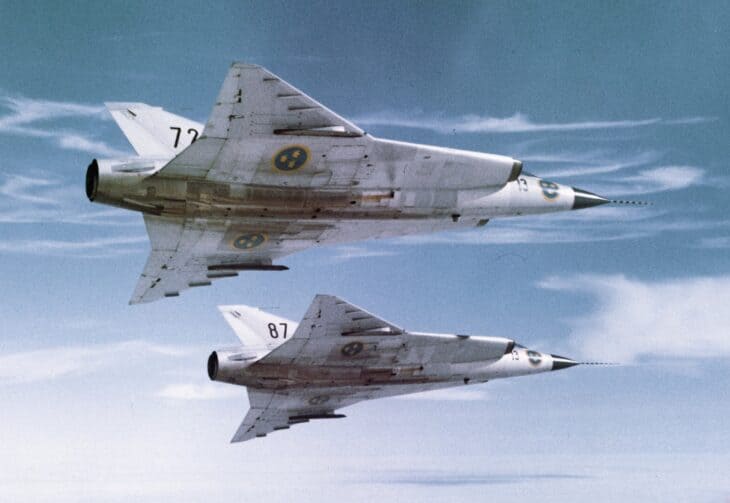

The Saab 35 Draken first flew on October 25, 1955, with a double-delta wing so unproven that Saab built a smaller test jet, the Saab 210, to try it first. Its second prototype broke the sound barrier by accident while climbing on its first flight.
A J 35B prototype reached Mach 2 on January 14, 1960, and the Draken entered front-line service that March. It was designed as a bomber interceptor but proved a capable dogfighter for its time.
Its tricky handling had an unexpected legacy. Training Draken pilots to recover from super stalls led the Swedish Air Force to discover and develop the maneuver now known as the cobra.
Saab built 651, and it sold abroad to Austria, Denmark and Finland. Sweden retired it in December 1999, and Austria flew it until 2005, the last air force to do so. It never fought, which is why it sits below the Viggen despite outselling it two to one.
5. Saab 29 Tunnan
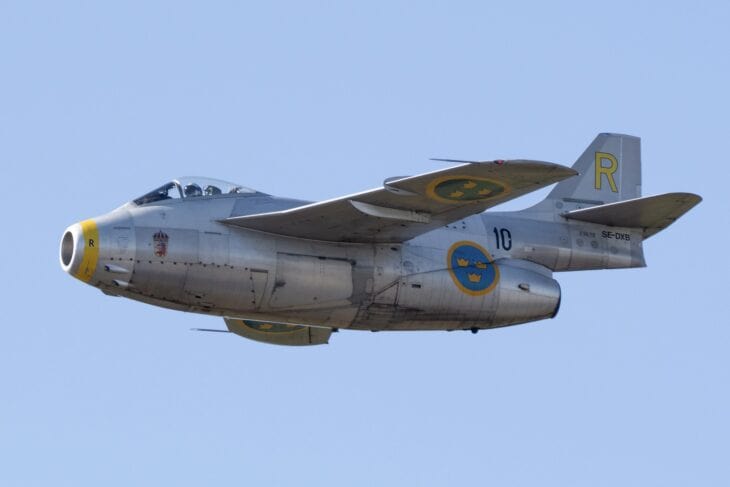

The Saab 29 Tunnan, “the Barrel,” first flew on September 1, 1948 and was the first Western European fighter built with a swept wing after the Second World War. The swept wing drew on wartime German research, and the round fuselage was shaped around a de Havilland Ghost engine.
Saab completed 661 between 1950 and 1956, the largest production run of any Saab aircraft. In 1954 a J 29 set a world speed record over a 310-mile (500 km) closed circuit at 607 mph (977 km/h).
It was also the first Swedish jet to see combat. From 1961, J 29Bs flew ground attack missions with the UN peacekeeping force in the Congo, and none was lost in action despite heavy ground fire. The fighter versions left front-line service in May 1967, and the last official military flight came in 1976.
6. Saab 32 Lansen
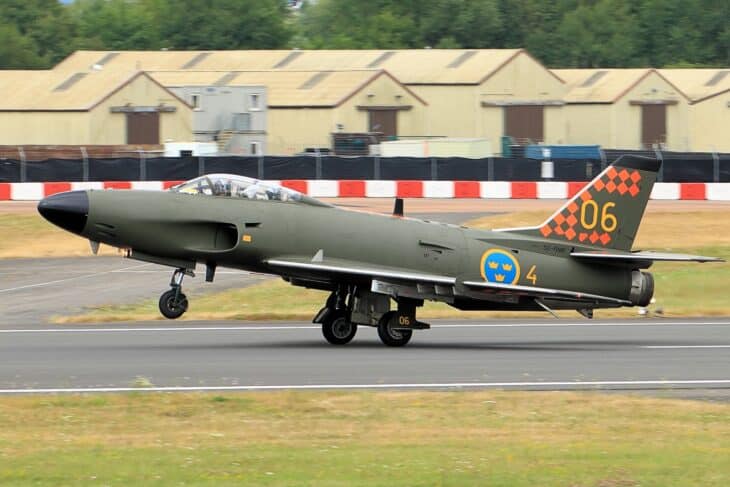

The Saab 32 Lansen, “the Lance,” first flew on November 3, 1952 as a replacement for Sweden’s propeller-driven attack aircraft. It was the Swedish Air Force’s first two-seat jet and the first with a built-in search radar.
On October 25, 1953 a Lansen passed Mach 1.12 in a shallow dive, breaking the sound barrier. Saab built about 450 in three main versions: the A 32A attack jet, the J 32B all-weather fighter and the S 32C reconnaissance jet.
Only the J 32B was a true fighter, armed with four 30 mm ADEN cannons and Rb 24 missiles, a licence-built AIM-9 Sidewinder. It ranks sixth because it was mainly a strike jet, though a long one: rebuilt Lansens flew electronic warfare and target-towing work until 1997.
7. Saab 21R
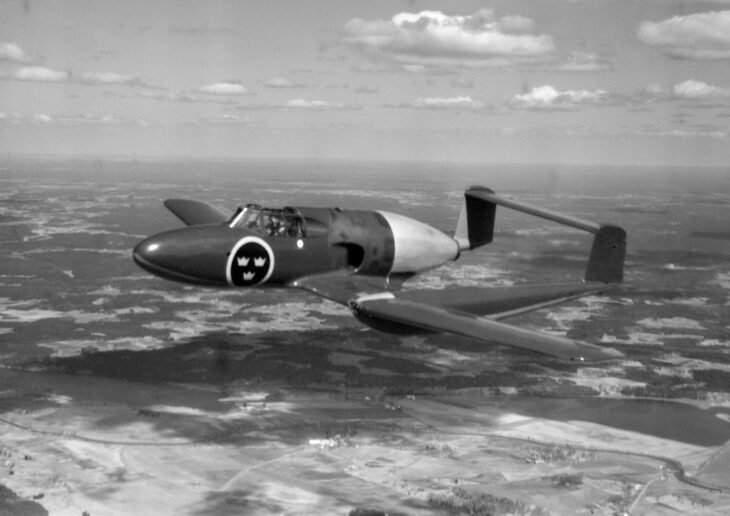
The Saab 21R was Saab’s first jet. It began as the J 21, a twin-boom pusher fighter with its propeller behind the pilot, and in 1947 Saab swapped the piston engine for a de Havilland Goblin turbojet. The converted prototype first flew on March 10, 1947.
It is one of only two jet fighters successfully converted from a piston design, the other being the Soviet Yak-15. Sweden planned 124 but built 64, used mainly as fighter-bombers, with a top speed of about 500 mph (800 km/h).
It was a stopgap and it served like one, giving way to the Vampire and the Tunnan in the early 1950s. It ranks last, but every jet above it grew from what Saab learned building it.
What comes after the Gripen
Sweden’s next fighter is still a study, not a program. Under the KFS (Koncept för Framtida Stridsflyg) effort, Saab won a contract worth about SEK 2.9 billion in September 2026 for flying and ground demonstrators and concepts for crewed and uncrewed aircraft, running from 2026 to 2028.
The work is meant to shape Swedish air power beyond 2040, and Swedish officials said in 2023 that the procurement decision would come in 2031. Until then the Gripen E carries the line, and the Swedish Air Force plans to fly it until at least 2060.
What about the Vampire, the Hunter and the Saab 105?
Sweden flew foreign jets too, and the first came before any Saab. The air force bought 70 de Havilland Vampires in 1946, as the J 28, and later flew Hawker Hunters as the J 34, so the 21R was Saab’s first jet but not Sweden’s. The Saab 105, flown as the SK 60 for 57 years until June 18, 2024, was a trainer with a light attack version, not a fighter. Nor were the Saab fighters ever wholly Swedish: the Tunnan, Lansen and Draken used British de Havilland and Rolls-Royce engine designs, and every jet from the Viggen onward has used an American-derived engine.
For where these jets sit against the rest of the world, see our ranking of the best fighter jets in the world, where the Gripen competes with far larger and costlier designs.
FAQ
Sources and references used for research and fact-checking.
- Saab, Gripen E-series
- Saab, Saab signs contract for Gripen E for Ukraine
- Saab, Saab signs contract for Gripen E/F with Colombia
- The Aviationist, Sweden Receives First Gripen E
- Shephard, FIA 2026: Gripen marks operational milestone as Ukraine deal moves forward
- Defense News, Saab tapped to continue work on Sweden's next flagship fighter jet
- Breaking Defense, Sweden commits to future fighter procurement decision in 2031
- FlightGlobal, World Air Forces 2026
- Wikipedia, Saab JAS 39 Gripen
- Wikipedia, Saab 37 Viggen
- Wikipedia, Saab 35 Draken
- Wikipedia, Saab 29 Tunnan
- Wikipedia, Saab 32 Lansen
- Wikipedia, Saab 21R
- Wikipedia, Saab 105
- Wikipedia, de Havilland Vampire
- Wikipedia, Swedish Air Force
Get the Newsletter
The latest aviation news and stories sent to your inbox.
About the Author

Tim is the owner and lead editor of AeroCorner since 2019, overseeing aviation content covering aircraft, airlines, airports, and the broader aviation industry. Through years of researching, writing, editing, and publishing aviation-focused content, he has developed extensive practical knowledge of commercial aviation and air travel. Based in Asia and a frequent traveler himself, Tim also brings firsthand passenger experience to AeroCorner’s coverage. Outside of publishing, he has also explored aviation firsthand through hands-on flight training in New Zealand.