

Table of Contents
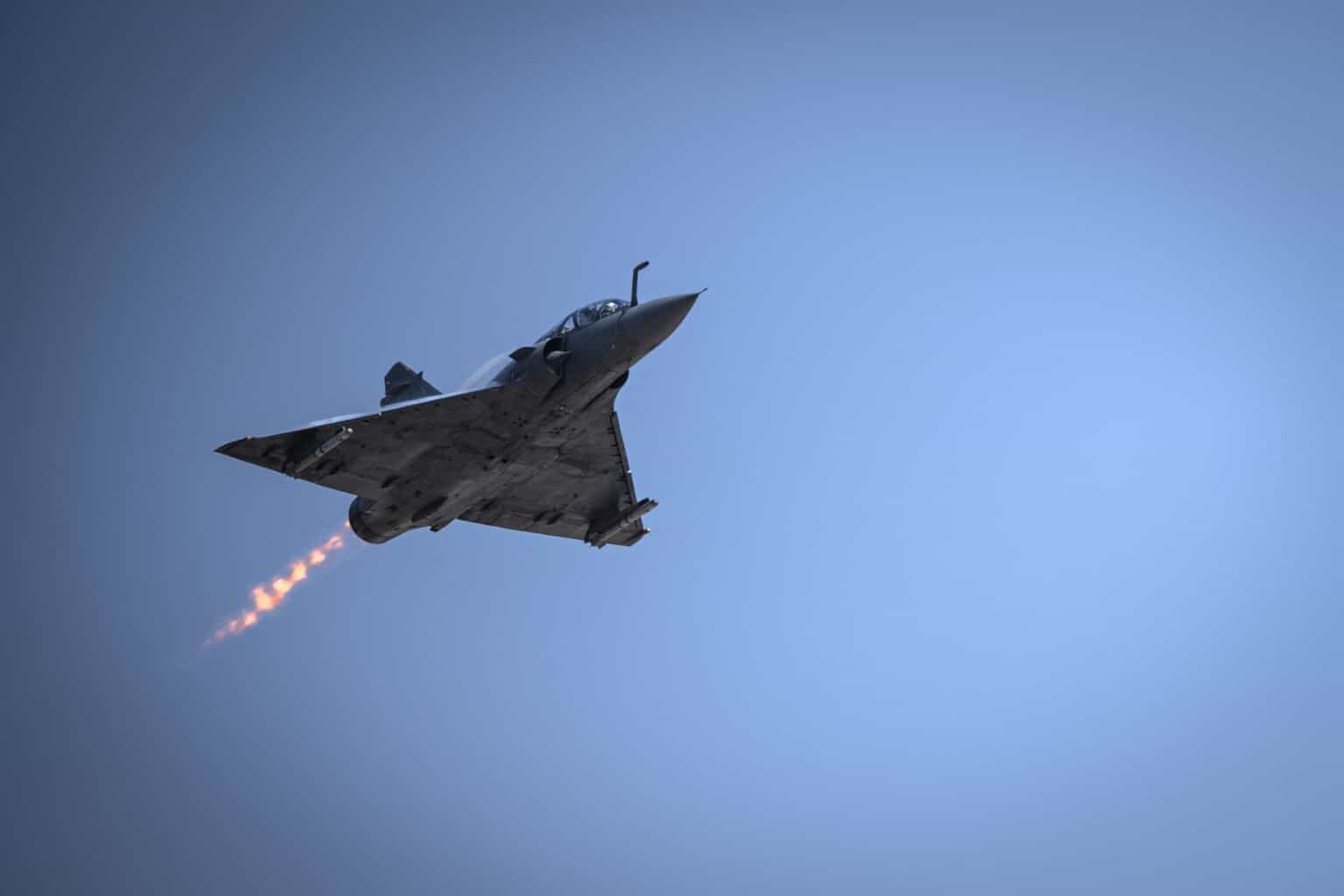
The Peruvian Air Force’s best fighter is still the Dassault Mirage 2000P, a French jet it began receiving in the mid-1980s. FlightGlobal’s 2026 directory lists nine single-seat Mirages and two two-seaters, alongside eight MiG-29s and eight Su-25s bought from Belarus in the late 1990s.
All of them are due to give way to the Lockheed Martin F-16 Block 70. Peru signed for the first 12 in April 2026, and in November 2026 the government authorized up to S/5.7 billion in bonds to pay for 12 more.
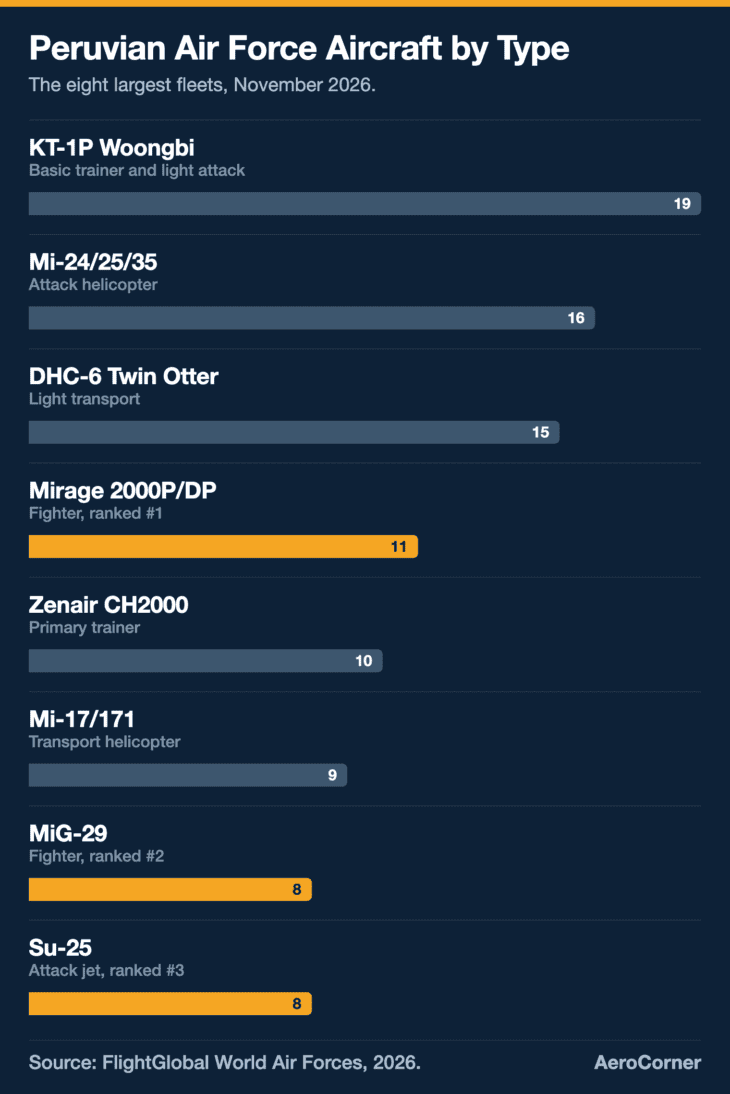
This guide ranks every aircraft type the Fuerza Aérea del Perú (FAP) flies by its weight in Peruvian air power, as of November 2026. Counts come from FlightGlobal’s World Air Forces 2026, which lists 156 aircraft, though 20 of those are A-37s that Peru has already retired.
| Rank | Aircraft | Role | In use | Status |
|---|---|---|---|---|
| 1 | Dassault Mirage 2000P/DP | Multirole fighter | 11 (9 P, 2 DP) | Replaced by F-16 from about 2029 |
| 2 | MiG-29 Fulcrum | Air superiority fighter | 8 (6, plus 2 trainers) | Replaced by F-16 from about 2029 |
| 3 | Sukhoi Su-25 Frogfoot | Ground attack jet | 8 (2, plus 6 two-seaters) | In service |
| 4 | Mi-25 and Mi-35 Hind | Attack helicopter | 16 | In service since 1983 |
| 5 | KC-130H and special mission aircraft | Tanker, reconnaissance | 2 tankers, 6 special mission | KC-135R reported in the F-16 deal |
| 6 | C-27J Spartan, Twin Otter and transports | Airlift | 4 C-27J, 15 DHC-6, 28 transports in all | Fifth C-27J ordered May 2026 |
| 7 | Mi-17/171 and light helicopters | Transport and utility helicopters | 9 Mi-17/171, 5 light | In service |
| 8 | KT-1P Woongbi and light trainers | Trainers | 19 KT-1P, 23 light trainers | No jet trainer since the MB-339 retired |
| Next | Lockheed Martin F-16 Block 70 | Multirole fighter | 0 (12 contracted, 12 more being financed) | First jets expected 2029 to 2030 |
How this ranking works
Aircraft are ranked by their weight in Peruvian air power in November 2026: fighters first, then attack aircraft, tankers and spy planes, transports, helicopters and trainers. Counts come from FlightGlobal’s World Air Forces 2026 directory, which lists only aircraft in day-to-day use, drawn on October 1, 2025. Listed is not the same as flyable: Peru does not publish readiness figures. The F-16 is covered after the Mirage but not ranked, because none has been delivered.
1. Dassault Mirage 2000P/DP: Still the Best Jet Peru Has
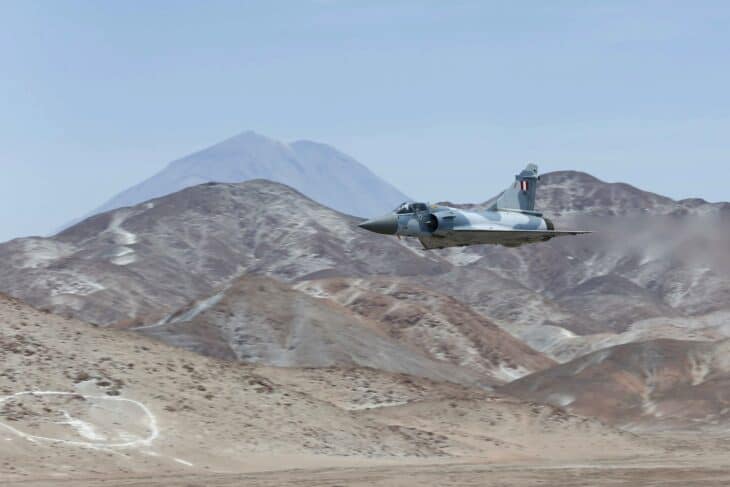

Peru ordered the Mirage 2000 in December 1982 and received 12, 10 single-seat 2000Ps and two two-seat 2000DPs, according to Migflug. They have flown for four decades.
The jets fly with Grupo Aéreo 4 at La Joya air base, near Arequipa in the south. One was lost on April 11, 2024, and FlightGlobal now counts nine 2000Ps and two 2000DPs.
Dassault began inspecting the fleet and modernizing its electronics in 2009, Wikipedia records. Migflug notes a November 2024 report that the air force had ruled out a further upgrade, and the Mirage is now the main jet the F-16 is being bought to replace. Our Mirage 2000-5 Mk2 page covers the later version of the design.
Next: Lockheed Martin F-16 Block 70, 24 Planned
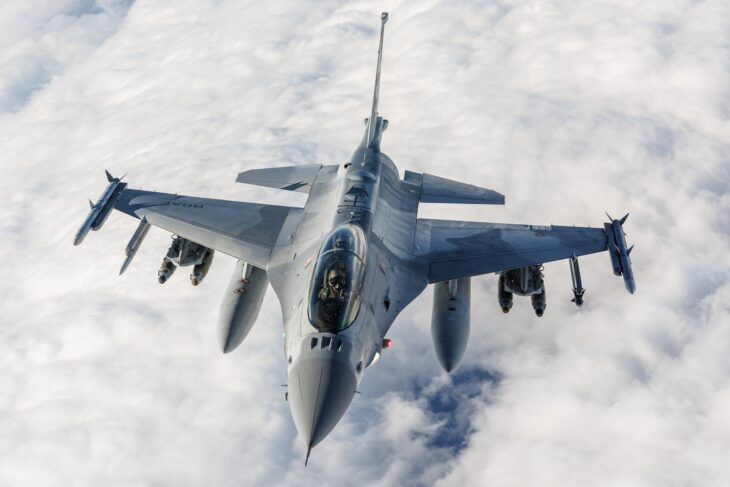

The US State Department approved the sale of 10 single-seat F-16Cs and two two-seat F-16Ds to Peru on September 15, 2025, in a package valued at up to $3.42 billion, TWZ reported. It included AN/APG-83 radars, AIM-120C-8 AMRAAM and AIM-9X missiles, and targeting pods.
Peru beat out the Saab Gripen E and the Dassault Rafale to pick the F-16. Lockheed Martin announced the selection on April 23, 2026, and said the jets will be built in Greenville, South Carolina.
Getting there was messy. Interim President José Balcázar postponed the April 17 signing, saying the next government should take on the commitment, and Defense Minister Carlos Díaz and Foreign Minister Hugo de Zela resigned, The Aviationist reported.
A technical signing went ahead on April 20, 2026, and Peru transferred a first payment of $462 million to Lockheed Martin. Pucara puts the contract for the first 12 jets at about $1.54 billion, with a used KC-135R tanker reportedly included at no extra cost.
The second batch of 12 is not signed yet. Congress approved $346.9 million for it in October 2026, and on November 20, Infobae reported a decree authorizing up to S/5.7 billion in bonds to finance it. Pucara expects that contract to be signed in early December 2026.
Roughly $3.5 billion for 24 jets
Infobae puts the two tranches at a combined S/13.28 billion, roughly $3.5 billion, for 24 F-16s. The first jets are expected between 2029 and 2030, according to US Ambassador Bernie Navarro, and Pucara reports that they will be based at La Joya, home of today’s Mirage squadron.
2. MiG-29 Fulcrum: The Belarus Jets
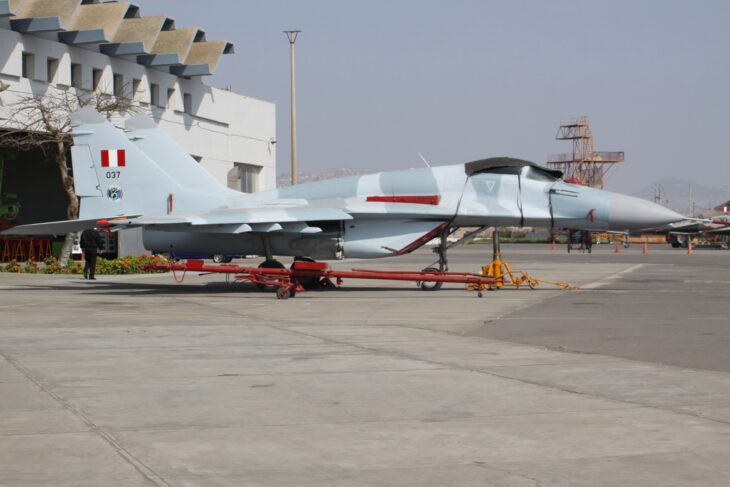

Peru bought its MiG-29s and Su-25s from Belarus in 1996 and 1997, the year after its 1995 border war with Ecuador. Three more MiG-29s came new from Russia in 1998, Migflug records.
Eight were upgraded by RAC MiG under a $106 million contract signed in 2008, according to Migflug. FlightGlobal now counts six MiG-29s as combat jets and two more as trainers, flying from Chiclayo with Grupo Aéreo 6.
Russian parts and support are the problem. TWZ noted in 2025 that “the number of serviceable Russian-made aircraft has fallen dramatically,” which is why the F-16 replaces the MiG-29 as well as the Mirage.
3. Sukhoi Su-25 Frogfoot: The Ground Attack Jet
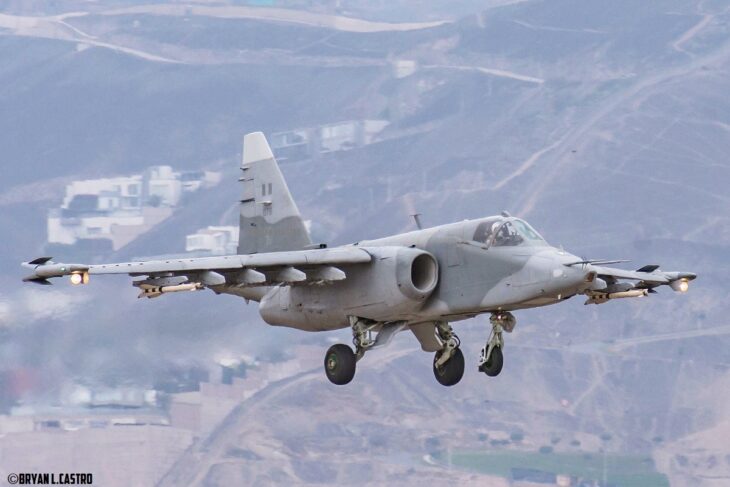

The Su-25 is a heavily armored attack jet built to support troops on the ground. Peru received 18 from Belarus in the late 1990s, according to TWZ, and flies them from El Pato air base at Talara with Grupo Aéreo 11.
By 2018, the fleet needed outside help to stay in the air. Infodefensa reported that year that SEMAN Peru and Rosoboronexport were recovering 10 Su-25s for about S/96.4 million.
FlightGlobal’s 2026 directory lists two Su-25s as combat aircraft and six as trainers, so most of the jets it counts are two-seaters. No replacement has been announced.
Does Peru still fly the A-37 Dragonfly?
No, even though FlightGlobal’s 2026 directory still lists 20 of them. Peru flew the Cessna A-37B light attack jet from the mid-1970s, but El Estratégico reported in November 2024 that it was withdrawn in 2023, and the MB-339 jet trainer was retired as well. Peru’s air force commander said that year the studies for a replacement were done and that the problem was the budget.
4. Mi-25 and Mi-35 Hind: The Attack Helicopters
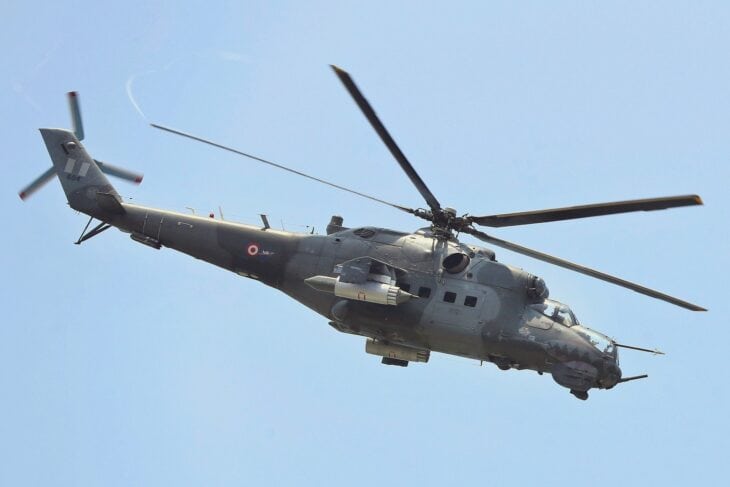

Peru has flown the Hind since 1983. Migflug records 12 Mi-25Ds and two Mi-25DUs from the Soviet Union in 1983 to 1985, seven more from Nicaragua in 1992, and two Mi-35Ps from Russia by 2011.
FlightGlobal counts 16 in use, making the Hind the force’s second-largest fleet. They fly from Vítor air base, near Arequipa, with Grupo Aéreo 2. Our Mi-35 page has the type’s specs.
5. KC-130H Tankers and the Spy Planes
Peru’s two aerial tankers are ex-Spanish KC-130H Hercules, bought for about $35 million and received in 2020 or 2021, depending on the source Migflug cites.
Six smaller aircraft fly reconnaissance and photo-mapping: two Learjets, three Merlin IV/Metro twins and a Turbo Commander, by FlightGlobal’s count. Migflug notes that the Metros, flown as C-26s, were donated by the United States for counter-drug work.
A KC-135R Stratotanker would be a big step up. Pucara reports one is included in the F-16 deal, though neither Lockheed Martin nor the US government has confirmed it.
6. C-27J Spartan, Twin Otter and the Transport Fleet
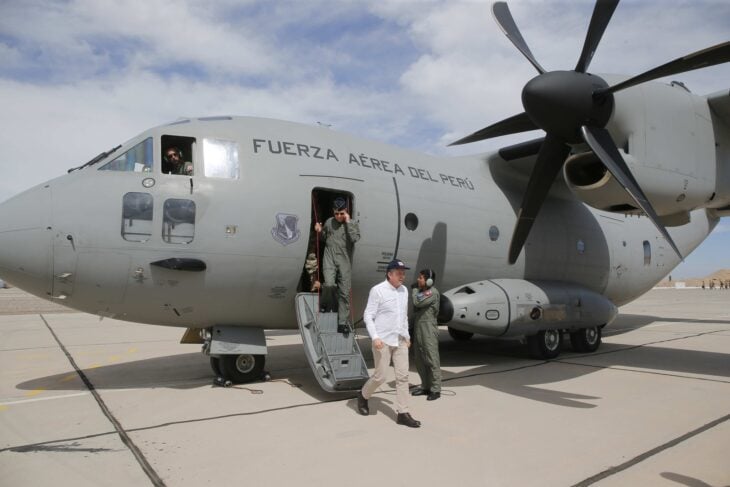

Peru’s transports have to reach the Amazon and the high Andes. FlightGlobal counts 28 in all, led by 15 DHC-6 Twin Otters, which Grupo Aéreo 42 flies from Iquitos, in the Amazon.
The C-27J Spartan is the newest tactical transport: four were delivered from 2015 to 2017, and a fifth, a C-27J Next Generation, was ordered on May 4, 2026, for €57.97 million, according to Migflug.
The rest are three L-100 Hercules, the civil version of the C-130, an An-32, two King Air 360s and a handful of light aircraft. Migflug reports that the first of two new Boeing 737-800s arrived in June 2026.
7. Mi-17/171 and the Utility Helicopters
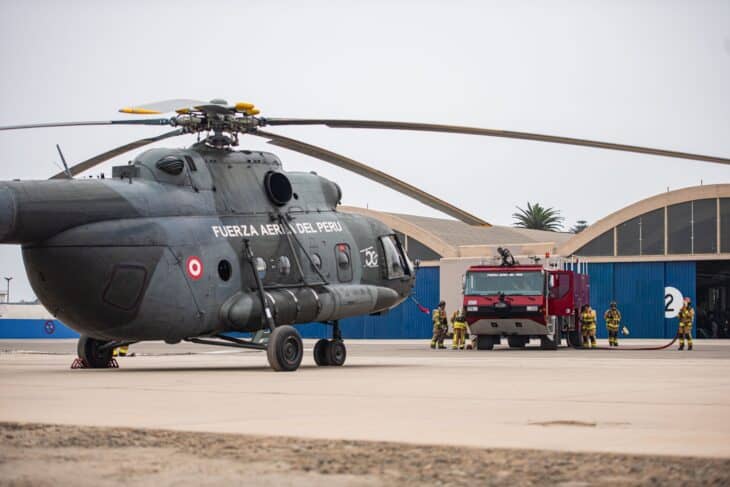

FlightGlobal counts nine Mi-17 and Mi-171 transport helicopters, plus three Bell 212 and 412s and two BO105 light helicopters. One Mi-17 was lost on February 22, 2026, Migflug records.
Peru’s Army flies far more of the same family: FlightGlobal lists 43 Mi-8, Mi-17 and Mi-171s in Army aviation, almost five times the air force’s number.
8. KT-1P Woongbi: Built in Peru
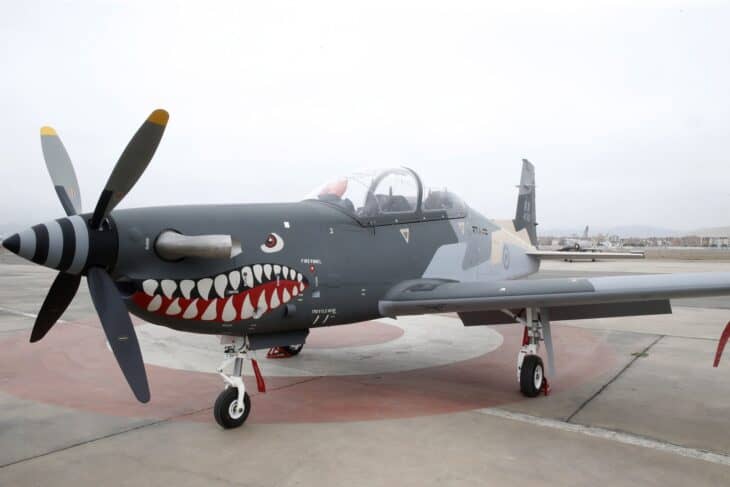

Peru ordered 20 KAI KT-1 Woongbi turboprops from South Korea on November 6, 2012, for about $208 million: 10 KT-1P trainers and 10 armed KA-1Ps. Korea Aerospace Industries built four, and SEMAN, the air force’s own maintenance company, assembled the rest in Peru, Migflug records.
One was lost on May 21, 2025, and FlightGlobal counts 19, the force’s largest single fleet. Students start on 10 Zenair CH2000s and three Zlin 242s, and helicopter pilots train on Enstrom 280s and Hughes 269s.
The gap is in the middle. With the MB-339 gone, El Estratégico reported in 2024 that the KT-1P was covering training on its own, and Infodefensa reported that Peru had put an advanced jet trainer behind new fighters in its spending plans.
From 1929 to the Cenepa War: A Short History
Peru’s Army began military flying on January 28, 1919. On May 20, 1929, Army and Navy aviation merged into the Cuerpo de Aviación del Perú, the date usually given as the air force’s founding, and the name Fuerza Aérea del Perú arrived on July 18, 1950.
Its best-known pilot is Lt. José Quiñones Gonzales, killed on July 23, 1941, while attacking an Ecuadorian position on the Zarumilla River in a North American NA-50. Peru made him a national hero, and July 23 is its Day of Military Aviation, according to Migflug.
The Cenepa War with Ecuador ran from January 26 to February 28, 1995. Ecuador claims its fighters shot down two Peruvian Su-22s and an A-37B on February 10, a claim Peru disputes for the Su-22s, and Peru lost at least two helicopters.
Its darkest peacetime day came on April 20, 2001. A Peruvian A-37B, guided by a CIA-contracted surveillance plane, fired on a missionary floatplane near Pebas, killing Veronica Bowers and her seven-month-old daughter, Charity, and the United States suspended the joint drug interdiction program.
How Strong Is the Peruvian Air Force?
On paper, Peru has 27 jet fighters and attack jets. But the youngest of them arrived in the late 1990s, the Russian-built ones are short of parts, and Peru does not publish how many can fly.
Its neighbors have moved faster. The Chilean Air Force flies 46 F-16s, and Colombia’s air force has 17 Gripens on order. Peru’s 24 F-16 Block 70s would close much of that gap, but not before 2030.
Our rankings of the largest air forces in the world and the best air forces in the world show how far size and strength can drift apart.
FAQ
Sources and references used for research and fact-checking.
- FlightGlobal, World Air Forces 2026 directory
- Lockheed Martin, Peru Selects Lockheed Martin F-16 Block 70
- The Aviationist, Peru Selects F-16 Block 70 Fighters Amid Political Crisis
- TWZ, F-16 Cleared To Be Peru's Next Fighter
- Militarnyi, Peru Buys F-16s Instead of Gripen, Despite Tender Win
- Infobae, Perú completa el pago para la compra de 24 aviones de combate
- Pucara, Perú avanza con la compra del segundo lote de doce F-16 Block 70
- Aviacionline, Perú prepara un contrato de USD 1.150 millones por los otros 12 F-16 Block 70
- Migflug, Peruvian Air Force
- Wikipedia, Peruvian Air Force
- Infodefensa, La Fuerza Aérea de Perú incorpora el primer Su-25 recuperado
- El Estratégico, KAI FA-50: una posibilidad para reemplazar a los aviones MB-339 y A-37B dados de baja
- Infodefensa, La Fuerza Aérea del Perú descarta al Yak-130 y priorizará la compra de aviones caza
Get the Newsletter
The latest aviation news and stories sent to your inbox.
About the Author

Tim is the owner and lead editor of AeroCorner since 2019, overseeing aviation content covering aircraft, airlines, airports, and the broader aviation industry. Through years of researching, writing, editing, and publishing aviation-focused content, he has developed extensive practical knowledge of commercial aviation and air travel. Based in Asia and a frequent traveler himself, Tim also brings firsthand passenger experience to AeroCorner’s coverage. Outside of publishing, he has also explored aviation firsthand through hands-on flight training in New Zealand.