

Table of Contents
The biggest bomb ever dropped is the Soviet Tsar Bomba, a 27-tonne (about 59,500 lb) hydrogen bomb released from a Tu-95V bomber over the Arctic on October 30, 1961. It is the heaviest bomb ever dropped from an aircraft and, at 50 megatons, the most powerful explosion humans have ever set off.
The biggest non-nuclear bomb ever dropped is the American T-12 Cloudmaker, a 43,600 lb (19,800 kg) earthquake bomb that was test-dropped from a B-36 but never used in war. The heaviest one used in combat is the 30,000 lb (13,600 kg) GBU-57 Massive Ordnance Penetrator, which B-2 bombers dropped on Iran in June 2025.
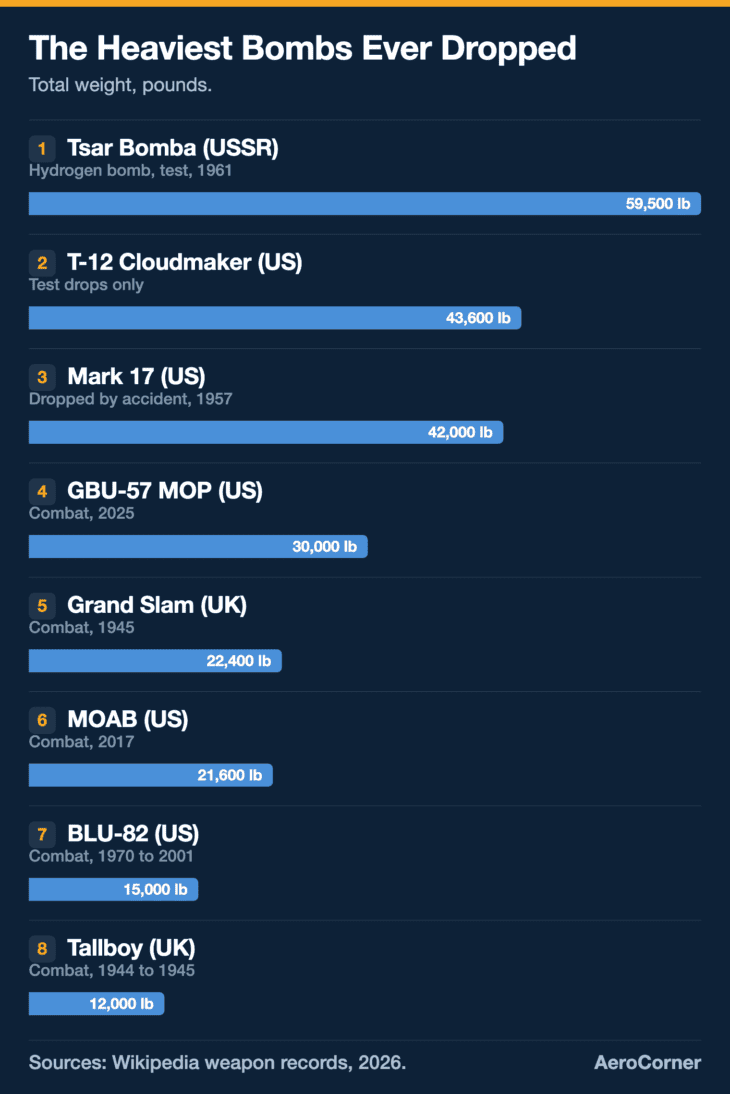
This list ranks bombs by total weight, as of November 2026. Every entry was actually released from an aircraft, in a test, in combat or by accident.
| Rank | Bomb | Weight | Type | Dropped |
|---|---|---|---|---|
| 1 | Tsar Bomba (AN602), USSR | 59,500 lb (27,000 kg) | Hydrogen bomb, 50 megatons | Test, 1961 |
| 2 | T-12 Cloudmaker, US | 43,600 lb (19,800 kg) | Earthquake bomb | Tests, B-36 era |
| 3 | Mark 17, US | 42,000 lb (19,000 kg) | Hydrogen bomb | Accident, 1957 |
| 4 | GBU-57 MOP, US | 30,000 lb (13,600 kg) | Guided bunker buster | Combat, 2025 |
| 5 | Grand Slam, UK | 22,400 lb (10,200 kg) | Earthquake bomb | Combat, 1945 |
| 6 | GBU-43/B MOAB, US | 21,600 lb (9,800 kg) | Air-burst blast bomb | Combat, 2017 |
| 7 | BLU-82 Daisy Cutter, US | 15,000 lb (6,800 kg) | Blast bomb | Combat, 1970 to 2001 |
| 8 | Tallboy, UK | 12,000 lb (5,400 kg) | Earthquake bomb | Combat, 1944 to 1945 |
| 9 | Fat Man, US | 10,265 lb (4,656 kg) | Atomic bomb, 21 kilotons | Combat, 1945 |
| 10 | Little Boy, US | 9,700 lb (4,400 kg) | Atomic bomb, about 15 kilotons | Combat, 1945 |
How this ranking works
Bombs are ranked by total weight, the measure that decides which aircraft can carry them. Only bombs that actually left an aircraft count, whether in a test, in combat or by accident, so designs that never flew are out. Explosive power is a different measure: a 9,700 lb atomic bomb releases far more energy than a 30,000 lb bunker buster, so the yield or explosive fill is given for each entry as well. Bombs whose total weight was never published, such as Russia’s Father of All Bombs, are covered at the end rather than ranked.
1. Tsar Bomba (AN602): 59,500 lb (27,000 kg)
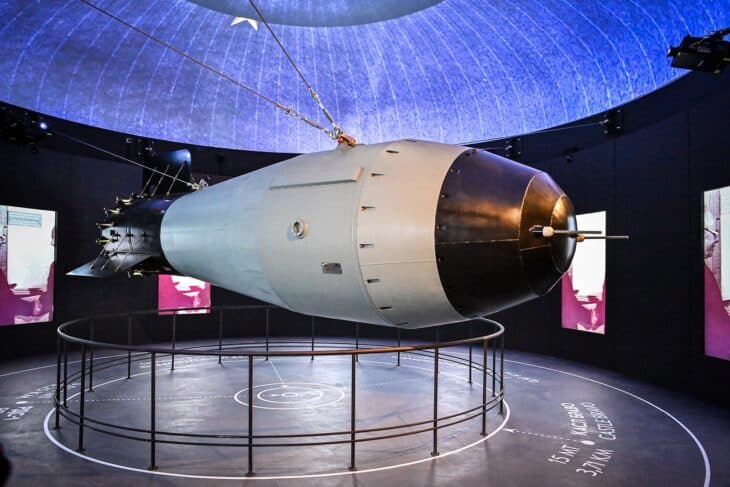

The Tsar Bomba weighed 27 tonnes and measured 26 feet (8 m) long and 6 feet 11 inches (2.1 m) across. It was so large that the Tupolev Tu-95 chosen to carry it had its bomb bay doors and fuselage fuel tanks removed to fit it.
On October 30, 1961, Major Andrei Durnovtsev’s crew dropped it over Severny Island in the Novaya Zemlya archipelago. An 1,800 lb (800 kg) parachute of about 17,000 square feet (1,600 square meters) slowed its fall, and it detonated 13,000 feet (4,000 m) above the ground.
The yield was 50 megatons, about 1,570 times the combined energy of the Hiroshima and Nagasaki bombs. The mushroom cloud rose about 42 miles (67 km), and the flash was seen almost 620 miles (1,000 km) away.
The crew was given a 50-50 chance
The Tu-95V and its Tu-16 observer aircraft were painted with reflective paint, yet Durnovtsev’s crew was told it had only a 50% chance of surviving. The shock wave knocked the bomber down 2,600 feet (800 m) in the air, but both aircraft recovered and landed safely. The design could have yielded about 100 megatons; it was cut to 50 partly to give the bomber time to escape.
2. T-12 Cloudmaker: 43,600 lb (19,800 kg)
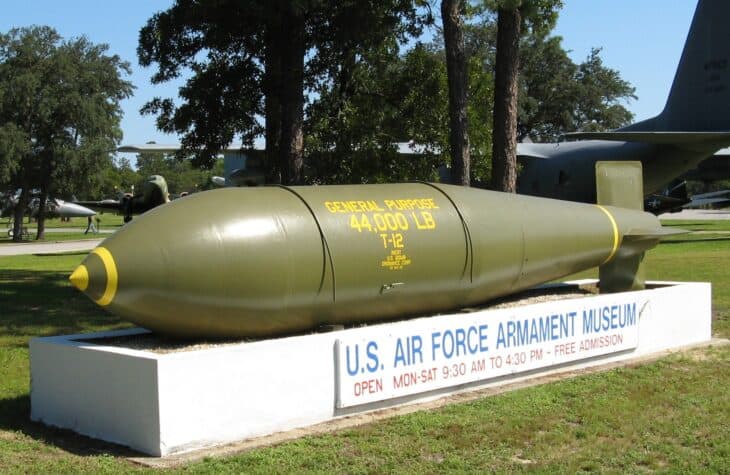

The T-12 is the heaviest non-nuclear bomb ever dropped. The United States developed it from 1944 to 1948 as a scaled-up answer to Britain’s wartime earthquake bombs, with a thick hardened nose built to bury itself deep in the ground before exploding.
Its target weight was 42,000 lb, half the maximum payload of the Convair B-36 Peacemaker, and the finished bomb came in at 43,600 lb. That made it twice the weight of America’s previous largest bomb, the 22,000 lb T-14, a US-built copy of the Grand Slam.
Only the B-36 could carry it in service, although a converted B-29 was used for early testing. One B-36 test flight dropped two of them, the first from 30,000 feet and the second from 40,000 feet. The T-12 stayed in the inventory from 1949 until the B-36 retired in 1958 and was never used in combat.
3. Mark 17 Hydrogen Bomb: 42,000 lb (19,000 kg)
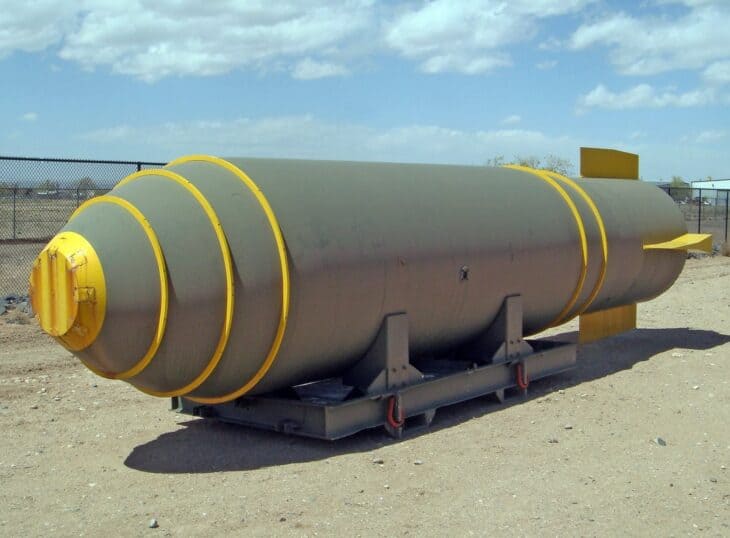

The Mark 17 and its near-twin, the Mark 24, were the first mass-produced American hydrogen bombs and the largest nuclear weapons the United States ever put into service. Each was 24 feet 8 inches (7.52 m) long, weighed 42,000 lb, and carried a design yield of 15 megatons.
Only the B-36 could lift one. The Air Force built 200 Mark 17s and 105 Mark 24s between October 1954 and November 1955, then withdrew them all by August 1957 as smaller, lighter bombs arrived.
One Mark 17 was dropped anyway. In May 1957, a B-36 approaching Kirtland Air Force Base in New Mexico at about 1,700 feet (520 m) let one fall through its closed bomb bay doors just south of Albuquerque.
A 25-foot crater, and no nuclear blast
The bomb’s conventional explosives went off on impact and left a crater about 25 feet (7.6 m) wide and 12 feet (3.7 m) deep. A nuclear chain reaction was impossible because the plutonium core was stored separately on the aircraft, but the blast spread radioactive debris over an area about a mile wide.
4. GBU-57 Massive Ordnance Penetrator: 30,000 lb (13,600 kg)
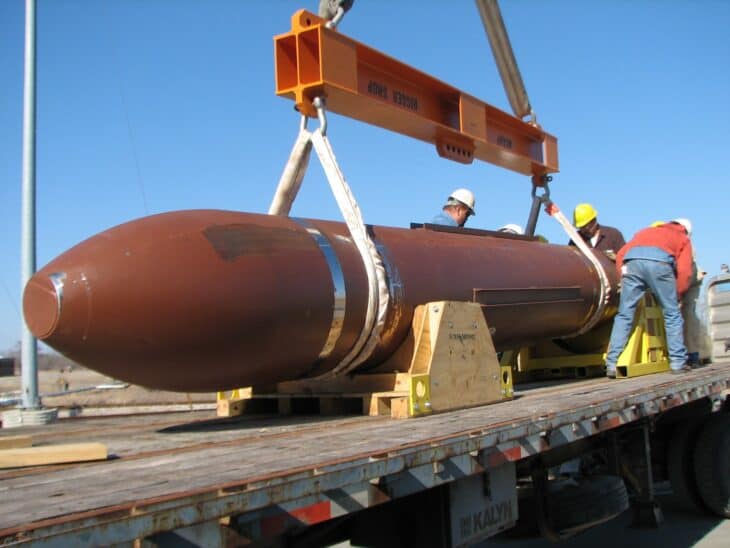

The GBU-57 MOP is the heaviest bomb ever used in combat. Boeing built it for the US Air Force as a 30,000 lb class, 20.5-foot (6.2 m) GPS-guided bunker buster with a case of high-density steel designed to punch deep underground before the fuze sets it off.
Most of that weight is steel: the explosive fill is 5,342 lb (2,423 kg). Only the B-2 Spirit is configured to carry it, two at a time, and the B-21 Raider is slated to follow.
The first combat use came on June 22, 2025, in Operation Midnight Hammer. Seven B-2s flew from Whiteman Air Force Base in Missouri and dropped 14 MOPs, 12 on the Fordow enrichment plant and two on Natanz.
5. Grand Slam: 22,400 lb (10,200 kg)
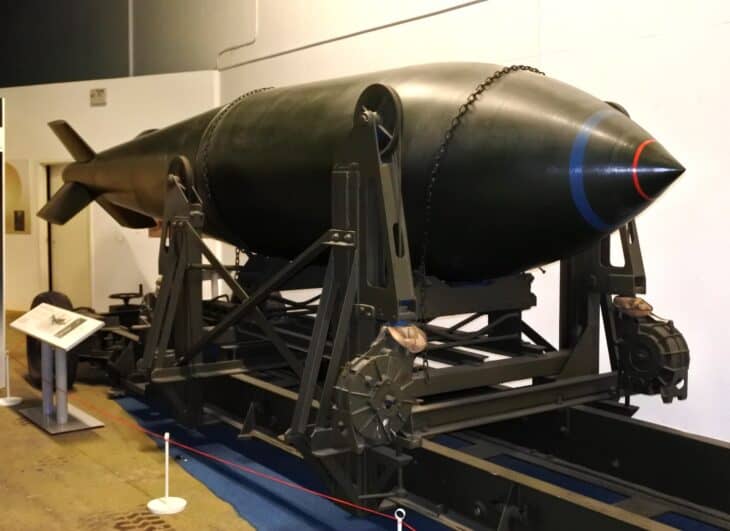

Barnes Wallis’s Grand Slam was the heaviest bomb of the Second World War. Officially the “Bomb, Medium Capacity, 22,000 lb”, the finished weapon weighed 22,400 lb, stood 25.5 feet (7.8 m) long and held 9,200 lb (4,200 kg) of Torpex explosive, poured into the nose a bucketful at a time.
Specially modified Avro Lancasters of 617 and 9 Squadrons carried it. The first operational drop, on March 14, 1945, helped bring down a section of the Bielefeld railway viaduct that 54 earlier raids had failed to cut for long.
Between March 14 and April 19, 1945, the RAF dropped 42 Grand Slams on Germany, mostly on railway viaducts, bridges and U-boat pens. It is still heavier than the MOAB that the US used in 2017, although half its weight is steel casing.
6. GBU-43/B MOAB: 21,600 lb (9,800 kg)
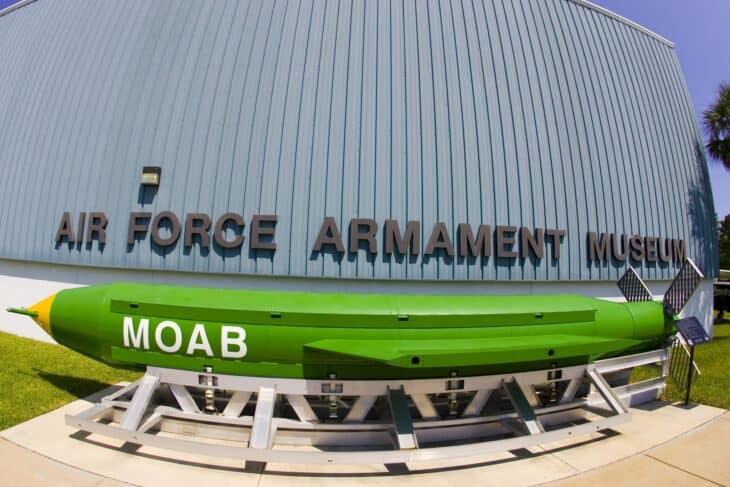

The Massive Ordnance Air Blast bomb, nicknamed the Mother of All Bombs, is the opposite of a penetrator. A light 2,900 lb (1,300 kg) aluminum case wraps 18,700 lb (8,500 kg) of H-6 explosive, so almost all of its weight goes into the blast.
It rides out of the back of an MC-130 special operations transport on a cradle pulled by drogue parachutes, then falls free under GPS guidance. It was first tested at Eglin Air Force Base, Florida, on March 11, 2003, and 15 have been built.
The first combat use came on April 13, 2017, against an Islamic State tunnel complex in the Achin district of Nangarhar province, Afghanistan. By the weight of explosive it carries, it is described as the most powerful conventional bomb ever used in combat.
Heavier is not more powerful
The GBU-57 outweighs the MOAB by more than 8,000 lb, but the MOAB carries roughly three and a half times as much explosive: 18,700 lb against 5,342 lb. One is built to survive hitting rock, the other to turn nearly all of its weight into blast.
7. BLU-82 Daisy Cutter: 15,000 lb (6,800 kg)
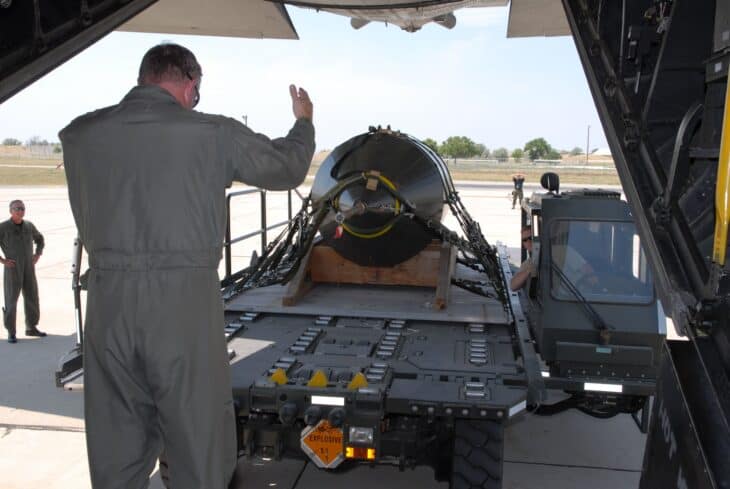

The BLU-82 earned its nickname in Vietnam, where it flattened a section of jungle into an instant helicopter landing zone. Its 12,600 lb (5,700 kg) of GSX slurry, a mix of ammonium nitrate, aluminum powder and polystyrene, was set off just above the ground so it cleared trees without digging a crater.
It was pushed out of C-130 and MC-130 transports, and 225 were built. The first went down north of Long Tieng, Laos, on March 22, 1970, and later drops followed in the 1991 Gulf War and in Afghanistan in 2001.
Its blast was big enough that a British SAS team that watched one in 1991 radioed that the Americans had “just nuked Kuwait”. The last BLU-82 was dropped at the Utah Test and Training Range on July 15, 2008, and the MOAB replaced it.
8. Tallboy: 12,000 lb (5,400 kg)
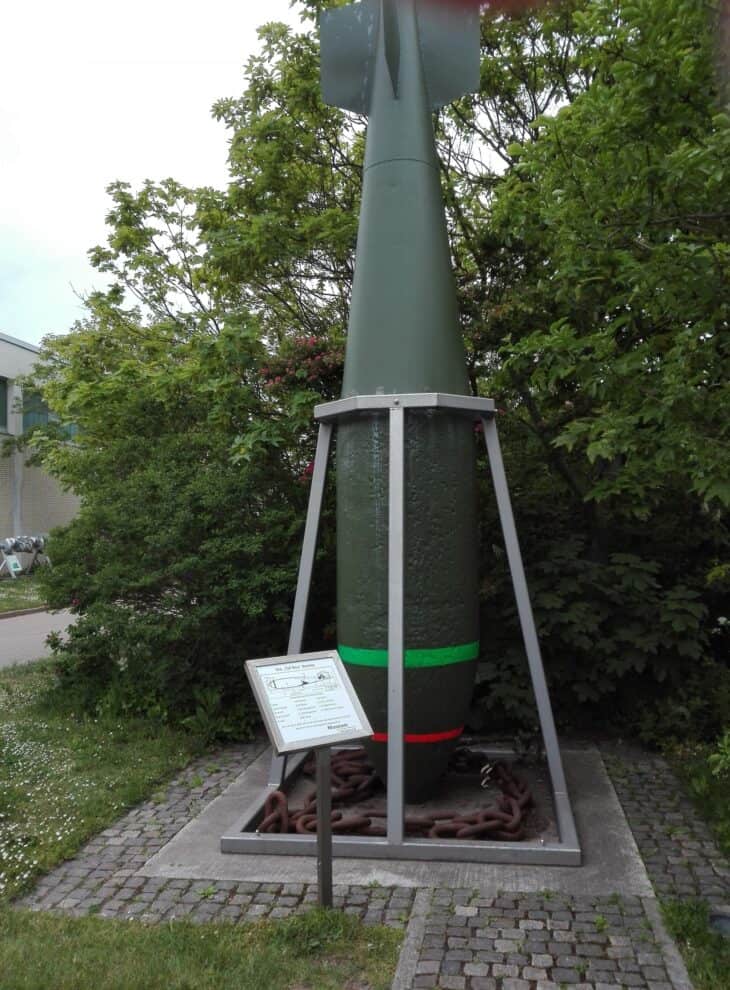

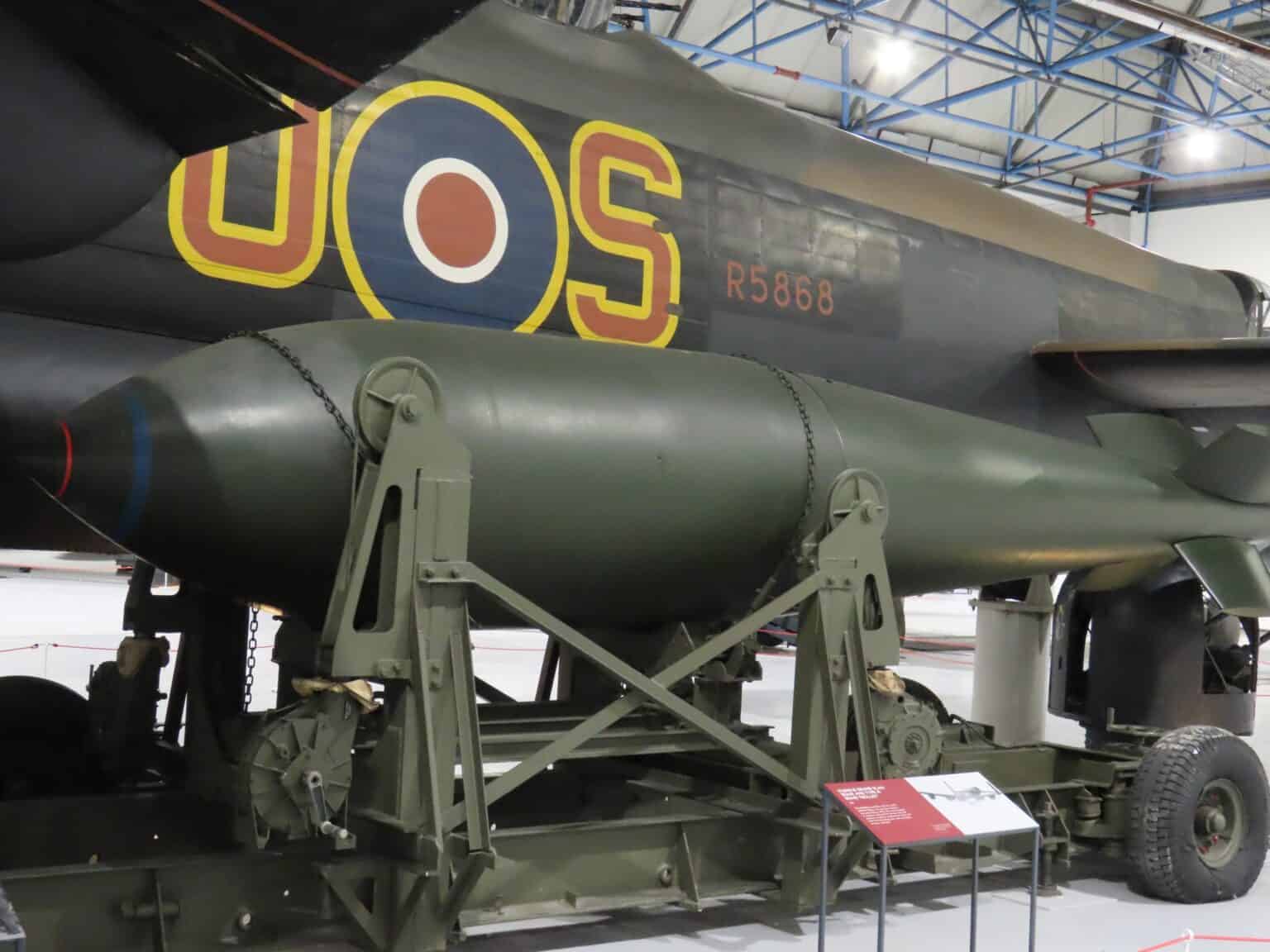
Tallboy was the Grand Slam’s smaller predecessor, also designed by Barnes Wallis. It was built to be dropped from about 18,000 feet (5,500 m), hit the ground at around 750 mph (1,210 km/h) and bury itself before exploding, leaving a crater about 80 feet (24 m) deep.
Only stripped-down Lancasters could lift one, with armor and some defensive guns removed. Tallboys wrecked V-weapon sites, a railway tunnel in France and U-boat pens in 1944 and 1945, and they sank the battleship Tirpitz, a raid told in full in our story of the Lancaster attack that capsized the Tirpitz.
9. Fat Man: 10,265 lb (4,656 kg)
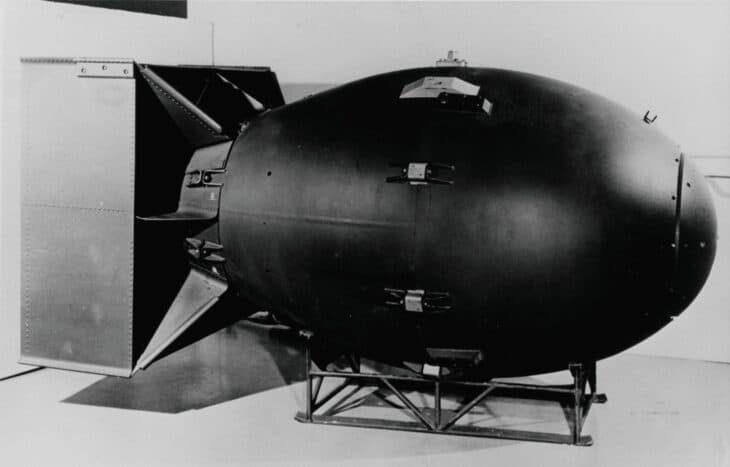

Fat Man, the plutonium implosion bomb dropped on Nagasaki on August 9, 1945, weighed 10,265 lb and measured about 10 feet 8 inches (3.26 m) long and 5 feet (1.53 m) across. It is the heavier of the only two nuclear weapons ever used in war.
Only about 2.2 lb (1 kg) of its 13.6 lb (6.19 kg) of plutonium actually fissioned, yet it released the energy of 21 kilotons of TNT. That makes it the most powerful bomb ever used in combat, despite weighing a third as much as the GBU-57.
10. Little Boy: 9,700 lb (4,400 kg)
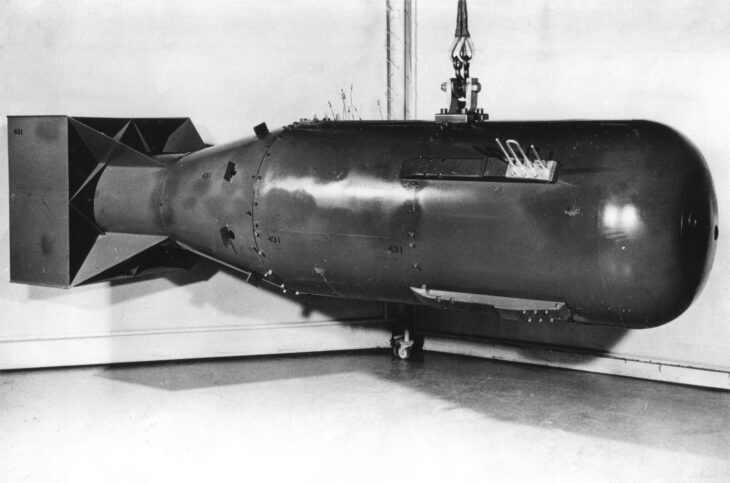

Little Boy, the uranium gun-type bomb, weighed about 9,700 lb and was 10 feet (3 m) long and 28 inches (71 cm) across. The B-29 Enola Gay dropped it on Hiroshima on August 6, 1945, the first use of a nuclear weapon in war.
It exploded with the energy of about 15 kilotons of TNT. President Truman’s announcement put it at 20 kilotons, a figure his speech writers rounded up from an early visual estimate. The pilot who flew it, Paul Tibbets, later spent a decade running the jet company that became NetJets.
What About the Father of All Bombs?
Russia’s Aviation Thermobaric Bomb of Increased Power, nicknamed the Father of All Bombs, is often called the most powerful non-nuclear bomb in the world. Russia says it uses about seven tons of a new explosive and yields the equivalent of 44 tonnes of TNT, four times the MOAB.
Those figures come from one Russian test announced on September 11, 2007, and analysts have questioned them. Wired noted that the test video never shows the bomb and the bomber in the same shot, while Jane’s editor Robert Hewson told the BBC it was likely the world’s biggest non-nuclear bomb.
Why it is not on the list
Russia has never published the bomb’s total weight, only its claimed explosive load and yield, and it has no confirmed combat use. On the measure this list uses, it cannot be placed. On claimed blast power alone it would beat the MOAB, but that claim rests on Russia’s word and one edited video.
The bombs on this list also tell the story of the aircraft built around them, from the Lancaster to the B-2. For the aircraft side, see our ranking of the best bombers in the world.
FAQ
Sources and references used for research and fact-checking.
- Wikipedia, Tsar Bomba
- Wikipedia, T-12 Cloudmaker
- Wikipedia, Convair B-36 Peacemaker
- Wikipedia, Mark 17 nuclear bomb
- Wikipedia, GBU-57A/B MOP
- Wikipedia, Operation Midnight Hammer
- Wikipedia, Grand Slam (bomb)
- Wikipedia, GBU-43/B MOAB
- Wikipedia, BLU-82
- Wikipedia, Tallboy (bomb)
- Wikipedia, Fat Man
- Wikipedia, Little Boy
- Wikipedia, Father of All Bombs
Get the Newsletter
The latest aviation news and stories sent to your inbox.
About the Author

Tim is the owner and lead editor of AeroCorner since 2019, overseeing aviation content covering aircraft, airlines, airports, and the broader aviation industry. Through years of researching, writing, editing, and publishing aviation-focused content, he has developed extensive practical knowledge of commercial aviation and air travel. Based in Asia and a frequent traveler himself, Tim also brings firsthand passenger experience to AeroCorner’s coverage. Outside of publishing, he has also explored aviation firsthand through hands-on flight training in New Zealand.