

Table of Contents
At 8:15 and 17 seconds on the morning of August 6, 1945, a single bomb fell out of a B-29 at 31,600 feet (9,630 m) over Hiroshima. The man at the controls had 43 seconds to throw the bomber into a turn steep enough to outrun the shock wave.
That pilot was Paul Tibbets, and those 43 seconds are almost all most people know about him. His flying life actually ran from a barnstormer’s open cockpit in 1927 to the president’s office of a private jet company in the 1980s.
This is the aviation career the biographies skim: why the Army picked him, what the mission demanded of the pilot, and the second career almost nobody connects to the Enola Gay.
Who Was Paul Tibbets?
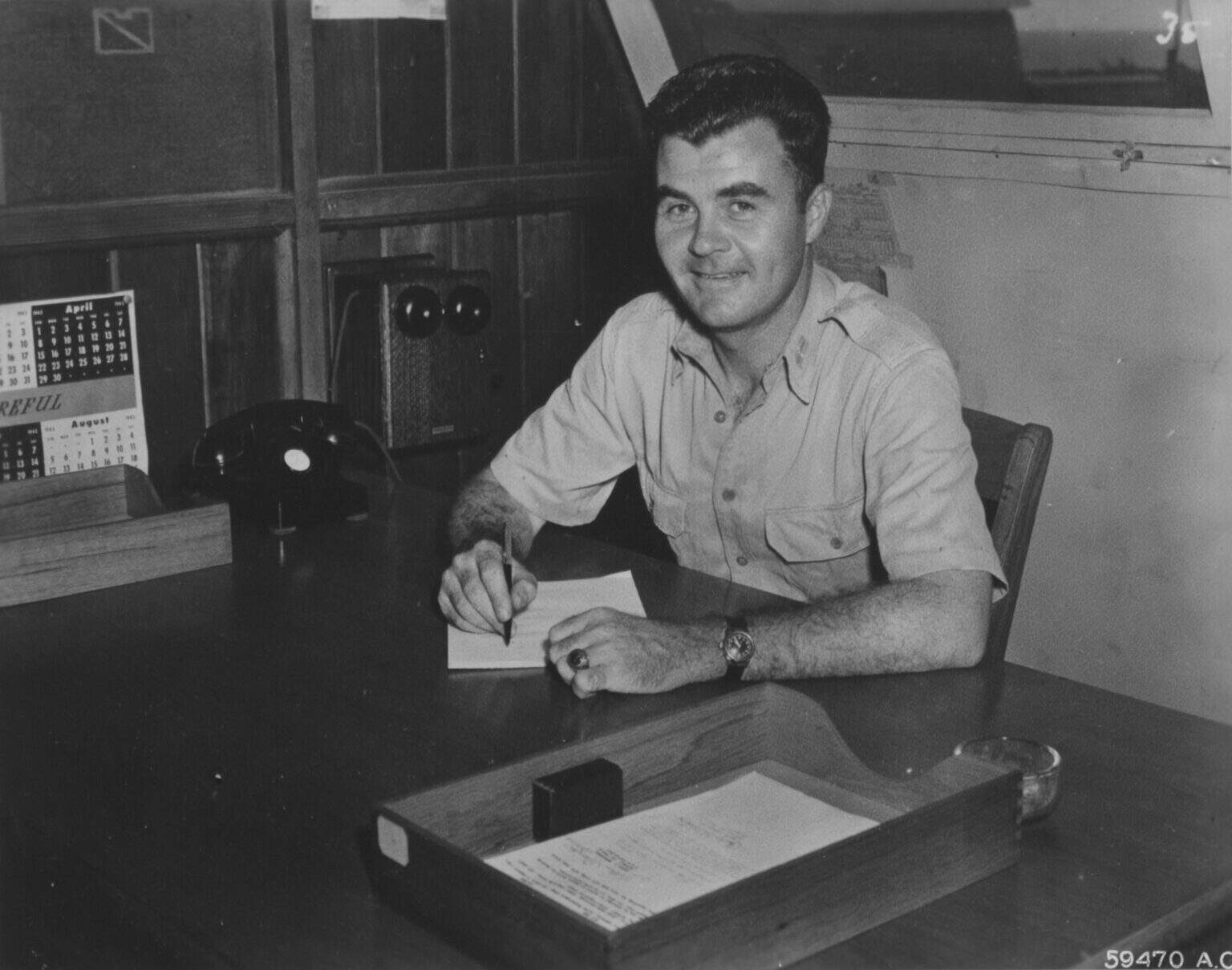
Paul Warfield Tibbets Jr. (1915 to 2007) was the US Army Air Forces pilot who commanded the 509th Composite Group and flew the B-29 Enola Gay on the first atomic bomb mission, against Hiroshima, on August 6, 1945. He was a 30-year-old colonel at the time.
Before that, he flew B-17s in the first American heavy bomber raids on occupied Europe and became one of the most experienced B-29 pilots in the world. After the war he retired from the Air Force as a brigadier general in 1966, then helped run Executive Jet Aviation, the company now called NetJets.
Paul Tibbets at a glance
Born February 23, 1915, in Quincy, Illinois. Earned his pilot rating in 1938. Flew B-17s over Europe in 1942, test-flew the B-29 from 1943, commanded the 509th Composite Group from September 1944, and piloted the Enola Gay on August 6, 1945. Retired as a brigadier general in 1966. President of Executive Jet Aviation from 1976 to 1986. Died November 1, 2007, in Columbus, Ohio, aged 92.
Why the Army Picked Him for the Bomb
Tibbets got the job because by 1944 almost nobody else had his mix of combat command and bomber test time. He had first flown at 12, in 1927, riding with a barnstormer who dropped Baby Ruth candy bars on little parachutes over Hialeah Park in Florida.
He left medical school to join the Army Air Corps in 1937 and earned his wings at Kelly Field, San Antonio, in 1938. By February 1942 he commanded the 340th Bombardment Squadron of the 97th Bomb Group, flying the Boeing B-17 Flying Fortress.
The first American heavy bomber raid on Europe
On August 17, 1942, 18 B-17Es of the 97th took off from England, with 12 bombing the railroad yards at Rouen-Sotteville in France and six flying a diversion. Tibbets was in the cockpit of the lead ship, Butcher Shop, alongside group commander Col. Frank Armstrong.
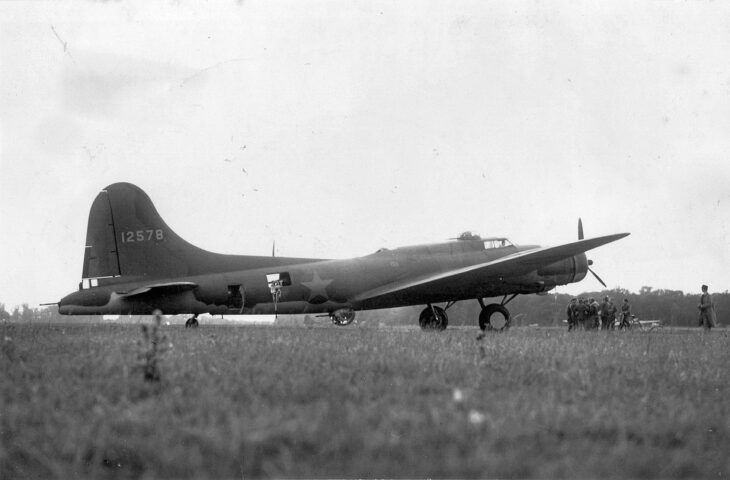

Accounts differ on which of the two sat in the left seat, but they agree no bomber was lost. On October 9, 1942, Tibbets led the first American raid of more than 100 bombers in Europe, against Lille, and he also flew Maj. Gen. Mark Clark to Gibraltar.
The B-29 test pilot who used two WASPs to shame the doubters
In February 1943 he was sent home to help fix the Boeing B-29 Superfortress, a program in trouble after chief test pilot Edmund Allen died in a prototype crash. Flying out of Wichita, Tibbets soon had more time in the B-29 than any other pilot.
He found that stripping out the guns and armor made the bomber about 7,000 pounds (3,200 kg) lighter. In mock combat against a P-47 at 30,000 feet (9,100 m), the lightened B-29 could escape simply by turning away.
Crews still feared the B-29, which was bigger than anything they had flown and prone to engine fires. So Tibbets trained two Women Airforce Service Pilots, Dora Dougherty and Dorothea Moorman, and sent them around in a B-29 named Ladybird. Dougherty had never flown a four-engine airplane before.
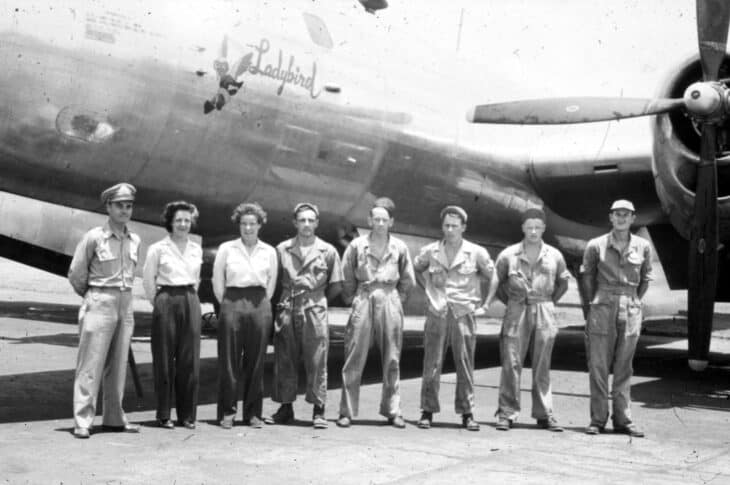

It worked: the men stopped complaining once women were flying the airplane they called too dangerous. Air Staff Maj. Gen. Barney Giles shut the tour down after a few days, saying the women were “putting the big football players to shame.”
Why Tibbets and not someone senior
On September 1, 1944, Tibbets was briefed in Colorado Springs by Maj. Gen. Uzal Ent and Manhattan Project officers. Frank Armstrong and Roscoe Wilson were the other leading candidates, but Tibbets was younger, had combat command, and was already an experienced B-29 pilot. He chose the remote base at Wendover, Utah, to train the new 509th Composite Group.
What the Hiroshima Mission Asked of the Pilot
The Enola Gay was not a standard B-29. Glenn L. Martin’s plant in Nebraska built a batch of Silverplate bombers for the mission, with every gun turret except the tail removed, the armor plate taken out and the bomb bay rebuilt for an atomic weapon.
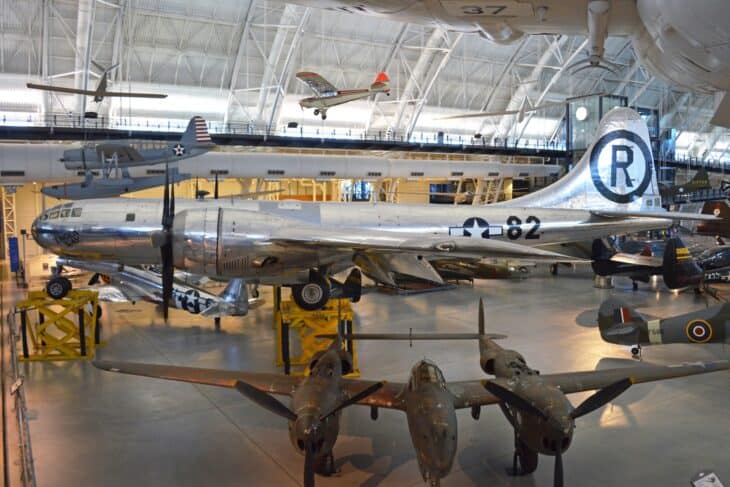

Fifteen Silverplate aircraft went to the 509th. Tibbets picked serial 44-86292 himself while it was still on the assembly line, which displaced its regular commander, Robert Lewis, who flew the mission as co-pilot and was angry about it.
Robert Oppenheimer had warned Tibbets that his aircraft might not survive the shock waves. The answer was the escape turn: after release, Tibbets made what he called “the required 155-degree turn away from the target,” putting as much distance as he could between the bomber and the burst.
The Enola Gay took off from North Field on Tinian at 2:45 a.m. and reached Hiroshima about six hours later. The bomb exploded 43 seconds after release, about 1,800 feet (550 m) above the city.
Three shock waves reached the bomber: the first at 2.5 G, the second at 2 G, then a smaller third. Tibbets later recalled a peculiar taste in his mouth and a cloud already 10,000 feet above them by the time they turned to look.
He had only named the airplane the day before, on August 5, 1945, after his mother, Enola Gay Tibbets. Nearly 80,000 people were killed instantly, and almost every building within 2 miles (3.2 km) of the burst was destroyed.
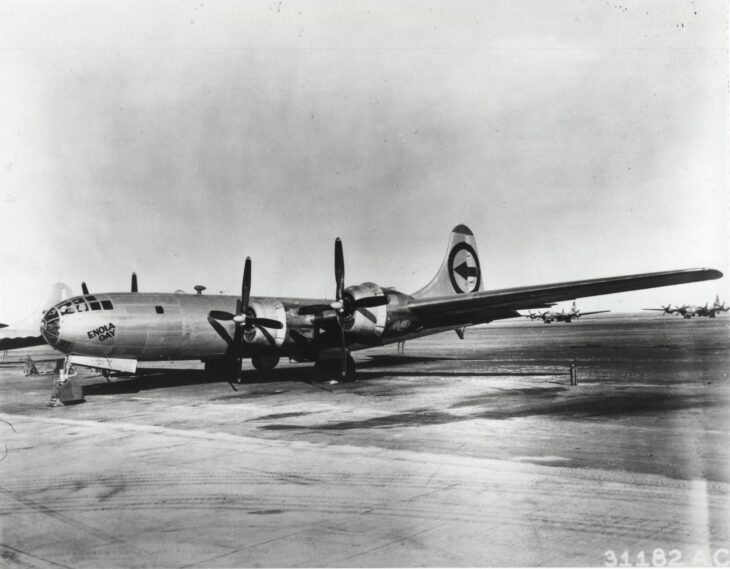

The Enola Gay survives today at the Smithsonian’s Steven F. Udvar-Hazy Center in Chantilly, Virginia, after a restoration that took nearly two decades. Of every B-29 built, only two still fly today.
A 60-Year Flying Life in Dates
Hiroshima sits roughly in the middle of a career that started with candy drops and ended in business aviation.
1927
First flight, age 12. Rides with barnstormer Doug Davis, dropping Baby Ruth bars over Hialeah Park, Florida.
1938
Pilot rating. Earns his wings at Kelly Field, San Antonio, after enlisting in 1937.
Aug 17, 1942
First US heavy bomber raid on Europe. Flies the lead B-17, Butcher Shop, against Rouen-Sotteville.
1943
B-29 test pilot. Builds more B-29 time than any other pilot at Wichita.
Sep 1, 1944
Picked for the bomb. Takes command of what becomes the 509th Composite Group at Wendover, Utah.
Aug 6, 1945
Hiroshima. Pilots the Enola Gay; awarded the Distinguished Service Cross on Tinian.
1950 to 1952
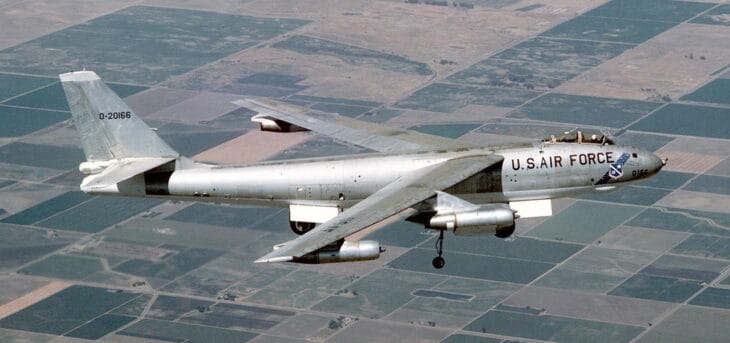
Jet bombers. B-47 project officer at Boeing in Wichita.
1966
Retires from the Air Force. Leaves as a brigadier general on August 31, after serving as military attaché in India.
1976 to 1986
President of Executive Jet Aviation. The company later renamed NetJets.
2007
Dies in Columbus, Ohio. Aged 92, on November 1.
The jet years were not a footnote. He spent 1950 to 1952 as project officer for the Boeing B-47 Stratojet, then commanded the 308th Bombardment Wing and the 6th Air Division before his promotion to brigadier general in 1959.

The Second Career: The Company That Became NetJets
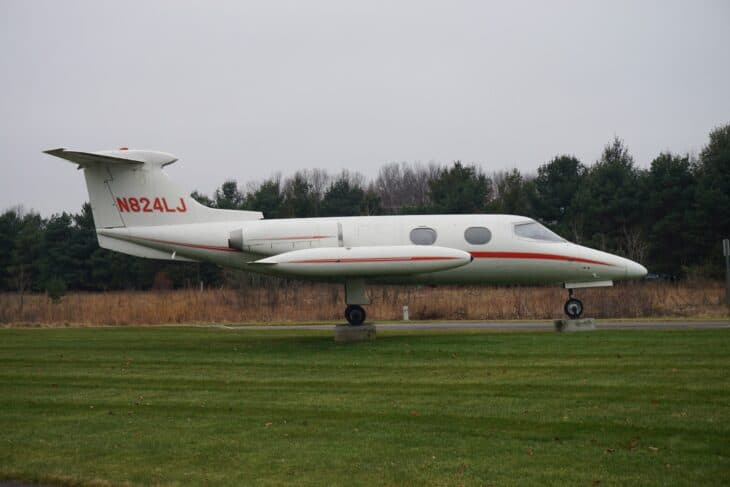
This is the part of the story almost nobody knows. In 1964 a retired Air Force general, Olbert “Dick” Lassiter, founded Executive Jet Airways, later Executive Jet Aviation, with a fleet of ten Learjet 23s.

Its founding board read like a Strategic Air Command reunion with a Hollywood guest list. Gen. Curtis LeMay and Paul Tibbets sat on it, and so did two entertainers who were also pilots, James Stewart and Arthur Godfrey.
Tibbets joined the company after leaving the Air Force in 1966 and tried, unsuccessfully, to expand it into Europe. He left in 1968, but Bruce Sundlun, who took over as president after the banks foreclosed in 1970, brought him back that year.
On April 21, 1976, Tibbets succeeded Sundlun as president of Executive Jet Aviation. He held the job until 1986, consulted for a year, and retired for the second time in 1987.
The Enola Gay pilot ran the company where fractional jets were born
Richard Santulli, a mathematician and former Goldman Sachs executive, bought Executive Jet Aviation in 1984 while Tibbets was president. The fractional ownership program he launched there in 1986 became NetJets, which Warren Buffett’s Berkshire Hathaway bought in 1998 for $725 million. The company took the NetJets name in 2002.
That company’s fleet has since grown bigger than Southwest Airlines’. The man who flew the first atomic mission ran it through the years when the idea behind it was being born.
The Myth: Did Paul Tibbets Regret Hiroshima?
The myth
A popular story holds that the pilot who dropped the bomb on Hiroshima spent the rest of his life haunted by guilt. The record says the opposite: Tibbets never expressed regret for flying the mission.
In 1975, Tibbets said he was proud of the plan. He also said, “I’m not proud that I killed 80,000 people,” and added, “I sleep clearly every night.”
His view never changed. In 2005 he said the killing had been foreseeable, and that his job had been to end the war as quickly as possible.
In 1976 he flew a restored B-29 over an air show in Harlingen, Texas, while a charge on the runway sent up a mushroom cloud to re-create the attack. Japan was outraged, and the US government issued a formal apology; Tibbets said the display “was not intended to insult anybody.”
He was just as deliberate about his death. Tibbets asked for no funeral and no headstone, fearing either would give protesters a place to gather, and his ashes were scattered over the English Channel.
The Tibbets Name Still Flies Bombers
The 509th did not disband after 1945. Its successor, the 509th Bomb Wing at Whiteman Air Force Base, Missouri, flies the world’s only fleet of B-2 Spirit stealth bombers.
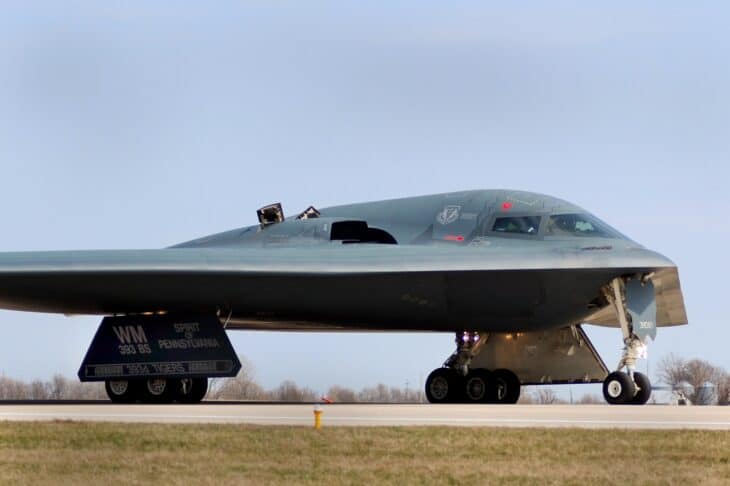

On June 5, 2015, Brig. Gen. Paul W. Tibbets IV, the Enola Gay pilot’s grandson and a former B-2 squadron commander, took command of that wing and its 5,500 airmen. “If my grandfather was here today, he would tell all of you how proud he is,” he told them.
Tibbets earns his spot among the most famous pilots in history for one morning over Japan. The rest of the logbook, from the first B-17 raid to the first fractional jet company, is the part worth knowing too.
Sources and references used for research and fact-checking.
- Wikipedia, Paul Tibbets
- Atomic Heritage Foundation, Tibbets on Hiroshima
- Smithsonian National Air and Space Museum, Boeing B-29 Superfortress "Enola Gay"
- PBS American Experience, Fly Girls: The WASP and the B-29
- This Day in Aviation, 17 August 1942
- Wikipedia, NetJets
- CBS News, Pilot Who Dropped Hiroshima Bomb Dead At 92
- U.S. Air Force, Continuing the legacy: Tibbets takes command of 509th Bomb Wing
Get the Newsletter
The latest aviation news and stories sent to your inbox.
About the Author

Tim is the owner and lead editor of AeroCorner since 2019, overseeing aviation content covering aircraft, airlines, airports, and the broader aviation industry. Through years of researching, writing, editing, and publishing aviation-focused content, he has developed extensive practical knowledge of commercial aviation and air travel. Based in Asia and a frequent traveler himself, Tim also brings firsthand passenger experience to AeroCorner’s coverage. Outside of publishing, he has also explored aviation firsthand through hands-on flight training in New Zealand.