

Table of Contents
In January 1942, an 18-year-old aircraft mechanic at Victorville, California, climbed into an airplane for the first time. His engineering officer had offered him a ride on a test flight.
It went badly. “After puking all over myself I said, ‘Yeager, you made a big mistake’,” he recalled.
That mechanic was Chuck Yeager. Within three years he was a fighter ace, and within six he had flown faster than sound. This is the whole flying life behind the name, including the parts the sound-barrier story leaves out, and the numbers that even official sources cannot agree on.
Who Was Chuck Yeager?
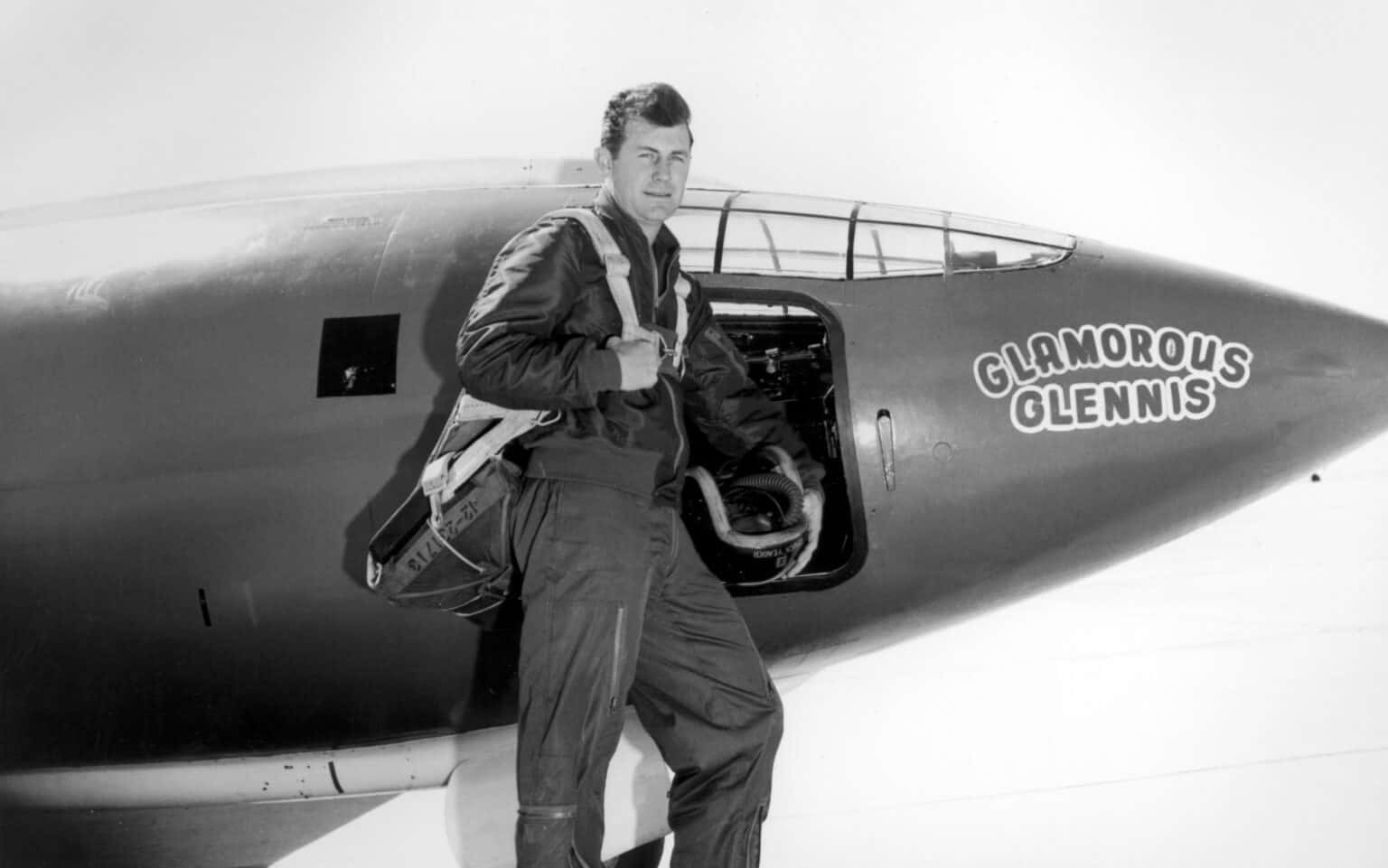
Charles Elwood “Chuck” Yeager (1923 to 2020) was a US Air Force pilot from West Virginia, and on October 14, 1947, he became the first person to fly faster than the speed of sound. He did it in the Bell X-1 rocket plane, which he named Glamorous Glennis after his wife.
That one flight made him famous, but it was the middle of a military career that ran more than three decades.
He was a World War II fighter ace who escaped occupied France on foot. He later set a Mach 2.44 record, ran the school that trained military astronauts, and flew 127 combat missions over South Vietnam. He retired as a brigadier general.
1923
Born in Myra, West Virginia. He grew up in nearby Hamlin and graduated from Hamlin High School in 1941.
1941
Enlists as an aircraft mechanic. He joins the Army Air Corps in September and gets his pilot wings as a flight officer in March 1943.
1944
Shot down, escapes, becomes an ace. He evades capture in France in March and downs five German fighters in one mission in October.
1947
First flight faster than sound. The Bell X-1 reaches Mach 1.06 on October 14.
1953
Mach 2.44 in the X-1A. He nearly dies when the aircraft tumbles out of control.
1962
Commandant of the Aerospace Research Pilot School. He trains the military’s astronaut candidates at Edwards.
1966
Combat again. He commands the 405th Fighter Wing and flies 127 missions in South Vietnam.
1975
Retires as a brigadier general. His last post is director of Aerospace Safety at Norton AFB.
2012
Supersonic at 89. He rides in an F-15 on the 65th anniversary of the X-1 flight.
2020
Dies on December 7, aged 97.
From Mechanic to Ace in a Day
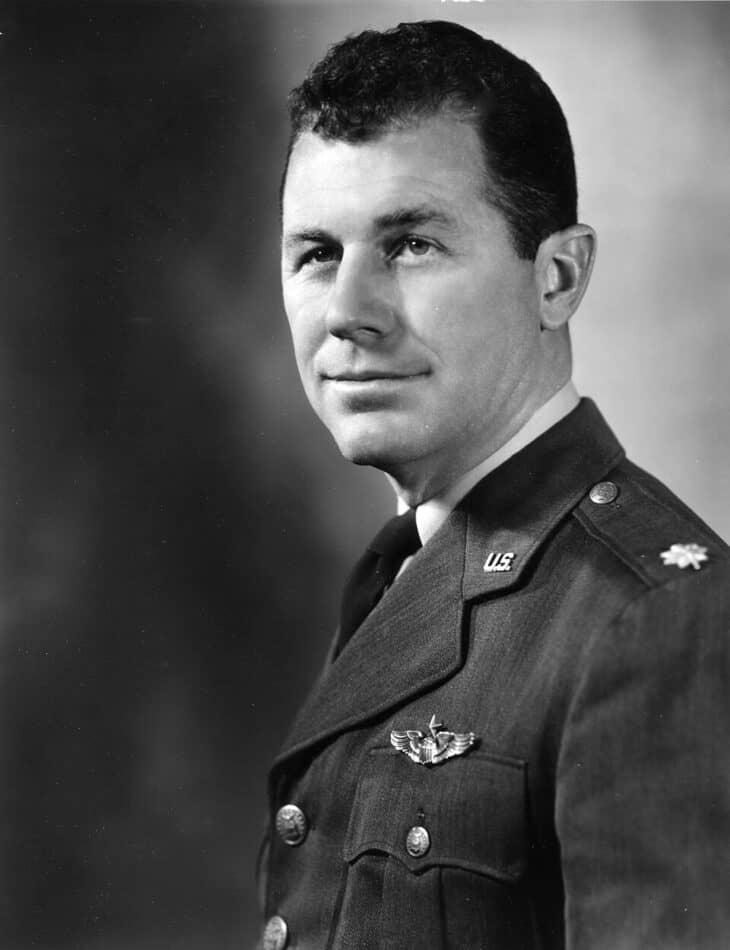
Yeager was not allowed to fly at first. He enlisted in September 1941 with only a high school diploma, too young and too uneducated for officer pilot training.
The war changed the rules. In July 1942 he was accepted into the “flying sergeant” program for enlisted men, and he earned his wings at Luke Field, Arizona, in March 1943.
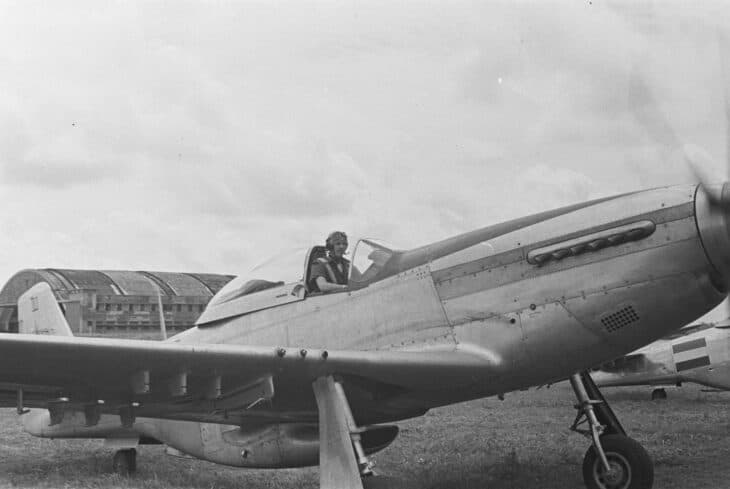
Flying the P-51 Mustang from England, he was shot down over German-occupied France on March 5, 1944, on only his eighth mission.

The French Resistance, the Maquis, hid him and moved him toward the Pyrenees. He crossed into Spain on March 30, helping a navigator, Pat Patterson, over the mountains, which earned him a Bronze Star.
That should have ended his combat career. Regulations barred evaders from flying over enemy territory again, so that a second capture could not compromise the Resistance groups that had hidden them.
Yeager refused to go home. On June 12, 1944, he and fellow evader Fred Glover took their case directly to General Dwight D. Eisenhower. “I raised so much hell that General Eisenhower finally let me go back to my squadron,” he said.
On October 12, 1944, near Hanover, he shot down five Messerschmitt Bf 109s in a single mission, making him an “ace in a day.” On November 6, he downed a Me 262, one of Germany’s new jet fighters, as it came in to land.
Two kills without firing a shot
Two of Yeager’s five victories on October 12, 1944, came without him firing. One German pilot panicked and collided with his own wingman, and both aircraft went down.
That record puts him among the best fighter pilots of the war, though the size of his final tally depends on who you ask (more on that below).
Mach 1, Then Mach 2.44 and a 51,000-Foot Fall
Back in the US, Yeager was posted to Wright Field, Ohio, in July 1945. Colonel Albert Boyd, the father of Air Force flight test, noticed his flying and sent him through the Flight Performance School, the forerunner of today’s Air Force Test Pilot School.
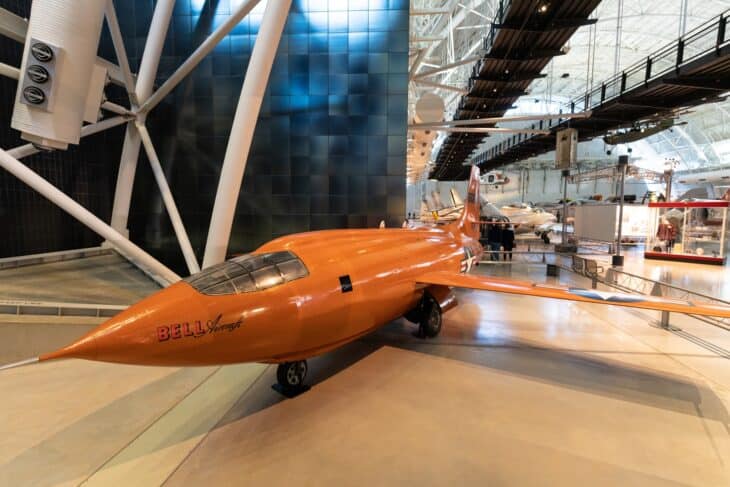
That assignment led to his selection as pilot of the Bell X-1. On October 14, 1947, the 24-year-old captain was dropped from a B-29 Superfortress and flew it to Mach 1.06, about 700 mph (1,127 km/h), at 43,000 feet (13,100 m), according to the Smithsonian.

He did it with two broken ribs, a story we tell in full in how Yeager broke the sound barrier with a sawed-off broom handle.
The flight stayed secret until June 10, 1948. By then Yeager had already pushed the X-1 to Mach 1.45, about 957 mph (1,540 km/h), on March 26, 1948.
Then came a race. On November 20, 1953, test pilot Scott Crossfield became the first to reach Mach 2, in the Navy’s Douglas D-558-II Skyrocket. Yeager and his engineer Jack Ridley answered within a month.
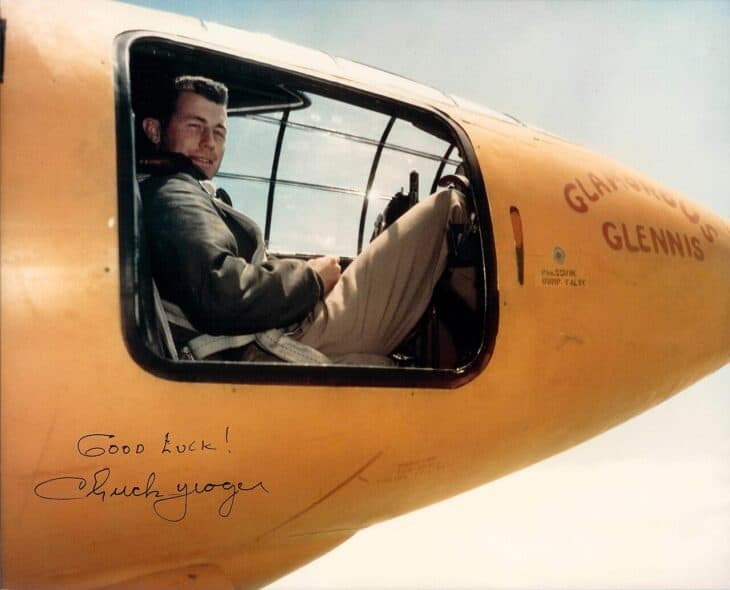
On December 12, 1953, Yeager flew the Bell X-1A to Mach 2.44, more than 1,600 mph (2,575 km/h). Moments later, at about 80,000 feet (24,400 m), an effect called inertia coupling threw the aircraft out of control.
The X-1A fell 51,000 feet (15,500 m) in under a minute, He regained control near 29,000 feet (8,800 m) and landed it, and the flight earned him the Distinguished Service Medal.
In the same period he was one of the first Americans to fly a MiG-15, after North Korean pilot No Kum-sok defected with one. Both rocket planes now sit in the story of the X-planes that changed flight.
The Man Who Trained Astronauts but Could Never Be One
In July 1962, Yeager became commandant of the Aerospace Research Pilot School at Edwards Air Force Base, which the Air Force describes as the school “where all military astronauts are trained.”
He could never have joined them. The 1959 Mercury astronaut selection criteria asked for a bachelor’s degree or equivalent, and Yeager had only a high school education. He later said he regretted that his lack of a college degree kept him from becoming an astronaut.
His most dangerous flight of that era came on December 10, 1963. He was flying the NF-104A, a Lockheed F-104 Starfighter fitted with an extra rocket motor, on a preparation flight for a planned 120,000-foot altitude record.
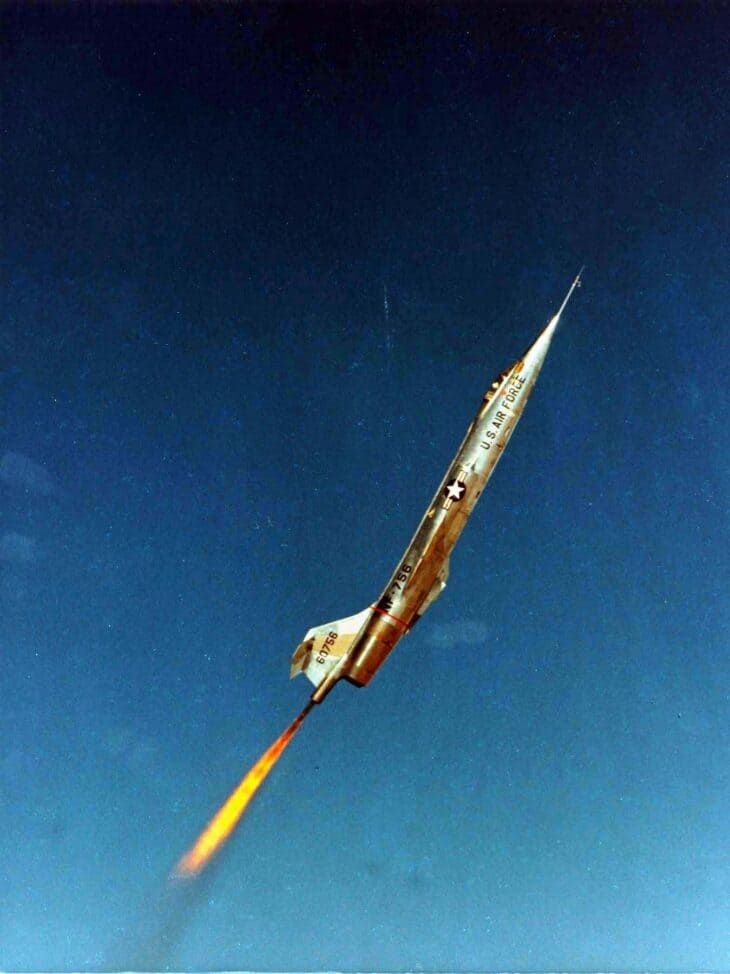

The jet fell into a flat spin at 65,000 feet (19,800 m) and turned 13 times. Yeager ejected at about 5,000 feet (1,500 m), and the still-smoldering seat struck him in his parachute lines, burning his face.
Investigators found no mechanical failure. They blamed the pilot’s decisions and the program managers’ insufficient training and preparation.
Vietnam, Pakistan and a General’s Star
Yeager went back to war in his forties. In July 1966 he took command of the 405th Fighter Wing at Clark Air Base in the Philippines and flew 127 missions in South Vietnam.
In February 1968 he took over the 4th Tactical Fighter Wing and led it to South Korea during the Pueblo crisis. He was promoted to brigadier general effective August 1, 1969.
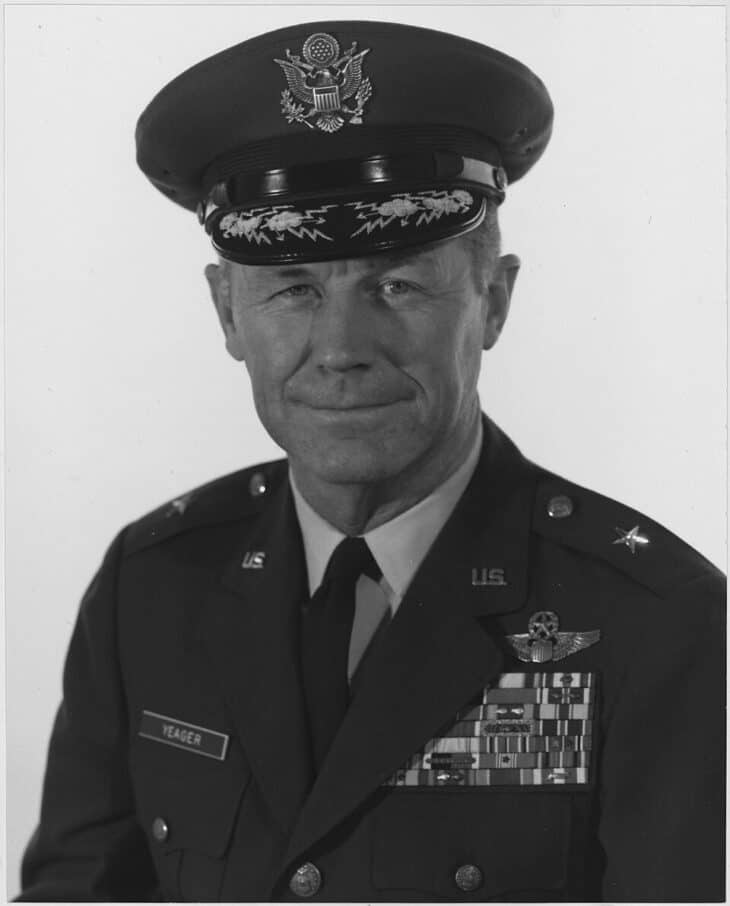
From January 1971 he was the US defense representative to Pakistan, where his Beechcraft Queen Air was destroyed in an Indian air raid. He finished his career running Air Force aerospace safety at Norton Air Force Base, California, and retired in 1975.
The Right Stuff, and Supersonic at 89
Outside aviation, few knew his name until Tom Wolfe’s 1979 book The Right Stuff made him its hero. The 1983 film followed, with Sam Shepard playing Yeager and Yeager himself in a cameo as Fred, the bartender.
The film dramatized the NF-104 crash as an unauthorized joyride. In reality it was part of a scheduled test program.
His memoir, Yeager: An Autobiography, written with Leo Janos, came out in 1985, the same year President Reagan gave him the Presidential Medal of Freedom. In 1986 Reagan appointed him to the Rogers Commission that investigated the Challenger disaster.
The honors kept coming. Congress awarded him a special silver medal, described as the noncombat equivalent of the Medal of Honor, which President Ford presented on December 8, 1976. In 2005, President George W. Bush promoted him to major general on the retired list.
Charleston, West Virginia, named its airport after him. Today Yeager Airport (CRW) averages 18 flights a day to 18 destinations, in the same city where, on October 10, 1948, Yeager flew an F-80 under a bridge at 450 mph (724 km/h).
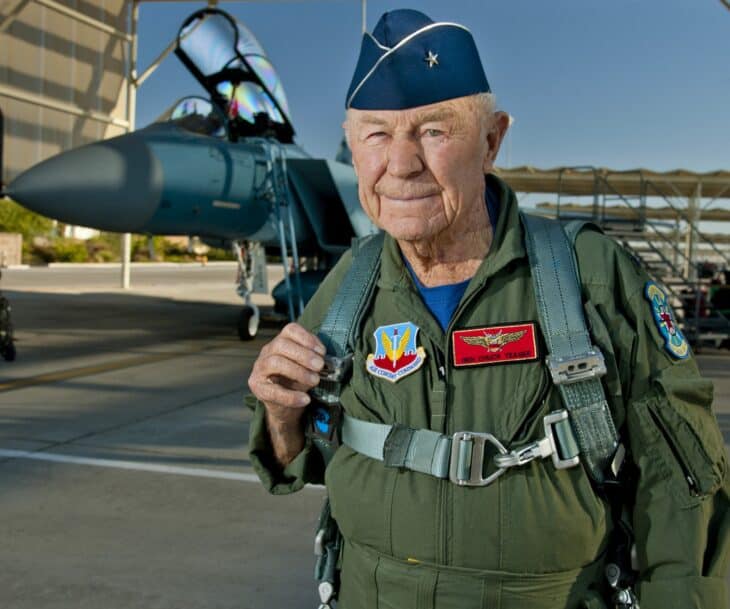
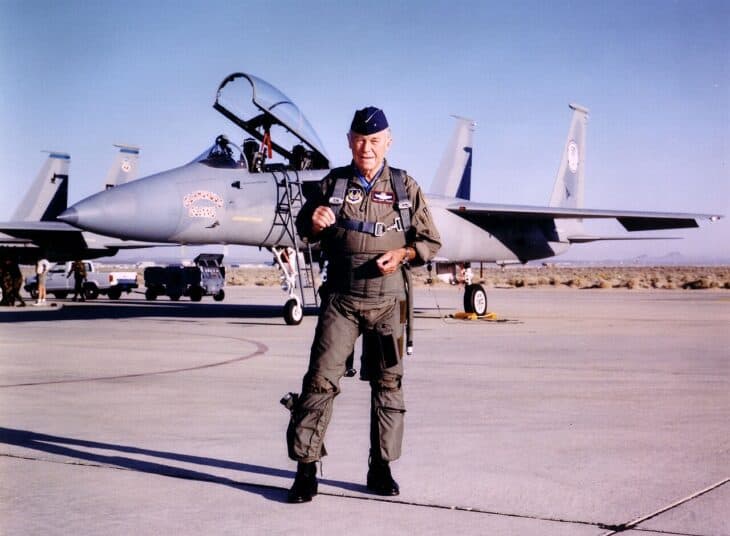
He kept flying fast to the end. On October 14, 2012, the 65th anniversary of the X-1 flight, the 89-year-old rode in the back seat of a McDonnell Douglas F-15 Eagle as it went supersonic out of Nellis Air Force Base, Nevada. He died in California on December 7, 2020, at 97.
.jpg)
Why Yeager’s Numbers Never Agree
For a man so carefully documented, Yeager’s statistics are a mess. Even Air Force sources contradict each other, and many of the figures you will find online trace back to one source or another.
| Figure | One version | Another version |
|---|---|---|
| WWII aerial victories | 13 (official USAF biography) | 11.5 (Air Force Historical Study 85) |
| Aircraft types flown | More than 361 (USAF biography) | 155 (Air Force Test Center, 2020); 341 (Yeager, 2009) |
| Flying hours | More than 10,000 (USAF biography) | About 18,000 (Yeager, 2009) |
| X-1 top speed, Oct. 14, 1947 | Mach 1.06, 700 mph (Smithsonian) | Mach 1.05 (Wikipedia); “past 660 mph” (AP) |
The victory count is the most repeated split. The Air Force’s own biography says Yeager shot down 13 enemy aircraft. The service’s formal credit list, Air Force Historical Study 85, totals 11.5, because one of his kills, on September 13, 1944, was shared with another pilot.
The aircraft count is worse. Yeager himself said 341 types, his official biography says more than 361, and the 2020 obituary from the Air Force Test Center at Edwards said 155. The likely difference is what counts as a “type”: every variant and model, or every distinct aircraft family.
Even the date of the five-kill mission gets garbled. West Virginia’s state encyclopedia places it in November 1944, but the mission was October 12.
Myth: Yeager flew the X-15
He never did. NASA lists the 12 pilots who flew the X-15, among them Neil Armstrong and Scott Crossfield, and Yeager is not one of them. Nor was he first to Mach 2: Crossfield got there three weeks earlier, though the Air Force still credits Yeager as the first past twice the speed of sound in level flight.
Yeager tended to wave away the legend. “I was just a lucky kid who caught the right ride,” he said, a strange summary from a man who started out throwing up in the back of a test airplane, and who, more than anyone, earned his place among the most famous pilots in history.
Sources and references used for research and fact-checking.
- U.S. Air Force, Brigadier General Charles E. "Chuck" Yeager
- Air Force Test Center, Renowned test pilot Chuck Yeager dies
- Wikipedia, Chuck Yeager
- Smithsonian National Air and Space Museum, Bell X-1 Glamorous Glennis
- Military Times (Associated Press), Chuck Yeager, 1st to break sound barrier, dies at 97
- Center for Land Use Interpretation, NF-104A, December 10, 1963
- NASA, X-15
- Wikipedia, Mercury Seven
- e-WV: The West Virginia Encyclopedia, Chuck Yeager
- Marshall University Society of Yeager Scholars, Chuck Yeager
Get the Newsletter
The latest aviation news and stories sent to your inbox.
About the Author

Tim is the owner and lead editor of AeroCorner since 2019, overseeing aviation content covering aircraft, airlines, airports, and the broader aviation industry. Through years of researching, writing, editing, and publishing aviation-focused content, he has developed extensive practical knowledge of commercial aviation and air travel. Based in Asia and a frequent traveler himself, Tim also brings firsthand passenger experience to AeroCorner’s coverage. Outside of publishing, he has also explored aviation firsthand through hands-on flight training in New Zealand.