

Table of Contents
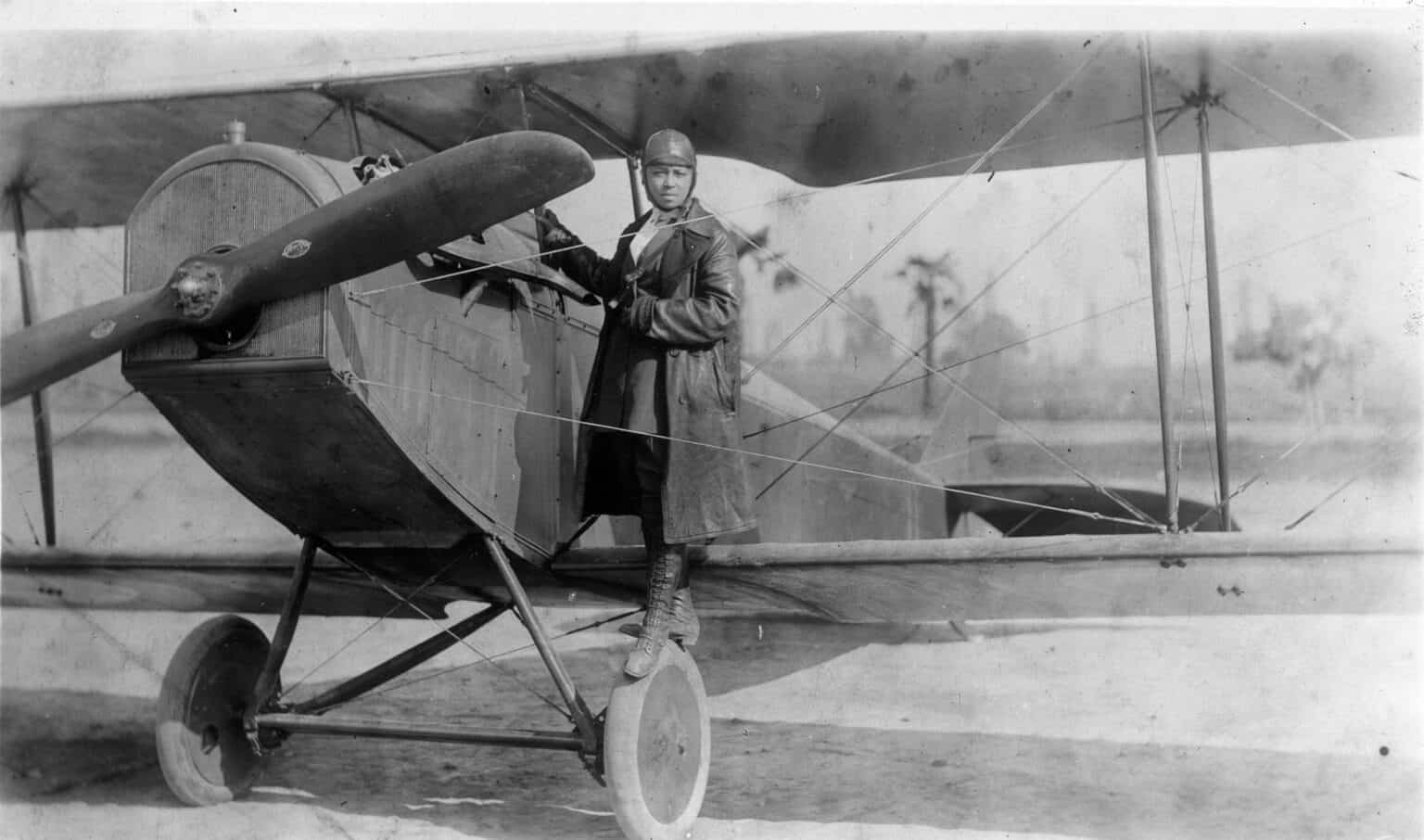
Soon after World War I, a manicurist at the White Sox Barber Shop in Chicago decided she was going to fly. Every American flight school she approached turned her down, because she was Black and because she was a woman.
So Bessie Coleman learned French, sailed to France, and came home with a pilot’s license that almost no American of her era held. Most profiles stop there. The more interesting detail is what that license meant in a country that, at the time, did not license pilots at all.
Here is who she was, what she flew, how she died, and which of the “firsts” attached to her name actually hold up.
Who Was Bessie Coleman?
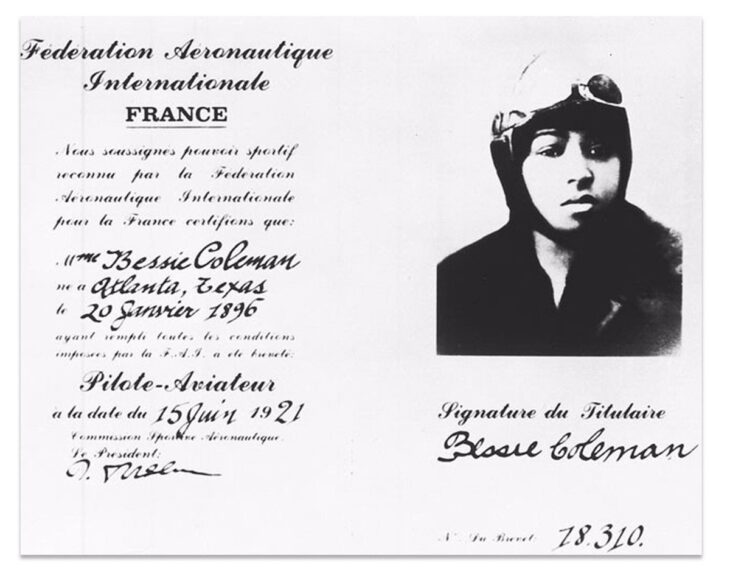
Bessie Coleman was an American stunt pilot and the first African American woman to hold a pilot’s license. The Fédération Aéronautique Internationale (FAI), the world body that certified aviators, issued it to her in France on June 15, 1921.
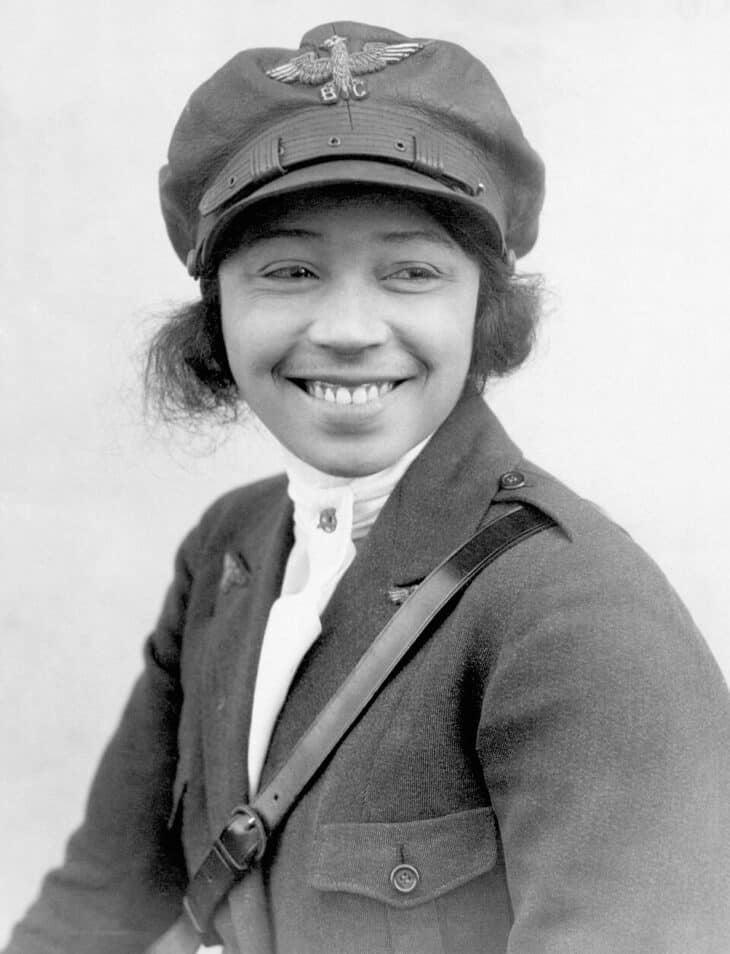
She spent the next five years barnstorming across the United States as “Queen Bess,” refused to perform for segregated crowds, and died in a crash in Jacksonville, Florida, on April 30, 1926. She was 34. She ranks 13th on our list of the most famous pilots in history, measured by how many people look her up.
Bessie Coleman at a glance
Born: January 26, 1892, Atlanta, Texas. Raised: Waxahachie, Texas. Trained: Caudron brothers’ flying school, Le Crotoy, France. Licensed: June 15, 1921, by the FAI. First US air show: September 3, 1922, Curtiss Field, Long Island. Died: April 30, 1926, Jacksonville, Florida, age 34. Buried: Lincoln Cemetery, Chicago.
From the Cotton Fields to a Chicago Barber Shop
Coleman was born on January 26, 1892, in Atlanta, Texas, the twelfth of 13 children, and grew up in Waxahachie, south of Dallas. Her parents could neither read nor write. Her father, whose family had Native American roots, left in 1900 or 1901, and the children picked cotton and took in laundry to keep the household going.
She walked four miles each way to a one-room segregated school and finished all eight grades. She managed one semester at the Colored Agricultural and Normal University in Langston, Oklahoma, before the money ran out.
In Chicago she lived with a brother and worked as a manicurist at the White Sox Barber Shop. Two of her brothers served in France during World War I, and the Smithsonian records that one of them came home with stories of French women who flew. That, by her own account, settled it.
Why She Had to Learn to Fly in France
White American instructors would not teach her. Robert S. Abbott, the publisher of the Chicago Defender, told her to learn French and apply to flying schools in France instead.
She took French lessons, got a US passport on November 9, 1920, and sailed from New York on November 20. She trained at the École d’Aviation des Frères Caudron at Le Crotoy, on the Somme estuary in northern France.
Her trainer was a Nieuport Type 82 biplane. She described its controls as “a vertical stick the thickness of a baseball bat in front of the pilot and a rudder bar under the pilot’s feet.” Accounts of the course run from seven months (the Smithsonian) to ten (the Handbook of Texas), and she took the FAI test in June 1921.
The license came before the law
Coleman’s FAI license is dated June 15, 1921. The United States did not create a federal pilot’s license until the Air Commerce Act, signed on May 20, 1926: twenty days after she died. Federal Pilot License No. 1 was issued on April 6, 1927.
A License in a Country That Didn’t Issue Them
This is the part most biographies skip. In 1921, the US government licensed no pilots at all. Anyone could buy a war-surplus biplane and fly it without a government license, and the FAA’s own history notes that in the years before World War I nearly all American pilots were unlicensed.
The internationally recognized credential was the FAI certificate. That is why “she earned a US pilot’s license” is wrong: there was no such thing to earn.

Congress changed that with the Air Commerce Act, which President Calvin Coolidge signed on May 20, 1926, less than three weeks after Coleman’s death. The new Aeronautics Branch issued Pilot License No. 1 to its own chief, William P. MacCracken Jr., on April 6, 1927, after Orville Wright declined the honor. Today’s pilot certificates descend from that system.
The FAA’s own history notes that James Herman Banning, on a list published about six months after June 1927, was the first known African American to hold a federal pilot license. Coleman never had the chance to apply.
Queen Bess: Five Years of Barnstorming
Coleman came home in September 1921 to a crowd of Black and white reporters in New York. A license alone would not fill a grandstand, so in 1922 she went back to Europe for advanced training, including lessons in Germany from the chief pilot of the Fokker aircraft company.
Her first American air show was on September 3, 1922, at Curtiss Field on Long Island, at an event honoring the Black veterans of the 369th Infantry Regiment. It was the first public flight by a Black woman in the United States. The bill called her “the world’s greatest woman flier.”
From then on she flew mostly Curtiss JN-4D “Jenny” biplanes and other army-surplus aircraft left over from the war. Lectures with film of her German flights often paid better than the flying, and she used them to recruit young Black men and women into aviation.
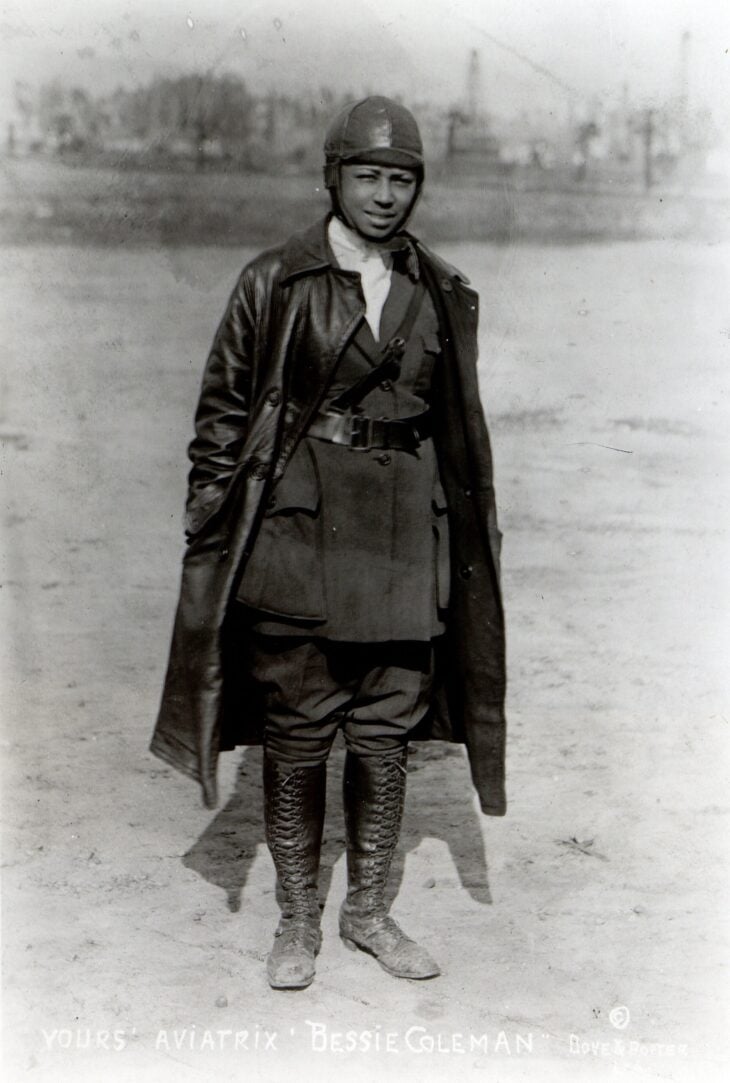

Her first serious crash came in California, when the engine of a newly bought Jenny stalled shortly after takeoff from Santa Monica. Most accounts date it to February 1923; the Handbook of Texas puts it in 1924. She left with a broken leg and cracked ribs.
She set up a base in Houston and flew there on June 19, 1925, Juneteenth. In Waxahachie, her hometown, she refused to fly at a show with separate entrances for Black and white spectators until organizers agreed to one gate. The crowd was still segregated inside.
She also walked away from a leading film role after learning the film opened with her in rags. “No Uncle Tom stuff for me!” she said, according to the Smithsonian. She was never offered another.
The Crash at Jacksonville
On April 30, 1926, Coleman was in Jacksonville, Florida, for a May Day show sponsored by the Negro Welfare League. She took off from Paxon Field on a test flight in a Curtiss biplane with William D. Wills, her 24-year-old mechanic and publicity agent, at the controls in the front cockpit.
She sat in the rear cockpit with her seat belt unfastened, leaning over the side to scout the field for a parachute jump planned for the next day.
About 10 to 12 minutes into the flight, the plane went into a dive it did not pull out of, then spun and flipped. Coleman was thrown out and killed, and Wills died when the plane hit the ground.
Accounts of the crash disagree
There was no federal accident investigation in April 1926, and the wreckage burned. The US Air Force history puts the fall at about 500 feet; the National Women’s History Museum says about 3,000 feet. A local pilot who examined the wreck reported a wrench left in the tail, and her death certificate says the elevator controls jammed, while other accounts say the wrench jammed a gearbox.
What every source agrees on is the cause in broad terms: a loose wrench jammed the controls. The Handbook of Texas notes that the charred wreckage prevented a full investigation. Coleman and Wills were the first people killed in an aircraft accident in Jacksonville.
Services were held in Jacksonville and Orlando before her body went home to Chicago. There, the Air Force history records, more than 10,000 people filed past her coffin, and the journalist and activist Ida B. Wells spoke at the funeral before her burial at Lincoln Cemetery.
Which of Her Firsts Are Actually True?
Coleman’s real record needs no inflation, but it often gets it. Three claims in wide circulation do not survive a check against the FAA’s own history of pilot licensing.
“The first Black pilot in the world.” No. The FAA credits Eugene Bullard, a Black American who flew combat missions for France, as probably the first African American with a pilot certificate of any type, issued by the French air service in 1917.
“The first American woman with an international pilot’s license.” No. Harriet Quimby received her FAI license on July 31, 1911, a decade before Coleman, and became the first licensed female aviator in the United States.
“The first African American woman to earn a US pilot’s license.” Not as worded, since there was no US license in 1921. The FAA records that the first woman to receive one from a civilian federal agency was Phoebe Omlie, on June 30, 1927.
What does hold: Coleman was the first African American woman to hold a pilot’s license of any kind, and the FAA says she was the first African American of either sex to receive one from the FAI. Because of her father’s ancestry, she is also widely described as the first Native American woman to hold one.
July 31, 1911
Harriet Quimby gets her FAI license. She becomes the first licensed woman aviator in the United States.
1917
Eugene Bullard earns French wings. The FAA calls him probably the first African American with a pilot certificate of any type.
June 15, 1921
Bessie Coleman is licensed by the FAI. The first African American woman with a pilot’s license, and the first African American to get one from the FAI.
April 30, 1926
Coleman dies at Jacksonville. She is thrown from a Curtiss biplane during a test flight.
May 20, 1926
The Air Commerce Act becomes law. For the first time, the federal government will license pilots.
April 6, 1927
Federal Pilot License No. 1. It goes to William P. MacCracken Jr., after Orville Wright turns it down.
June 30, 1927
Phoebe Omlie is federally licensed. The first woman to get a pilot’s license from a civilian US agency.
What She Left Behind
Coleman never opened the flight school for Black students she had planned. Her followers built the next best thing. William J. Powell founded the Bessie Coleman Aero Club, and on Labor Day 1931 the Bessie Coleman clubs staged the first all-Black air show in America, which drew 15,000 spectators.
That same year, Chicago’s Challenger Air Pilots Association began flying over her grave at Lincoln Cemetery and dropping flowers, a tradition Black aviators have kept up since. The Smithsonian draws a line from those clubs to Willa Brown, Janet Bragg and the Tuskegee Airmen.
The honors came late but kept coming. The US Postal Service issued a 32-cent Bessie Coleman stamp on April 27, 1995, and the US Mint put her on a quarter in 2023 in its American Women Quarters series. Astronaut Mae Jemison carried a photo of her into space in 1992.
Today she sits second only to Amelia Earhart among the most famous female pilots by readership. Roads at O’Hare, Oakland and Tampa airports carry her name.
The next time you see her described as the woman who earned an American pilot’s license against the odds, the real story is better. She earned the only license that counted, in a second language, in another country, five years before her own government had one to give.
Sources and references used for research and fact-checking.
- Smithsonian National Air and Space Museum, Bessie Coleman
- Federal Aviation Administration, The First U.S. Federal Pilot License
- Federal Aviation Administration, William P. MacCracken, Jr.
- Handbook of Texas, Texas State Historical Association, Coleman, Bessie
- National Women's History Museum, Bessie Coleman
- U.S. Air Force, Bessie Coleman: Woman who dared to dream made aviation history
- Jacksonville Historical Society, The Daring of Bessie Coleman, 100 Years Later
- Wikipedia, Bessie Coleman
Get the Newsletter
The latest aviation news and stories sent to your inbox.
About the Author

Tim is the owner and lead editor of AeroCorner since 2019, overseeing aviation content covering aircraft, airlines, airports, and the broader aviation industry. Through years of researching, writing, editing, and publishing aviation-focused content, he has developed extensive practical knowledge of commercial aviation and air travel. Based in Asia and a frequent traveler himself, Tim also brings firsthand passenger experience to AeroCorner’s coverage. Outside of publishing, he has also explored aviation firsthand through hands-on flight training in New Zealand.