

Table of Contents
In the spring of 1917, one of the best-known race car drivers in America sailed for France with General John Pershing’s party. He was not going as a pilot. He was going because the Army wanted men who could drive and fix cars.
Within 18 months, that driver was commanding a fighter squadron and had shot down more enemy aircraft than any other American. Twenty-four years after that, he was drifting on a raft in the middle of the Pacific, living on four oranges and whatever he could catch.
His name was Eddie Rickenbacker, and almost every chapter of his life involved an aircraft. Here is who he was, what he actually did, and the part of his story that is usually told wrong.
Who Was Eddie Rickenbacker?
Eddie Rickenbacker was America’s leading fighter ace of World War I, credited with 26 confirmed victories with the 94th Aero Squadron. He received the Medal of Honor for a lone attack on seven German aircraft on Sept. 25, 1918.
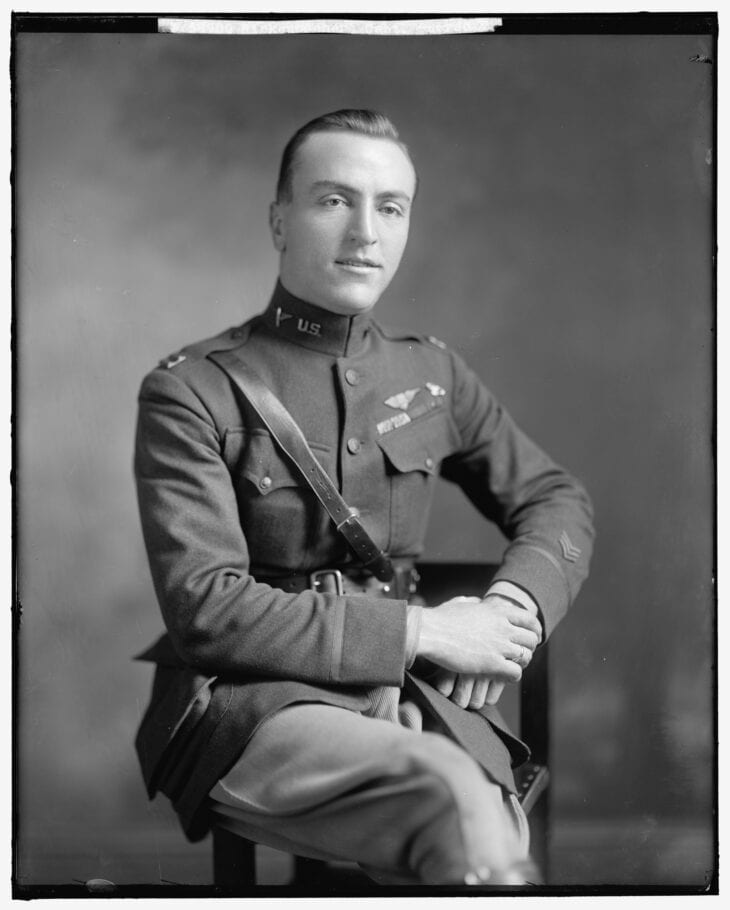

Before the war he was a racing driver. After it, he built a car company, owned the Indianapolis Motor Speedway and ran Eastern Air Lines for more than two decades. He survived two air crashes in 20 months during World War II, and died in Zurich in 1973, aged 82.
Eddie Rickenbacker at a glance
Born Oct. 8, 1890, in Columbus, Ohio. Racing driver with four Indianapolis 500 starts. America’s top WWI ace with 26 victories. Medal of Honor, awarded in 1930. Owner of the Indianapolis Motor Speedway (1927 to 1945). General manager of Eastern Air Lines from 1935, owner from 1938. Survived the 1941 Eastern crash near Atlanta and 24 days adrift in the Pacific in 1942. Died July 23, 1973.
From Racing Driver to Fighter Pilot at 26
Rickenbacker was born Edward Rickenbacher in Columbus, Ohio, on Oct. 8, 1890. Cars, not airplanes, made his name: he started the Indianapolis 500 four times, in 1912 and from 1914 to 1916, with a best finish of 10th in 1914.
He changed the spelling of his surname to Rickenbacker in 1917, partly to make it sound less German after he was detained in England on suspicion of being a spy. The middle name Vernon was his own invention too.
In France he drove Army officers, and one of them was Lt. Col. William “Billy” Mitchell of the Air Service. Mitchell approved Rickenbacker’s request to become a pilot, and on Aug. 23, 1917, Sgt. Rickenbacker reported to the Aviation Training School at Tours. He was 26.

His mechanical skill nearly kept him out of combat. The Air Service made him an engineering officer because he knew gasoline engines so well, and it took a direct request to Maj. Carl Spaatz to get him posted to the 94th Aero Squadron at the front.
How He Became America’s Ace of Aces
The 94th Aero Squadron was known as the “Hat-in-the-Ring Gang” for its insignia. Rickenbacker scored his first victory on April 29, 1918, bringing down a German Pfalz D.III near Baussant.
By the armistice in November 1918 he had 26 confirmed victories: 21 aircraft and 5 observation balloons. You can see where his total sits among the greats in our list of the best fighter pilots in history.
A late start, a fast finish
Rickenbacker reported for flight training in August 1917, scored his first victory in April 1918 and finished the war seven months later as the top American ace. All 26 of his victories came in the six and a half months between April 29 and the armistice.
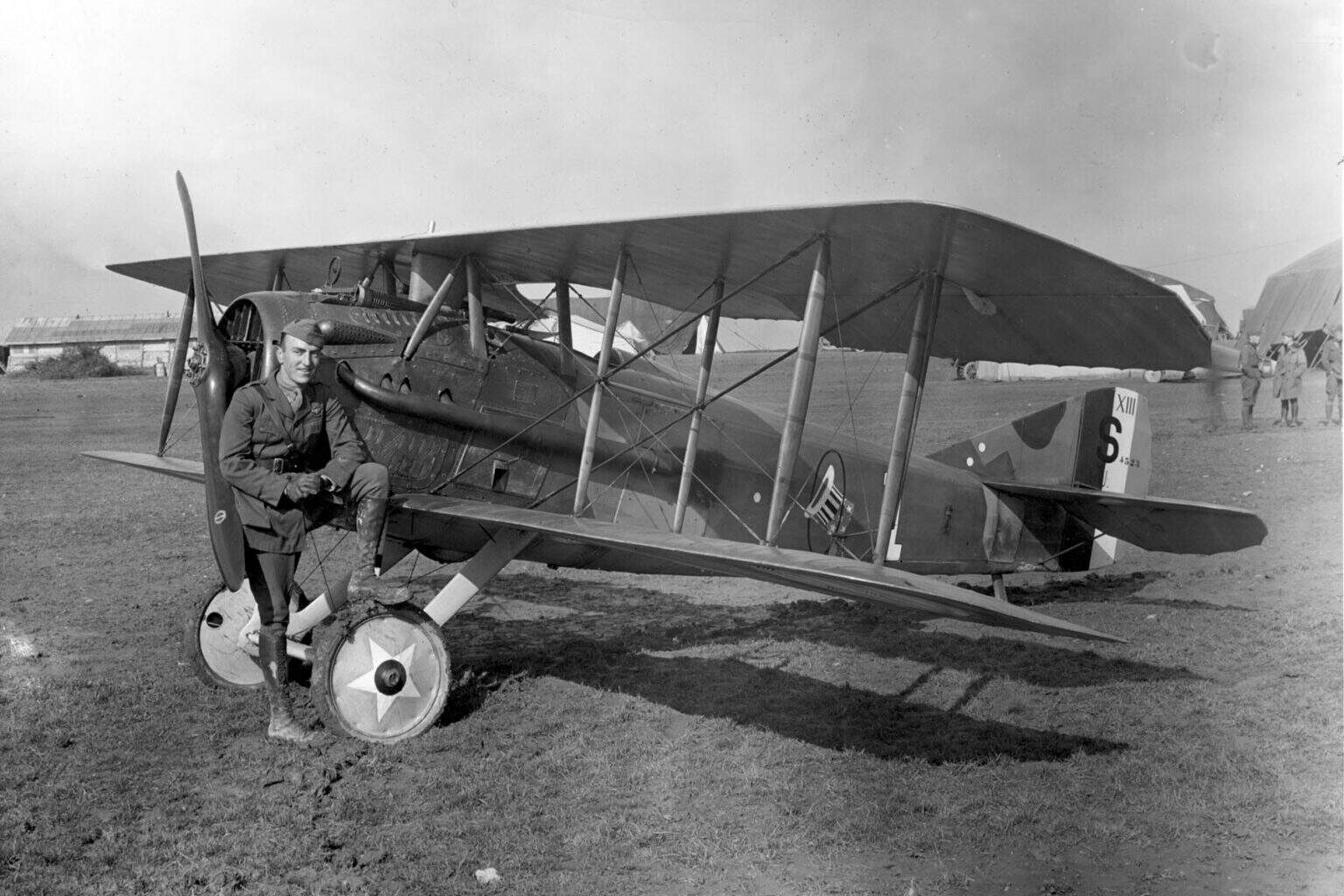
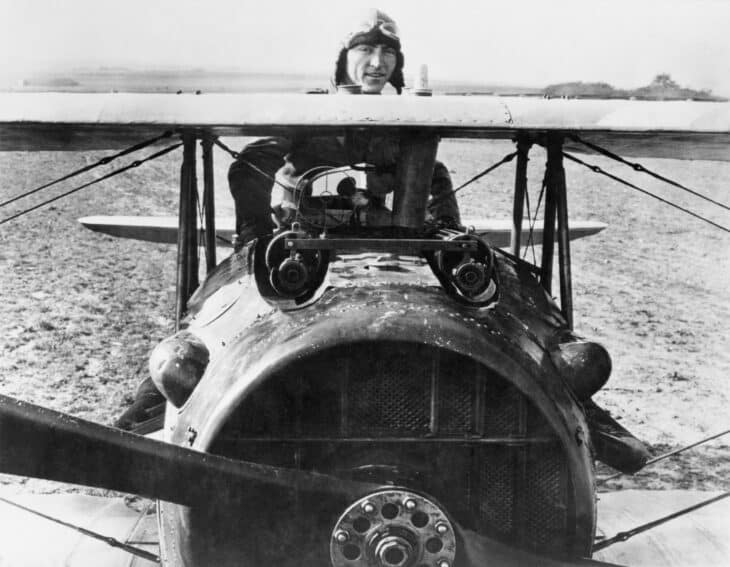
He took command of the 94th in September 1918, and by October he was flying a French-built SPAD from the airfield at Rembercourt. The aircraft he faced, and flew, are covered in our guide to the airplanes of World War I.
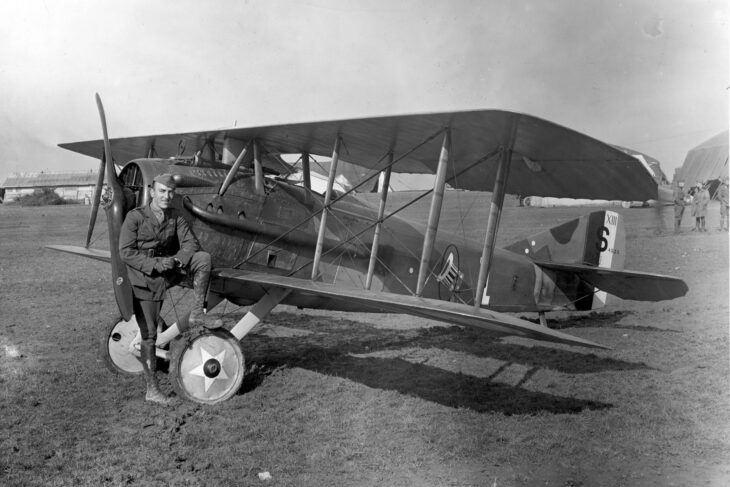

The action that earned the Medal of Honor came on Sept. 25, 1918. Patrolling alone near Billy, France, he spotted seven enemy aircraft, attacked them anyway and shot down two of them. President Herbert Hoover awarded him the medal in 1930, 12 years after the fact.
The Myth: Pershing’s Chauffeur
The most repeated line about Rickenbacker is that he was General Pershing’s personal chauffeur, and that the commander of the American Expeditionary Forces then helped the general’s driver into the cockpit. It is a great story. It is mostly wrong.
Myth: Rickenbacker was Pershing's chauffeur
He was recruited for that job, which is where the story comes from. But the National Museum of the U.S. Air Force says he primarily drove for Maj. Townsend F. Dodd, a subordinate of Billy Mitchell, and later became Mitchell’s own driver. It was Mitchell, not Pershing, who approved his transfer to flight training.
The difference matters more than it seems. Dodd and Mitchell were airmen, and the museum notes that touring France with them left a lasting impression about airpower on all three men. Rickenbacker got into aviation through the Air Service’s own officers, not through a favor from the top general.
Even the Air Force’s own fact sheets say different things. One says he was offered the job as Pershing’s chauffeur and accepted. Another says he was recruited for it but mostly drove for Dodd. Both can be true, which is exactly why the shorter version stuck.
Speedway Owner, Carmaker, Airline Boss
Rickenbacker came home a celebrity and spent it quickly. His Rickenbacker Motor Company unveiled its first car at the 1922 New York Auto Show and went bankrupt in November 1927.
That same month he bought the Indianapolis Motor Speedway from Carl Fisher for $700,000. He owned it through the Depression and World War II, and sold it to Tony Hulman in 1945.
Aviation pulled him back in 1935, when he became general manager of Eastern Air Lines, then owned by General Motors. In 1938 he and his backers bought the airline from GM for $3.5 million.
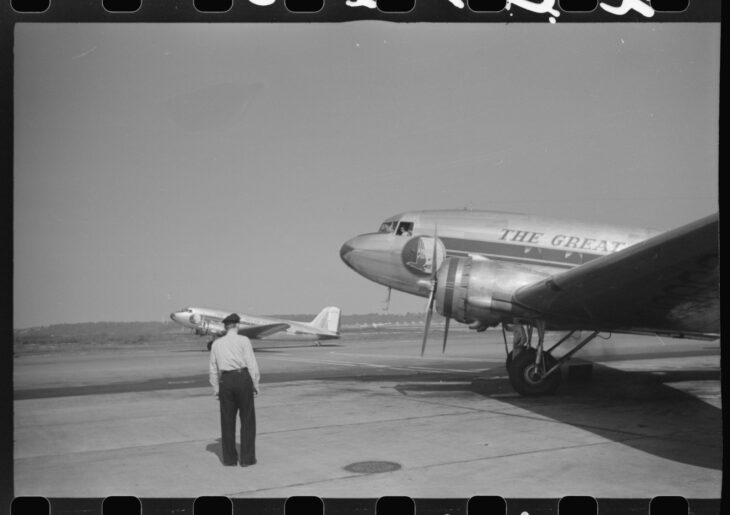

Eastern earned a profit every year from 1935 to 1960 under his management, according to the Library of America’s account, and it never took a government subsidy in the postwar years.
He was forced out as chief executive on Oct. 1, 1959, and left the board at the end of 1963. Eastern itself stopped flying in January 1991.
Two Crashes in 20 Months
On Feb. 26, 1941, Rickenbacker was a passenger on his own airline’s Flight 21, a Douglas DC-3 that crashed outside Atlanta. His injuries read like a medical textbook: a fractured skull, a pelvis broken in two places, a crushed hip socket, broken ribs, a broken left knee and a left eye knocked out of its socket.
Newspapers reported him dead. He was in critical condition for ten days and spent four months in the hospital.
In the fall of 1942, Secretary of War Henry Stimson asked him to tour the Pacific and report on morale and air tactics. On Oct. 21, 1942, Rickenbacker left Hickam Field, Hawaii, for Canton Island aboard a B-17 Flying Fortress with seven other men.
The crew never found the tiny atoll. When the fuel ran out, the pilot ditched in the open ocean, and the eight men climbed into three small rafts with four oranges between them.
The story everyone remembers is the bird. A gull landed on Rickenbacker’s head, he caught it, and the men ate it raw and used its innards as fish bait (some accounts identify the bird as a tern). One man, Sgt. Alexander Kaczmarczyk, who had swallowed seawater escaping the aircraft, died and was buried at sea.
On Nov. 13, 1942, a Navy flier found the B-17’s pilot on a raft near the Ellice Islands, now Tuvalu, and the rest of the survivors were picked up in the same area within two days. Rickenbacker had lost about 40 pounds. After two weeks in a Navy hospital he finished the mission.
21 days or 24?
Rickenbacker’s own 1943 book about the ordeal, Seven Came Through, said 21 days. His 1967 autobiography corrected it to 24, the figure most accounts now use.
Where Rickenbacker’s Name Still Flies
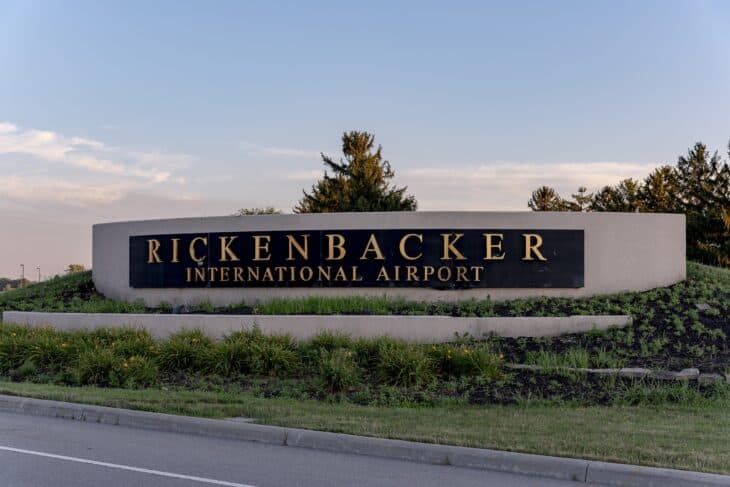
Rickenbacker died of pneumonia in Zurich, Switzerland, on July 23, 1973, and is buried in Greenlawn Cemetery in his hometown of Columbus. A year later, Lockbourne Air Force Base outside Columbus was renamed in his honor.
The airfield is now shared by the Ohio Air National Guard and Columbus Rickenbacker Airport (LCK), a cargo-heavy field whose longest runway, 05R/23L, runs 12,106 feet (3,690 m), according to our airport data updated Oct. 18, 2026.

1890
Born in Columbus, Ohio. Edward Rickenbacher is born Oct. 8.
1912 to 1916
Indianapolis 500 driver. Four starts, best finish 10th in 1914.
Aug. 1917
Flight training. Reports to the Aviation Training School at Tours, France, at age 26.
April 29, 1918
First victory. Downs a Pfalz D.III with the 94th Aero Squadron.
Sept. 25, 1918
Medal of Honor action. Attacks seven German aircraft alone near Billy, France, and downs two.
Nov. 1918
War ends. America’s top ace with 26 victories: 21 aircraft and 5 balloons.
1927
Buys the Indianapolis Motor Speedway. Pays Carl Fisher $700,000; his car company fails the same month.
1938
Buys Eastern Air Lines. $3.5 million from General Motors, three years after becoming general manager.
Feb. 26, 1941
Eastern Flight 21 crash. Critically injured near Atlanta and wrongly reported dead.
Oct. 21, 1942
Pacific ditching. B-17 runs out of fuel looking for Canton Island; rescue comes on Nov. 13.
1959 to 1963
Leaves Eastern. Forced out as CEO in 1959, leaves the board at the end of 1963.
July 23, 1973
Dies in Zurich. Lockbourne AFB is renamed Rickenbacker AFB the following year.
The next time you see a flight tracker showing a cargo jet landing at Rickenbacker, remember the name belongs to a man who learned to fly at 26, out-scored every other American in the first air war, and walked away from two crashes that should have killed him.
He still makes our ranking of the 20 most famous pilots in history, more than a century after his last victory.
Sources and references used for research and fact-checking.
- Wikipedia, Eddie Rickenbacker
- National Museum of the U.S. Air Force, Capt. Edward V. Rickenbacker
- National Museum of the U.S. Air Force, Edward V. Rickenbacker: AEF Chauffeur
- Air Mobility Command History Office, Col Eddie Rickenbacker's 1942 Pacific Mission
- Fox News, This World War I ace went on to survive two plane crashes and 22 days lost at sea
- Library of America, Notes on War Experience (Eddie Rickenbacker)
- Wikipedia, Eastern Air Lines
- AeroCorner, Columbus Rickenbacker Airport (LCK)
Get the Newsletter
The latest aviation news and stories sent to your inbox.
About the Author

Tim is the owner and lead editor of AeroCorner since 2019, overseeing aviation content covering aircraft, airlines, airports, and the broader aviation industry. Through years of researching, writing, editing, and publishing aviation-focused content, he has developed extensive practical knowledge of commercial aviation and air travel. Based in Asia and a frequent traveler himself, Tim also brings firsthand passenger experience to AeroCorner’s coverage. Outside of publishing, he has also explored aviation firsthand through hands-on flight training in New Zealand.