

Table of Contents
On the night of January 16, 1942, TWA Flight 3, a Douglas DC-3 carrying Carole Lombard home from a war bond tour, flew into a cliff on Potosi Mountain about 15 minutes after leaving Las Vegas. All 22 aboard died: Lombard, 33, her mother Elizabeth Peters, MGM publicist Otto Winkler, passenger Lois Hamilton, 15 members of the Army Air Corps and a crew of three.
The crash is usually told as a wartime blackout that left the pilots flying blind. The record says the night was clear, the radio range was working, and one beacon on the route was lit. The airplane flew almost exactly the course written on its flight plan, and that course was wrong.
This article is built from the Report of the Civil Aeronautics Board on the accident, File No. 119-42, Docket SA-58, adopted on July 16, 1942, and released four days later. The full text is public, and every course, altitude and time below comes from it unless another source is named.


January 15, 1942
Flight 3 leaves New York. TWA’s scheduled transcontinental service is bound for Burbank, the airline’s Los Angeles terminal, with stops along the way.
January 16, early morning
Indianapolis. Lombard, her mother and Otto Winkler board after her war bond rally in Indiana.
St. Louis
A weather delay. The flight waits 1 hour 56 minutes, the longest of several delays that leave it about three hours late.
4:06 p.m. MST
Albuquerque. A new crew takes over: Captain Wayne C. Williams, First Officer M. A. Gillette and Air Hostess Alice Frances Getz. Twelve Army men board.
4:40 p.m. MST
Departure, cleared to Winslow. In the air, with enough fuel to skip the stop, Williams is released to continue direct to Las Vegas.
6:36 p.m. PST
Las Vegas. The DC-3 lands and takes on fuel. Night landings on this route were made at Las Vegas because Boulder City had no airport lights.
7:07 p.m.
Takeoff for Burbank. The flight is cleared to fly contact, by visual reference, at a planned 8,000 feet.
About 7:20 p.m.
Potosi Mountain. The airplane strikes a near-vertical cliff at about 7,770 feet. Witnesses see a fire on the mountain at about 7:22.
January 17, about 9 a.m.
The wreckage is reached by searchers, among them Army personnel and Clark County deputy sheriffs.
January 23 and 24
Public hearing in Los Angeles: 12 witnesses and 17 exhibits.
July 16, 1942
The report is adopted. The CAB releases it on July 20.
What happened
After the US entered the war, Lombard traveled to her home state of Indiana for a war bond rally and raised more than $2 million in defense bonds in a single evening. Her party had been booked home by train. She wanted to fly, though her mother and Winkler were both afraid of flying.
They joined TWA Flight 3 at Indianapolis. The airplane was a Douglas DC-3, registration NC 1946, delivered to TWA in March 1941 and powered by two Wright Cyclone engines rated at 1,200 horsepower for takeoff. The CAB found it airworthy and properly maintained.
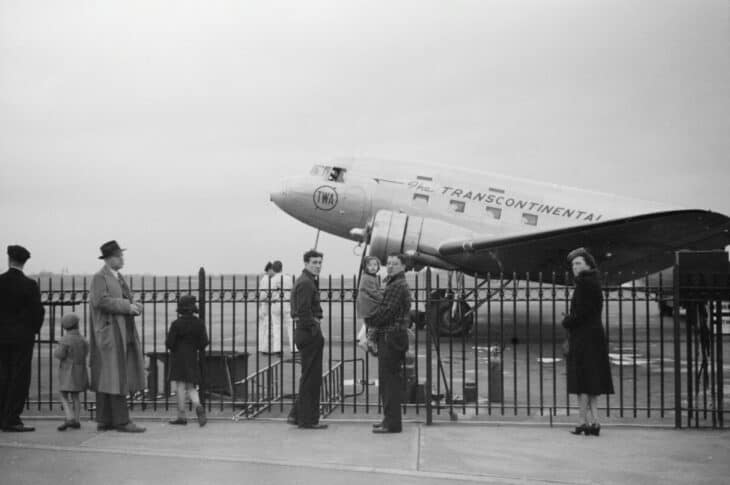
At Albuquerque the flight took on 12 Army men, and other passengers were taken off to make room, among them the violinist Joseph Szigeti. Lombard argued her group’s war bond work made it essential too, and they kept their seats. The load was so heavy that the DC-3 left with only 350 gallons of fuel, so the plan added fuel stops at Winslow, Arizona, and Las Vegas.
That fuel plan changed the route. Flight 3 normally ran Albuquerque to Burbank nonstop, and when it did stop, a daylight flight used Boulder City. At night it had to use Las Vegas, because Boulder City’s airport had no lights.
The new crew knew the Boulder City route far better. Williams, 41, had 12,024 flying hours and had made 7 trips between Burbank and Boulder City but only 2 via Las Vegas. Gillette, 25, had made 37 via Boulder City and 6 via Las Vegas.
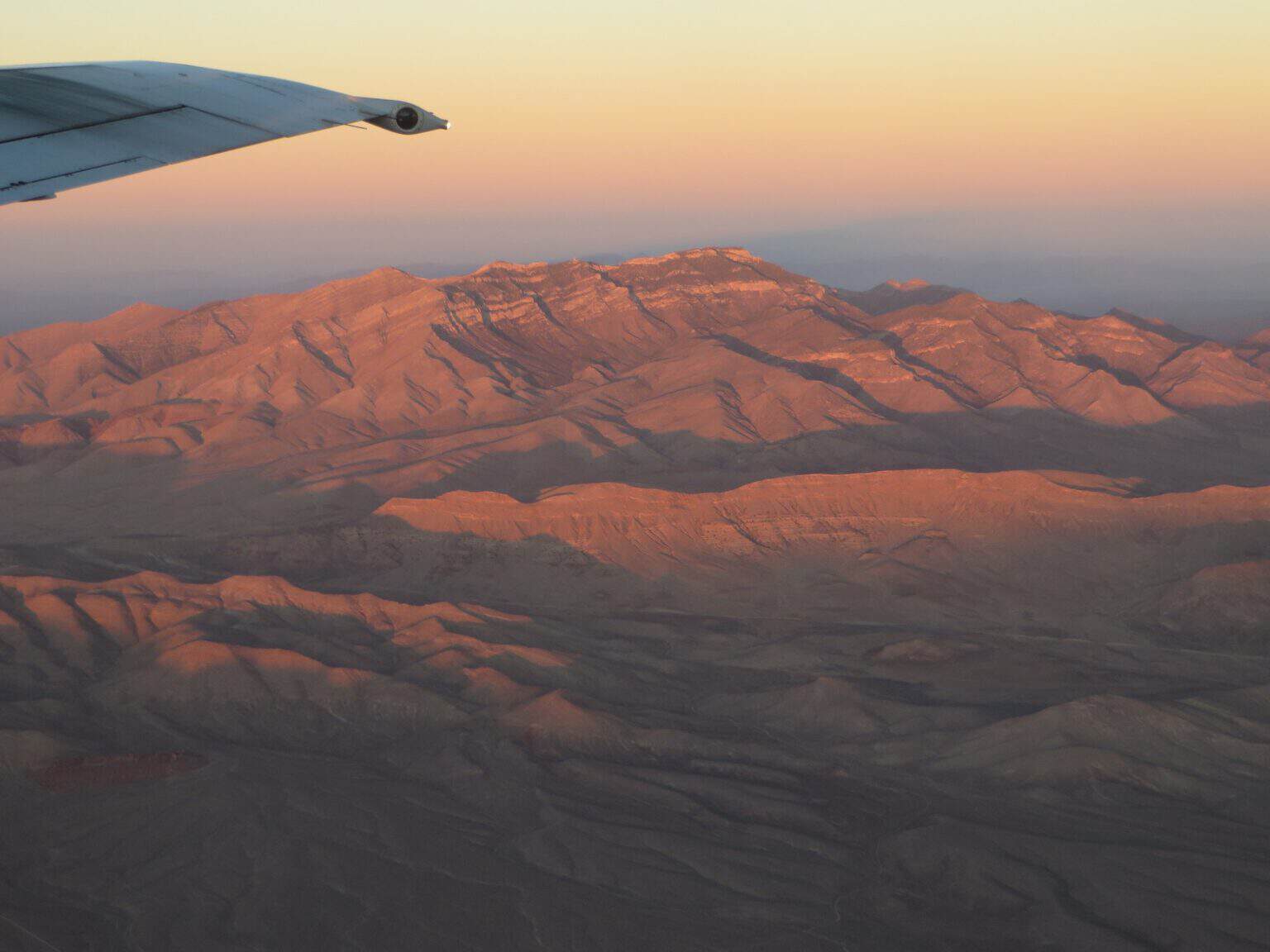
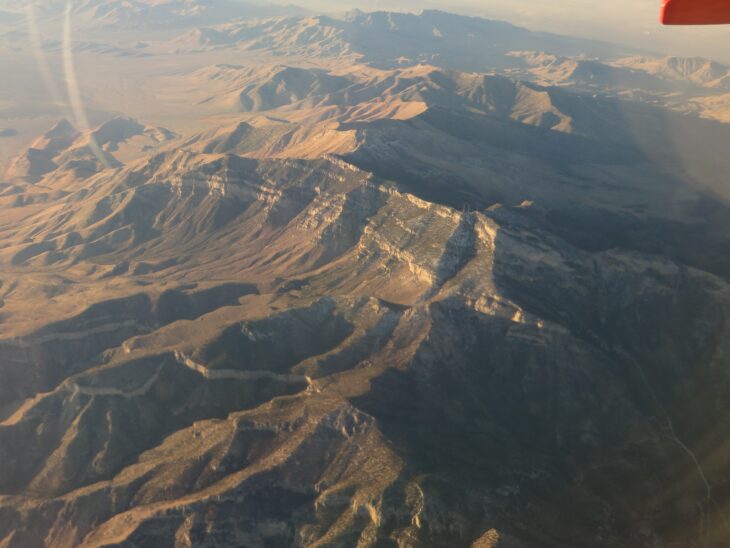
The DC-3 left Las Vegas at 7:07 p.m. Witnesses on the ground said it flew farther northwest than the airliners they usually saw. About 15 minutes after takeoff, it struck a rock face on Potosi Mountain, roughly 33 miles (53 km) southwest of the airport, at about 7,770 feet (2,370 m), some 80 feet below the top of the cliff.

What the CAB found
In 1942 the Civil Aeronautics Board investigated airline accidents. The NTSB would not exist until 1967. The board’s investigator reached Las Vegas in the early hours of January 18 and went straight to the scene, and a two-day public hearing opened in Los Angeles a week after the crash.
The probable cause, in the board’s words, was “the failure of the captain after departure from Las Vegas to follow the proper course by making use of the navigational facilities available to him.”
It named three contributing factors: the use of an erroneous compass course, the blackout of most beacons in the area for the war emergency, and the pilot’s failure to follow a TWA directive of July 17, 1941, which asked pilots on this airway to stay on the actual on-course radio signal.
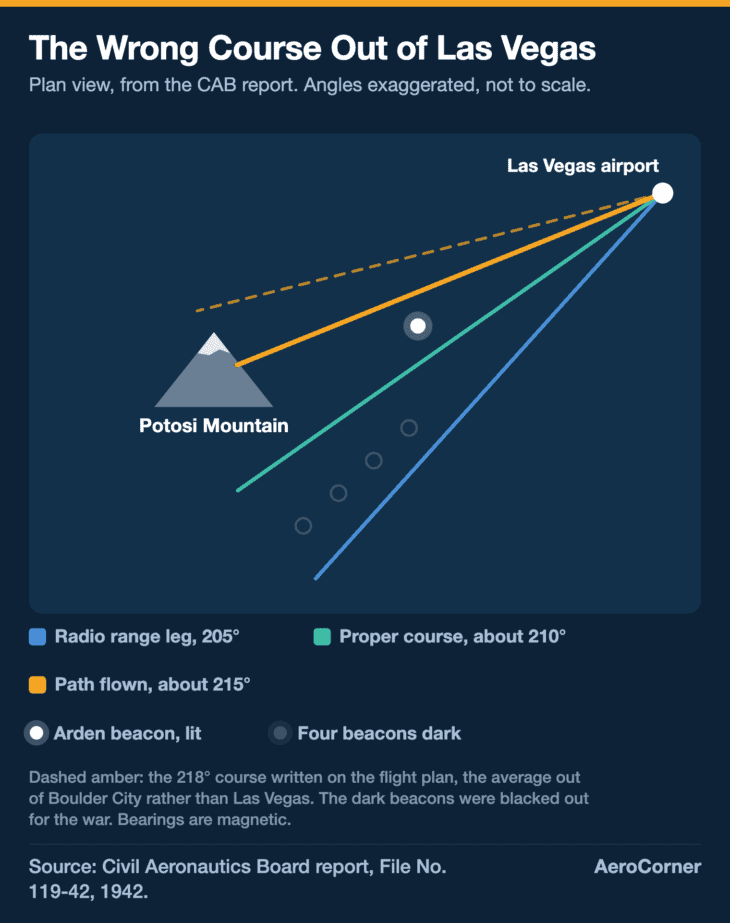
The key exhibit was the flight plan, filed at Albuquerque. For the leg from Las Vegas to Daggett, California, it gave a magnetic course of 218 degrees.
The correct average course from Las Vegas was about 210 degrees. The crash site lay at about 215 degrees from the airport, so the airplane flew close to the course on the paper.
The board traced the number. The average course from Boulder City to Daggett is 218 degrees, and it concluded that the Boulder City figure had probably been written in by mistake. Investigators then found another TWA flight plan for the same route carrying the same 218 degrees, which TWA’s chief pilot called “obviously a mistake.”
Company rules said the first officer prepared the plan and the captain approved and signed it. Only Gillette’s name was on this one, and with no flight superintendent at Albuquerque, nobody else checked it.
The wreckage ruled out the alternatives. The DC-3 hit the cliff almost level, going straight ahead under cruising power, and the board found no failure of the structure, controls, engines or propellers before impact. It concluded the airplane had been climbing steadily from the 1,900-foot field and had not quite reached 8,000 feet.
What most accounts get wrong
The crash is usually blamed on the wartime blackout, as if the crew had no way to see the mountain. The CAB found the weather entirely satisfactory, with unlimited ceiling and visibility, and snow on the peaks that a crew with dimmed cockpit lights could have made out. One of the five beacons to Silver Lake, the Arden beacon, was lit, and the Las Vegas radio range was working normally. The blackout was a contributing factor. The probable cause was the course: the airplane flew close to the 218 degrees on its flight plan, a figure that belonged to the Boulder City route, instead of following the radio range. Two other details often repeated are also off. The board put the impact at about 7,770 feet, not near the 8,300-foot level, and its report, six months after the crash, identified the likely source of the wrong course.
How airline pilots navigated at night in 1942
Airliners of the era had two ways to find an airway at night. The first was a chain of lighted beacons, rotating lights on towers spaced along the route, which pilots flying by visual reference could follow from one to the next.
The second was the low-frequency radio range. Each station sent out Morse “A” and “N” signals in different directions, and where they overlapped they merged into one steady tone. That tone marked the airway, and a pilot drifting off it heard the A or the N take over in the headphones.
The southwest leg of the Las Vegas range ran at 205 degrees magnetic, over terrain that stayed below 6,000 feet. Potosi Mountain, about 8,500 feet (2,590 m) at its crest, sat inside the airway’s boundaries but off the radio beam. On the course Flight 3 flew, the report says, the crew would have heard a moderate A signal had they been listening to the range, which would have told them plainly that they were off course.
The one lit beacon may have misled them. The Arden beacon stood about 20 miles (32 km) out and 2.5 miles (4 km) right of the range’s center line, so southwest-bound flights passed to its left. Flight 3 passed to its right.
Williams’s previous night flight on the route, on December 21, 1941, had found every beacon dark, and the board suggested he may have assumed this one sat on course.
Even the proper average course would not have kept the DC-3 on the beam. The board calculated that a flight on about 210 degrees would still have passed the 8,000-foot level of the high ground by about 3.5 miles (5.6 km). On 215 degrees, that margin was gone.
The board’s blunter reading was that both pilots were paying little attention to the ground and were not using the radio range at all. Every layer of airline navigation was available that night, and none of them was in use.
The flight plan nobody checked, and the weights nobody believed
The report also looked at how Flight 3 was loaded. To fit the passengers under the 25,200-pound (11,430 kg) limit, the Albuquerque agent asked the officer in charge of the 12 Army men for their weights, then assigned each of them an average of 130 pounds (59 kg).
Army records showed the men weighed substantially more. The board estimated the DC-3 was probably over its permitted weight by less than 500 pounds (227 kg), said the overweight did not seem to have had any bearing on the accident, and called the figure “an intrinsically improbable statement” that had been accepted because it kept the flight moving.
The FBI looked for sabotage, chasing tips that included Szigeti and a strange light in the sky. Nothing in its file points to sabotage, and a January 21 field report quoted a CAA official saying there was no evidence of it. Orson Welles later claimed the airliner was shot down by Nazi agents, but the CAB’s wreckage findings describe a sound airplane under power, flying level into rock.
What changed
The board formally recommended that the Administrator of Civil Aeronautics set contact flight procedures at each airport so that airliners would climb and descend “at a safe distance from all obstructions.”
It also said it was considering rules that would keep night contact flights inside the on-course signal and at least 1,000 feet above the highest obstacle within 10 miles of the course. It said every airline should check its flight plans, and it was considering making it a violation for a captain not to sign one.
Today’s US airline rule has the same shape. Under 14 CFR 121.657, an airliner flying at night under visual rules must stay at least 1,000 feet above the highest obstacle within 5 miles of the center of its intended course, or 2,000 feet in designated mountainous areas. And the captain no longer checks the plan alone: under 14 CFR 121.533 an airline dispatcher shares responsibility for preflight planning and the release of every flight.
Clark Gable, 40, chartered a plane to Las Vegas that night and was persuaded back from the mountain trail. Shortly after, he joined the Army Air Forces and flew five combat missions with a B-17 group in England, filming aerial gunners. In January 1944 he attended the launch of the Liberty ship SS Carole Lombard.
FAQ
Sources and references used for research and fact-checking.
- Civil Aeronautics Board, via Wikisource, Report of the Civil Aeronautics Board, accident to NC 1946 near Las Vegas, Nevada, January 16, 1942 (File No. 119-42, Docket SA-58)
- US DOT National Transportation Library (ROSAP), Investigation of Aircraft Accident: TWA, Las Vegas, Nevada, 1942-01-16 (scanned report)
- eCFR, 14 CFR 121.657, Flight altitude rules
- Jack El-Hai, The FBI's File on Carole Lombard
- LostFlights (Commercial Aviation Archaeology), January 16, 1942: Transcontinental & Western Air, Douglas DC-3 (NC1946), Potosi Mountain, NV
- Wikipedia, TWA Flight 3
- Wikipedia, Carole Lombard
- Wikipedia, Clark Gable
- Wikipedia, Low-frequency radio range
- The Daily Mirror (Los Angeles history), Carole Lombard Among 22 Dead in Crash; Gable Charters Plane for Las Vegas
- US Deadly Events, 1942, Jan 16, TWA Flight 3 (with Carole Lombard), Hits Potosi Peak, NV
Get the Newsletter
The latest aviation news and stories sent to your inbox.
About the Author

Tim is the owner and lead editor of AeroCorner since 2019, overseeing aviation content covering aircraft, airlines, airports, and the broader aviation industry. Through years of researching, writing, editing, and publishing aviation-focused content, he has developed extensive practical knowledge of commercial aviation and air travel. Based in Asia and a frequent traveler himself, Tim also brings firsthand passenger experience to AeroCorner’s coverage. Outside of publishing, he has also explored aviation firsthand through hands-on flight training in New Zealand.