

Table of Contents
On September 24, 1929, a small Army biplane taxied out at Mitchel Field on Long Island with a canvas hood pulled over its rear cockpit. The pilot underneath could not see the ground, the sky or the horizon.
He took off, flew a course, came back around and landed, all by instruments. A safety pilot rode up front with his hands in his lap. About 15 minutes later, flying in cloud stopped being a gamble and started becoming a skill that could be taught.
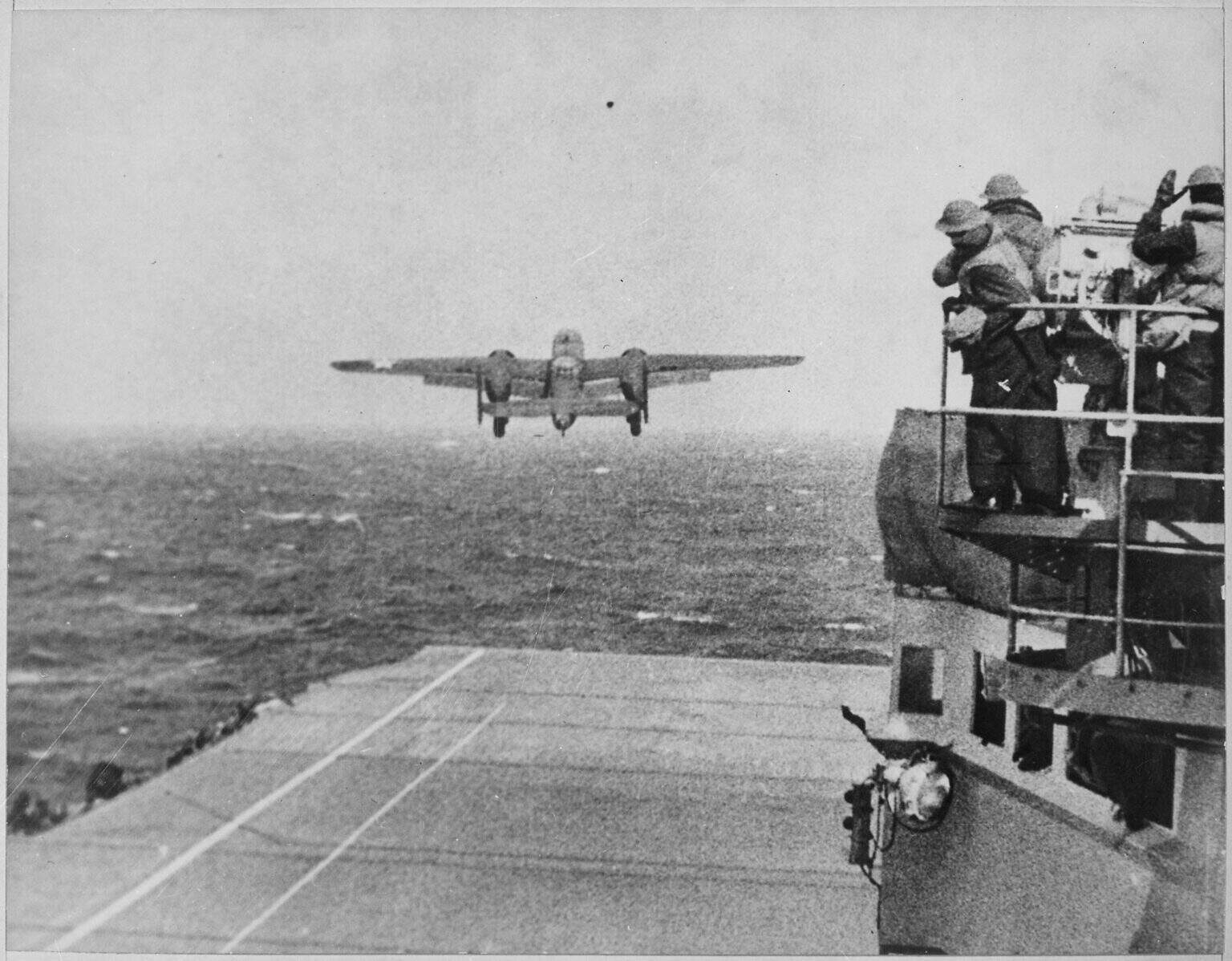
The pilot was Jimmy Doolittle. Most people know him for one day in April 1942, when he led 16 bombers off an aircraft carrier to hit Japan. That raid made him a legend, but it is not the whole story, and it is arguably not his most important flight.
Who Was Jimmy Doolittle?
James Harold “Jimmy” Doolittle (December 14, 1896 to September 27, 1993) was an American aviator, aeronautical engineer and Air Force general. He set speed and distance records in the 1920s and 1930s, flew the first full blind flight in 1929, and led the Doolittle Raid on Japan in 1942, which earned him the Medal of Honor.
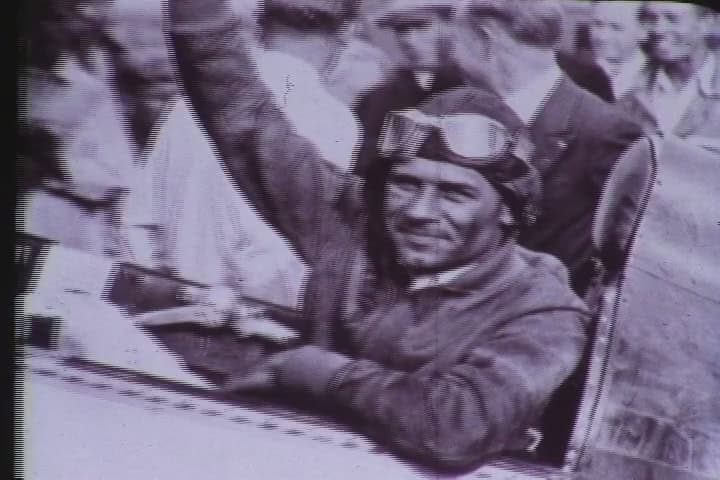
He then commanded three numbered air forces in World War II, including the Eighth Air Force in England. In 2003, Air & Space/Smithsonian magazine ranked him first on its list of the greatest pilots of all time, and he sits high on our list of the most famous pilots in history.
Jimmy Doolittle at a glance
Born in Alameda, California, in 1896. Earned a doctorate in aeronautics from MIT in 1925. First pilot to cross the US in less than a day (1922). Flew the first takeoff, flight and landing on instruments alone (1929). Led the Doolittle Raid on Japan (April 18, 1942) and received the Medal of Honor. Commanded the Eighth Air Force from January 1944. Promoted to four-star general in 1985. Died in 1993, aged 96.
A 5-Foot-4 Boxer With an MIT Doctorate
Doolittle spent his early childhood in Nome, Alaska, where his father worked as a carpenter and prospected for gold. Back in California as a teenager, he was 5 feet 4 inches (1.63 m) tall and a fierce amateur boxer, who sometimes fought for money under the name Jimmy Pierce so his mother would not find out.
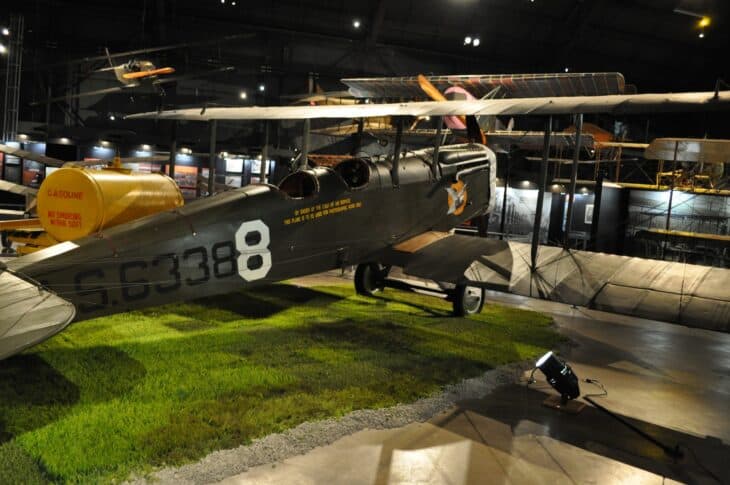
He joined the Army Air Service during World War I. His first record came on September 4, 1922. He flew a modified de Havilland DH-4 from Pablo Beach, Florida, to Rockwell Field near San Diego with a single fuel stop in San Antonio, becoming the first pilot to cross the continent in less than a day.

The Army then sent him to the Massachusetts Institute of Technology. He earned a master’s degree in 1924 and a doctorate in aeronautics in 1925, one of the first such doctorates granted in the United States.
His master’s research measured how much stress an airframe could take, using an accelerometer in aircraft he flew to their limits at McCook Field in Dayton, Ohio.
That mix of scientist and stick-and-rudder pilot was the point. Doolittle believed the engineer and the test pilot should be the same person, and he set out to be that person.
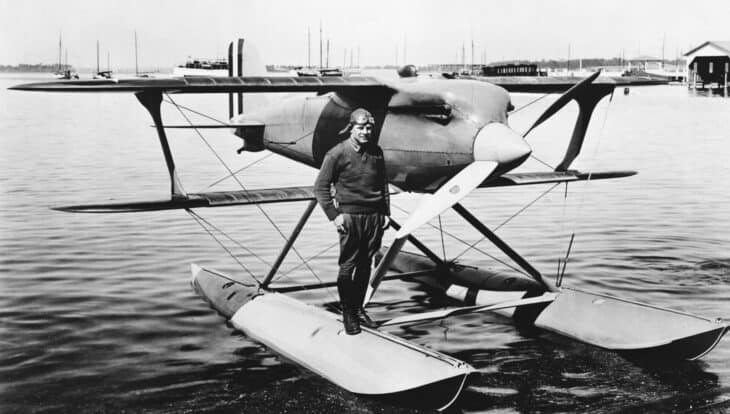
In 1925 he won the Schneider Trophy seaplane race in a Curtiss R3C-2 on floats, averaging 232 mph (373 km/h).

In May 1927, in Dayton, he flew what is credited as the first outside loop, a full loop with the pilot on the outside of the circle, diving from 10,000 feet (3,050 m) and reaching about 280 mph (450 km/h). “Don’t know why I did it,” he said later.
How Jimmy Doolittle Flew Blind in 1929
In the 1920s, cloud and fog killed pilots. Without a visible horizon, the inner ear lies: a slow turn feels like level flight, and a pilot flying by feel can spiral into the ground convinced the wings are level.
The Daniel Guggenheim Fund set up a Full Flight Laboratory at Mitchel Field to solve this, with the Army Air Corps, the Department of Commerce and three companies. Doolittle was its test pilot, and the airplane was a Consolidated NY-2 biplane fitted with three new instruments.
A Kollsman sensitive altimeter gave altitude precise enough to land by. Sperry supplied an artificial horizon, the ancestor of today’s attitude indicator, and a directional gyro to hold a heading. A radio range and a marker beacon built by the Bureau of Standards told him where the field was.
On September 24, 1929, Doolittle took off under the hood, flew a circuit of roughly 15 to 20 miles (24 to 32 km) and landed without seeing outside. Lt. Benjamin Kelsey sat in the front cockpit as safety pilot, ready to take over if needed. The flight won Doolittle the Harmon Trophy.
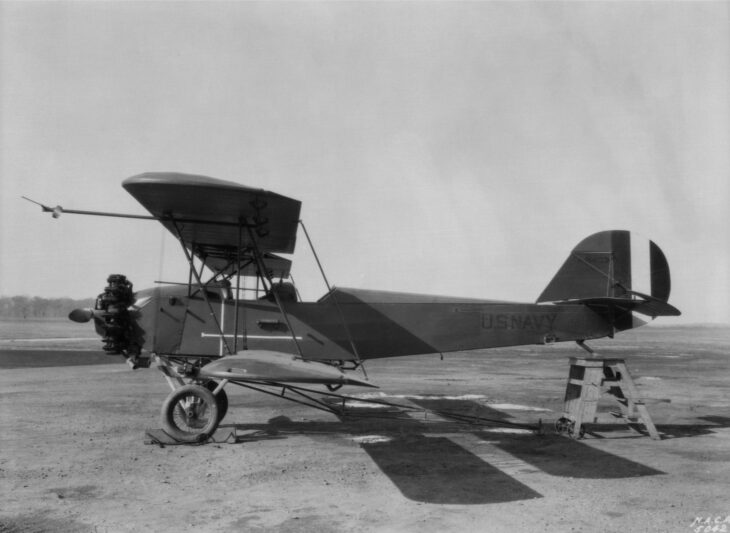

The instruments are still in the cockpit
The three instruments on Doolittle’s 1929 panel, an artificial horizon, a directional gyro and a sensitive altimeter, are still the core of the six-pack every student pilot learns today. The IEEE named his flight an engineering milestone in 2014, with a plaque at the Cradle of Aviation Museum in Garden City, New York.
That is a fair case for ranking the blind flight above the raid. Every airliner that lands in cloud today does what the NY-2 did first, using the descendants of the same six classic flight instruments.
The Racer Who Called Himself Conservative
Doolittle resigned his regular Army commission in February 1930 and went to work for Shell Oil, staying in the Air Corps Reserve. He kept racing. In 1931 he won the first Bendix Trophy, from Burbank to Cleveland, in a Laird Super Solution, then flew on to Newark to set a coast-to-coast record of under 12 hours.
In 1932 he flew the Gee Bee R-1, a stubby racer that was mostly engine. He set a landplane speed record of about 296 mph (476 km/h) in it, then won the Thompson Trophy at Cleveland at about 252 mph (406 km/h).
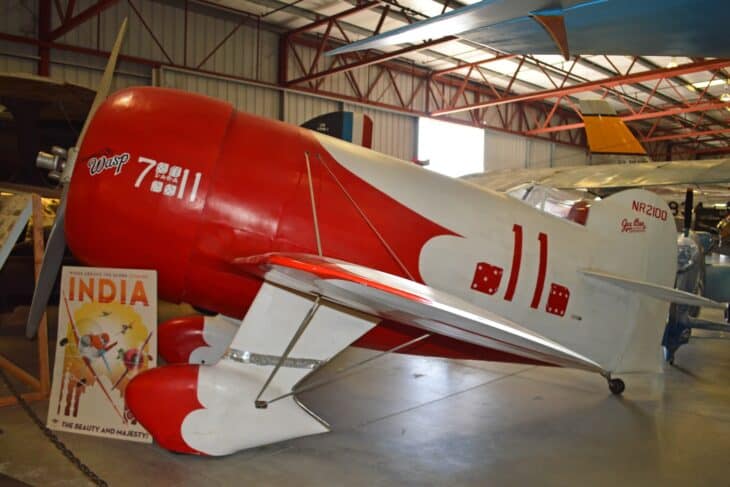

He called the Gee Bee the most dangerous aircraft he ever flew, and he announced his retirement from racing straight afterward. “I have always tried to be conservative,” he said, which sounds strange from a man famous for stunts until you remember he was the one with the engineering degree.
His most important work in the 1930s happened at a desk. As Shell’s aviation manager, he pushed the company to make 100-octane aviation gasoline before any engine needed it, a bet colleagues called “Doolittle’s million-dollar blunder.” The Army Air Corps standardized on 100-octane fuel by mid-1936.
By mid-1940 the United States could produce up to 650,000 gallons (2.5 million liters) of it a day, and it was the only country able to make it in large quantities.
The British used high-octane fuel in the Battle of Britain, and the Air Force’s own historian argues that Doolittle’s advocacy helped Britain survive that summer. For more on how aviation fuels differ, see kerosene vs avgas.
What Happened on the Doolittle Raid?
Doolittle returned to active duty in July 1940. After Pearl Harbor, President Roosevelt wanted Japan hit at home, and a Navy submariner, Capt. Francis Low, suggested flying Army bombers off a carrier. Gen. Hap Arnold gave the job of training and leading the mission to Doolittle.
The aircraft was the North American B-25 Mitchell, in a modified B-25B version. Sixteen B-25Bs and their crews, 80 men in all, were loaded onto USS Hornet at Alameda on April 1, 1942. None of the pilots had ever launched from a carrier.
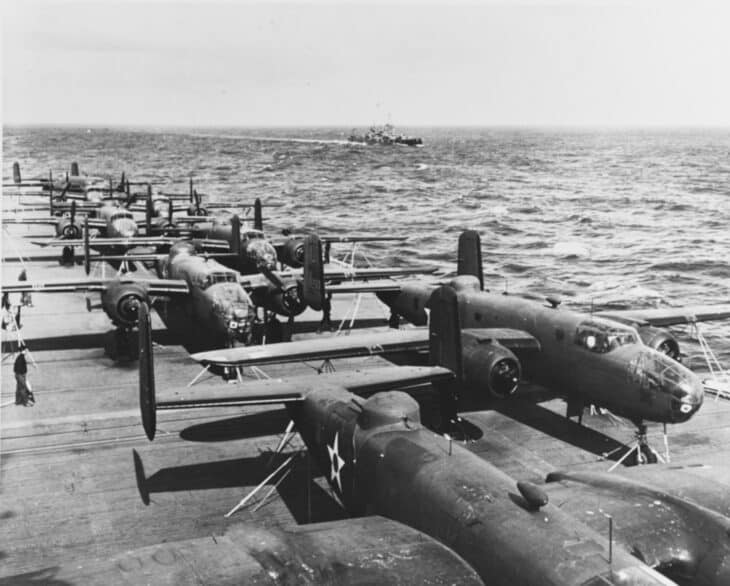

The plan was to bomb Japan and fly on to friendly airfields in China. At dawn on April 18, a Japanese picket boat spotted the task force about 650 miles (1,050 km) out. Doolittle and Adm. William Halsey chose to launch at once, about 150 miles (240 km) short of the planned point.
Doolittle took off first, in rough seas. All 16 bombers reached Japan and dropped their bombs on targets in Tokyo, Yokohama, Kobe, Osaka and Nagoya, and none was shot down over Japan.
The extra distance meant none could reach the Chinese airfields. One crew diverted to the Soviet Union and was interned. The other 15 crews bailed out, crash-landed or ditched along the Chinese coast, and Doolittle and his crew were among those who bailed out.
One man died bailing out and two drowned when their bomber ditched. Eight were captured: three were executed, one died in captivity, and four were freed after Japan surrendered in 1945. The Air Force museum notes that Japanese forces later killed as many as a quarter million Chinese civilians in reprisal for helping the Raiders.
Early 1942
Doolittle is picked to lead. Gen. Hap Arnold gives him the job of training crews to fly B-25s off a carrier.
Apr. 1, 1942
Loaded at Alameda. Sixteen modified B-25Bs and 80 crewmen go aboard USS Hornet.
Apr. 18, 1942
Spotted and launched early. A picket boat finds the task force about 650 miles from Japan, and all 16 bombers take off.
Apr. 18-19, 1942
Out of fuel over China. Fifteen crews bail out, crash-land or ditch; one lands in the Soviet Union.
1942
Medal of Honor. Promoted to brigadier general, skipping colonel, Doolittle receives the medal from President Roosevelt.
Aug. 1945
The last prisoners go free. Four of the eight captured Raiders survive the war.
Why Doolittle Thought He Would Be Court-Martialed
Sitting in China after the raid, Doolittle believed it had failed. He had launched early and lost every one of his 16 aircraft, and he expected to be court-martialed when he got home.
Instead he was promoted two grades to brigadier general and given the Medal of Honor at the White House. The citation praised “conspicuous leadership above the call of duty, involving personal valor and intrepidity at an extreme hazard to life.”
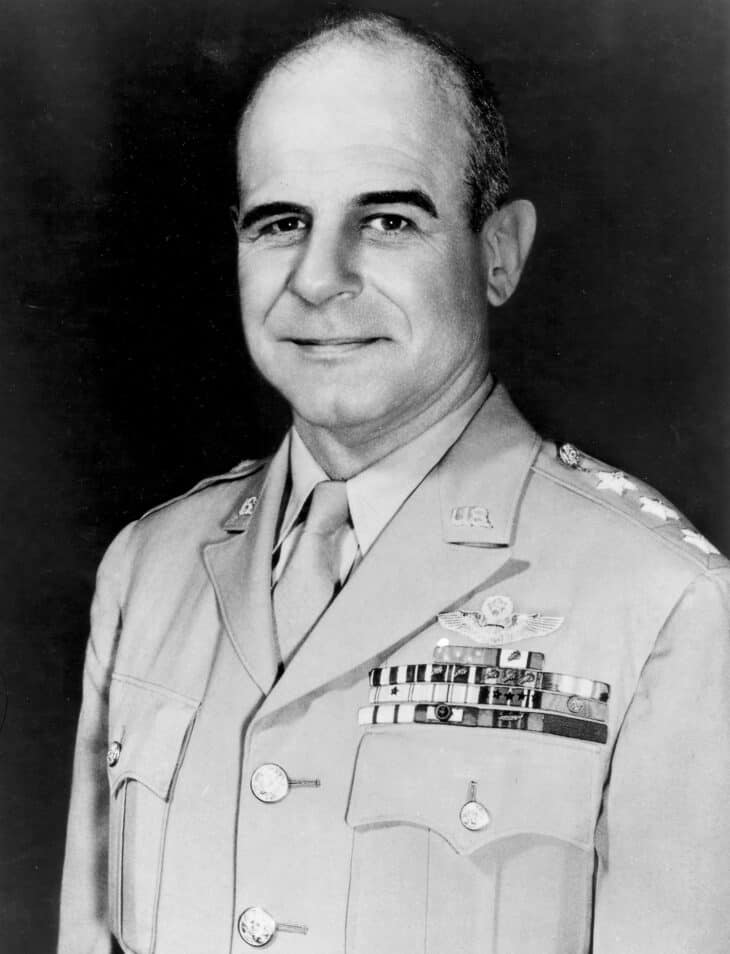

He had misjudged the effect on both sides. Americans, after months of Japanese victories, got the hit back they wanted. In Japan, the commander of the Combined Fleet, Adm. Isoroku Yamamoto, used the raid to push through his plan to attack Midway, over opposition from the Army and the Navy General Staff, and that battle became a Japanese disaster.
Myth: Doolittle was a daredevil who got lucky
The stunts are real, but they were the smaller part of his career. Doolittle held a doctorate in aeronautics, tested instruments and airframes to their limits on purpose, quit racing because he judged the Gee Bee too dangerous, and closed his logbook with more than 10,000 hours in 265 aircraft types. The raid itself was planned around fuel figures, and it was the fuel that ran out.
The Sign He Took Down in England
Doolittle went on to command the Twelfth Air Force in North Africa and the Fifteenth in the Mediterranean. In January 1944 he took over the Eighth Air Force, the heavy bomber force flying against Germany from England.
Visiting VIII Fighter Command, he saw a sign: “The first duty of Eighth Air Force fighters is to bring the bombers back alive.” He had it taken down. The replacement read: “The first duty of Eighth Air Force fighters is to destroy German fighters.”
Escorts no longer had to stay glued to the bombers. They could fly ahead and hunt German fighters before those fighters reached the formations. His fighter pilots went on to win air superiority over the Luftwaffe.
The Eighth’s average monthly heavy-bomber loss rate fell from 5.1% in 1943 to 1.9% in 1944. Doolittle called the change “the most important and far-reaching military decision I made during the war.”
How Jimmy Doolittle Is Remembered
After the war Doolittle went back to Shell, sat on government advisory boards and served as the last chairman of the National Advisory Committee for Aeronautics before it became NASA in 1958. He retired from the Air Force Reserve in 1959 as a lieutenant general, the only Reserve officer to retire at that rank.
In 1985 President Ronald Reagan and Sen. Barry Goldwater pinned on his fourth star, and in 1988 President George H. W. Bush gave him the Presidential Medal of Freedom. He died in his sleep at Pebble Beach, California, on September 27, 1993, at 96, and is buried at Arlington National Cemetery.
The raid still carries his name forward. On September 19, 2016, the Air Force named its new stealth bomber the B-21 Raider, announced on stage by Dick Cole, Doolittle’s copilot in the lead B-25. Cole, the last surviving Raider, died on April 9, 2019, at 103.
Doolittle was one of a generation of Army airmen who fought to prove what air power could do, alongside Billy Mitchell, who was court-martialed for saying so in public. Doolittle only feared that he would be.
So the next time a flight descends into cloud and breaks out lined up with the runway, remember the canvas hood at Mitchel Field. The Tokyo raid made Jimmy Doolittle famous, but those 15 blind minutes in 1929 are the part of his work that flies with you.
Sources and references used for research and fact-checking.
- Air Force History and Museums Program, General James H. Doolittle: The Air Force's Warrior-Scholar
- IEEE Engineering and Technology History Wiki, Milestones: First Blind Takeoff, Flight and Landing, 1929
- Air & Space Forces Magazine, An American Hero
- Air & Space Forces Magazine, Targeting the Luftwaffe
- National Museum of the United States Air Force, America Hits Back: The Doolittle Tokyo Raiders
- Naval History and Heritage Command, H-004-4: Doolittle Raid
- Wikipedia, Jimmy Doolittle
- NASA, NACA chairman James Doolittle (image AMF-GRC-1958-C-48117)
- Defense News, It's the Raider: Air Force unveils name of new B-21 bomber
- EAA, The Last Raider: Dick Cole Dead at Age 103
Get the Newsletter
The latest aviation news and stories sent to your inbox.
About the Author

Tim is the owner and lead editor of AeroCorner since 2019, overseeing aviation content covering aircraft, airlines, airports, and the broader aviation industry. Through years of researching, writing, editing, and publishing aviation-focused content, he has developed extensive practical knowledge of commercial aviation and air travel. Based in Asia and a frequent traveler himself, Tim also brings firsthand passenger experience to AeroCorner’s coverage. Outside of publishing, he has also explored aviation firsthand through hands-on flight training in New Zealand.