

Table of Contents
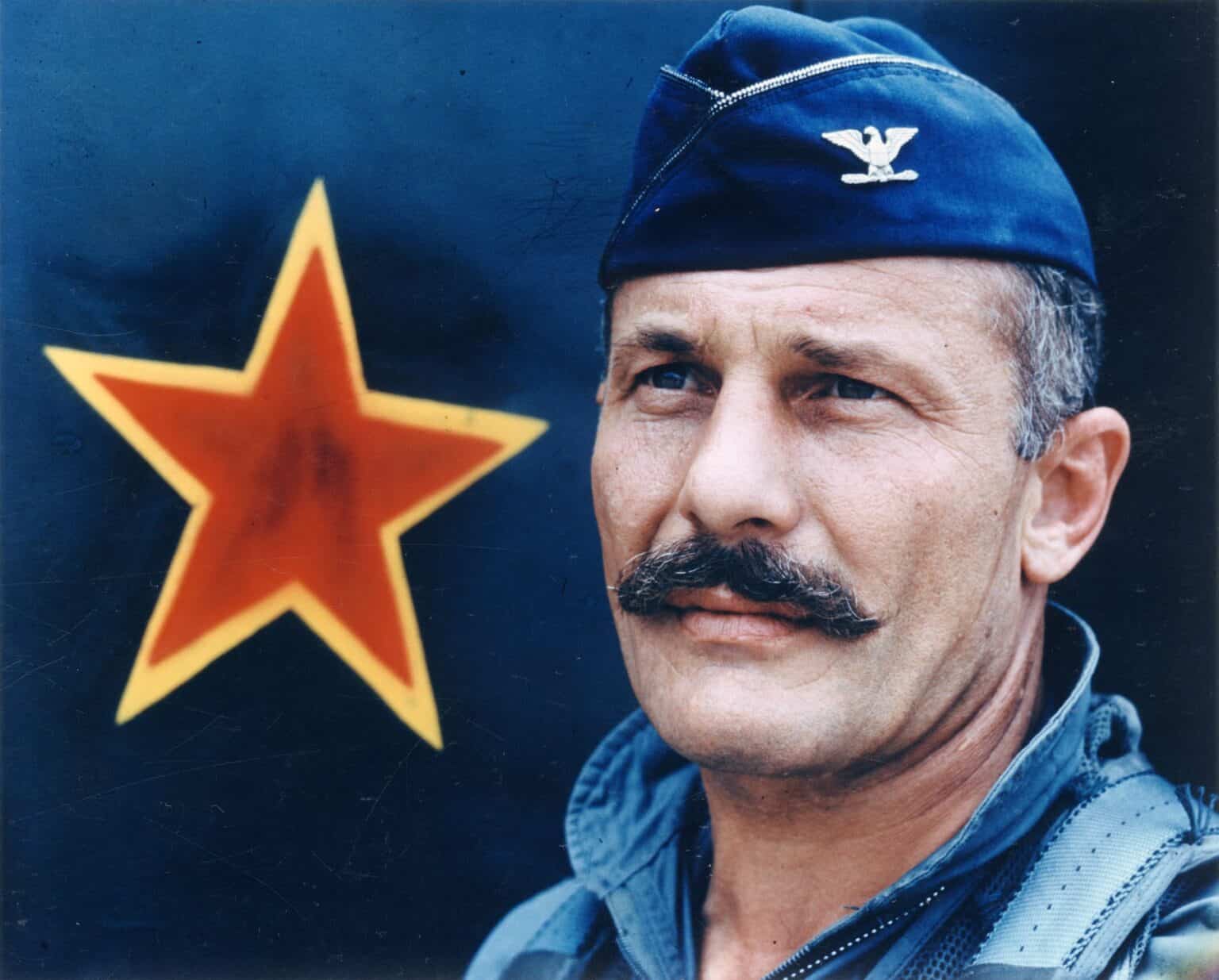
In the summer of 1967, a 44-year-old colonel with a waxed handlebar mustache had North Vietnamese MiGs in front of his guns and missiles, and let them go. He had already shot down four. One more would have made him an ace in a second war.
Robin Olds said later that he passed on that shot, and others like it, on purpose. The reason tells you more about him than any victory tally does, and the tally itself is not as settled as most profiles make it look.
Here is who Olds was, why the Air Force still talks about him, and why sources disagree on how many enemy aircraft he actually destroyed.
Who Was Robin Olds?
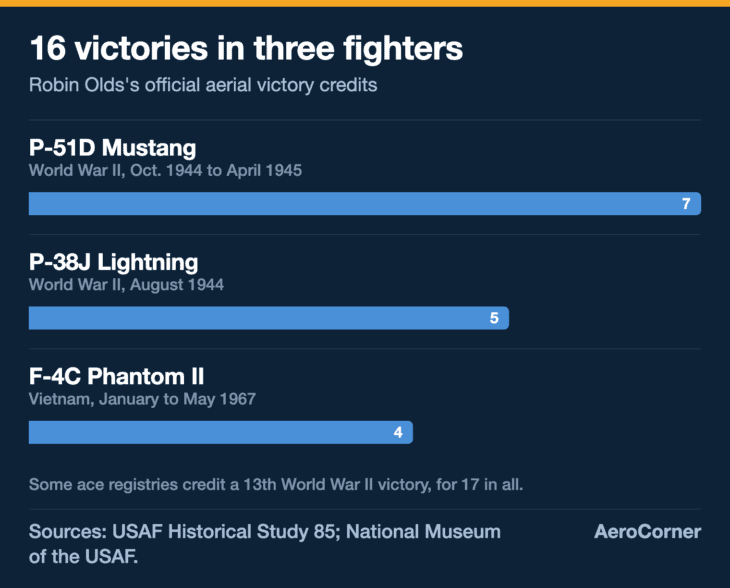
Robin Olds (1922 to 2007) was a U.S. Air Force fighter pilot who became an ace in World War II, then commanded the 8th Tactical Fighter Wing in Vietnam. The National Museum of the U.S. Air Force credits him with 12 victories over Germany and 4 MiGs over North Vietnam, a lifetime total of 16.
He is famous for three things: planning Operation Bolo, the trap that destroyed seven MiG-21s in one afternoon without a single American loss, leading his wing from the front, and openly defying the brass. He retired as a brigadier general in 1973.
Robin Olds at a glance
Born July 14, 1922, in Honolulu. All-American tackle at West Point, 1942. WWII: 12 aerial victories (USAF credit) in the P-38 and P-51. Vietnam: 4 MiGs in the F-4C as commander of the 8th Tactical Fighter Wing. Air Force Cross, four Silver Stars. Commandant of cadets at the Air Force Academy. Died June 14, 2007, in Steamboat Springs, Colorado.
An Ace at 22, in Two Different Fighters
Olds was born in Honolulu on July 14, 1922, into aviation. His father, Robert Olds, was a World War I pursuit pilot, an aide to Billy Mitchell and the commander of the first B-17 squadron, according to the Air Force museum.
At West Point he was a 6-foot-2 tackle who made All-American in 1942, and he later entered the College Football Hall of Fame. He graduated on June 1, 1943, went through flight training and shipped out to England with the 479th Fighter Group.
Flying the twin-boom Lockheed P-38 Lightning, he shot down two Fw 190s on August 14, 1944, and three Bf 109s on August 25. That made him the group’s first ace.
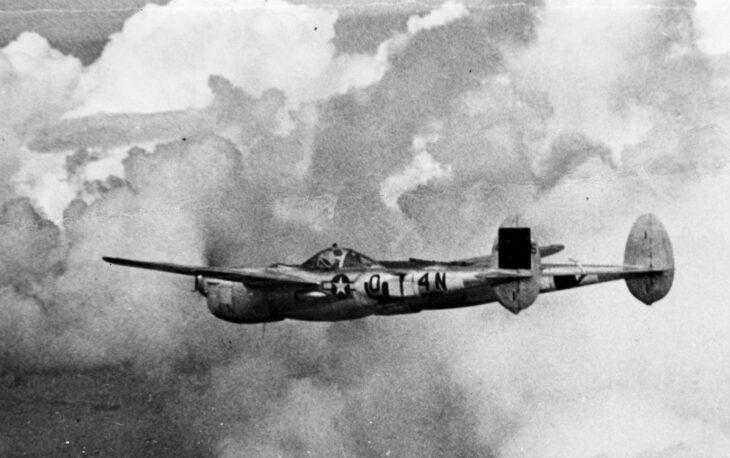

When the 479th converted to the North American P-51 Mustang, he kept scoring, seven more by the official count. In March 1945, at 22 and less than two years out of West Point, he was a major commanding the 434th Fighter Squadron.
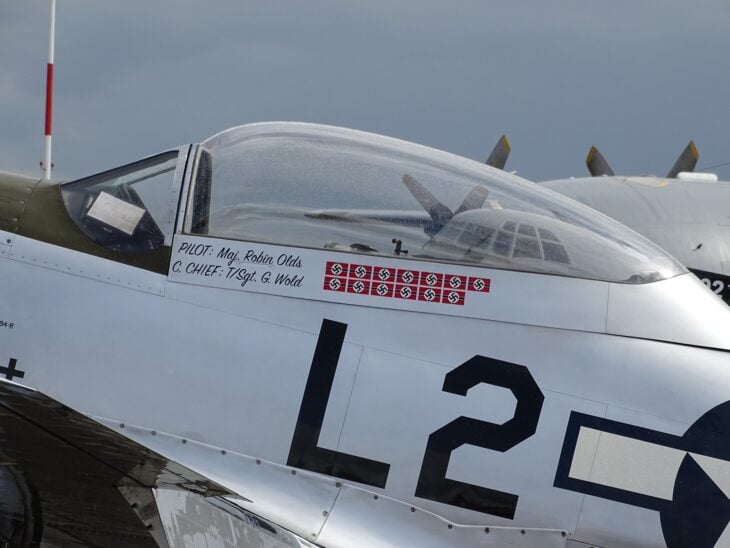

He also destroyed 11.5 German aircraft on the ground, strafing airfields in the war’s final weeks. On one of those passes, at Tarnewitz on the Baltic, five P-51s went in and his was the only one that made it home.
The Jet Age, and a War He Missed
After the war Olds flew in the first jet demonstration team built around the Lockheed P-80 Shooting Star. In 1947 he married the Hollywood actress Ella Raines.

On an exchange tour from October 1948 to September 1949 he commanded No. 1 Squadron of the Royal Air Force at Tangmere. He was the first foreigner to command an RAF unit in peacetime.
Korea passed him by. The museum notes that he could not get a combat posting during that war, which left him determined not to miss the next one.
Operation Bolo: The Day the Wolfpack Baited a Trap
Olds took command of the 8th Tactical Fighter Wing, the “Wolfpack,” at Ubon in Thailand on September 30, 1966. His pilots flew the McDonnell Douglas F-4 Phantom II, and they had a problem.

American rules of engagement barred attacks on North Vietnamese airfields, so MiGs could only be killed in the air. The MiG pilots, in turn, went after the bomb-laden F-105 Thunderchiefs and avoided fights they could not win.
Olds and his tactics officer, Capt. John “J.B.” Stone, turned that habit into bait. On January 2, 1967, the wing’s F-4s flew into North Vietnam from the west on the F-105s’ usual route, altitude and formation, carrying the F-105s’ own jamming pods.
The MiG-21 pilots climbed up expecting heavy fighter-bombers and found Phantoms loaded for air-to-air combat instead. F-4s from the 366th Tactical Fighter Wing came in from the east to block the MiGs’ escape.
Twelve minutes over Hanoi
In a 12-minute engagement on January 2, 1967, the 8th Tactical Fighter Wing claimed seven MiG-21s, about half of North Vietnam’s operational MiG-21 force, with no U.S. losses. Olds shot down one of them himself. Four days later a second ruse, this time mimicking a reconnaissance flight, downed two more.
The museum says the losses greatly reduced MiG activity for several months. The Wolfpack went on to become the Air Force’s top MiG-killing wing in Southeast Asia.
Why Robin Olds Refused His Fifth MiG
Olds kept flying the hardest missions himself. He shot down a second MiG-21 over Phuc Yen on May 4, 1967, and two MiG-17s on May 20, after they had shot down his wingman in a large dogfight.
That made four. In his memoir he wrote that he then held off on a fifth, even though he had at least ten chances to take it.
His reason: he had learned in mid-June that Seventh Air Force, at the direction of Air Force Secretary Harold Brown, would relieve him of command the moment he became a Vietnam ace. He would be flown home as a publicity asset. Olds preferred the cockpit to the press tour.
Some of the men around him later hinted at more. Historian John Darrell Sherwood wrote that sources he interviewed suggested Olds did shoot down more than four, and that those kills went unclaimed or were credited to wingmen. Olds himself denied further MiG kills in his memoir.
He also earned the Air Force Cross for leading a strike on the heavily defended Paul Doumer Bridge in Hanoi on August 11, 1967. He flew his last combat mission over North Vietnam on September 23, 1967.
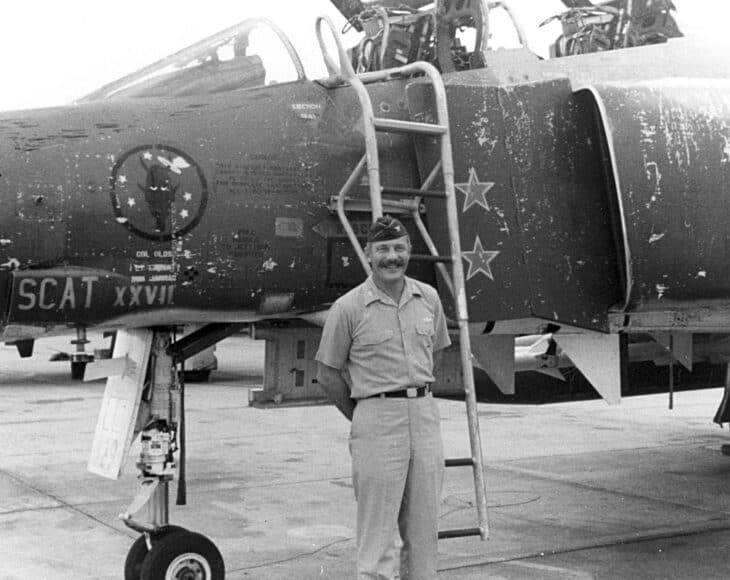
Across both wars he flew 259 combat missions: 107 in World War II and 152 in Southeast Asia, 105 of them over North Vietnam. His F-4C, Scat XXVII, now sits in the National Museum of the U.S. Air Force in Dayton, Ohio.
The Mustache That Started an Air Force Tradition
In Vietnam, Olds grew an extravagant, waxed handlebar mustache that broke Air Force grooming rules. He called it “a gesture of defiance,” and wrote that it “became the middle finger I couldn’t raise in the PR photographs.”
When he got home, Air Force Chief of Staff Gen. John P. McConnell looked at it and said, “Take it off.” Olds answered, “Yes, sir,” and later called it the most direct order he had received in twenty-four years of service.
The episode is credited with inspiring Mustache March, the month when airmen worldwide grow mustaches in a good-natured protest against the facial hair rules.
After Vietnam: Commandant, Critic, Retiree
Olds reported to the Air Force Academy in December 1967 as commandant of cadets, and was promoted to brigadier general on June 1, 1968. He spent about three years there, rebuilding morale after a cheating scandal.
In late 1971 he toured the fighter bases in Thailand for the Inspector General. He told the Chief of Staff, Gen. John D. Ryan, that Air Force pilots “couldn’t fight their way out of a wet paper bag,” because the service had stopped training them for air-to-air combat.
When the air war over North Vietnam resumed in 1972, the Air Force’s fighter units were struggling with a kill-to-loss ratio near 1 to 1 by June, just as he had warned. Olds offered to drop back to colonel to return to combat command, was turned down, and retired on June 1, 1973.
1922
Born in Honolulu on July 14, son of future Maj. Gen. Robert Olds.
1942
All-American tackle at West Point; graduates June 1, 1943.
1944
Becomes an ace in the P-38 with five victories in August.
1945
Commands the 434th Fighter Squadron at 22 and ends the war with 12 credited victories.
1948-49
Commands No. 1 Squadron RAF at Tangmere on an exchange tour.
1966
Takes command of the 8th Tactical Fighter Wing at Ubon, Thailand, on September 30.
1967
Operation Bolo on January 2, then 3 more MiGs and the Air Force Cross.
1968
Promoted to brigadier general as commandant of cadets at the Air Force Academy.
1973
Retires on June 1.
2007
Dies on June 14 in Steamboat Springs, Colorado, aged 84.
He was enshrined in the National Aviation Hall of Fame in 2001. He died in Steamboat Springs, Colorado, on June 14, 2007, at 84, and is buried at the Air Force Academy Cemetery.
His memoir, Fighter Pilot: The Memoirs of Legendary Ace Robin Olds, written with his daughter Christina Olds and fighter pilot Ed Rasimus, came out in 2010.
16, 17 or More? Why Robin Olds’s Score Depends on Who Counts
The number most profiles get wrong
Some profiles, including the American Fighter Aces Association’s and Air and Space Forces Magazine’s, give Olds 13 victories in World War II, which would make 17 in all. The official U.S. credit is 12, for 16 in all. The gap is one German fighter.
The Air Force’s official record, USAF Historical Study 85, credits Olds with 12 aerial victories in World War II. The National Museum of the U.S. Air Force uses that number and adds the 4 MiGs for a lifetime total of 16.
The American Fighter Aces Association tells it differently. Its profile says he scored three confirmed victories in one dogfight on February 14, 1945, where the official list credits two, and it takes his World War II score to 13. Air & Space Forces Magazine also gives 13.
Either way, he clears the bar for “triple ace,” which means 15 or more victories. Then there are the uncounted Vietnam kills Sherwood’s sources described, which nobody can credit.
Operation Bolo has its own gap. The U.S. claimed seven MiG-21s, but a North Vietnamese history acknowledges only five, and says all five pilots ejected safely. The U.S. claim is the one in the official record; the Vietnamese count is a reminder that air combat claims rarely match on both sides.
Was Robin Olds Part of Top Gun?
No. Olds was an Air Force officer, and TOPGUN is the Navy’s fighter weapons school, so his name belongs to a different service’s story.
The connection people sense is real, though. Navy and Marine Corps fighters trained under the TOPGUN program did well when the air war resumed in 1972, while the Air Force, whose chief of staff had disagreed with his warning, struggled.
Olds spent his career arguing that fighter pilots must be trained to dogfight. That argument, more than his score, is why his name still sits on lists like our ranking of the best fighter pilots in history.
So the next time you see a photo of that ridiculous mustache, remember the MiG he let go. Robin Olds says he chose to stop at four in Vietnam, because a fifth would have taken him away from his pilots.
Sources and references used for research and fact-checking.
- National Museum of the United States Air Force, Brig. Gen. Robin Olds: Combat Leader and Fighter Ace
- National Museum of the United States Air Force, Operation Bolo
- American Fighter Aces Association, Robin Olds
- Air & Space Forces Magazine, Heroes and Leaders: Robin Olds
- Wikipedia, Robin Olds
- Wikipedia, Operation Bolo
Get the Newsletter
The latest aviation news and stories sent to your inbox.
About the Author

Tim is the owner and lead editor of AeroCorner since 2019, overseeing aviation content covering aircraft, airlines, airports, and the broader aviation industry. Through years of researching, writing, editing, and publishing aviation-focused content, he has developed extensive practical knowledge of commercial aviation and air travel. Based in Asia and a frequent traveler himself, Tim also brings firsthand passenger experience to AeroCorner’s coverage. Outside of publishing, he has also explored aviation firsthand through hands-on flight training in New Zealand.