

Table of Contents
In 1933 a graduate student at the University of Michigan ran a wind tunnel model of Lockheed’s new twin-engine airliner, the Model 10 Electra, and decided it would not fly straight. His professor disagreed. Lockheed’s chief engineer, Hall Hibbard, eventually did not.
Lockheed hired the student as a tool designer at $83 a month, then sent him straight back to the tunnel to fix the problem. It took him 72 runs.
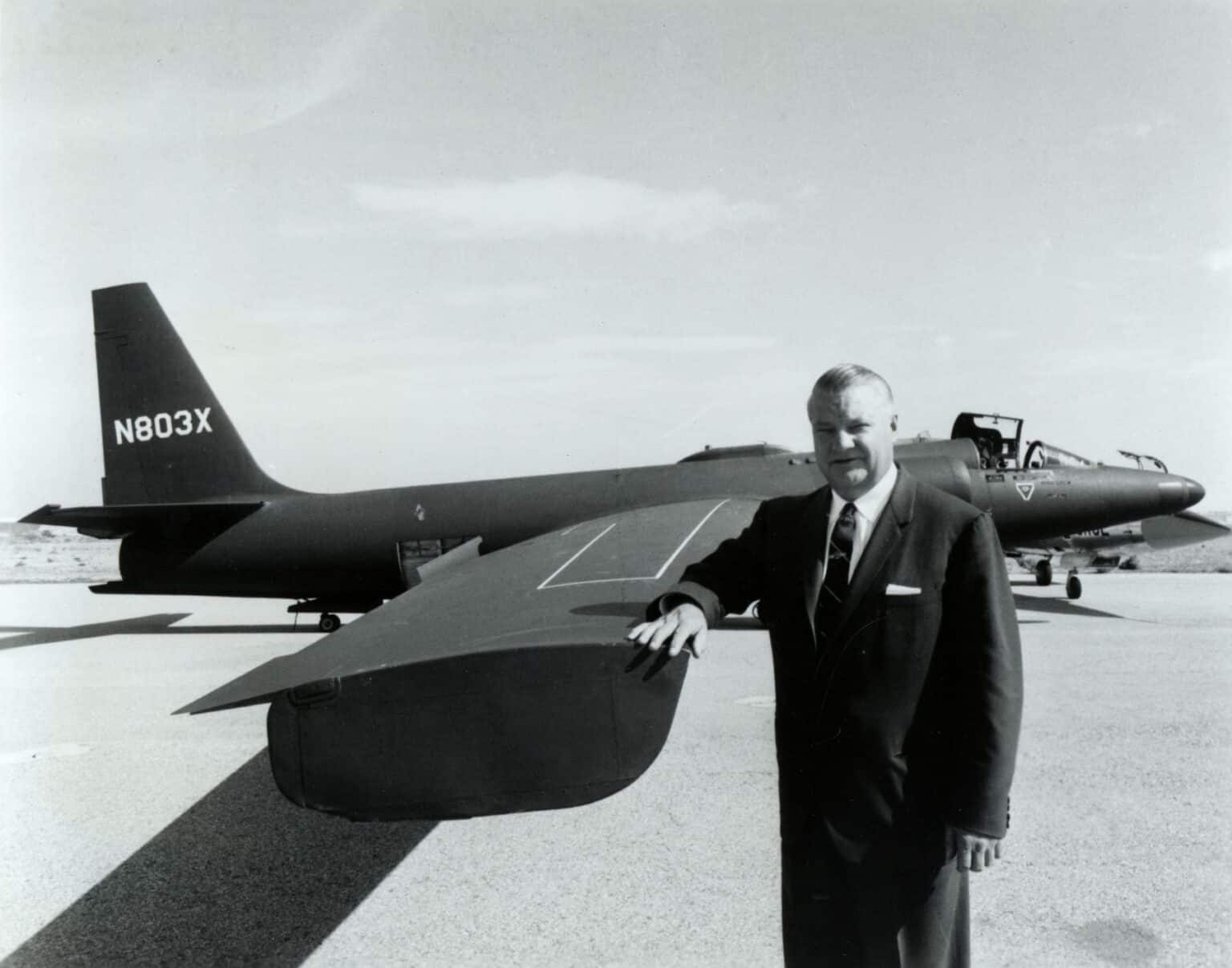
The student was Clarence “Kelly” Johnson. Over the next 42 years he designed more than 40 aircraft, founded the Skunk Works and drew the fastest air-breathing jet a crew has ever flown. This is how he did it, and the one thing most people get wrong about his Blackbirds.
Who Was Kelly Johnson?
Clarence Leonard “Kelly” Johnson (1910 to 1990) was the Lockheed aeronautical engineer who led the design of the P-38 Lightning, the P-80 Shooting Star, the F-104 Starfighter, the U-2 and the SR-71 Blackbird. He founded and ran Lockheed’s secret Advanced Development Projects division, known as the Skunk Works.
He held 44 US patents, won the Collier Trophy twice and received both the Presidential Medal of Freedom (1964) and the National Medal of Science. Lockheed offered him the company presidency three times, and he turned it down each time.
Kelly Johnson at a glance
Born February 27, 1910, in Ishpeming, Michigan, the seventh of nine children of Swedish immigrants. University of Michigan bachelor’s degree in 1932 and master’s in 1933. Joined Lockheed in 1933. Chief research engineer in 1938, vice president of Advanced Development Projects in 1958. Retired in 1975 and was succeeded by Ben Rich. Died December 21, 1990, in Burbank, California.
The nickname came from a schoolyard. Classmates in Michigan turned “Clarence” into “Clara,” and after he tripped one of them hard enough to break the boy’s leg, they started calling him “Kelly,” after a popular song, instead.
The Student Who Fixed the Electra
The Electra’s problem was directional stability: the single tail could not keep it pointing straight. Johnson’s fix was a twin vertical tail, with controllable plates on the horizontal tail and the central fin removed.
The Model 10 was a success, and one of them became the most famous airliner of the decade: Amelia Earhart’s Electra was a Model 10E. Johnson moved on to make the Fowler flap work on the larger Model 14, which won him the 1937 Lawrence Sperry Award at age 27.
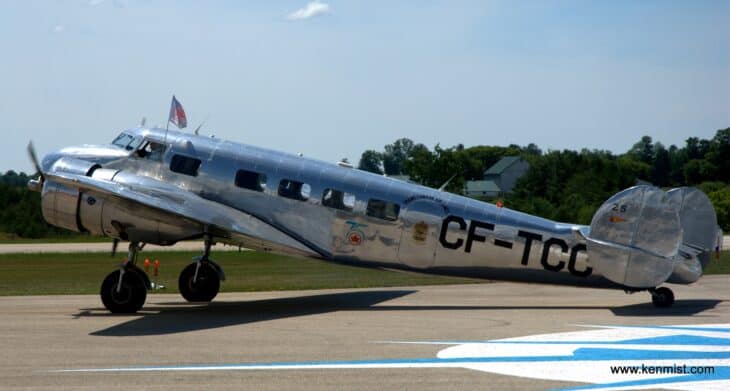

In 1938 Britain wanted a military version of the Model 14 in a hurry. Johnson flew to London, reworked it into the Hudson in a 72-hour redesign, and came home with an order for 200 aircraft worth about $25 million.
The P-38, and the Jet Built in 143 Days
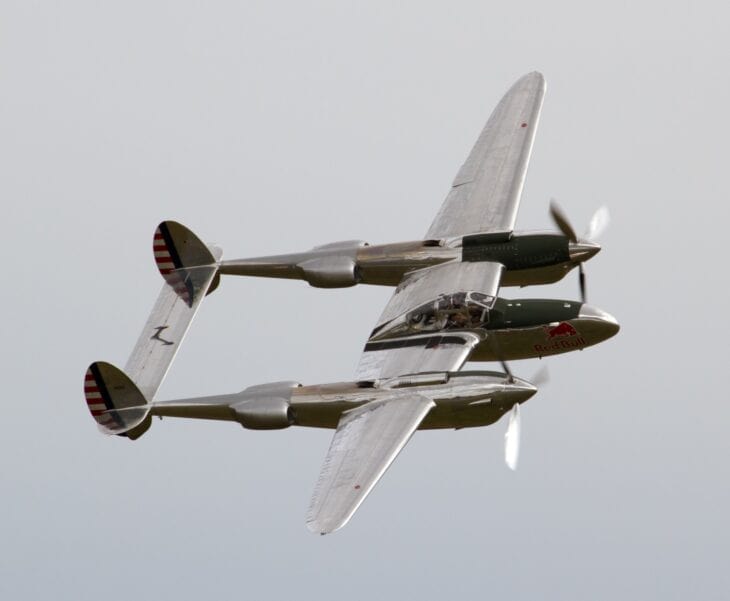
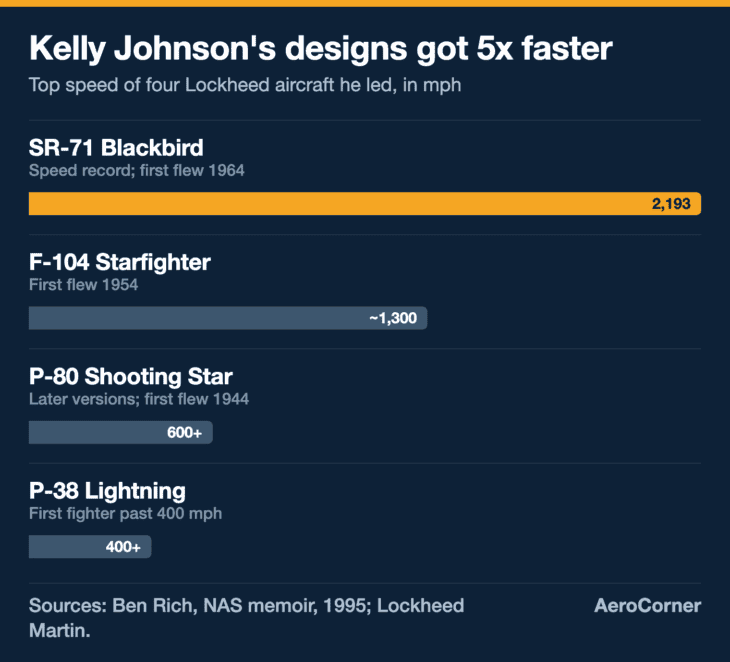
Johnson led the team behind the twin-boom Lockheed P-38 Lightning, which won a 1937 Army Air Corps competition and became the first fighter to go faster than 400 mph (640 km/h). Lockheed built almost 10,000 of them.

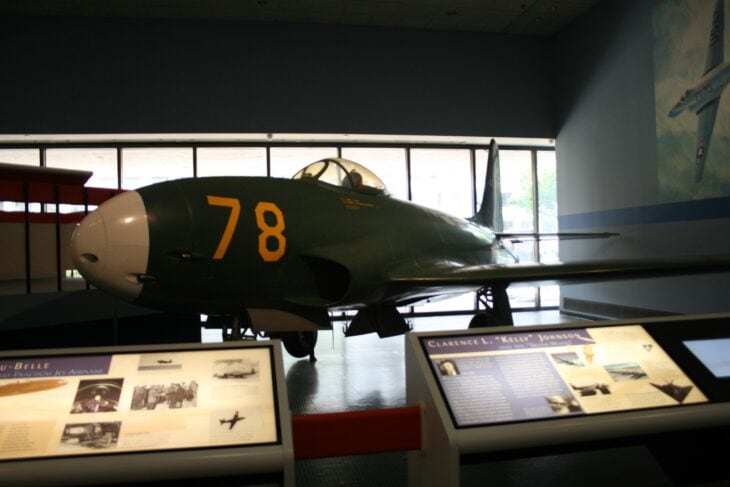
In May 1943 the Army Air Forces asked Lockheed for a jet fighter, and Johnson promised one fast. His team of 23 engineers and 103 shop mechanics worked in a rented circus tent at the edge of the Burbank plant, downwind from a foul-smelling plastics factory.
They delivered the XP-80 prototype in 143 days, and it first flew on January 8, 1944. The production Lockheed P-80 Shooting Star became America’s first operational jet fighter, and some later versions could top 600 mph (970 km/h).

Where the name Skunk Works came from
The smell gave the team its name. Engineer Irv Culver took to answering the internal phone “Skonk Works!”, after the moonshine still in Al Capp’s comic strip Li’l Abner.
When the name leaked out, Capp’s lawyers objected, so Lockheed changed the spelling to “Skunk Works.” The company later trademarked it.
143 days, against which deadline?
Lockheed’s own history says the XP-80 beat a 150-day War Department deadline by seven days. Ben Rich’s National Academy of Sciences memoir puts it 37 days ahead of schedule, which matches the Smithsonian’s account that Lockheed promised a prototype in 180 days. Every source agrees on the 143.
The Starfighter and the Spy Plane
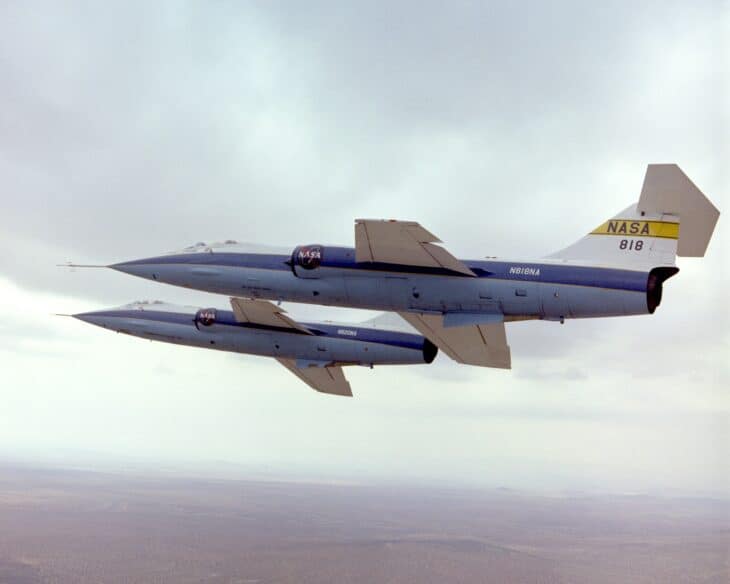
In November 1952 Johnson sent the Air Force an unsolicited proposal for a lightweight, very fast fighter. The XF-104 first flew in March 1954, and the Lockheed F-104 Starfighter could reach about 1,300 mph (2,090 km/h).
The US bought only 296, but more than 2,500 were built for air forces worldwide. The last one went to Italy in 1980, 26 years after the first flight.

Then the CIA came to him for a high-altitude spy plane to fly over the Soviet Union, and Johnson promised delivery in eight months. In 1955, at the CIA’s request, he set up a secret test site on a dry lakebed at Groom Lake, Nevada, the place later known as Area 51.
The Lockheed U-2 first left the ground there on August 1, 1955, by accident: test pilot Tony LeVier was running a taxi test when it lifted off at about 70 knots. In service it flew above 70,000 feet (21,300 m). The first overflight of the Soviet Union came on July 4, 1956, and the flights ended on May 1, 1960, when a Soviet missile brought down Francis Gary Powers near Sverdlovsk.
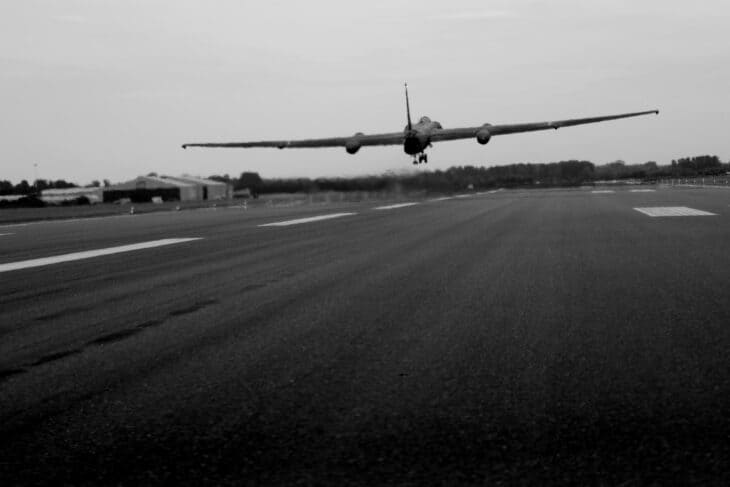

The U-2 also came in under budget. Rich’s memoir says Johnson handed about $2 million back to the government and built six extra aircraft for the same money. Two years after Powers, a U-2 photographed the missile sites in Cuba.
How He Ran the Skunk Works
Johnson’s motto was “Be quick, be quiet, and be on time.” He wrote down 14 rules of management to make it possible: one manager with real authority, a small team, as little paperwork and reporting as possible, monthly cost reviews, and a customer who trusted the builder to run the flight tests.
He is also credited with “Keep it simple, stupid.” Rich quotes him: “KISS is our constant reminder.” He also kept a standing 25-cent bet against anyone who disagreed with him.
His bosses thought he had an unfair advantage. “That damned Swede can actually see air,” Hibbard reportedly said of him.
Each new Johnson design flew far faster than the one before it. Between the late 1930s and 1964, his fighters and spy planes went from the first 400 mph fighter to a jet built to cruise above Mach 3.
The Myth: The SR-71 Was Not the First Blackbird
The myth
The SR-71 is usually described as Kelly Johnson’s Mach 3 spy plane, as if it came first. It did not. The first Blackbird was the CIA’s single-seat A-12, which first flew officially on April 30, 1962, more than two and a half years before the SR-71.
Johnson started on the problem under a project called Archangel. In 1959 the CIA chose his design over Convair’s, and the result was the Lockheed A-12, code-named Oxcart, built almost entirely of titanium and designed for Mach 3.2.
Johnson called that speed target “the toughest job the Skunk Works ever had.” Titanium was so hard to work with at the time that, at one point, 80% of the titanium delivered for manufacture was rejected.
The family grew from there. The YF-12A interceptor flew on August 7, 1963, and the two-seat SR-71, a slightly longer version carrying more fuel and cameras, flew on December 22, 1964.
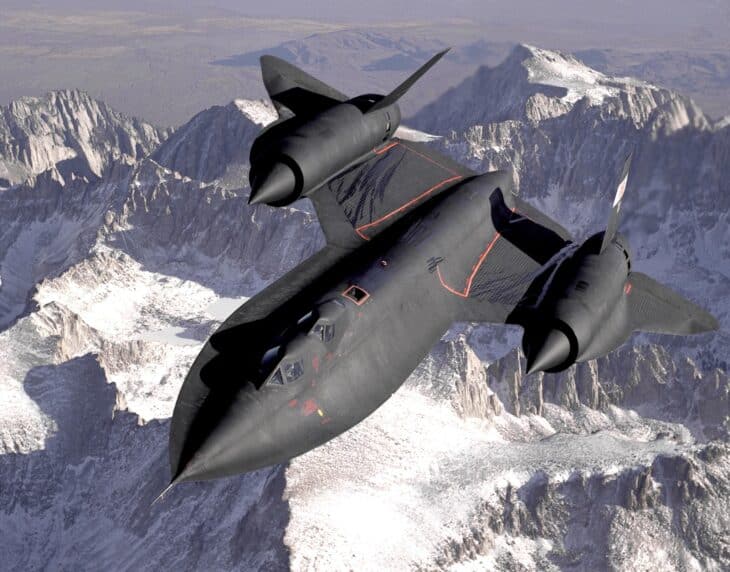

The A-12 flew its last operational mission over North Korea on May 8, 1968, and was retired that June. The Air Force’s SR-71 went on to fly until 1998, which is why it took the fame. Of the 32 SR-71s built, 12 were lost, and none to enemy fire.
And no, President Johnson did not misread the name
A favorite Blackbird story says President Lyndon Johnson was meant to announce the “RS-71” in July 1964 and transposed the letters by mistake. In fact Gen. Curtis LeMay preferred “SR,” for strategic reconnaissance, and lobbied to have the speech changed before it was given.
The press transcript still said “RS-71” in places, and that mismatch is where the story of the slip came from.
1933
Joins Lockheed. Hired as a tool designer at $83 a month after spotting the Electra’s stability problem.
1938
The Hudson. Redesigns the Model 14 for Britain in 72 hours in London.
Jan 8, 1944
XP-80 flies. America’s first operational jet fighter, built in 143 days.
Mar 1954
XF-104 flies. The Starfighter; more than 2,500 are built.
Aug 1, 1955
U-2 flies. First flight at Groom Lake, Nevada.
Apr 30, 1962
A-12 flies. The first Blackbird, built for the CIA.
Dec 22, 1964
SR-71 flies. First flight at Palmdale, California.
1975
Retires. Ben Rich takes over the Skunk Works; Johnson stays on as an advisor.
Dec 21, 1990
Dies in Burbank. Aged 80.
What He Left Behind
Johnson retired in 1975 as a senior vice president, handed the Skunk Works to Ben Rich, and stayed on as an advisor. He left Lockheed’s board in 1980.
In June 1983 Lockheed renamed its Rye Canyon research center the Kelly Johnson Research and Development Center. He was inducted into the National Aviation Hall of Fame in 1974, and in 2003 Aviation Week ranked him eighth on its list of the top 100 figures in aerospace.
He died on December 21, 1990, at 80. That March, on one of its last Air Force flights, an SR-71 had crossed the US coast to coast in 68 minutes, and its speed and altitude records for an air-breathing crewed jet still stand.
Most people know the airplanes and not the name. Johnson logged about 2,300 hours in the air as a flight test engineer, yet he is not on our list of the most famous pilots in history. Three of its top nine are tied to his work: Amelia Earhart flew the Electra he fixed, Howard Hughes’s TWA was the customer for the Constellation he helped develop, and Francis Gary Powers was shot down in his U-2.
Sources and references used for research and fact-checking.
- National Academy of Sciences (Ben R. Rich, Biographical Memoirs Vol. 67, 1995), Clarence Leonard (Kelly) Johnson, 1910-1990: A Biographical Memoir
- Air & Space Forces Magazine, Lord of the Skunk Works
- Lockheed Martin, The P-80 Redefines Fast, In the Air and On the Assembly Line
- Wikipedia, Kelly Johnson (engineer)
- Wikipedia, Lockheed A-12
- Wikipedia, Lockheed SR-71 Blackbird
- This Day in Aviation, Groom Lake (tag archive: the U-2's first flight)
- AeroCorner, Amelia Earhart
Get the Newsletter
The latest aviation news and stories sent to your inbox.
About the Author

Tim is the owner and lead editor of AeroCorner since 2019, overseeing aviation content covering aircraft, airlines, airports, and the broader aviation industry. Through years of researching, writing, editing, and publishing aviation-focused content, he has developed extensive practical knowledge of commercial aviation and air travel. Based in Asia and a frequent traveler himself, Tim also brings firsthand passenger experience to AeroCorner’s coverage. Outside of publishing, he has also explored aviation firsthand through hands-on flight training in New Zealand.