

Table of Contents
On the morning of January 3, 1944, a Marine major in an F4U Corsair took off from Bougainville to lead a fighter sweep over the Japanese fortress at Rabaul. Pilots behind him saw him shoot down a Zero. Then he vanished into the fight, and nobody in his squadron saw him again for 20 months.
That Zero was his 26th victory, the number Eddie Rickenbacker had set as the American record in World War I. Two months later, with its pilot presumed lost, the US government awarded Gregory “Pappy” Boyington the Medal of Honor.
Today the Marine Corps credits him with 28. But the arithmetic behind that number is stranger than the legend, and it starts with a bonus scheme in Burma. Here is who Boyington was, how the record was built, and why the Black Sheep were never the misfits television made them.
Who Was Pappy Boyington?
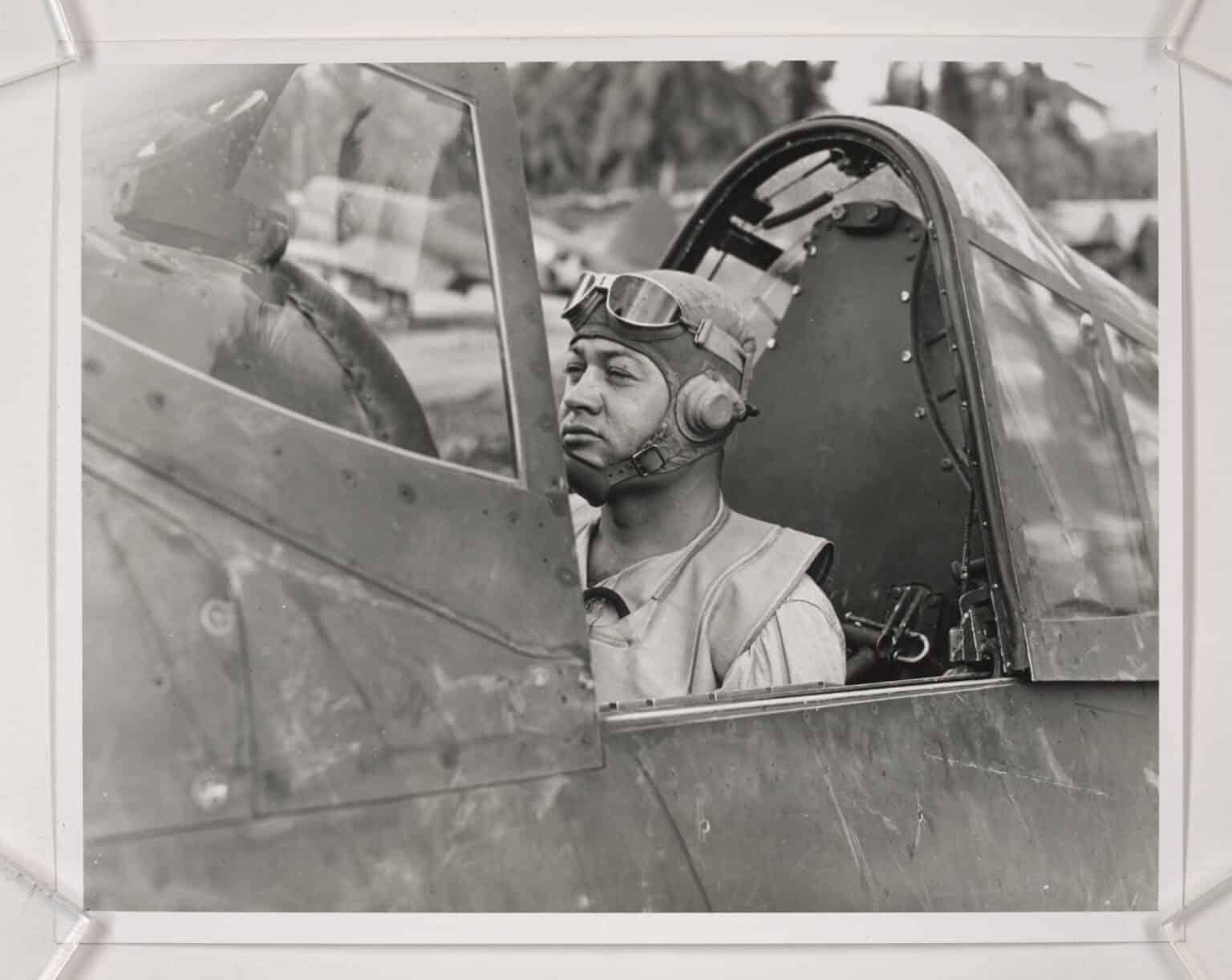
Gregory Boyington (1912 to 1988) was a US Marine Corps fighter pilot who flew with the Flying Tigers in Burma and China, then commanded Marine Fighting Squadron 214, the “Black Sheep,” in the Solomon Islands. He was shot down over Rabaul, survived Japanese captivity, and received both the Medal of Honor and the Navy Cross in October 1945.
He was born on December 4, 1912, in Coeur d’Alene, Idaho, and grew up as Gregory Hallenbeck, believing his stepfather was his father. He only learned his legal surname was Boyington when he pulled his birth certificate to apply as a Marine aviation cadet.
Pappy Boyington at a glance
Born December 4, 1912, Coeur d’Alene, Idaho. Flying Tigers flight leader, 1941 to 1942. Commanded VMF-214, the Black Sheep, in the F4U Corsair, 1943 to 1944. Shot down over Rabaul January 3, 1944, and held as a prisoner until August 1945. Medal of Honor and Navy Cross. Official Marine Corps credit: 28 aircraft. Died January 11, 1988, buried at Arlington.
He was also, by nearly every account including his own, a brawler and a heavy drinker. Those traits got him out of the Marines once, into the Flying Tigers, and very nearly out of the war before his famous squadron ever existed.
How Many Planes Did Pappy Boyington Shoot Down?
The official Marine Corps answer is 28. That total adds 22 victories with VMF-214 to the six Japanese aircraft Boyington always said he destroyed with the Flying Tigers.
The trouble is the six. The American Volunteer Group’s own records credit him with two aircraft destroyed in the air, plus a share of planes burned on the ground in a strafing raid. Ground kills are not aerial victories, so on the AVG’s books his air-to-air total in Asia was two.
| Version of the record | Flying Tigers part | Marine Corps part | Total |
|---|---|---|---|
| Official Marine Corps credit | 6 (Boyington’s claim) | 22 | 28 |
| Medal of Honor citation, March 1944 | 6 (Boyington’s claim) | 20 | 26 |
| AVG records plus Marine credit | 2 | 22 | 24 |
| Marine Corps combat only | 0 | 22 | 22 |
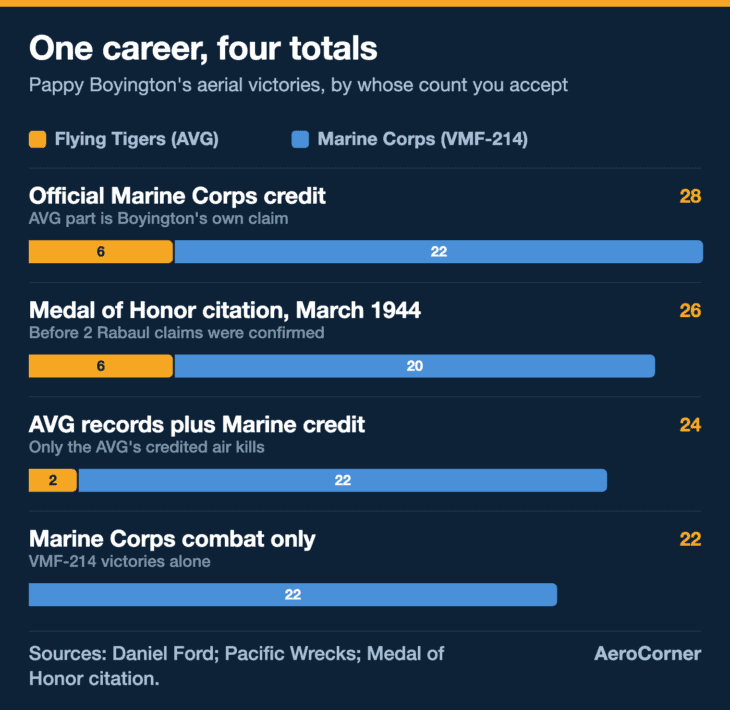
Strip out the disputed four and Boyington is still a great ace, with 24 aerial victories. What changes is the headline. The 26 that matched Rickenbacker, and the 28 that made him the top Marine ace of the war on paper, both depend on numbers the Flying Tigers never confirmed.
For context on where he sits among the war’s leading pilots, see our ranking of the highest-scoring WW2 flying aces by country.
The Flying Tigers Years: Where the Missing Four Came From
Boyington resigned his Marine commission in August 1941, facing likely trouble after punching another officer while instructing at Pensacola. He signed with the Central Aircraft Manufacturing Company, the civilian front that staffed the American Volunteer Group, as a flight leader at $675 a month.
The recruiter’s pitch, as AVG historian Daniel Ford records it, was a bonus of $500 for every Japanese aircraft a pilot knocked down. That made every claim a payroll entry, which is why the AVG’s bonus ledger, not a pilot’s memory, became the record.
Flying the Curtiss P-40 with the 1st Squadron, the “Adam and Eves,” Boyington was credited with two Japanese Army fighters over Rangoon on February 6, 1942. On March 24 he was one of the pilots who strafed the airfield at Chiang Mai in Thailand, where some 15 planes were burned on the ground.
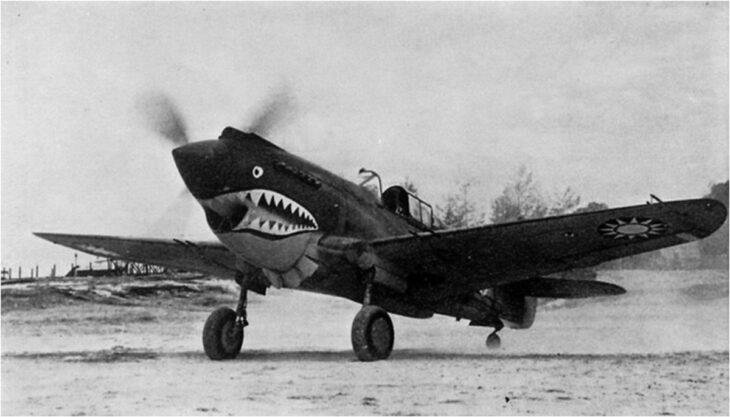

Claire Chennault’s citation of April 27, 1942 credited him with two and a half of those ground kills. Ford writes that the Chiang Mai credit was later shared equally among all the raid’s pilots, leaving Boyington 1.5. Either way, his bonus credits totaled between 3.5 and 4.5 aircraft, and only two of them were air-to-air.
He quit in April 1942, three months before his contract ran out, after repeated clashes with Chennault, who gave him a dishonorable discharge. Ford also notes that AVG record-keeping was sloppy, which is the strongest argument Boyington’s defenders have. But the AVG record that survives shows two air kills, not six.
The Black Sheep and the 26th Kill
Back in the Marines as a major from September 1942, Boyington spent months as executive officer of VMF-122 on Guadalcanal without shooting anything down. In 1943 he took command of VMF-214, a new squadron built largely from replacement pilots.
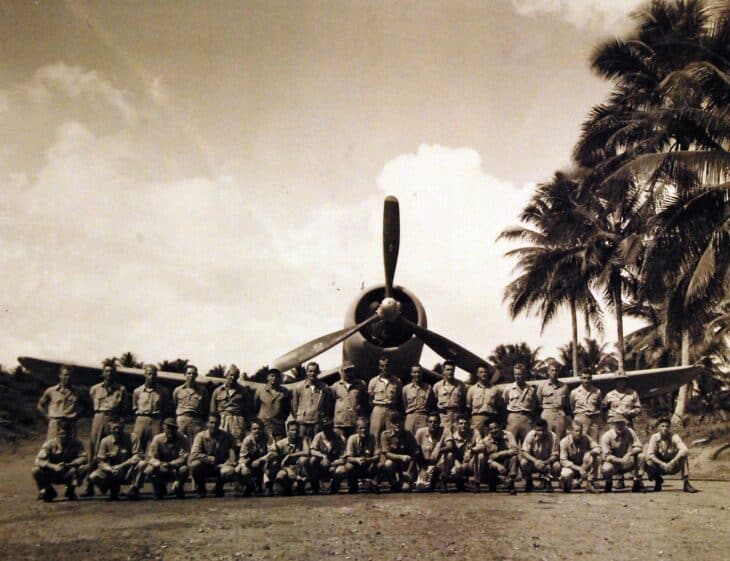
The Black Sheep flew the Vought F4U Corsair, and the results came fast. On September 16, 1943, during a raid on the Ballale airfield off Bougainville, Boyington was credited with five Zeros in a single engagement.

Zeros for baseball caps
In October 1943 the Associated Press reported that Boyington’s squadron offered to shoot down one Japanese Zero for every baseball cap from the winning World Series team. Caps kept the tropical sun out of pilots’ eyes and were scarce in the Solomons.
On October 17, 1943, he led 24 fighters over the Japanese airfield at Kahili and dared the enemy to come up. According to his Medal of Honor citation, the squadron shot down 20 aircraft that day without losing a plane.
At 30 he was around a decade older than most of his pilots, who first called him “Gramps.” A squadron song parody turned it into “Pappy,” and the name stuck. Under his command, VMF-214 destroyed 97 enemy aircraft in 84 days and produced eight aces.
Shot Down, Listed Missing, Awarded the Medal of Honor
On January 3, 1944, Boyington led a sweep of more than 40 American fighters over Rabaul. After the 26th kill his wingman, Capt. George Ashmun, was shot down and killed, and Boyington’s own Corsair was riddled. He ditched in St. George’s Channel and was picked up by the Japanese submarine I-181.
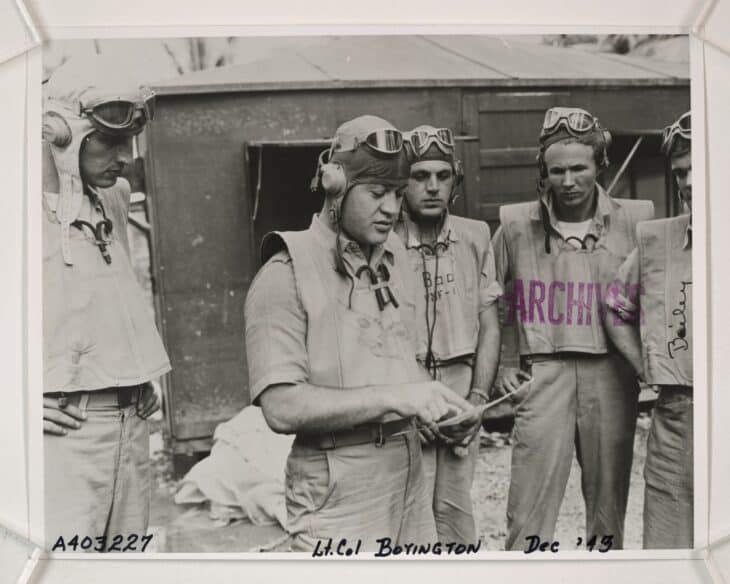

The Japanese never registered him as a prisoner of war, so the Red Cross was not told and the Marine Corps listed him missing. He was moved from Rabaul to Truk, where he survived the US carrier raid of February 1944, and then to the Ofuna and Omori camps near Tokyo.
Jan. 3, 1944
Shot down over Rabaul. Seen to destroy his 26th aircraft before disappearing; rescued from the water by submarine I-181.
Feb. 1944
Flown to Truk. Arrives during the US carrier strikes of Operation Hailstone, then moves on to Japan.
Mar. 1944
Medal of Honor awarded. President Roosevelt approves the medal while Boyington is listed as missing in action; it is held until he can receive it.
Aug. 29, 1945
Liberated. Freed from Omori Prison Camp near Tokyo after Japan’s surrender, some 20 months after he went missing.
Oct. 4, 1945
Navy Cross. Presented by the Commandant of the Marine Corps for the January 3 Rabaul mission.
Oct. 5, 1945
Medal of Honor presented. President Truman hands it over at the White House, one of 14 presented that day.
Once home, Boyington reported that two more Zeros had gone down in front of his guns on January 3. They were credited, lifting his total to 28 and settling the record question in the Marine Corps’ books, if not in the historians’.
A second dispute followed. Japanese pilot Masajiro “Mike” Kawato later claimed in books and public appearances that he had shot Boyington down. The claim has since been disproven, though Kawato repeated it until his death.
The Myth vs the Reality: The “Misfits” Who Weren’t
The myth
The Black Sheep were a squadron of misfits, troublemakers and pilots facing court-martial, given one last chance by a rebel commander.
That version comes from television. Boyington’s memoir, Baa Baa Black Sheep, appeared in 1958, and the TV series built on it ran for two seasons from 1976 to 1978, with Robert Conrad as Pappy.
Squadron veterans were offended by it. They pointed out that they were ordinary replacement pilots, not castoffs, and many resented that the show glamorized their commander. It even gave him a dog named Meatball that he never had in the Pacific.
Boyington, who made walk-on appearances as a visiting general, called the series “hogwash and Hollywood hokum.” The only real misfit in the story was arguably the commander himself.
What Happened to Pappy Boyington After the War?
He retired from the Marine Corps on August 1, 1947, and was promoted to colonel on the retired list for his combat record. Civilian life was rougher: he worked a string of jobs, including refereeing professional wrestling, and he married four times, with drinking a likely factor in the divorces.
He said captivity had done his health good because it forced him to stay sober. He died of lung cancer in Fresno, California, on January 11, 1988, aged 75, and was buried at Arlington National Cemetery four days later.
His hometown airport in Coeur d’Alene was renamed Pappy Boyington Field in 2007. The name on the sign carries the legend, but the number beneath it deserves the footnote: 22 confirmed Marine victories, 2 confirmed in China, and 4 that only Boyington ever vouched for.
He belongs on any list of the most famous pilots in history either way. It is just worth knowing which of his numbers the records can carry.
Sources and references used for research and fact-checking.
- Wikipedia, Pappy Boyington
- Warbird's Forum (Daniel Ford), Greg Boyington: Flying Tiger
- Pacific Wrecks, Major Gregory "Pappy" Boyington
- HistoryLink.org, Boyington, Gregory "Pappy" (1912-1988)
- National Medal of Honor Museum, Gregory "Pappy" Boyington
- Aces of WW2, Gregory "Pappy" Boyington
- Wikipedia, Eddie Rickenbacker
Get the Newsletter
The latest aviation news and stories sent to your inbox.
About the Author

Tim is the owner and lead editor of AeroCorner since 2019, overseeing aviation content covering aircraft, airlines, airports, and the broader aviation industry. Through years of researching, writing, editing, and publishing aviation-focused content, he has developed extensive practical knowledge of commercial aviation and air travel. Based in Asia and a frequent traveler himself, Tim also brings firsthand passenger experience to AeroCorner’s coverage. Outside of publishing, he has also explored aviation firsthand through hands-on flight training in New Zealand.