

Table of Contents
On the night of April 17, 1973, a small French business jet with the registration N8FE took off from Memphis carrying the first Federal Express air package. By morning, 14 converted Dassault Falcon 20s had moved 186 packages to 25 US cities.
The tail number was a bluff. N8FE was the first Falcon the company took delivery of, not the eighth, and Fred Smith was happy to let the public assume he already had a fleet of eight.
That small piece of showmanship says a lot about the man. Most retellings of his life lean on a college paper and a night in Las Vegas. The real story is an aviation one: a pilot who read the federal rulebook, found the one class of airplane it let him fly, and then lobbied Congress to tear the limit down.
Who Was Frederick W. Smith?
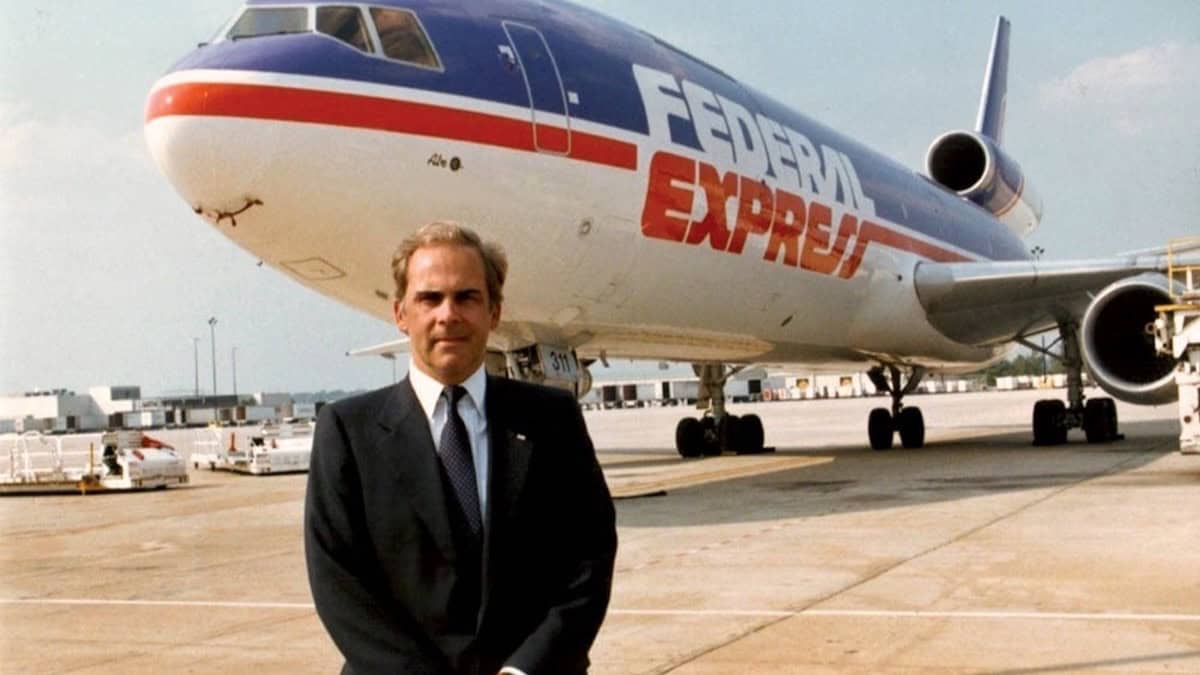
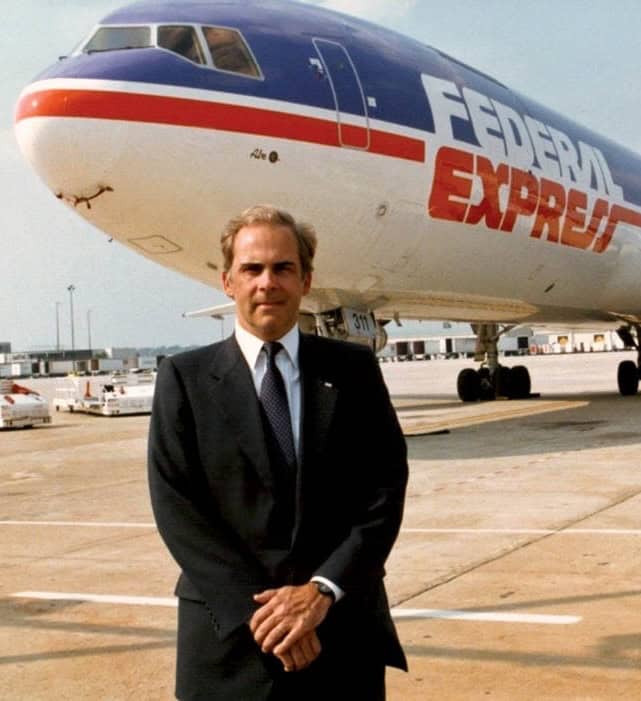
Frederick Wallace Smith was born on August 11, 1944, in Marks, Mississippi, and founded Federal Express on June 18, 1971. He ran the company for more than 50 years, handed the CEO job to Raj Subramaniam in 2022, and died on June 21, 2025, at 80, still its executive chairman.
He was also a pilot, a Marine combat veteran and a used-jet trader before he was an airline founder. Those three things, more than any business-school idea, explain why FedEx began as an airline with a sorting hub attached rather than a courier company that bought plane tickets.
Fred Smith at a glance
Born August 11, 1944, Marks, Mississippi. Learned to fly as a teenager and flew weekend charters while at Yale. US Marine Corps 1966 to 1969, two tours in Vietnam, Silver Star, Bronze Star and two Purple Hearts. Founded Federal Express in 1971 and launched it from Memphis on April 17, 1973. CEO until 2022. Died June 21, 2025.
A Pilot Before He Was a Founder
Smith learned to fly as a teenager, over his mother’s objections, and was working around a crop duster by 15. At Yale, where he earned his degree in 1966, he flew charter flights on weekends, carrying students and goods for extra money.
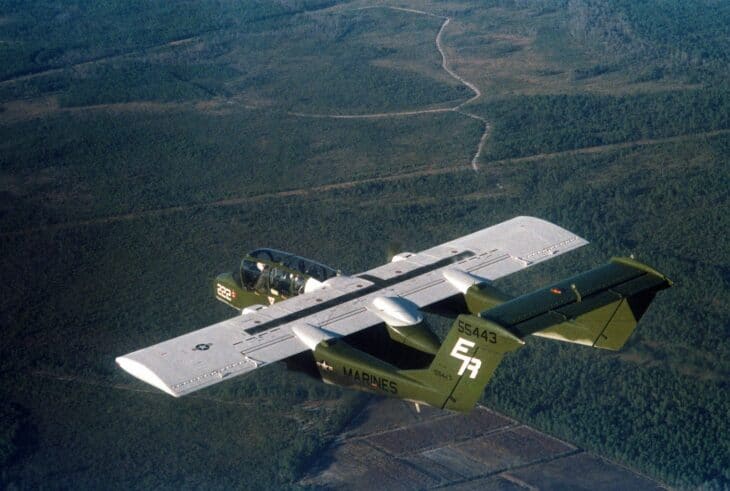
He then joined the Marine Corps and served two tours in South Vietnam as a platoon leader and a forward air controller. In that second role he flew in the back seat of the OV-10 Bronco, spotting targets for the strike aircraft overhead.

He left in 1969 as a captain, with the Silver Star, the Bronze Star and two Purple Hearts. In 1970 he bought the controlling interest in Ark Aviation Sales in Little Rock, Arkansas, a maintenance shop that by 1971 was mostly trading used jets.
That is the résumé of someone who knew what an airplane cost to buy, convert and run. It shaped every early decision at Federal Express, starting with which airplane it could legally fly.
The 7,500-Pound Loophole
In the early 1970s, US airlines were tightly controlled by the Civil Aeronautics Board, which decided who could fly which routes. A new carrier could not simply start flying jets between 25 cities.
Air taxi operators, flying small planes, were the exception. A board regulation dating to 1958 held them to payloads of no more than 7,500 pounds (3,400 kg), and Federal Express started life as one, built to fit under that line.
The Dassault Falcon 20 fit it. Pan Am, which marketed the jet in the US as the Fan Jet Falcon, had taken 35 of them when, as one of its pilots told Memphis Magazine, “the market just fell out.”
The seller was so keen to unload them that it once weighed trading a jet for a taco factory in Mexico. Then Smith bought the lot.
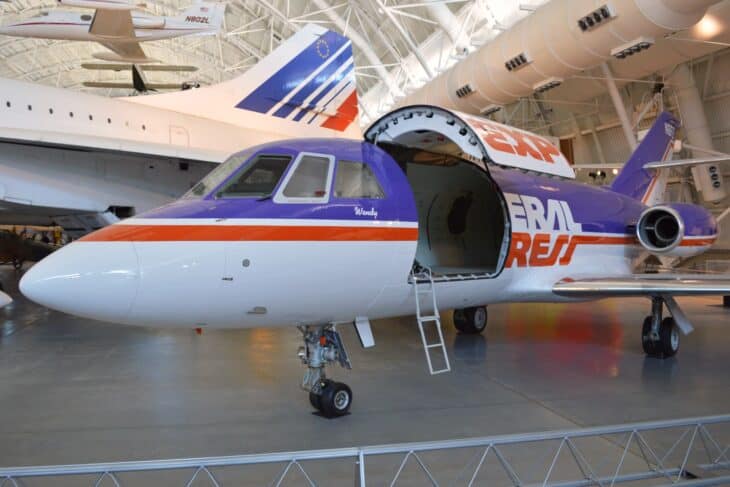

The conversion was done in Little Rock. According to the Smithsonian, each Cargo Falcon got a 55 by 74.5 inch cargo door, a strengthened floor and plugged windows, raising its all-up weight to 28,660 pounds (13,000 kg) from the executive version’s 25,300 pounds (11,480 kg).
The first two were delivered in June 1972 at $1.2 million each. They topped out at 535 mph (861 km/h), and early FedEx hands put the usable payload at about 6,000 pounds (2,720 kg), comfortably inside the cap.
Same payload, 50 years apart
FedEx still flies an aircraft in the Falcon’s weight class. Its 2026 annual report lists 39 Cessna 408 SkyCouriers, each with a maximum payload of 6,000 pounds, about what the original Falcons could carry. Today they are feeders. In 1973, that payload was the whole airline.
Smith’s real invention sat on the ground at Memphis. Every Falcon flew in to one central sorting point overnight and flew back out before dawn, so a package from any city could reach any other in one night. The Smithsonian credits that hub system with creating a new category of airline, the all-cargo air express carrier.
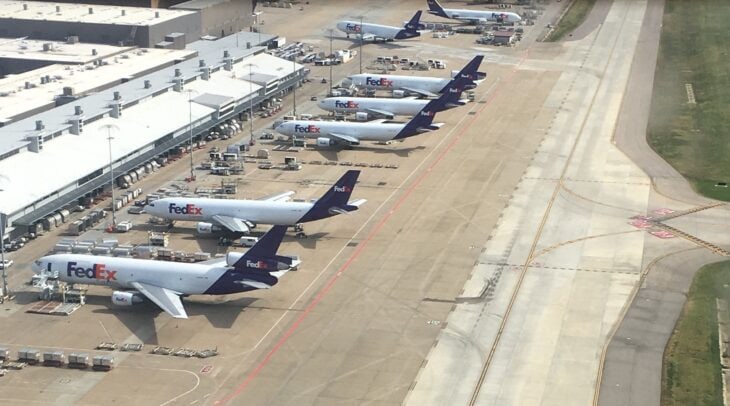
Smith chose Memphis for its central location, moderate climate and labor supply. It is still FedEx’s main hub, one reason it ranks among the busiest cargo airports in the US.
When the Loophole Became a Ceiling
The 7,500-pound rule that let FedEx exist soon held it back. By the end of 1974, according to the Smithsonian, 33 Falcons were flying the network, and by early 1976 demand had outgrown the small jets.
The Civil Aeronautics Board refused to let the company fly larger aircraft. So Smith went to Congress, and in 1977 what Memphis Magazine calls the “Federal Express Bill” passed as part of the deregulation of US air cargo.
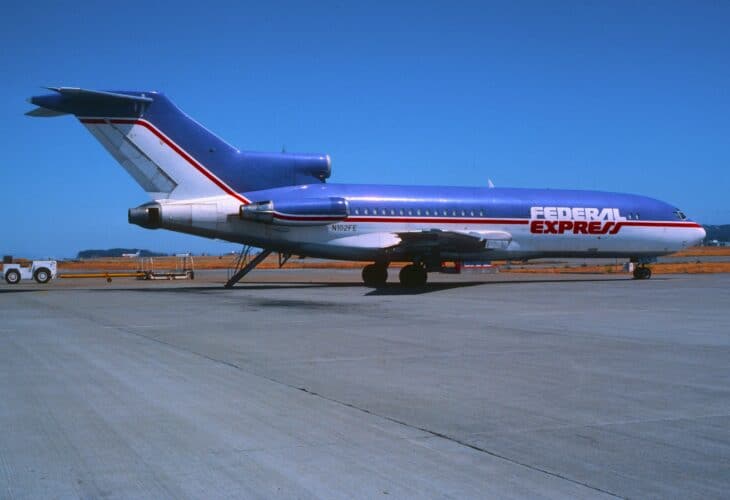
FedEx immediately bought seven Boeing 727s, each with about five times the capacity of a Falcon. By 1982 its front-line freighters were McDonnell Douglas DC-10s, whose holds, the Smithsonian notes, could swallow several Falcons each.

1944
Born in Marks, Mississippi. Frederick W. Smith is born on August 11.
1966-1969
Marine Corps. Two tours in Vietnam, including forward air control from the back seat of the OV-10.
1971
Federal Express founded. Incorporated on June 18 while Smith runs a used-jet business in Little Rock.
1972
First Falcons delivered. Two Falcon 20s arrive in June at $1.2 million each.
1973
First night in Memphis. 14 Falcons carry 186 packages to 25 cities on April 17.
1974
33 Falcons. That many are flying the network by year end.
1977
Air cargo deregulated. The payload cap falls and FedEx buys seven Boeing 727s.
1983
Falcons retired. N8FE, the first, goes to the Smithsonian as a gift from FedEx.
2022
Steps down as CEO. Raj Subramaniam takes over; Smith stays executive chairman.
2025
Dies at 80. FedEx announces his death on June 21.
The Myths: The C Grade and the Blackjack Table
Two stories follow Smith everywhere. Both are better known than the payload rule, and neither holds up as the reason FedEx exists.
Myth: a Yale professor gave the FedEx idea a C
The paper is real: Smith wrote about air transportation for a Yale economics class. The C is not documented. A 1975 UPI profile told the Yale story with no grade, and the C first appeared in Esquire in August 1978. Asked in 2004, Smith said: “I don’t know, probably made my usual C.”
The Las Vegas story is better attested. In the cash crunch of FedEx’s early years, after General Dynamics declined to put in more money, Smith flew to Las Vegas with about $5,000 of company money and came back with $27,000 from the blackjack tables.
Retellings often add that the winnings paid a $24,000 fuel bill and kept the airline flying for another week. Smith himself was more modest about it: “The $27,000 wasn’t decisive, but it was an omen that things would get better.”
What did save the company was investors’ money, somewhere between $72 million and $91 million depending on the account, on top of the roughly $4 million Smith put in from his inheritance, and the 1977 law that let it fly bigger airplanes. Neither makes as good a story as a blackjack table, which is why the blackjack table gets told.
From 14 Falcons to 700 Aircraft
The airline Smith launched with 14 business jets reported a fleet of 700 aircraft as of May 31, 2026, in its latest annual report. Every type on the list, from the Boeing 777F down to the single-engine Cessna Caravan, carries a payload figure the company publishes alongside it.
| Aircraft | In fleet | Max payload per aircraft |
|---|---|---|
| Boeing 777F | 59 | 233,300 lb (105,800 kg) |
| Boeing MD-11 | 29 | 192,600 lb (87,400 kg) |
| Boeing 767F | 152 | 127,100 lb (57,700 kg) |
| Airbus A300-600 | 57 | 106,600 lb (48,400 kg) |
| Boeing 757-200 | 86 | 63,000 lb (28,600 kg) |
| ATR 72-600F | 27 | 19,290 lb (8,750 kg) |
| ATR 72 | 19 | 17,970 lb (8,150 kg) |
| ATR 42 | 16 | 12,070 lb (5,470 kg) |
| Cessna 408 SkyCourier | 39 | 6,000 lb (2,720 kg) |
| Cessna 208B Caravan | 216 | 2,830 lb (1,280 kg) |
| Total | 700 |
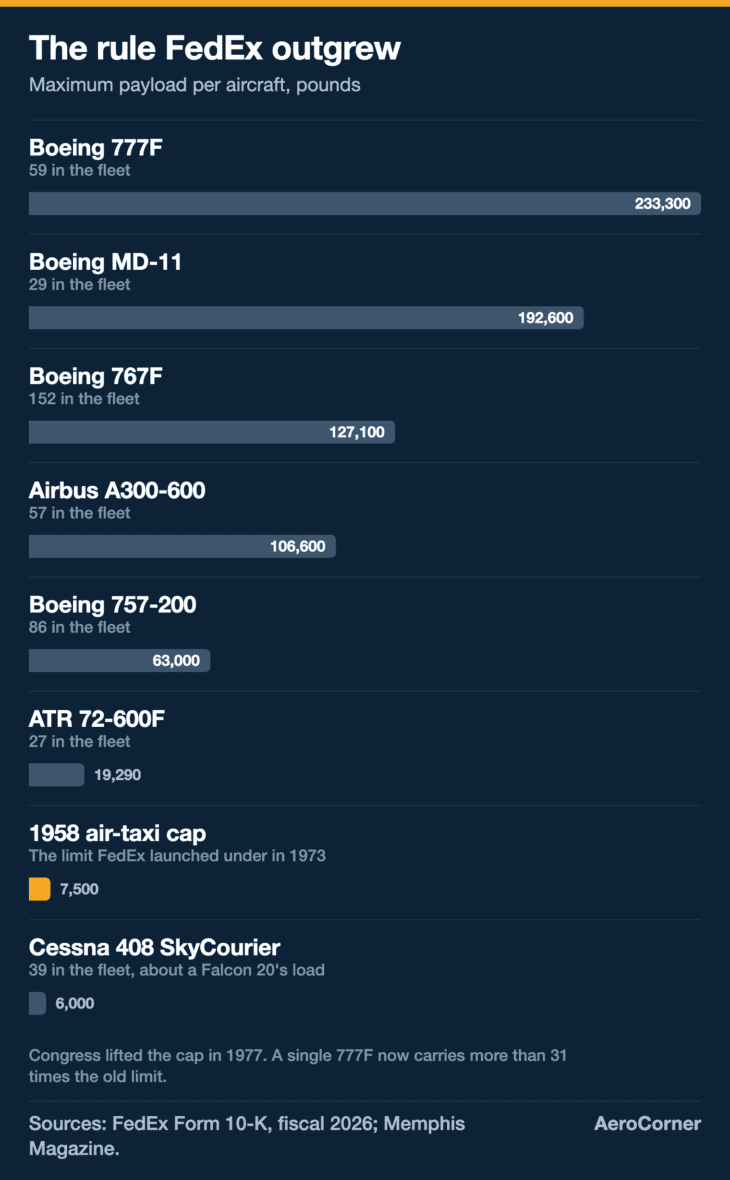
Set against that list, the old rule looks absurd. A single 777F can carry more than 31 times the payload the law once allowed a FedEx aircraft.
Some of the fleet carries its own history. The MD-11s, grounded with every other MD-11 by an FAA emergency directive in November 2025, began returning to service in May 2026, and the story of who still flies them is in our look at how many MD-11s are still flying.
N8FE did not end up in a scrapyard. FedEx gave it to the Smithsonian in 1983, and it is on display in the Business Aviation exhibit at the Steven F. Udvar-Hazy Center in Chantilly, Virginia, still wearing the name Wendy, after Smith’s daughter.
That is where to see the real Fred Smith story. Not a graded paper or a casino chip, but a ten-seat business jet with a big door cut in its side, small enough to slip under a 1958 rule and fast enough to build an airline in the dark.
He earned his place among the most famous pilots in history without ever being famous for flying. He was famous for knowing exactly what a small airplane could do, and what it could not.
Sources and references used for research and fact-checking.
- Smithsonian National Air and Space Museum, Dassault Falcon 20 (N8FE)
- U.S. Securities and Exchange Commission, FedEx Corp. Form 10-K for fiscal year ended May 31, 2026
- Memphis Magazine, FedEx at Forty: Fred Smith's Million-Dollar Dream Machine
- Memphis Magazine, FF40: How It All Began
- Wikipedia, Frederick W. Smith
- Encyclopedia.com, Smith, Fred 1944-
- Marketplace, Fred Smith bio
- Quote Investigator, I Don't Know, Probably Made My Usual C
- Fox Business, How Fred Smith rescued FedEx from bankruptcy by playing blackjack in Las Vegas
- Airways Magazine, FedEx at 50 years of operations
- FedEx Newsroom, FedEx Marks 40th Anniversary
- FedEx Newsroom, FedEx Message Regarding Passing of Founder and Executive Chairman Frederick W. Smith
Get the Newsletter
The latest aviation news and stories sent to your inbox.
About the Author

Tim is the owner and lead editor of AeroCorner since 2019, overseeing aviation content covering aircraft, airlines, airports, and the broader aviation industry. Through years of researching, writing, editing, and publishing aviation-focused content, he has developed extensive practical knowledge of commercial aviation and air travel. Based in Asia and a frequent traveler himself, Tim also brings firsthand passenger experience to AeroCorner’s coverage. Outside of publishing, he has also explored aviation firsthand through hands-on flight training in New Zealand.