

Fighter Jets
Republic F-84F Thunderstreak
ICAO: F84F
The single-engine, supersonic fighter-bomber that flew most of the early U.S. strikes on North Vietnam.
Updated: by Tim de Vries
The latest aviation news and stories sent to your inbox.
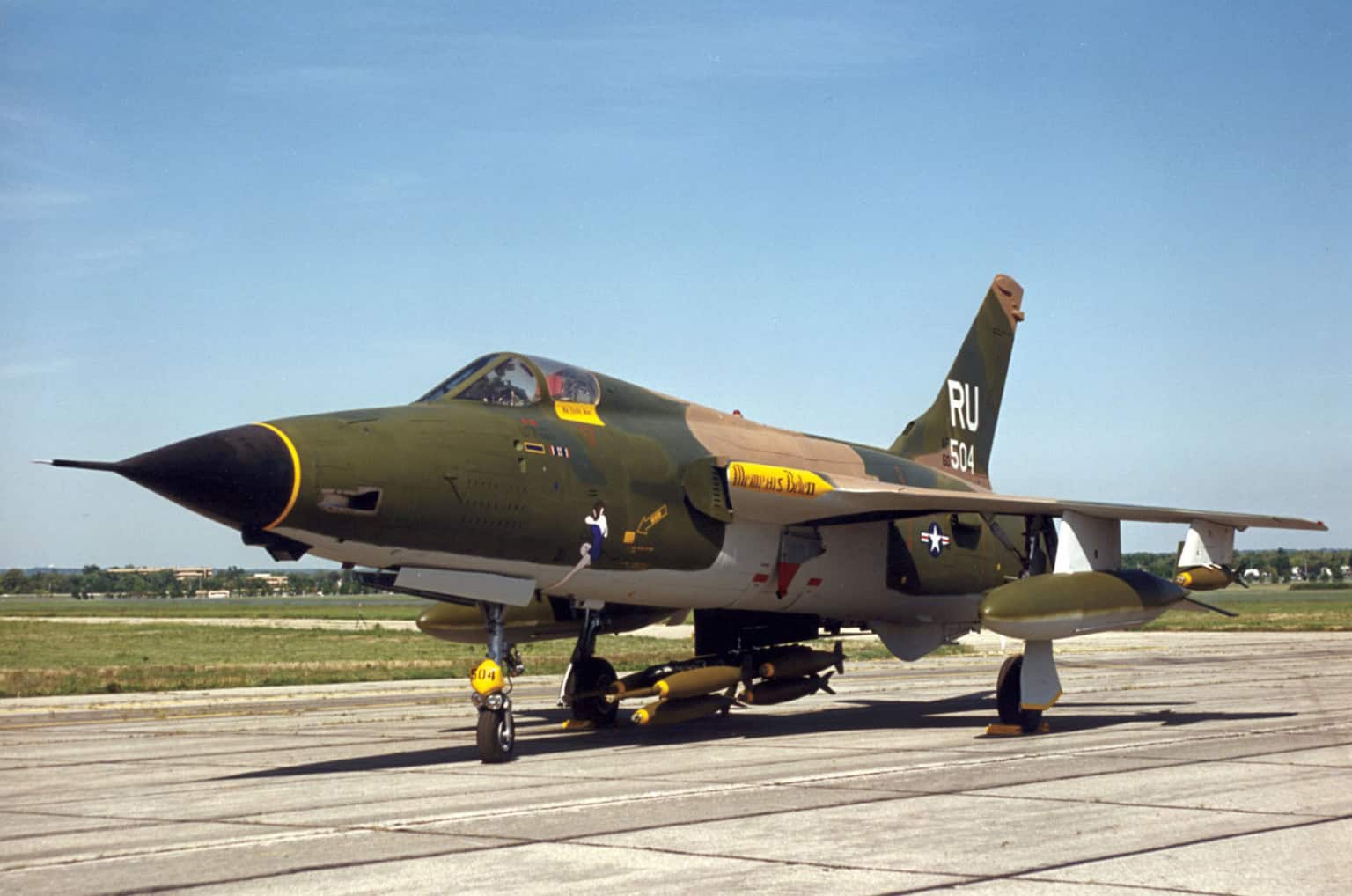
The Republic F-105 Thunderchief was a supersonic, single-engine fighter-bomber designed for the U.S. Air Force to carry a nuclear bomb at low level and high speed. Republic built 833 of them between 1955 and 1964. In Vietnam the “Thud” flew the majority of the early strike missions against North Vietnam, and its two-seat versions became Wild Weasel missile-site hunters. The last F-105 flight was in February 1984.
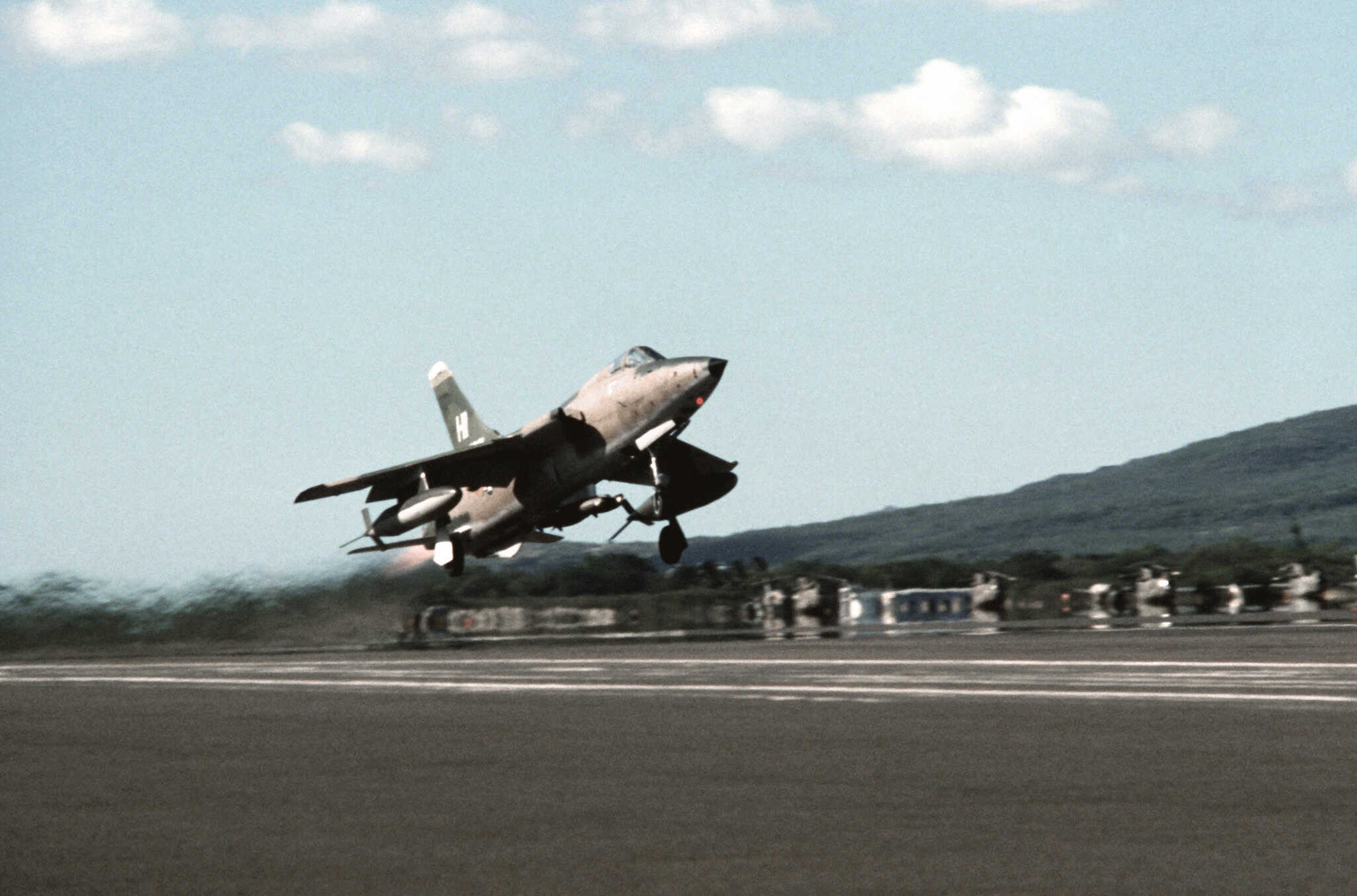


The Republic F-105 Thunderchief was a supersonic, single-engine fighter-bomber that the U.S. Air Force flew from 1958 to 1984. It was designed to race in at low level and drop a single nuclear bomb, then spent its war dropping conventional bombs on North Vietnam.
Republic built 833 of them. The F-105 flew the majority of the early U.S. strike missions over North Vietnam, and its two-seat versions became the Wild Weasels that hunted surface-to-air missile sites.
It also suffered some of the heaviest losses of any American combat aircraft in that war. Crews called it the “Thud,” first as an insult and later with something close to affection.
Republic Aviation began the project in 1951 as a company venture to replace the F-84F Thunderstreak family. A team led by designer Alexander Kartveli looked at some 108 configurations before settling on a large, single-engine design called the AP-63.
The mission shaped everything. The aircraft had to penetrate enemy airspace at supersonic speed and low altitude with a nuclear weapon carried internally, so range, payload and low-level ride came first and dogfighting came second.
That produced a big engine, a relatively small wing with a high wing loading, and a bomb bay in the fuselage. The small wing gave a steadier ride in the dense, bumpy air near the ground and less drag at supersonic speed.
The program had a rocky start. The Air Force cut its first order from 199 aircraft to 37 fighter-bombers and nine reconnaissance jets as the Korean War wound down, and suspended the whole program late in 1953, before ordering 15 aircraft in June 1954.
The design also outgrew its intended Allison J71 engine, so Republic switched to the more powerful Pratt & Whitney J75.
The first YF-105A prototype flew on October 22, 1955. It used the smaller J57 engine as a stopgap, yet it still reached Mach 1.2 on its first flight.
Republic did not consider the two YF-105As representative. The production design was reshaped around the area rule, the NACA finding that pinching a fuselage where the wing joins it cuts drag near the speed of sound, which gave the F-105 its narrow “wasp waist.”
The intakes changed too. The production F-105 got distinctive forward-swept intakes in the wing roots, with variable geometry to manage airflow at supersonic speed, and the redesign let the F-105B reach Mach 2.15.
In June 1957 Republic asked for the name Thunderchief, continuing its line after the P-47 Thunderbolt, the F-84 Thunderjet and the F-84F Thunderstreak. The Air Force made it official a month later.

The fighter community did not warm to the F-105 at first. It was huge for a single-seat fighter, and its early service was dogged by maintenance problems and groundings.
It picked up a string of unflattering nicknames, including “Lead Sled,” “Squat Bomber” and “Ultra Hog.” The one that stuck was “Thud,” which F-105 crews say came from Chief Thunderthud, a character on the Howdy Doody television show.
Others claimed it was the sound of an F-105 hitting the ground. Pilots also joked that the airplane was a “Triple Threat”: it could bomb you, strafe you, or fall on you.
Combat changed the tone. Colonel Jack Broughton, who flew the F-105 over North Vietnam, said that the name “originally spoken with a sneer has become one of utmost respect through the air fraternity.”
Three production models accounted for almost all of the 833 aircraft built, and several more versions were canceled on paper.
The F-105D also had a mid-life variant of its own. Thirty D-models received the Thunderstick II upgrade, with an inertial navigation system housed in a long dorsal spine, but they were never used in Vietnam.
The internal bomb bay was designed around one nuclear bomb, but in practice it usually held an extra fuel tank, 390 US gallons on the F-105D. Weapons hung from four underwing pylons and one on the centerline.
The Air Force’s own characteristics sheet for the F-105D lists a maximum of sixteen 750-pound M117 bombs: six on a multiple rack on the centerline, four on each inner wing pylon and one on each outer pylon.
In a June 1961 test, an F-105D delivered 15,430 lb (7,000 kg) of conventional bombs. The National Museum of the U.S. Air Force notes that the F-105 could carry a heavier bomb load than a World War II B-17 Flying Fortress.
Other stores included AGM-12 Bullpup and AGM-45 Shrike missiles, rocket pods, cluster bombs, and AIM-9 Sidewinder missiles for self-defense. The F-105D could also carry the Mk 28 and Mk 43 nuclear bombs.
Yes. Every F-105 carried an M61 Vulcan, a six-barrel, 20 mm rotary cannon mounted in the left side of the nose, with 1,028 rounds.
The gun mattered in combat. Of the F-105’s 27.5 confirmed air-to-air victories, 24.5 were scored with cannon fire.

F-105s went to Southeast Asia shortly after the Gulf of Tonkin incident in the summer of 1964. The first F-105D combat mission, on August 14, 1964, was an attack on an anti-aircraft site on the Plain of Jars in Laos.
When Operation Rolling Thunder began in March 1965, large numbers of F-105Ds moved to Korat and Takhli air bases in Thailand. From there, the Thud became the dominant U.S. strike aircraft of the war’s early years.
A typical mission to the Hanoi area meant two underwing fuel tanks, the bomb-bay tank and five or six bombs. It also meant inflight refueling from a tanker on the way in and sometimes on the way out.
Near Hanoi, pilots flew along a ridge of mountainous terrain to evade the air defenses around the city. It became known as Thud Ridge.
On April 4, 1965, during the second day of strikes on the Thanh Hoa Bridge, North Vietnamese MiG-17s slipped past the escorts and shot down two F-105s. Air Force Chief of Staff General John McConnell was reported to be “hopping mad” that subsonic, Korean War-era MiGs had done it.
On July 27, 1965, 48 F-105s attacked two surface-to-air missile sites in Operation Spring High. The sites turned out to be dummies made of white-painted bamboo, ringed by anti-aircraft guns, and six aircraft were lost.
The Smithsonian’s National Air and Space Museum counts 126 F-105s lost in 1966 alone, 103 of them to anti-aircraft artillery.
A July 1966 Air Force summary of air operations warned that at the April to July loss rate, the entire F-105 force in Southeast Asia would have to be replaced in about eight months. The Smithsonian puts a Thud pilot’s chance of surviving a 100-mission tour over North Vietnam at 75 percent.

Counts differ by source and by what they include. The Smithsonian’s National Air and Space Museum puts the figure at 350 F-105Ds and Fs lost in combat.
The breakdown given in Wikipedia’s F-105 article counts 395 Thunderchiefs lost in Southeast Asia: 334 to enemy action (296 F-105Ds and 38 two-seaters) and 61 in operational accidents. That is nearly half of the 833 built.
Anti-aircraft guns did most of the damage. The Air Force confirms 17 F-105s lost to enemy fighters, while North Vietnamese pilots claimed 23 more that the Air Force never confirmed.
The Thud hit back. F-105 pilots were credited with 27.5 air-to-air victories, all of them against MiG-17s, the half being a kill shared with an F-4 Phantom II.
North Vietnam’s Soviet-built SA-2 missiles forced a new mission. The Air Force first tried two-seat F-100F Super Sabres as Wild Weasels, with an electronic warfare officer in the back seat to locate enemy radars.
The F-100F was too slow and carried too little to keep up with the F-105s it protected. The two-seat F-105F was the answer.
The first F-105F Wild Weasel flew on January 15, 1966, and 11 arrived in Thailand in May and June 1966. They flew their first mission on June 6, 1966.
The cost was high. Five of the first 11 were lost in July and August 1966, and of the first eight crews at Takhli, four airmen were killed, two became prisoners of war and two were wounded.
The Weasels flew ahead of the strike force to draw fire and destroy missile sites, then stayed until the bombers had left, which is where the motto “first in, last out” comes from. The National Museum of the U.S. Air Force notes that North Vietnam fired about 15 SA-2s per aircraft shot down in 1965, and about 48 by the end of Rolling Thunder in 1968.
The improved F-105G moved its jamming equipment into two long blisters under the fuselage, freeing the outboard pylons for weapons. Thirty were wired for the AGM-78 Standard anti-radiation missile.
Two F-105F Wild Weasel pilots received the Medal of Honor. On March 10, 1967, Captain Merlyn Dethlefsen and Captain Kevin Gilroy kept attacking a missile site defending the Thai Nguyen steel works after their aircraft was damaged.
On April 19, 1967, Captain Leo Thorsness and Captain Harold Johnson covered the rescue of another downed Wild Weasel crew, shooting down two MiG-17s in the process. After running out of ammunition, they kept flying as decoys to draw the MiGs away from the rescue aircraft.

The full specification table for the F-105 is on this page, drawn from the F-105D’s Standard Aircraft Characteristics sheet. A few of its figures need context.
Range. The panel’s 1,917 nm (2,210 mi) is a ferry range: a one-way flight with external tanks and no bombs. On the Air Force’s standard nuclear-strike mission, the combat radius was 543 nm, and real Vietnam missions needed tankers.
Speed. The 1,192 kt (1,372 mph) maximum speed was measured at 36,089 feet, where it works out to a little over Mach 2. What mattered for the mission was the low-level dash: the same sheet gives 726 kt at sea level, faster than the speed of sound.
Thrust. The 26,500 lbf (118 kN) rating is the J75-P-19W’s takeoff figure with both afterburner and water injection. The water supply limited it to about two and a half minutes, after which the engine produced 24,500 lbf in afterburner and 16,100 lbf without it.
Ceiling. The 48,500 ft (14,800 m) ceiling is a combat ceiling in afterburner. Without afterburner, the Air Force sheet gives a service ceiling of 41,200 ft.
The Air Force once planned to buy more than 1,500 F-105Ds. Secretary of Defense Robert McNamara capped the type at seven combat wings, and in November 1961 production was cut in favor of the Navy’s F-4 Phantom II and, later, the F-111 Aardvark. Production ended in 1964.
Those two aircraft replaced the F-105 as the strike aircraft over North Vietnam. The last F-105D wing in Southeast Asia, the 355th Tactical Fighter Wing at Takhli, began returning home in October 1970, while the F-105G Wild Weasels stayed until the end of the war.
The F-105 also had a short air show career. In 1964, modified F-105Bs flew with the U.S. Air Force Thunderbirds, but after only six shows a fatal accident caused by overstressing the airframe sent the team back to the F-100.
After Vietnam, the surviving Thuds went to Air National Guard and Air Force Reserve squadrons. The Georgia Air National Guard retired the last F-105Gs on May 25, 1983.
The last F-105 flight was made by the Air Force Reserve’s 466th Tactical Fighter Squadron on February 25, 1984.
No. No F-105 has flown since the Air Force Reserve’s final flight in February 1984, and none is airworthy today.
Plenty survive on the ground. A list compiled to May 2021 counts 105 complete airframes in museums and on display, most of them in the United States, with others in France, Germany, Japan, Mexico and Poland.
The National Museum of the U.S. Air Force in Dayton, Ohio, displays an F-105D painted as Memphis Belle II, with two red stars for its claimed MiG kills. It also displays an F-105G that claimed three MiGs while flying as an F-105F with the 355th Tactical Fighter Wing.
The Smithsonian’s National Air and Space Museum has an F-105D that flew from Korat with the 421st Tactical Fighter Squadron in 1967. For the wider picture, see our guide to the fighter jets of the Vietnam War.
The Smithsonian puts F-105 combat losses at 350. Wikipedia’s breakdown counts 334 lost to enemy action and 61 more to accidents, 395 in Southeast Asia in all. Most fell to anti-aircraft guns, and the Air Force confirms 17 lost to MiGs.
For its job, largely yes. It was fast at low level, carried a heavy bomb load and scored 27.5 air-to-air kills, but it was designed for a short nuclear war, and weaknesses such as fuel tanks that were not self-sealing cost it dearly in a long conventional one.
No. The last F-105 flight was on February 25, 1984, with the Air Force Reserve’s 466th Tactical Fighter Squadron. About 105 complete airframes survive as museum and display aircraft.
Yes. It carried an M61 Vulcan 20 mm six-barrel cannon in the nose with 1,028 rounds. Most of the F-105’s air-to-air kills were made with it.
F-105 crews say the nickname came from Chief Thunderthud on the Howdy Doody show; others say it was the sound of one crashing. It started as mockery and became a term of respect.
Republic built 833 between 1955 and 1964. The total includes 610 F-105Ds and 143 two-seat F-105Fs.
The F-4 Phantom II and the F-111 took over the strike role over North Vietnam. The F-4G replaced the F-105G as the Air Force’s Wild Weasel.
Sources and references used for research and fact-checking.

_060831-F-1234S-040.jpg)
_in_flight_with_full_bomb_load_060901-F-1234S-013.jpg)

