Fighter Jets
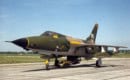
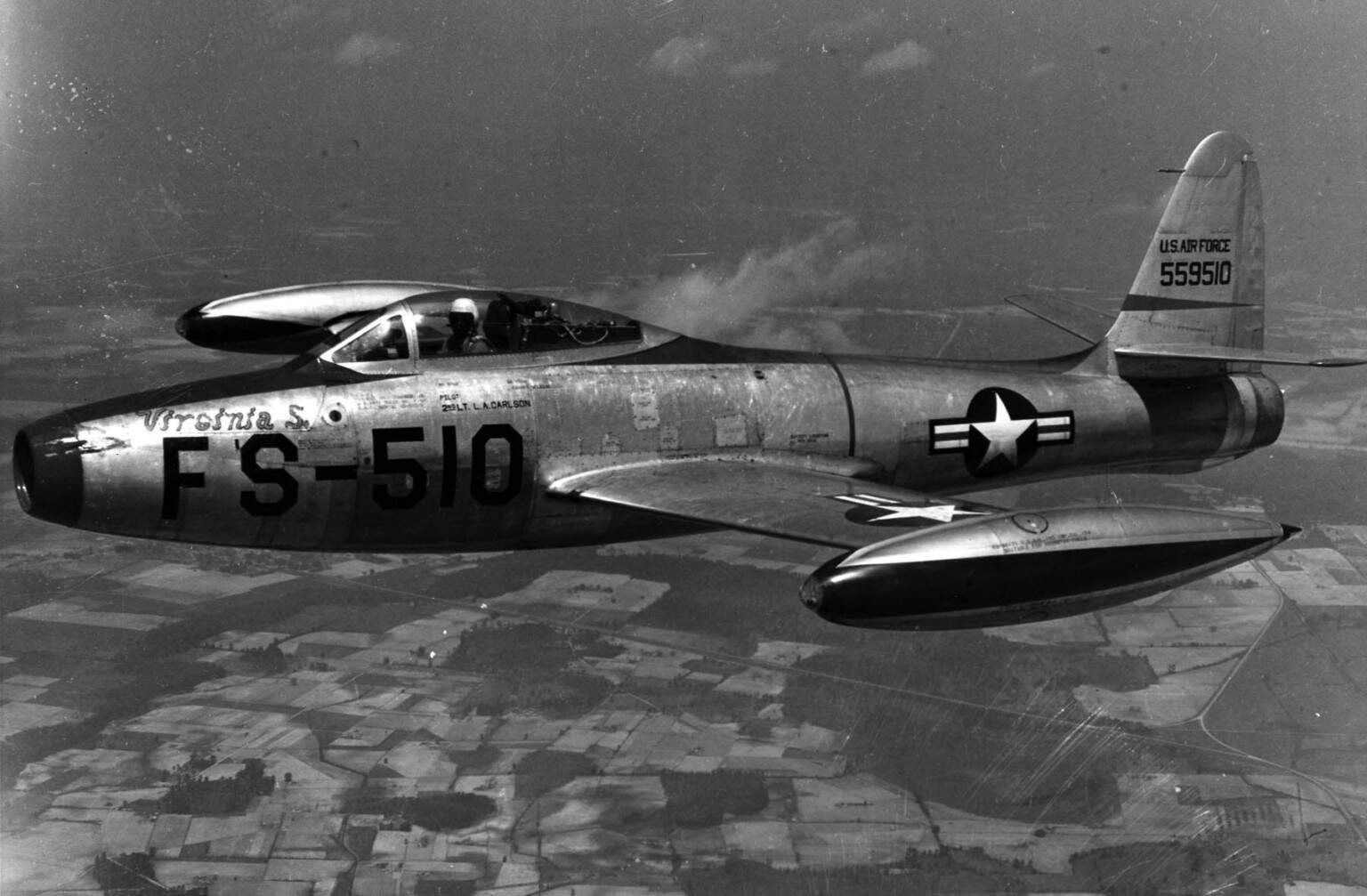
Republic F-84F Thunderstreak
ICAO: F84F
The first USAF fighter to refuel in flight and carry a nuclear bomb, and the jet that did most of the ground-attack work in Korea.
Updated: by Tim de Vries
The latest aviation news and stories sent to your inbox.
The Republic F-84 Thunderjet was a straight-wing, single-engine jet fighter-bomber that first flew in 1946. It was slow to mature, but by the Korean War it had become the United States Air Force’s main strike aircraft. The F-84G, the definitive straight-wing model, could refuel in flight and carry a tactical nuclear bomb. More than half of all F-84s built went to NATO and other allied air forces.
Live Fleet Activity (F84)
Fetching live data…


The F-84 Thunderjet was the Air Force’s second jet fighter to enter large-scale production, after the P-80. It started badly, then did most of the ground-attack work in the Korean War.
It was also the first production fighter to refuel in flight and the first able to carry a nuclear weapon. Over half of the 7,524 F-84s built, a total that includes the later swept-wing F-84F, served with NATO nations.
In 1944, Republic’s chief designer Alexander Kartveli tried to adapt the P-47 Thunderbolt to a jet engine. The Thunderbolt’s fat fuselage made that impossible, so his team drew a new aircraft with a slim body, a nose intake and an Allison axial-flow turbojet in the rear.
On September 11, 1944, the Army Air Forces issued a requirement for a day fighter that was both very fast and long-ranged, with a combat radius target of 850 miles. That proved too ambitious, and the radius target was later cut to 705 miles.
Republic received an order for three XP-84 prototypes on November 11, 1944, with no competition. The first flew on February 28, 1946, at Muroc Army Air Field (now Edwards Air Force Base), flown by Major Wallace “Wally” Lien.
Engines were scarce and weight kept climbing, so flight testing was thin before production started in 1947. When the Air Force became a separate service, the P-84 designation changed to F-84.
The F-84B reached the 14th Fighter Group in December 1947. It was the first production version, with an air-conditioned cockpit and an ejection seat, but it came with immediate flight restrictions.
A 1948 Air Force review found that none of the F-84B or F-84C aircraft could carry out any part of their intended mission. The program survived because the F-84D, already in production, fixed the main faults with thicker wing skins, a winterized fuel system and a more powerful engine.
One discovery was that the untested wingtip fuel tanks twisted the wings in hard maneuvers. Small triangular fins on the tanks helped cure it.
The first fully capable Thunderjet was the F-84E, which entered service in 1950. It had a longer fuselage and cockpit, an A-1B gunsight with AN/APG-30 radar ranging, and wet inboard pylons for a pair of extra drop tanks.
Even so, only half of F-84Es were operational in April 1950, mostly because of a shortage of Allison engine spares.
The F-84G was meant as a stop-gap until the swept-wing F-84F arrived, but it was ordered in huge numbers to build up NATO air forces. It added a refueling receptacle in the left wing, an autopilot, instrument landing equipment and the J35-A-29 engine.
Deliveries began in 1951 and production ended in July 1953 after 3,025 aircraft. Of those, 789 went to the USAF and 2,236 to allies under US military aid.
The straight-wing models (F-84A to E and G) were the “Thunderjet”. The swept-wing F-84F Thunderstreak was a different airplane that kept the number. The National Museum of the US Air Force counts about 4,450 straight-wing Thunderjets in all.

Takeoff was the notorious part. In hot Korean summers with a full combat load, an F-84 routinely needed about 10,000 feet of runway, even with rocket-assisted takeoff bottles.
Pilots had to haul it off the ground at around 160 mph with the stick held fully back, which earned it nicknames such as “Lead Sled” and “The World’s Fastest Tricycle”.
The thick straight wing reached its Mach 0.82 limit quickly at low altitude. Going beyond it caused a violent pitch-up that could tear the wings off. Pilots still praised its ruggedness and its stability as a gun and bombing platform.
It was a single-seat day fighter with no radar, which limited it to daylight operations.
The F-84E-equipped 27th Fighter Escort Group reached Japan aboard the carrier USS Bataan on November 30, 1950, and flew its first missions from Taegu on December 7. Its first job was escorting B-29 bombers.
The straight-wing F-84 was outclassed by the swept-wing MiG-15, which was faster and more maneuverable. The air-to-air job passed to the F-86 Sabre, and the Thunderjet became a ground-attack aircraft, where it excelled.
Over the war, F-84s flew 86,408 sorties, dropped 55,586 tons of bombs and 6,129 tons of napalm, and fired 22,154 rockets. The Air Force claimed they destroyed 60% of all ground targets in the war, including the 1952 attack on the Sui-ho Dam.
F-84 pilots were credited with eight MiG-15 kills. The USAF FY1953 statistical digest records 305 F-84 losses in Korea, 249 of them in combat missions.
For a wider look at the conflict, see our guide to Korean War fighter jets.

On September 22, 1950, two EF-84Es flew from Britain to the United States using probe-and-drogue refueling from Avro Lincoln tankers. One ran out of fuel near Newfoundland, but the other completed the 10-hour-2-minute crossing, showing that fighters could be ferried across the Atlantic in numbers.
On August 20, 1953, 17 F-84Gs of the 508th Strategic Fighter Wing flew from the United States to the United Kingdom with aerial refueling. It was then the longest nonstop flight ever made by jet fighters.
The F-84G was also the first aircraft flown by the USAF Thunderbirds, from 1953 to 1955, before the team moved to the F-84F.
The Thunderjet also served as a test bed. Experiments included docking with B-29 and B-36 motherships (the FICON project) and zero-length launching from a trailer in 1955.
The full specification table for the aircraft is on this page, and it describes the F-84G. A few of its figures need context.
The range row is a ferry range, flown with external tanks. On internal fuel alone the F-84G managed roughly 670 miles, and combat radius was far shorter than either figure.
The speed row is the sea-level maximum. Below 15,000 feet the Mach 0.82 limit mattered more than raw power, so the number was hard to use in a fight.
The thrust figure is for the J35-A-29. The earlier F-84D flew with a weaker engine, and the F-84G’s extra thrust helped with its heavier loads.
Climb is better described by time than rate. The F-84G needed about 7.9 minutes to reach 35,000 feet.
The National Museum of the US Air Force says the USAF supplied F-84s to 14 other countries. Turkey operated 479 F-84Gs, Italy 254, Denmark 240 and Yugoslavia 219.
Belgium, the Netherlands, Norway, Greece, France, Portugal, Iran, Thailand and Taiwan also flew Thunderjets.
The F-84E left USAF service in 1956 and lingered in the Reserve and Air National Guard until 1959. The F-84G was retired from the USAF in mid-1960.
Allied use lasted longer. Portugal flew F-84Gs in Angola into the early 1970s, with the last withdrawn in 1973, and Yugoslavia kept them until 1974.
It started poorly and ended well. The early F-84B and F-84C were judged unable to perform their mission in 1948, but the F-84E and F-84G were rugged and accurate strike aircraft. They were weak in air combat against the MiG-15 and needed very long takeoff runs.
Yes. It was the main USAF strike aircraft in the Korean War, flying 86,408 sorties. Taiwan’s air force also flew F-84Gs against Chinese MiG-17s in 1956, and Portugal used them in Angola.
Yes. According to the Planes of Fame Air Museum, the first production version, the F-84B, already had an ejection seat and an air-conditioned cockpit.
The F-84E left USAF service in 1956 and the F-84G in mid-1960. Yugoslavia retired its F-84Gs in 1974, and Portugal’s last operational examples were withdrawn in 1973.
The Thunderjet had straight wings. The F-84F Thunderstreak had swept wings and a different engine, and was a largely new aircraft that kept the F-84 number because production delays made the straight-wing F-84G a stop-gap.
Sources and references used for research and fact-checking.