

Table of Contents
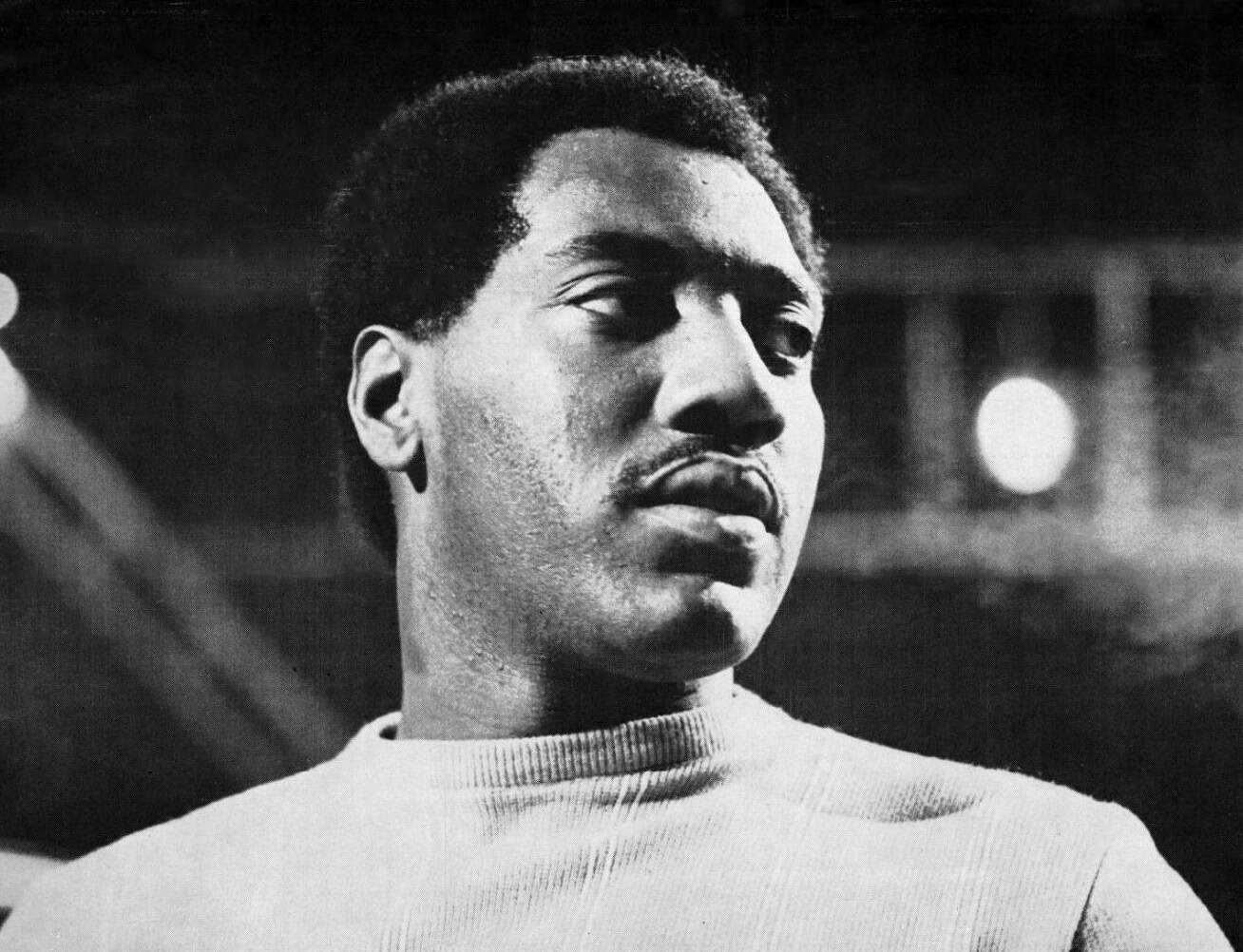
On the afternoon of December 10, 1967, Otis Redding’s twin-engine Beechcraft H18 went into Lake Monona, about 3 miles short of the runway at Madison, Wisconsin. Redding, 26, died with four members of the Bar-Kays, their 17-year-old valet and the pilot. Trumpeter Ben Cauley was the only survivor.
Most retellings give the crash a cause: the storm the plane took off into, a weak battery, or ice on the wings. The official record names none of them. The probable cause the investigators entered is “undetermined”, and the record still reads that way.
This article is built from the National Transportation Safety Board’s own accident record, file CHI68A0053 (docket 2-1109), and the FAA registration history of the airplane, N390R. Facts from other sources are named as they come.
October 31, 1967
The airplane is registered. The FAA issues the registration for Beech H-18 N390R, serial BA-623, to Otis Redding Enterprises Inc. of Macon, Georgia.
December 7, 1967
The last session. Redding records overdubs on “(Sittin’ On) The Dock of the Bay” at Stax in Memphis, finishing work begun on November 22.
December 9, 1967
Cleveland. Redding and the Bar-Kays appear on the Upbeat television show and play shows at Leo’s Casino.
Early afternoon, December 10
Departure. N390R leaves Cleveland for Madison, about 401 miles (645 km) away, on an IFR flight plan. Eight people are aboard.
About 3:25 p.m.
Last radio call. According to newspaper accounts, pilot Richard Fraser calls Truax Field from about 4 miles south and reports no problems.
Minutes later
The crash. The airplane goes into Lake Monona on final approach, about 3 miles from the runway. The NTSB logs the time as 3:25 p.m.
May 28, 1968
The finding. The NTSB completes its analysis. The probable cause is entered as miscellaneous: undetermined.
June 14, 1968
Registration cancelled. N390R is removed from the FAA register.
What happened
By late 1967, Redding was flying his band to shows in his own airplane, a twin-engine Beechcraft H18. The H18, introduced in 1963, was the last version of the Beech Model 18. The Isthmus reports that Redding bought his used for $78,000.
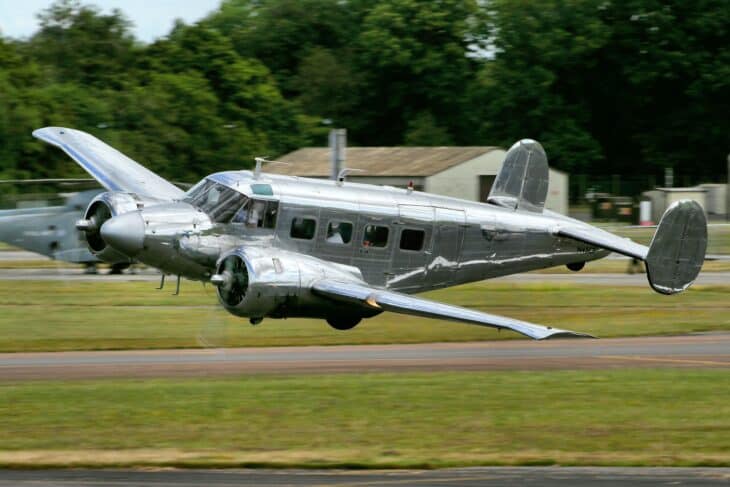
The FAA’s records show the registration to Otis Redding Enterprises was issued on October 31, 1967. The airplane had 2,263 hours on it, according to the NTSB file. The registration was about six weeks old.
On Sunday, December 10, the group left Cleveland for two shows that night at The Factory, a club on West Gorham Street in downtown Madison. Bassist James Alexander flew separately on an airline, because the Beech was full.
Carl Sims, a young singer booked to open the shows, flew commercial too. Alexander later told the Isthmus that he was the one who identified the bodies.
Aboard were Redding, pilot Richard Fraser, 26, and six passengers. They were the Bar-Kays guitarist Jimmie King, organist Ronnie Caldwell, saxophonist Phalon Jones, drummer Carl Cunningham and trumpeter Ben Cauley, plus valet Matthew Kelly. The four Bar-Kays who died were all 18 or 19.
Madison was under fog and low cloud. Fraser was flying an instrument landing system (ILS) approach to Truax Field. Newspaper accounts say he last radioed the field at about 3:25 p.m., roughly 4 miles south, and reported no problems.


A few minutes later, a witness on the lake told the Isthmus, the airplane came out of the overcast and went into the water.
Cauley later recalled, as quoted by the Badger Herald, that he had woken with a sense of falling and, without knowing why, unbuckled his seat belt. He could not swim and stayed afloat on a seat cushion until a police boat reached him.
Divers recovered the others over the following days. Redding’s body was found on December 11, still strapped into the copilot’s seat. Cauley died in 2015.
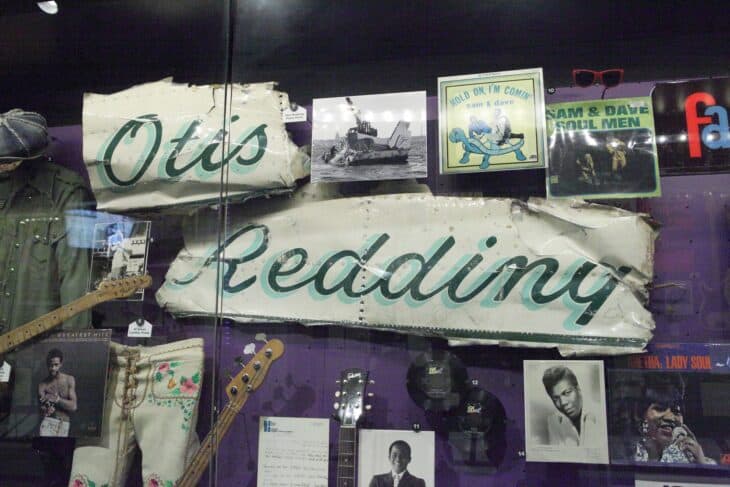
In Madison, promoter Ken Adamany offered refunds for the cancelled shows, then put on a free concert with two local bands. Two pieces of the airplane are now at the Rock & Roll Hall of Fame.

What the NTSB found
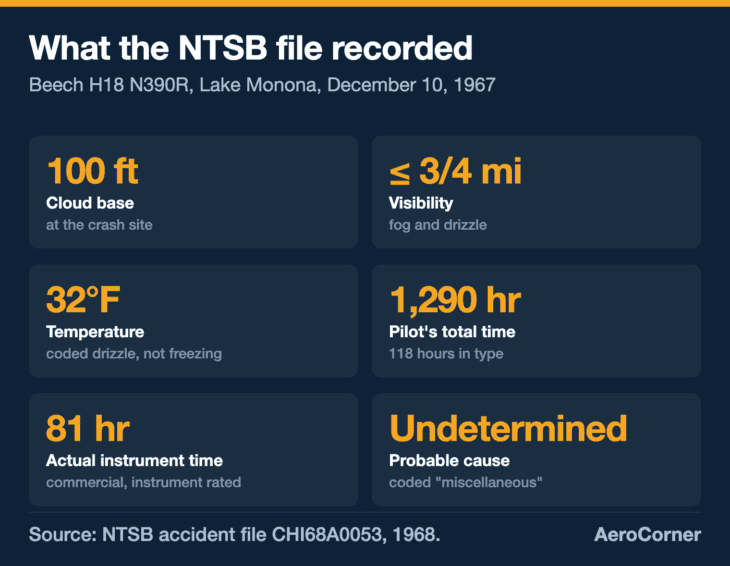
The NTSB, created that same year, opened file CHI68A0053. Unlike the long reports it writes today, the record is a single coded entry released as a “brief”. Its plain-text remarks run to one line: the aircraft crashed in the lake 3 miles from the runway, and the left engine and propeller were not recovered.
The probable cause is “miscellaneous: undetermined”. The accident type is also coded undetermined, in the final approach phase. The only other factor listed is that the aircraft came to rest in water.
The rest of the file describes a properly equipped, properly planned instrument flight. Fraser held a commercial certificate with a flight instructor rating, plus multi-engine and instrument ratings. He had 1,290 flying hours, 118 of them in the Beech 18 and 81 in actual instrument conditions.
He was flying on an IFR flight plan in an airplane equipped for instrument flight. He had received a weather briefing by radio from flight service, and the file rates the forecast “substantially correct”. The autopsy and toxicology tests found no alcohol or drugs.
The weather at the crash site is coded as IFR: a 100-foot ceiling, visibility of 3/4 mile or less in fog and drizzle, a temperature of 32°F and an 8-knot northeasterly wind. Those conditions are hard, but they are what an ILS approach exists for.
The precipitation code matters for what came later. The NTSB’s code list had a separate entry for freezing drizzle, and the investigators entered plain drizzle. That does not rule ice out, since ice can form in cloud above the surface, but no freezing precipitation was recorded at the site.
What most accounts get wrong
The crash is usually told with a cause attached: the plane took off into a storm despite warnings, the battery was weak, or ice brought it down. The NTSB named none of these. Its file records an instrument-rated pilot on an IFR flight plan with a correct forecast, and it codes the precipitation as drizzle, although the same code list had a separate entry for freezing drizzle. The battery story comes from a survivor’s recollection, and the ice theory from a biographer. Neither comes from the investigation, whose answer is undetermined.
Why an instrument approach in fog leaves so little margin
An ILS lets a pilot descend toward a runway without seeing it. Its basic parts are a localizer, which gives left-right guidance to the runway centerline, a glide slope, which gives a descent path, and a marker that fixes the distance. Inside cloud, the pilot’s job is to keep two needles centered.
Today’s rule, 14 CFR 91.175, says the pilot may not continue below the published decision height unless the approach lights or the runway are distinctly visible. If they are not, the pilot must fly a missed approach. That decision comes low and near the runway, at the end of the approach.
That is why the 100-foot ceiling, on its own, does not explain the crash. N390R went into the water about 3 miles out, well before the point where Fraser needed to see anything. Something brought the airplane down 3 miles early, and the NTSB could not say what.
The two popular theories describe real mechanisms. Ice forming on the wings and tail adds weight and drag and changes how an airplane flies. Jim Lowe, who trained Fraser, told the Isthmus he was certain ice brought the plane down, and that the autopilot would have masked its effects until it no longer could.
Biographer Jonathan Gould reached the same conclusion, while saying the cause can’t be known for sure. According to the Isthmus, he writes that six other fatal Beech 18 accidents on final approach between 1967 and 1983 all involved icing conditions. That is a biographer’s comparison, not an investigator’s finding.
An electrical fault is the other candidate, since the ILS receivers need power. The day after the crash, Cauley told the Capital Times he had heard a mechanic warn the pilot about the battery, according to the Badger Herald.
Neither theory appears in the file. With the left engine and propeller never recovered, the investigators had nothing to test either one against. It is a different story from the Buddy Holly plane crash in 1959, where the pilot held no instrument rating and the briefing was faulted.
What changed
We could find no rule or safety recommendation that traces back to this crash. With the cause undetermined, the file, closed on May 28, 1968, gave regulators nothing to act on. A modern investigation has far more to work with: the Paul Wellstone crash report traced that King Air’s airspeed from radar data and ruled ice out.
The music changed instead. “(Sittin’ On) The Dock of the Bay” was released on January 8, 1968, and reached No. 1 on the Billboard Hot 100 that March. It was the first posthumous No. 1 single in the US.
The airplane’s registration was cancelled on June 14, 1968. The FAA later reissued the number N390R to an unrelated aircraft, so a search for it today will not find Redding’s Beech 18.
FAQ
Sources and references used for research and fact-checking.
- National Transportation Safety Board, Aviation accident database, pre-1982 records (PRE1982.zip), file CHI68A0053, docket 2-1109, Beech H18 N390R, Madison, Wis., December 10, 1967
- National Transportation Safety Board, History of the National Transportation Safety Board
- Federal Aviation Administration, Releasable Aircraft Database (deregistered aircraft file), N390R
- eCFR, 14 CFR 91.175, Takeoff and landing under IFR
- Isthmus, Otis Redding's legacy endures 50 years after deadly Madison crash
- The Badger Herald, R&B legend Otis Redding died in Lake Monona just days after recording (Sittin' On) The Dock of the Bay
- Wikipedia, Otis Redding
- Wikipedia, (Sittin' On) The Dock of the Bay
- Wikipedia, The Bar-Kays
- Wikipedia, Beechcraft Model 18
Get the Newsletter
The latest aviation news and stories sent to your inbox.
About the Author

Tim is the owner and lead editor of AeroCorner since 2019, overseeing aviation content covering aircraft, airlines, airports, and the broader aviation industry. Through years of researching, writing, editing, and publishing aviation-focused content, he has developed extensive practical knowledge of commercial aviation and air travel. Based in Asia and a frequent traveler himself, Tim also brings firsthand passenger experience to AeroCorner’s coverage. Outside of publishing, he has also explored aviation firsthand through hands-on flight training in New Zealand.