

Table of Contents
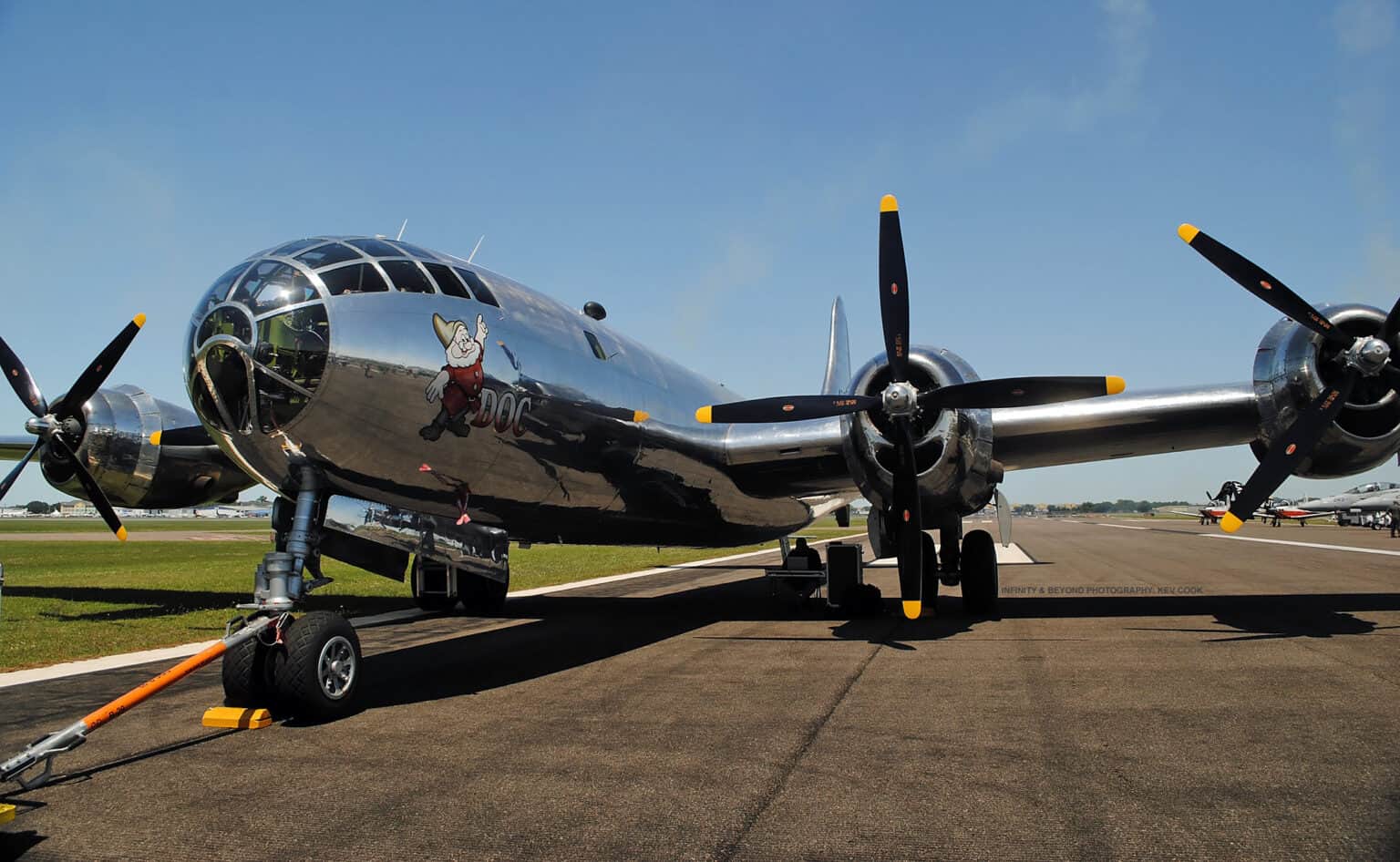
The B-29 Superfortress was one of the most advanced American bombers of World War II: pressurized, with remote-controlled gun turrets and four 18-cylinder engines. Its program cost $3 billion, more than the Manhattan Project that built the bombs two B-29s dropped on Japan.
Today you can count the flying ones on two fingers. And both of them spent decades parked in the California desert, where the U.S. Navy used them as targets.
Here is where the two survivors are, how they got out of that desert, and why even these two spend so much of each year on the ground.
How Many B-29s Are Still Flying?
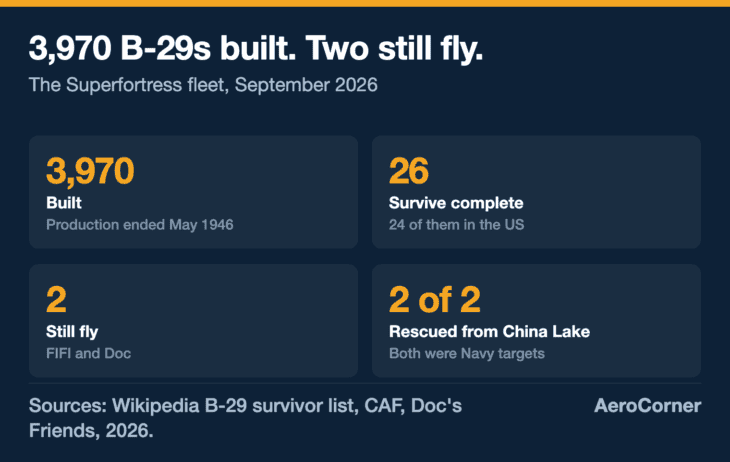
Two, as of September 2026: FIFI and Doc. They are the only airworthy examples of the 3,970 Boeing B-29 Superfortresses built before production ended in May 1946.
| Name | Serial / registration | Base | Operator | First flight after rescue |
|---|---|---|---|---|
| FIFI | 44-62070 / N529B | Dallas, Texas | Commemorative Air Force | August 1971 |
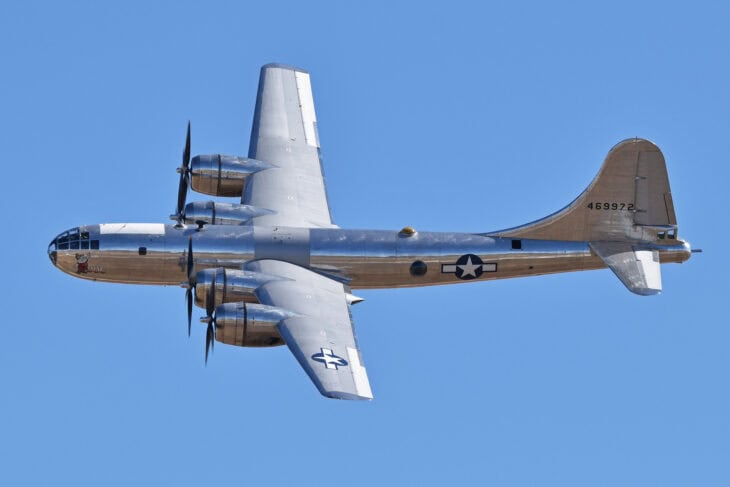
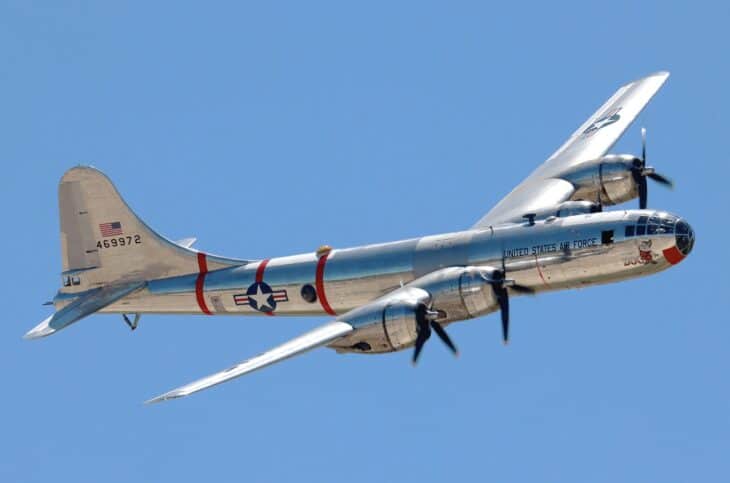
| Doc | 44-69972 / N69972 | Wichita, Kansas | Doc’s Friends (a nonprofit) | July 17, 2016 |
Both are active this year. FIFI has been on its 2026 tour since April, with stops from Dallas to Dayton, Ohio, and sold-out ride flights in Fayetteville, Arkansas, at the end of August. Doc flew from Cleveland’s Burke Lakefront Airport on September 12, 2026.
Until Doc’s first flight, FIFI was on its own. The two did not fly together until the EAA AirVenture show at Oshkosh, Wisconsin, in July 2017, the first B-29 formation since the type left U.S. Air Force service in the early 1960s.
Both Came Out of the Same Desert
The flying B-29s were not preserved by careful owners. They were saved from Naval Air Weapons Station China Lake, a Navy test range in the Mojave Desert that took in retired bombers and used them as targets.
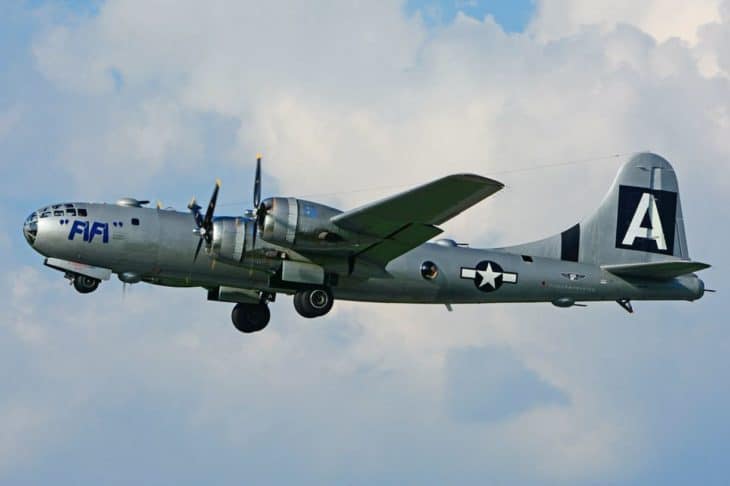
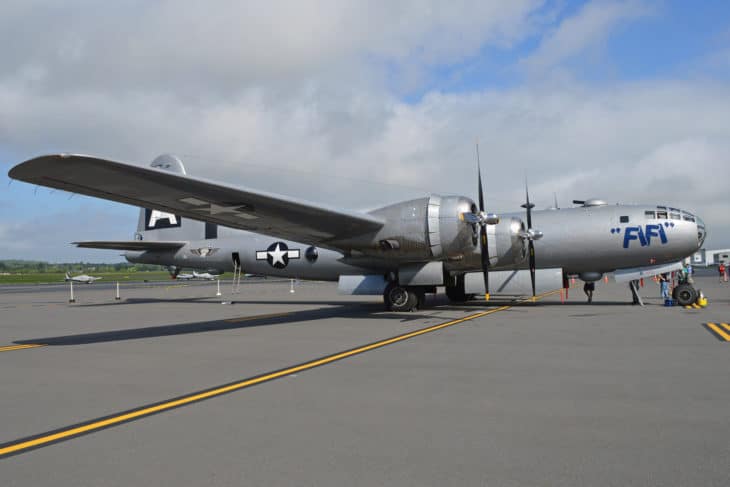
Doc arrived there in 1956 after years of radar calibration and target-towing work. FIFI followed in 1958 and was used as a ballistic missile target.
1956
Doc goes to China Lake. Struck off Air Force charge and sent to the Navy range as a target.
1958
FIFI follows. After an administrative career, 44-62070 becomes a ballistic missile target at the same range.
1971
The CAF takes FIFI. The Commemorative Air Force, then the Confederate Air Force, gets title in March and ferries the bomber to Harlingen, Texas, on August 3.
1987
Tony Mazzolini finds Doc. The Air Force veteran spots the bomber’s silhouette on the desert floor and starts trying to get it released.
1998
Doc leaves the desert. After the Navy is paid with a restored B-25, volunteers tow Doc out in April.
2000
Doc returns to Wichita. The bomber arrives in sections on flatbed trailers, a few hundred feet from where Boeing built it.
2016
Doc flies. The FAA issues an airworthiness certificate on May 20, and Doc flies on July 17, its first flight since 1956.
The price of Doc’s release is the detail most people miss. The Navy agreed to let the bomber go only if Mazzolini supplied a restored B-25 Mitchell for the National Naval Aviation Museum, so he found one in South America and restored it first.
That exchange took until 1998. Doc then spent 16 years being restored in Wichita by hundreds of volunteers, including retirees who had built B-29s at the same Boeing plant in the 1940s. In 2015 Doc’s Friends estimated it would cost $7 million to $9 million to finish the job, get Doc flying and give it a permanent home.
Where the Other B-29s Are
B-29 production wound down after the war, and many aircraft went into storage and were eventually scrapped as surplus. Others served through the Korean War and in a range of roles through the 1950s, and the type was retired in the early 1960s.
Twenty-six survive in complete form, according to Wikipedia’s survivor list, and 24 of them are in the United States. The most famous two are museum pieces for good reason: Enola Gay is at the Smithsonian’s Udvar-Hazy Center in Chantilly, Virginia, and Bockscar is at the National Museum of the U.S. Air Force in Dayton, Ohio.
Almost all of the others are on static display, with a handful in storage and one listed as under restoration. We could find no publicly announced project to return a third B-29 to the air.
The third B-29 that almost flew
In 1994 a team led by Darryl Greenamyer set out to fly the Kee Bird, a B-29 that had force-landed in northern Greenland in 1947, off the ice. They fitted new engines, propellers and tires. On May 21, 1995, during the takeoff attempt, a jury-rigged fuel tank for the auxiliary power unit leaked into the rear fuselage and the bomber burned where it sat.
Why So Few Fly: The Engine
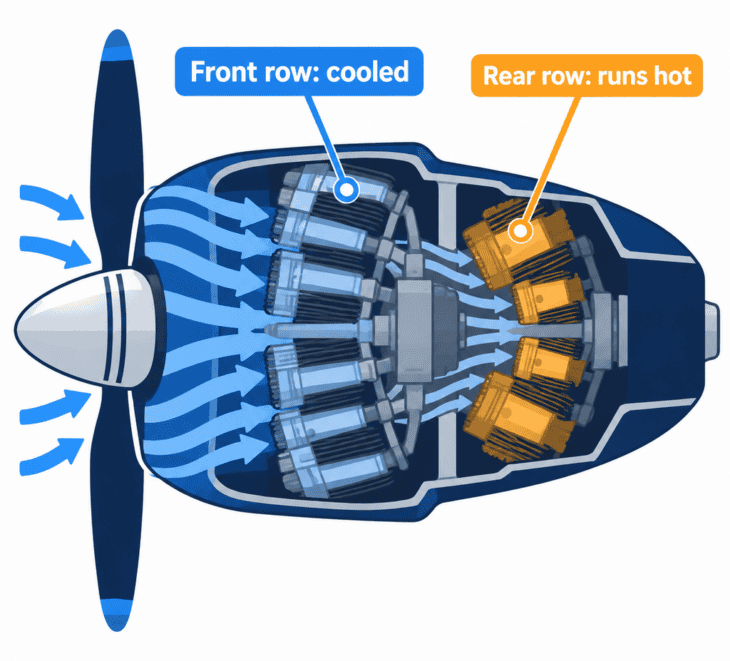
In wartime, the B-29’s Wright R-3350 Duplex-Cyclone was the biggest source of its maintenance headaches and catastrophic failures. It is also the part behind both survivors’ recent groundings. It is an 18-cylinder radial with two rows of nine cylinders, 3,350 cubic inches in all.
In wartime service the rear row overheated, partly because the gap between the cylinder baffles and the cowling was too tight to pass enough cooling air. The engines also tended to swallow valves.
The worst failures were fires. The crankcase had a high magnesium content, and a magnesium fire could burn at close to 5,600°F (3,090°C), hot enough to cut through the wing’s main spar in seconds. Wartime crews replaced engines as often as every 75 hours.
The engine outlived that reputation. After a redesign it powered postwar airliners such as the Lockheed Constellation and Douglas DC-7, and 50,192 were built before production ended in 1961.
FIFI shows what that means 80 years later. In 2006, after a run of engine problems including a failure during an air show, its squadron grounded it. The restoration took four years and cost $3 million, and all four engines were replaced with custom hybrids.
Those hybrids combine parts of two later versions of the engine, the R-3350-95W and the R-3350-26WD, drawn from the Douglas A-1 Skyraider and the Fairchild C-119 Flying Boxcar. FIFI flew again on August 5, 2010.
Why So Few Fly: Even Two Is Hard Work
A good year shows what these aircraft can do. In 2019 Doc toured 21 cities in 10 states, flew more than 115 hours and carried passengers on more than 70 ride flights.
But “airworthy” does not mean available. In 2026 alone, Doc lost months of its season to engines.
Two of its four engines went in for heavy maintenance in December 2025, and the tour that should have started in April was pushed back while one engine sat with the engine vendor. After an air show flight at Moses Lake, Washington, in June, one propeller and engine “entered an operating mode that requires further inspection.”
Stops in Twin Falls, Idaho, Wendover, Utah, and Tulsa, Oklahoma, were canceled, and August ride flights in Wichita slid by a week. By September, Doc was back on tour.
FIFI went through the same thing a year earlier. In 2025 a pre-flight inspection found a fault in the supercharger system of engines No. 2 and No. 4, which were sent from Texas to Vintage Radials in Tehachapi, California, for repair.
Two tour stops were canceled, and the Commemorative Air Force launched an appeal to cover the bill, raising its target from $50,000 to $100,000. FIFI was back in the air by the start of July 2025.
What One Hour in a B-29 Costs
Doc’s Friends publishes its numbers. Doc burns about 450 gallons of 100LL avgas per flight hour, roughly $3,375 of fuel at $7.50 a gallon.
Add engine and propeller reserves, maintenance, insurance and the Wichita hangar, and the group puts the all-in cost at $12,000 to $15,000 per flight hour. Doc typically flies about 150 hours a year.
FIFI’s numbers are in the same range. In 2021 the Commemorative Air Force put its operating cost at about $10,000 an hour, including roughly 400 gallons of fuel, with an all-volunteer crew.
Rides pay part of that. A Doc flight has 11 seats: the bombardier’s seat in the glass nose at $1,500, three forward seats at $1,200, and seven gunner seats in the back at $600. A sold-out flight grosses $9,300 for a ride of about 30 minutes.
Selling those seats takes permission. Carrying paying passengers in a former military bomber needs a special FAA exemption, known as a Living History Flight Experience, which covers limited and experimental category warbirds.
The FAA’s own policy says these exemptions give owners a way to offset “the considerable restoration, maintenance and operational costs” of flying them.
FIFI’s seats sold for $725 to $1,375 at its Fayetteville stop in 2026. The gap between ticket revenue and hourly cost is covered by donors, sponsors and volunteer crews, the same model that keeps the three B-17s that still fly in the air.
Why “Only Two” Is Not the Whole Story
Airworthy is not the same as flying
Pages that say two B-29s are flying are right, but they make it sound permanent. Both FIFI and Doc have lost large parts of a touring season to engine work in the last two years. On any given day, the number of B-29s actually able to fly can be just one.
The other common assumption is that the B-29s disappeared in combat. Combat is only part of it: after the war, many went into storage and were scrapped as surplus, long before anyone thought of them as history.
That is also why both flyers came from a weapons range. While much of the fleet was being scrapped, China Lake held on to FIFI and Doc for the Navy’s own use, and that kept them whole enough for volunteers to come and get them.
So if you hear four big radials over an air show and look up at a silver bomber with a glass nose, you are seeing one of two. It spent decades waiting to be blown up, and it is flying on engines that someone just spent the winter rebuilding.
Sources and references used for research and fact-checking.
- Wikipedia, List of surviving Boeing B-29 Superfortresses
- Wikipedia, Boeing B-29 Superfortress
- Wikipedia, Wright R-3350 Duplex-Cyclone
- Wikipedia, FIFI (aircraft)
- Commemorative Air Force, B-29 FIFI
- CAF AirPower History Tour, B-29 Superfortress FIFI
- CAF AirPower History Tour, B-29 Rides, Fayetteville AR 2026
- Vintage Aviation News, CAF AirPower History Tour Announces 2026 National Schedule
- Vintage Aviation News, B-29 FIFI to Visit National Museum of the U.S. Air Force
- Vintage Aviation News, B-29 Superfortress FIFI Nears Return to Flight After Critical Engine Repairs
- Commemorative Air Force, Iconic B-29 Superfortress FIFI Returns to the Skies After Major Repairs
- Doc's Friends, The B-29 Doc Story
- Wikipedia, Doc (aircraft)
- Doc's Friends, FAA Deems B-29 Doc Airworthy, First Flight Imminent
- Flying, Restored Doc B-29 Emerges on 70th Anniversary of First Delivery
- Doc's Friends, Take a Ride of a Lifetime
- Doc's Friends, B-29 DOC Schedule Update and Status: Launch of 2026 Tour Season
- Doc's Friends, B-29 DOC Tour Stop in Twin Falls, ID, Canceled Due to Aircraft Maintenance
- Doc's Friends, B-29 DOC Tour Stop in Wendover, UT, Cancelled
- Doc's Friends, B-29 DOC Tour Stop in Tulsa Canceled Due to Continued Aircraft Maintenance
- Doc's Friends, B-29 DOC Ride Weekend Added in Wichita: August 15 and 16
- Cleveland 19 News, WWII 'Doc' takes flight in Cleveland, reunited with veteran who saved it from the desert
- The Aviationist, Beautiful Video of the Only Two Flying B-29s Together for the First Time
- Air & Space Forces Magazine, 'FiFi' Is the B-29 Bringing WW2 History to Local Flight Lines
- Federal Register (FAA), Policy Regarding Living History Flight Experience Exemptions for Passenger Carrying Operations
- Wikipedia, Kee Bird
Get the Newsletter
The latest aviation news and stories sent to your inbox.
About the Author

Tim is the owner and lead editor of AeroCorner since 2019, overseeing aviation content covering aircraft, airlines, airports, and the broader aviation industry. Through years of researching, writing, editing, and publishing aviation-focused content, he has developed extensive practical knowledge of commercial aviation and air travel. Based in Asia and a frequent traveler himself, Tim also brings firsthand passenger experience to AeroCorner’s coverage. Outside of publishing, he has also explored aviation firsthand through hands-on flight training in New Zealand.