Military Transport Planes
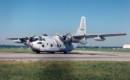
Fairchild C-82 Packet
ICAO: C82
Twin-boom Cold War airlifter that caught a satellite
Updated: by Tim de Vries
The latest aviation news and stories sent to your inbox.
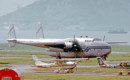
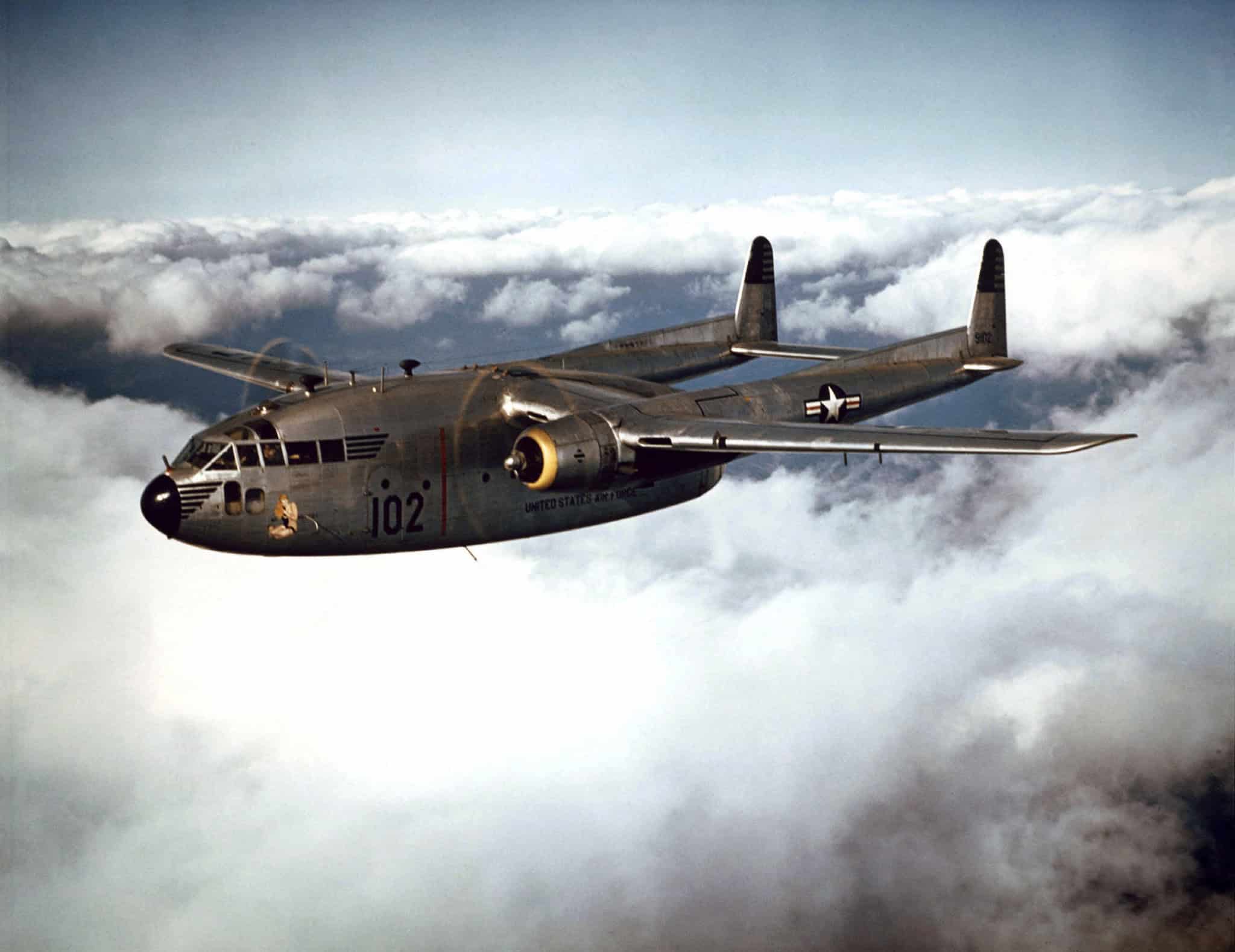
The Fairchild C-119 Flying Boxcar is a twin-engine, twin-boom military transport developed after World War II from the Fairchild C-82 Packet and built from 1949 to 1955. It carried troops, cargo, stretchers and vehicles through wide rear clamshell doors, dropped a bridge by parachute at the Chosin Reservoir in 1950, and in 1960 made the first midair recovery of an object returning from Earth orbit. Converted C-119s later flew as the AC-119 Shadow and Stinger gunships in Vietnam.
Live Fleet Activity (C119)
Fetching live data…


The Fairchild C-119 Flying Boxcar is a twin-engine, twin-boom military transport built from 1949 to 1955 to carry troops, cargo, stretcher patients and vehicles, and to drop them by parachute. The prototype first flew on November 17, 1947.
Between about 1,150 and 1,183 were built, depending on whose count you use. The Boxcar dropped a bridge to trapped troops in Korea, flew CIA-crewed supply runs at Dien Bien Phu, made the first midair catch of an object returning from orbit, and finished its combat career as the AC-119 gunship over Vietnam.
For how it compares with other freighters, see our guide to types of cargo planes. The last U.S. military C-119s were retired in 1974.
The C-119 grew out of the Fairchild C-82 Packet, of which 223 were built between 1945 and 1948. The Packet served the Air Force’s Tactical Air Command and Military Air Transport Service, but its design turned out to have several serious problems.
Fairchild’s fix was so extensive that the aircraft got a new designation. The biggest change moved the cockpit forward, flush with the nose, instead of perched on top of the cargo compartment. That improved the pilots’ view and made the usable hold longer.
The C-119 also got engines with about 60 percent more power, four-bladed propellers in place of three-bladed ones, and a wider, stronger airframe. The prototype, first called the XC-82B, flew in November 1947, and Fairchild began delivering production C-119Bs from its Hagerstown, Maryland factory in December 1949.
In 1951, Henry J. Kaiser won a contract to build more C-119s at the Kaiser-Frazer plant at Willow Run, Michigan, the former B-24 factory. Kaiser built 71 in 1952 and 1953 with Wright R-3350 engines instead of Fairchild’s Pratt & Whitney R-4360s, then converted the factory for a planned run of the C-123 Provider that never happened.
The name comes from the shape. The C-119 is essentially a box-section cargo hold slung between two tail booms, and when the Air Force redesignated the improved Packet as the C-119, it gave it the official nickname “The Flying Boxcar.”
Crews had names of their own. Veterans called it the “Dollar Nineteen,” and some pilots joked that it was “thousands of rivets flying in loose formation.”
The Navy and Marine Corps flew the same aircraft as the R4Q-1 and R4Q-2 until 1962, when the R4Qs were redesignated as C-119s.
The C-119 was built for straight-in loading from the back. Its rear clamshell doors swing open on vertical hinges to leave an opening 9 feet 10 inches (3.0 m) wide and 8 feet (2.4 m) high, as wide as the hold itself.
Combined with a level cargo floor, that let crews load vehicles and bulky freight straight in, and drop cargo and troops by parachute from the back in flight. The same rear door later made the satellite-recovery conversions possible.
Jane’s credits the C-119C with 67 troops, 35 stretchers or 27,500 pounds (12,500 kg) of cargo. Seat counts depended on how the hold was configured: Castle Air Museum lists 62 troops or 45 paratroopers for its C-119C.
The flight crew was five: pilot, co-pilot, navigator, radio operator and crew chief.
The full specification table for the aircraft is on this page, and it describes the C-119C with Pratt & Whitney R-4360 engines. A few figures need context, because museum placards quote different variants and different conditions.
Top speed is the most-quoted mismatch. The C-119C managed 281 mph (452 km/h), or 244 knots, at 18,000 feet, and cruised at about 200 mph (322 km/h) on 70 percent power. Museum placards quote 290 to 296 mph, mostly for later models with Wright R-3350 engines, which is where the higher top-speed figures online come from.
Range depends on load. Jane’s 1,770 miles (2,850 km) assumes only 5,500 pounds (2,500 kg) of cargo, while the Air Mobility Command Museum’s 2,280 miles (3,670 km) for the C-119G carries no load condition at all.
Payload figures run from 20,000 pounds (9,070 kg) on one museum’s C-119G placard to 30,000 pounds (13,600 kg) on the National Museum of the U.S. Air Force’s C-119J. The 27,500-pound figure in the table is Jane’s rating for the C-119C.
The takeoff and landing figures are distances over a 50-foot obstacle, not ground roll: 2,300 feet (700 m) to clear 50 feet on takeoff, and 1,890 feet (580 m) from 50 feet to a stop on landing.
Early C-119s used two Pratt & Whitney R-4360 Wasp Majors, 28-cylinder air-cooled radials rated at 3,500 hp (2,610 kW) each. The C-119C in the table uses the R-4360-20W.
The C-119F and G switched to the Wright R-3350 Duplex Cyclone. The National Museum of the U.S. Air Force lists 3,500 hp for its C-119J’s R-3350-89s, while the SAC Museum gives 3,400 hp for the R-3350-89W, so quoted power varies by exact engine model.
The C-119B was the first production model, with 55 built on R-4360-30 engines. The C-119C added a dorsal fin and dropped the tailplane extensions, and 303 were built.
The C-119F moved to Wright R-3350 engines, with 256 built for the Air Force and the Royal Canadian Air Force, including Kaiser’s 71. The C-119G, the most common model, was an F with different propellers, and 480 were built or converted.
The Navy and Marines took 39 R4Q-1s, based on the C-119C, and 58 R4Q-2s, based on the F. Totals differ slightly between sources: the SAC Museum, for example, counts 484 G-models and 210 F-models.
Later conversions included 62 C-119Js with a modified rear fuselage, the EC-119J for satellite tracking, the jet-boosted C-119K, 22 C-119Ls, and a single YC-119H with a longer wing and a redesigned tail.
Four C-119s went to the Far East Air Forces for service trials in July 1950. Two months later the type deployed with the 314th Troop Carrier Group and served in Korea for the rest of the war.
Its most famous mission came in December 1950. Chinese troops had blown up a bridge at a narrow point on the road between Koto-ri and Hungnam, blocking the withdrawal of U.N. forces from the Chosin Reservoir.
Eight Flying Boxcars dropped a replacement bridge in eight 16-foot (4.9 m) sections, each weighing 2,900 pounds (1,315 kg) and hanging from two parachutes. Wikipedia and the Air Mobility Command Museum credit the Air Force’s 314th Troop Carrier Group, although some sources say the aircraft were Marine R4Qs.
Marine engineers and the Army’s 58th Engineer Treadway Bridge Company assembled four of the sections, plus wooden extensions, into a working bridge. That let the column reach Hungnam.
From 1953, the CIA secretly loaned C-119s to French forces in Indochina. They generally flew in French markings with American pilots at the controls, often accompanied by French officers.
During the siege of Dien Bien Phu they flew supply drops into increasingly heavy anti-aircraft fire. James B. McGovern Jr. and Wallace A. Buford, officially employees of the airline Civil Air Transport, were the only two American pilots killed in the siege.
Their C-119 was hit by Viet Minh fire on May 6, 1954 while making an artillery drop, and it flew about 75 miles (121 km) into Laos before it crashed. The garrison surrendered the next day.
Recovery gear could be deployed from the C-119’s rear door, which made it a platform for midair recovery. From 1955, C-119s caught Ryan Firebee target drones in flight, and the 456th Troop Carrier Wing used them to snag instrument packages from high-altitude reconnaissance balloons.
The 6593rd Test Squadron at Hickam Air Force Base, Hawaii, then flew C-119s to catch film capsules from the Corona spy satellite program, whose missions flew under the Discoverer name.
On August 19, 1960, Capt. Harold E. Mitchell, flying under the callsign Pelican 9, caught the Discoverer 14 capsule on his third pass, about 360 miles (580 km) southwest of Honolulu.
It was the first film ever recovered from an orbiting satellite, and the first midair recovery of an object returning from Earth orbit. That aircraft, C-119J 51-8037, is displayed in the Space Gallery of the National Museum of the U.S. Air Force, one of the aviation museums in Ohio.
In Vietnam, 26 C-119Gs became AC-119G Shadow gunships. They carried four six-barrel 7.62 mm miniguns, armor plating, flare launchers and night-capable infrared equipment.
A further 26 became the AC-119K Stinger, which added two 20 mm M61 Vulcan cannon, better avionics, and two underwing J85 turbojets that together added nearly 6,000 pounds (27 kN) of thrust.
They flew close air support in South Vietnam and hunted trucks along the Ho Chi Minh Trail. The Shadows were handed to the South Vietnamese Air Force from 1970, and the AC-130 eventually replaced the type as the Air Force’s gunship.
From 1951 to 1962, C-119Cs, Fs and Gs equipped the first-line combat cargo units of U.S. Air Forces in Europe and the Far East Air Forces. In Europe, roughly 150 of them served with the 60th, 317th and 465th Troop Carrier Wings, flying anywhere from Greenland to India.
The C-130 Hercules began replacing them in Europe in 1958, but the Navy, Marine Corps, Air Force Reserve and Air National Guard kept flying C-119s into the 1970s. The last U.S. military use ended in 1974, when Navy Reserve squadrons at Detroit and Los Alamitos, California, gave up theirs.
Abroad, the C-119 flew with Belgium, Brazil, Canada, Ethiopia, France, India, Italy, Jordan, Morocco, Norway, South Vietnam and Taiwan. India took 79 and used them heavily to supply its forces in the 1962 Sino-Indian War, and it later bought 27 booster-jet kits for its fleet.
Taiwan’s air force was the last military operator, keeping its C-119s into the mid-1990s. Sources give 1995 and 1997 for the final retirement.
Surplus C-119s were bought by contractors that flew airtankers for the U.S. Forest Service and the Bureau of Land Management, and others went into civilian cargo work.
Many civil Boxcars carried the Steward-Davis Jet-Pak, a 3,400 lbf (15 kN) Westinghouse J34 turbojet in a pod above the fuselage. It raised the permitted takeoff weight to 77,000 pounds (34,900 kg), and Steward-Davis supplied 29 kits to U.S. civil operators and 27 to the Indian Air Force.
After a series of crashes raised concern about the age of the aircraft, the U.S. C-119 airtanker fleet was permanently grounded in 1987. The Air Mobility Command Museum’s C-119C, 48-0352, followed that path: it flew as a firefighter from 1969 to 1974, appeared in a 1985 episode of MacGyver, and was grounded in 1987.
In November 1952, two C-119s taking part in Exercise Warm Wind were lost in Alaska within eight days. “Gamble Chalk One” crashed on Mount Silverthrone on November 7, killing 19, and “Warmwind Three” was lost on November 15, and its 20 occupants were declared dead.
On July 17, 1953, a Marine R4Q-2 carrying 40 NROTC midshipmen crashed after an apparent port engine failure shortly after takeoff from NAS Whiting Field, Florida. Only two midshipmen and one of the six crew survived.
On August 10, 1955, two C-119s in a training formation collided over Edelweiler, Germany, killing 66. In 1958, a C-119C collided with a C-124 Globemaster II over Bridgeport, Texas, killing all 18 aboard both aircraft.
Belgian C-119G CP-45 was hit by a mortar round over the Sennelager training area in Germany in June 1963, killing all six crew and 32 paratroopers. On June 5, 1965, C-119G 51-2680 vanished between Homestead Air Force Base, Florida, and Grand Turk Island with nine men aboard.
Very few, if any, on a regular basis. Wikipedia lists only two airworthy C-119s, both ex-Navy C-119Fs owned privately in Eagle River, Alaska, and the FAA register as of September 2026 shows both still validly registered there, as N1394N and N8501W.
A current registration is not proof that an aircraft flies, and we found no public record of a C-119 making regular flights in recent years. A few more C-119s are still on the U.S. register, but most of those belong to museums or sit in storage.
The best-known survivor is the Discoverer 14 aircraft at the National Museum of the U.S. Air Force in Dayton, Ohio. The Air Mobility Command Museum at Dover Air Force Base, Delaware, has two: C-119C 48-0352, the 51st C-119 built, and C-119G RCAF 22118, which was fitted with a Jet-Pak during its firefighting career.
The Pima Air & Space Museum shows C-119C 49-0132 in the markings of Tanker 81, and the museum is on our list of aviation museums in Arizona. The Lauridsen Aviation Museum in Buckeye, Arizona, has RCAF 22130, which appeared in the 2004 film Flight of the Phoenix.
The Mid-Atlantic Air Museum in Reading displays an ex-Navy C-119F, one of the stops in our guide to aviation museums in Pennsylvania. Castle Air Museum, among the aviation museums in California, shows C-119C 49-0199.
Other examples sit at the Hagerstown Aviation Museum in Maryland, where RCAF 22111 appeared in the 1989 film Always, and at the National Warplane Museum in Geneseo, New York. Outside the U.S., C-119s are preserved in Belgium, Brazil, India and Taiwan, including a jet-pod-equipped C-119G at the Indian Air Force Museum in New Delhi.
Rarely, and almost never as a flying aircraft. Most surviving Boxcars belong to museums, and several former airtankers are stored at the Museum of Flight and Aerial Firefighting in Greybull, Wyoming.
Derelict airframes do change hands. The nonprofit Rolling Boxcar acquired C-119 N5216R from Battle Mountain, Nevada, stripped its wings, tails, engines and landing gear, and is mounting the 60-foot (18 m) fuselage on a school bus chassis as a traveling museum, with completion targeted for spring 2028.
Very few, if any, on a regular basis. Wikipedia lists only two airworthy C-119s, both ex-Navy C-119Fs privately owned in Eagle River, Alaska, and both remained validly registered with the FAA as of September 2026. We found no public record of any C-119 flying regularly in recent years.
It was a hard-working airlifter with a mixed reputation. More than 1,100 were built and it served more than a dozen air forces for decades, but it suffered landing gear failures, engine and propeller problems and violent stall behavior, and the U.S. airtanker fleet was grounded in 1987 after a series of crashes.
Its official nickname was the Flying Boxcar, after its box-shaped cargo hold. Crews also called it the “Dollar Nineteen,” and the gunship versions were named Shadow (AC-119G) and Stinger (AC-119K).
Wikipedia gives 1,183 delivered: 1,112 by Fairchild and 71 by Kaiser-Frazer. Museum counts run slightly lower: the SAC Museum gives 1,151, and the Air Mobility Command Museum says more than 1,150.
Early models, including the C-119B and C, used two Pratt & Whitney R-4360 Wasp Major radials of 3,500 hp each. The C-119F and G used Wright R-3350 Duplex Cyclones of about 3,400 to 3,500 hp.
The C-119C reached 281 mph (244 knots) at 18,000 feet and cruised at about 200 mph. Later R-3350-powered models are credited with 290 to 296 mph.
U.S. military use ended in 1974, when the last Navy Reserve squadrons replaced theirs. Taiwan’s air force kept flying C-119s into the mid-1990s, and U.S. civil airtankers were grounded in 1987.
In U.S. Air Force troop-carrier units, the Lockheed C-130 Hercules, which began replacing it in Europe in 1958. The AC-130 later replaced the AC-119 as the Air Force’s gunship.
Sources and references used for research and fact-checking.