Military Helicopters
The medium twin helicopter built for modern military transport missions.
The latest aviation news and stories sent to your inbox.
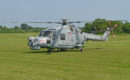
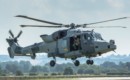
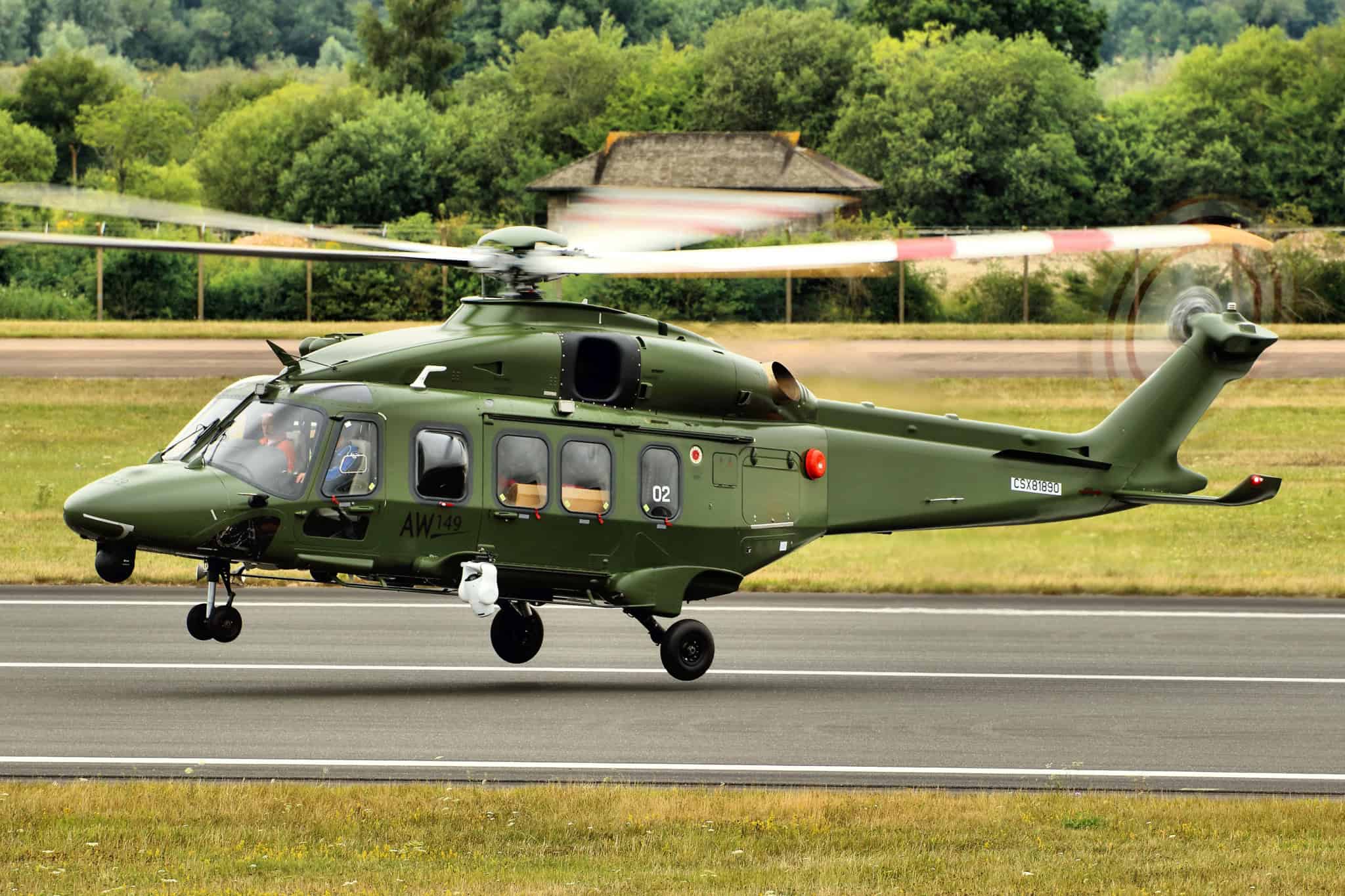
The AgustaWestland AW149 is a medium-lift military helicopter developed for troop transport and utility operations. Introduced in the late 2000s, it shares design lineage with civil models while incorporating military systems. The aircraft targets international defense markets.
Live Fleet Activity (A149)
Fetching live data…


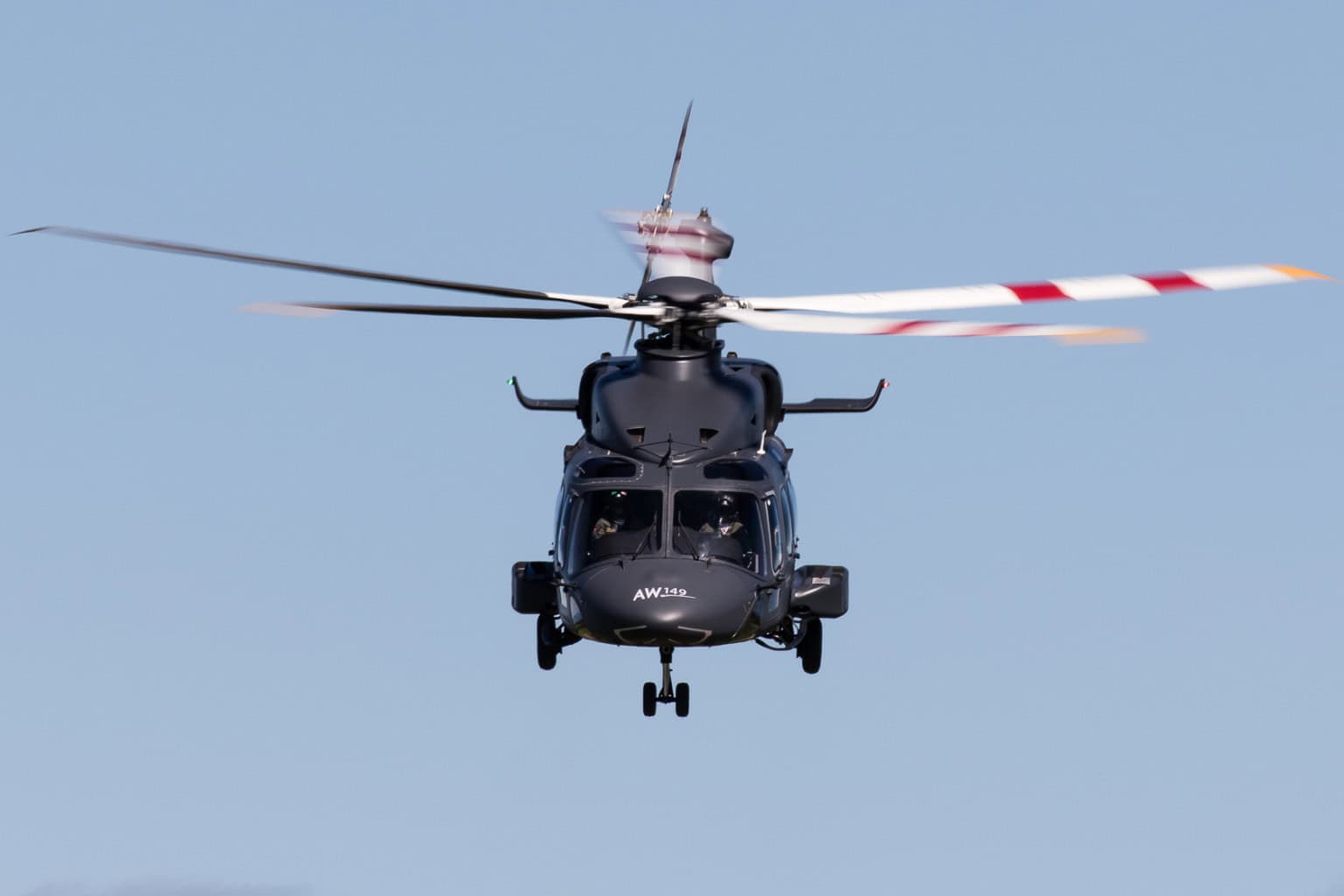


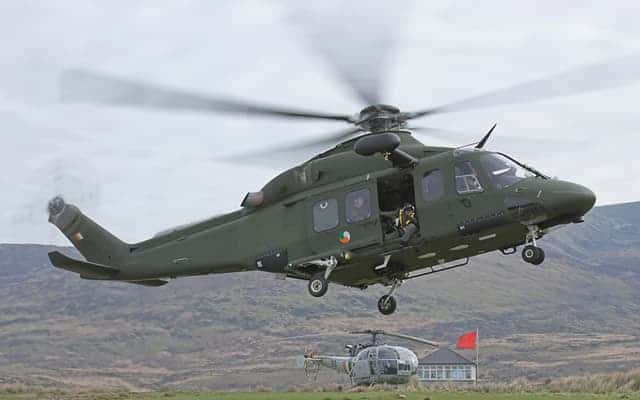

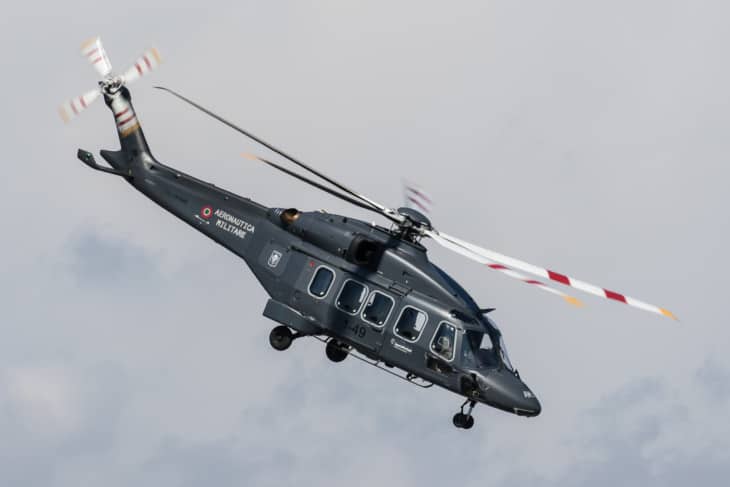
The AW149 first flew in 2009 as a militarized derivative of the AW139 platform. It features strengthened structures, defensive systems, and mission avionics suited to armed forces requirements. The helicopter employs a five-blade main rotor and twin-engine configuration for reliability.
Powered by two General Electric CT7 turboshaft engines producing approximately 2,000 shaft horsepower each, the AW149 cruises at around 150 knots (278 km/h). Maximum takeoff weight exceeds 18,000 pounds (8,165 kg). The cabin can carry up to 18 troops depending on configuration.
The AW149 has been selected by several military operators seeking a modern medium transport helicopter. Its design balances payload, range, and survivability. The aircraft reflects Leonardo’s strategy of adapting proven civil platforms for defense roles.
The AW149 program originated from a requirement to provide armed forces with a medium-lift helicopter that reduced development risk by leveraging an existing civil airframe. Program intent emphasized rapid entry to service, affordability through commonality, and adaptability across mission sets. Development teams focused on structural reinforcement, integration of military avionics, and survivability measures absent from the civil baseline.
Prototype activity prioritized evaluating the strengthened airframe and mission systems under representative military load conditions. Test objectives included assessment of external-load handling, rapid reconfiguration of the cabin for troops or litters, and the behavior of the rotor and transmission arrangements under higher weight factors. Flight test phases also validated rotorcraft handling with defensive aids installed and under simulated mission profiles.
Certification and entry into service followed national military qualification processes rather than exclusively civil certification. Production planning accounted for modular assembly zones to facilitate both standard transport deliveries and specialized mission fitters. Industrial arrangements included tooling and support facilities sized to support sustainment and spare parts provisioning for deployed fleets.
Program context placed emphasis on international marketing to armies, navies, and multi-role defense customers seeking a modern helicopter without the development lead time associated with a clean-sheet design. The manufacturer positioned the aircraft as a bridge between light utility types and larger transport helicopters, aiming to address a broad set of requirements while containing acquisition and operating costs.
The airframe uses a semi-monocoque fuselage with reinforced keel and cabin attach points to accommodate internal and external loads. The cabin floor is designed for rapid role conversion, with anchor points for seating, stretcher frames, and mission equipment racks. Access is provided by a wide rear ramp and large sliding doors to expedite troop movement and cargo handling.
Rotorcraft configuration applies a multi-blade main rotor and a conventional tail rotor, with attention to vibration reduction and low-signature acoustics. Transmission and drive components emphasize durability and maintainability, with accessible inspection panels and component replacement points intended for field-level servicing. Landing gear arrangement supports operations from unprepared sites.
Avionics philosophy centers on an open architecture mission system to allow integration of communications, navigation, and defensive subsystems chosen by operators. The cockpit presents glass displays with provisions for mission system control, night vision compatibility, and interfaces for helmet-mounted sights. Redundancy and compartmentalization of critical systems enhance survivability and mission continuity in degraded environments.
Distinctive features include a mission-oriented cabin layout and provisions for self-protection equipment. Structural hardpoints and wiring harnesses for external stores are pre-integrated at the factory to reduce candidate conversion time. Maintenance considerations such as modular components and ground support interfaces inform access panels and service points across the airframe.
The type is characterized as a medium-lift helicopter, designed to carry platoon-sized loads or equivalent cargo over medium distances while retaining the ability to operate from austere sites. Flight performance is tuned for a balance between cruise efficiency and the power reserves needed for hot and high operations. Mission endurance supports typical transport and utility tasks without approaching long-range fixed-wing endurance profiles.
Climb performance and single-engine capability are emphasized to meet military safety margins, particularly during external load missions and deck operations. Payload-range tradeoffs are a routine planning consideration for operators because mission equipment, defensive fits, or additional fuel installations meaningfully influence available cargo or troop capacity. Helicopter handling qualities are adjusted for responsive control inputs in low-speed maneuvering and formation flight.
Operational ceilings permit high-altitude transit and insertions in mountainous terrain when fitted with appropriate engine and environmental packages. Rate of climb and hover performance are influenced by installed systems and density altitude. Operators commonly plan missions with reserve power margins to accommodate contingencies and account for mission-specific weight growth.
Operational limitations include the dependence on ground support for heavy maintenance and the need for trained logistics personnel familiar with composite repairs and mission systems. Environmental constraints such as icing, extreme sand ingestion, and saltwater exposure require approved operating procedures and preventive maintenance to preserve airframe and avionics reliability.
Several mission-fit variants were offered to meet diverse customer requirements. Transport and utility configurations provide troop seating, cargo restraint systems, and medical evacuation kits. Dedicated maritime adaptations incorporate corrosion protection, flotation aids, and shipboard interface equipment for operations from naval platforms.
Armed reconnaissance and escort configurations are obtainable through external stores pylons, sensor turrets, and weapon stations. These builds emphasize cockpit sighting systems and integration of fire control interfaces while preserving primary transport capability. Training and special mission blocks allow for instrumented cockpits and instructor consoles as required by customers.
The manufacturer also offered bespoke options that combine elements from different mission fits, enabling hybrid roles such as troop lift with limited self-defense or long-range logistics with auxiliary fuel tanks. These options are implemented through modular kits to simplify depot-level conversion and to standardize spare parts across fleets.
The type entered service with multiple defense organizations in both continental and maritime roles. Operators used the helicopter for vertical movement of personnel, logistic resupply, casualty evacuation, and disaster relief. Operational deployments emphasized rapid reconfiguration between troop transport and medical evacuation roles to meet changing mission demands.
Fleet experience highlighted benefits of commonality with civil support infrastructure when maintaining non-mission-specific components. Logistical frameworks varied by customer but commonly included manufacturer-supported training for aircrews and maintenance personnel, and establishment of spares pipelines to sustain operations away from home basing. Aircraft availability and mission-capable rates depended on local maintenance practices and supply chain responsiveness.
Operational use in austere environments tested the machine for dust ingestion, corrosion control, and maintenance throughput. Reports from users emphasized the value of modular cabin fittings and quick-change mission kits in maximizing sortie generation. Night operations leveraged cockpit compatibility with night vision equipment and mission lighting tailored to low-observable procedures.
Training units adopted the helicopter for pilot conversion from lighter types and for mission crew tactics familiarization. Maintenance and ground crew programs focused on composite repair, rotor system inspections, and mission system troubleshooting. Lessons learned in early fleet deployments informed sustainment practices and logistical pre-positioning in theaters of operation.
The helicopter is employed primarily for utility lift and force projection rather than dedicated strike missions. When configured for contested environments it supports troop insertion, casualty evacuation, and resupply under escort or with self-protection systems fitted. Weapons and sensor packages are installed according to customer needs and rules of engagement.
Mission planning for hostile areas emphasizes routing, altitude management, and load planning to retain escape and maneuver options. Survivability measures include inflatable or ballistic protection kits, situational awareness sensors, and coordinated use with escort assets. The platform is generally used to enhance mobility and sustainment for ground forces rather than as a stand-alone combat system.
Engagements requiring direct fire support typically rely on accompanying attack helicopters or ground-based assets. The helicopter’s role in combined arms operations concentrates on rapid movement, logistics, and casualty handling, integrating with broader command and control structures for mission execution.
User organizations have integrated the type into existing rotary-wing fleets to fill medium transport capability gaps. Operators organize squadrons for troop lift, special operations support, and maritime duties. Training pipelines and maintenance standards are adapted to the helicopter’s mission system modularity and to ensure interoperability with allied platforms.
Procurement choices reflect the balance between purchase cost, sustainment arrangements, and the ability to incorporate nation-specific mission equipment. Operators commonly work with the manufacturer or licensed partners for long-term logistics support and periodic upgrades to avionics and defensive suites.
The program reinforces a model for adapting civil rotorcraft architectures to military missions with minimized development times. Lessons from the type’s operational service inform approaches to modular missionization, maintainability in austere conditions, and the integration of open-architecture avionics for future upgrades. The aircraft’s service experience contributes data on balancing payload flexibility and survivability for medium-lift rotary-wing platforms.
Sustainment and logistical insights from fielded units highlight the value of regional support networks and commonality with existing civil maintenance processes. Those lessons influence procurement planning for forces seeking cost-effective transport solutions that still permit tailored mission capability growth.
Sources and references used for research and fact-checking.