

Table of Contents
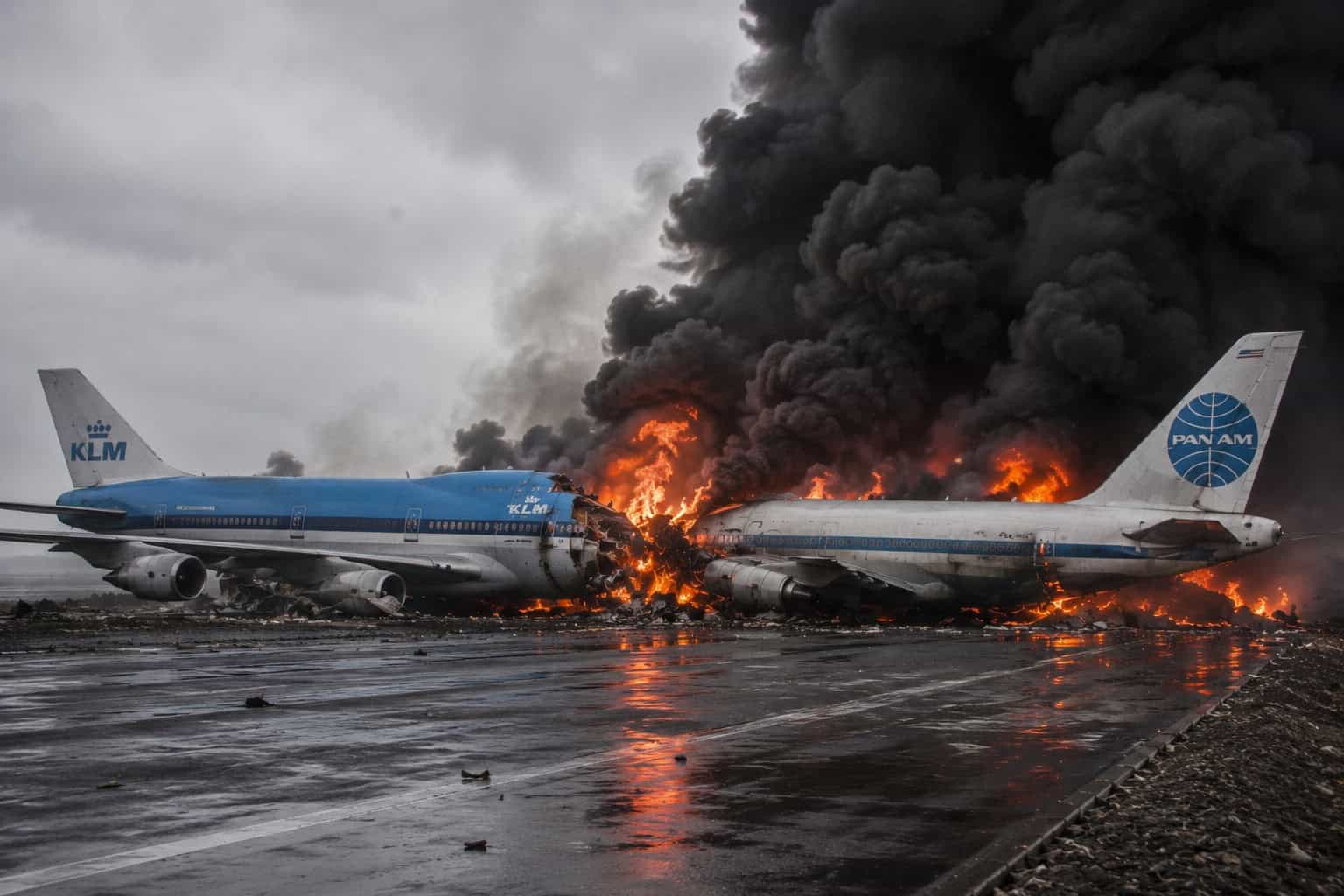
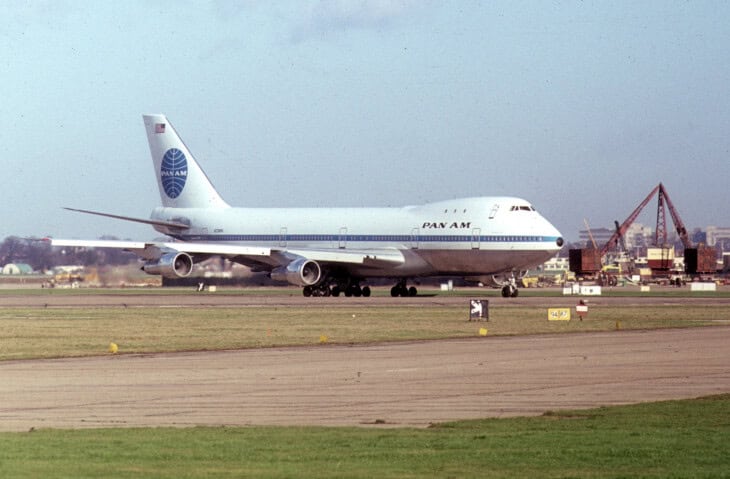
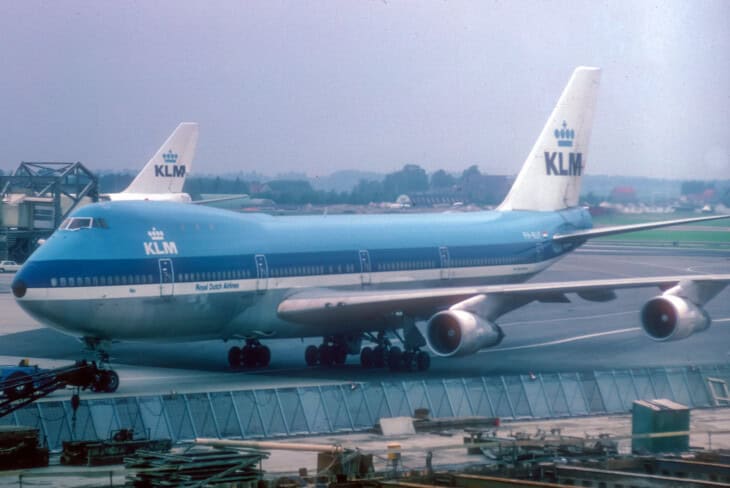
On the morning of March 27, 1977, a bomb in the passenger terminal at Gran Canaria’s Las Palmas Airport diverted dozens of flights to Los Rodeos Airport on the neighboring island of Tenerife. Los Rodeos was a small regional airport, built for inter-island traffic, and by early afternoon its taxiways were lined with wide-body jets that had nowhere else to go. Among them were KLM Flight 4805, a Boeing 747 from Amsterdam, and Pan Am Flight 1736, a 747 that had come from New York via Los Angeles. Both were waiting to continue to Las Palmas when it reopened. Both were running against crew duty time limits. When Las Palmas reopened, the congestion at Los Rodeos created a further problem: with the taxiways blocked by diverted aircraft, both 747s would have to backtrack down the main runway itself to reach the takeoff position.
By late afternoon, fog had begun rolling across the airport. At 17:06 local time, as the KLM 747 began its takeoff roll, the Pan Am 747 was still taxiing down the same runway. KLM’s captain, Jacob Veldhuyzen van Zanten, was the airline’s chief Boeing 747 flight instructor, one of the most experienced and respected aviators in European aviation. He believed he had received takeoff clearance. He had not. The two aircraft collided in dense fog at approximately 150 knots of closing speed. The impact killed all 248 people aboard the KLM aircraft and 335 of the 396 people aboard the Pan Am aircraft. Sixty-one people survived, all from the front section of the Pan Am plane. The Tenerife airport disaster is the deadliest accident in the history of aviation, with 583 people killed.
No mechanical failure caused the Tenerife disaster. Both aircraft were airworthy. The weather was difficult but within limits. The cause was a chain of miscommunication: between the KLM crew and air traffic control, between the two 747s sharing the same radio frequency, and between the members of the KLM crew themselves. The accident prompted a systematic examination of how pilots and controllers use language, and of what happens when the most senior person in a cockpit acts on a mistaken belief and no one effectively stops him. The changes that followed are now embedded in how every commercial flight operates, in every phraseology manual, and in every airline’s crew training program.
How a route clearance became a takeoff, and why no one stopped it
KLM 4805 completed its 180-degree turn at the end of Runway 12 at approximately 17:05. The fog was thickening. Van Zanten was under pressure: the refueling that had taken place during the long wait had added to the delay, and crew duty time limits were approaching. A departure before the fog reduced visibility below minimums was becoming urgent. At 17:05:44, KLM called the tower to report ready for takeoff. What the controller gave back was a route clearance: instructions for the departure routing, the altitude to climb to, and the turn to make after becoming airborne. This is a standard pre-departure clearance. It is not a takeoff clearance. The two are procedurally distinct. A route clearance tells a crew how they will fly after they are in the air. A takeoff clearance, which comes separately and must be explicitly stated, tells them they may begin the takeoff roll.
The cockpit voice recorder documents what happened next with precision. As the first officer read back the route clearance, van Zanten advanced the throttles. He then transmitted: “We are now at takeoff.” The phrase is ambiguous. It could mean “we are beginning our takeoff” or “we are holding at the takeoff position.” The tower controller heard it as the latter and responded: “OK… stand by for takeoff, I will call you.” That instruction, if heard clearly, would have stopped the accident. It reached the KLM crew at exactly the moment Pan Am Flight 1736 simultaneously transmitted its own message: “No, uh, we’re still taxiing down the runway, the Clipper 1736.” The two transmissions overlapped, producing a heterodyne squeal in the KLM cockpit that lasted 3.74 seconds. The “stand by for takeoff” instruction was masked. The Pan Am warning was masked. KLM 4805 was already accelerating down the runway.
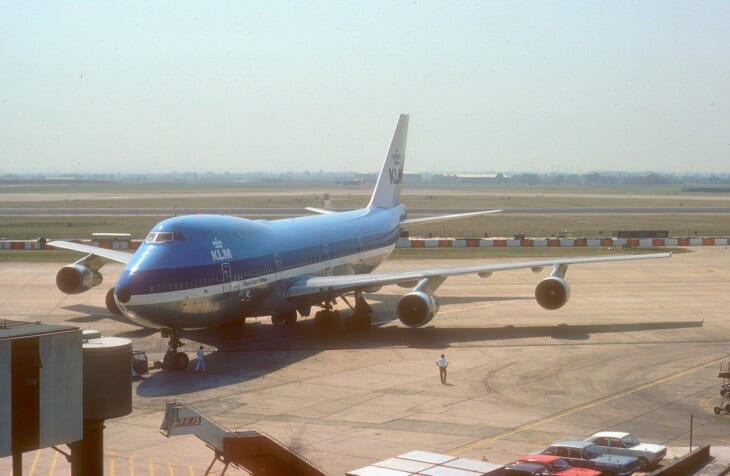
Inside the KLM cockpit, a challenge was raised and dismissed. Flight Engineer Willem Schreuder, who knew that Pan Am’s position on the runway was uncertain, asked the crew directly: “Is he not clear, that Pan American?” Van Zanten replied: “Oh yes.” Schreuder did not press the question further. Earlier, First Officer Klaas Meurs had noted that they did not yet have ATC clearance before the route clearance was read — a correct observation. After the route clearance, the concern had apparently been resolved in his mind. Both crew members who had doubts backed down in the face of the captain’s certainty. This is not best understood as individual failure of nerve. In 1977, commercial aviation had no systematic training for how junior crew members should challenge a senior captain’s judgment under operational pressure. The authority of the captain was not merely cultural expectation — it was the explicit professional norm. No framework existed that told a flight engineer his job included saying “I am not satisfied the runway is clear” and maintaining that position against a chief flight instructor’s dismissal. The accident exposed the absence of that framework as a systemic safety deficiency rather than a personal one.
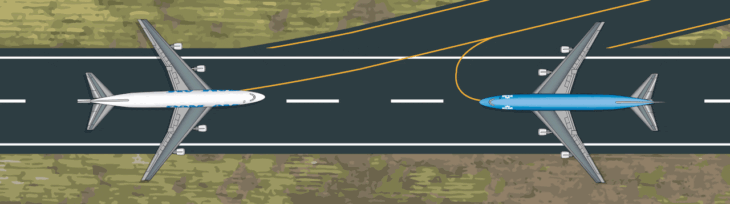
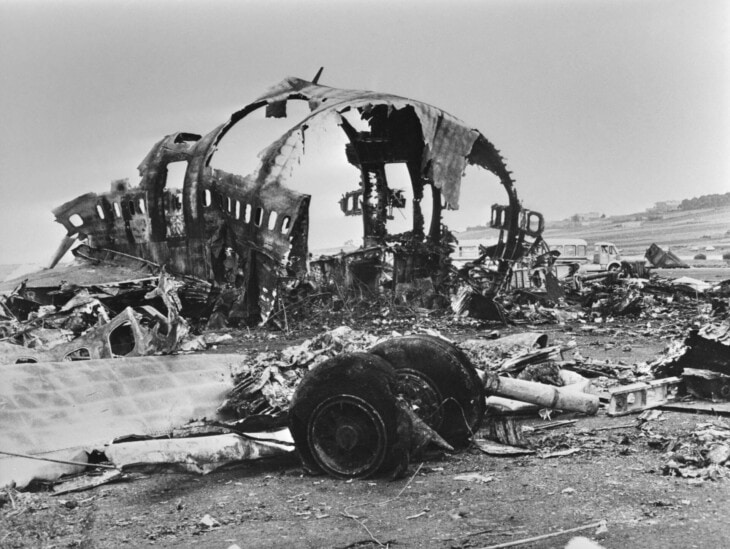
The collision occurred at 17:06:53. KLM 4805, having reached approximately 160 knots, attempted to rotate early when the Pan Am aircraft became visible through the fog ahead. The nose lifted but the aircraft was not yet at flying speed. The KLM 747’s main landing gear and lower fuselage dragged across the top of the Pan Am fuselage, tearing through the upper deck from roughly the wing to the tail. The KLM aircraft flew on for approximately 150 meters before crashing and burning completely. The Pan Am aircraft came to rest on the runway; fire swept the rear sections, killing those trapped there. The 61 survivors were those close enough to the front to escape before the fire reached them. Captain Victor Grubbs and First Officer Robert Bragg both survived. Van Zanten and all of his crew died in the KLM wreckage.
The last challenge that could have stopped it
At approximately 17:06:21, as KLM 4805 began its takeoff roll, Flight Engineer Willem Schreuder asked Captain van Zanten: “Is he not clear, that Pan American?” Van Zanten replied: “Oh yes.” Schreuder did not challenge further. The Spanish investigation and subsequent human factors studies identified this exchange as the final moment at which the accident could have been stopped from inside the cockpit. The flight engineer had correct information: Pan Am’s position was unconfirmed. He raised it. He was dismissed. In 1977, aviation had no training program that prepared a crew member for what to do next. Building that training program became one of the defining safety projects of the following decade.
The communication rules and crew training standards that came from Tenerife
The most immediate and precisely traceable change was to language. Following the accident, ICAO undertook a comprehensive review of standard radiotelephony phraseology and implemented reforms that govern every pilot-controller communication to this day. The word “takeoff” was restricted to a single context: it may be spoken only when issuing an actual takeoff clearance (“cleared for takeoff”) or when canceling one (“cancel takeoff clearance”). At all other times, before the clearance is given, pilots and controllers use the word “departure”: “ready for departure,” “departure runway 30.” The phrase that allowed van Zanten to hear his route clearance as a takeoff clearance cannot arise within this structure. The ambiguity is closed by the rule itself.
ICAO also reformed several other points of phraseology where ambiguity had been possible. “Affirm” replaced “affirmative” to prevent the word’s opening from being confused with “negative” if a transmission is partially lost; “say again” replaced “repeat,” which had specific meanings in other radio contexts; “go ahead” was replaced by “pass your message” to protect the safety-critical phrase “go around” from any possible confusion. These reforms addressed a broader set of radiotelephony vulnerabilities that the Tenerife investigation had surfaced. Mandatory readback requirements were also strengthened: when a crew reads back an ATC clearance, the controller is explicitly required to correct any error. The investigation found that no one in the chain had clearly corrected the ambiguity in the KLM readback. Requiring active verification rather than passive acknowledgment closed that procedural gap.
The deeper change took longer and reached further. Tenerife became the foundational case study for what aviation would come to call Crew Resource Management. The accident made it impossible to look at the KLM cockpit as simply a captain who made a wrong decision: it made visible a system in which junior crew members who held correct information could not effectively use it to prevent a senior crew member from acting on a wrong belief. United Airlines implemented the first formal CRM program in commercial aviation in 1981, drawing directly on the Tenerife accident as its primary case study. The program, initially called Cockpit Resource Management, established that crew members at every rank had not only the right but the professional responsibility to challenge incorrect actions, and provided training on how to do so effectively against the authority gradient present in every cockpit. The NTSB published a dedicated human factors study on Tenerife in 1986, specifically to advance the adoption of these principles across the US industry. The FAA mandated CRM training for all Part 121 airline crews in 1995, making formal and binding what had developed through the preceding decade and a half as voluntary industry practice. The mandate traces its lineage directly to the Tenerife runway.
The airport infrastructure failures also produced lasting change. Los Rodeos had no surface detection radar: the controller had no way to see the position of aircraft on the runway in the fog. The absence of airport surface detection equipment at an airport handling two Boeing 747s in conditions of reduced visibility was a gap the accident made untenable. Investment in airport surface detection equipment accelerated following Tenerife, and ICAO formally established runway incursion as a reportable safety event category, creating the global tracking and analysis infrastructure needed to address the problem systematically. The specific conditions at Los Rodeos on March 27, 1977, a crowded airport, a runway used as a taxiway, ground radar absent, and a fog bank arriving faster than expected, became a reference scenario for airport emergency planning and traffic management standards worldwide.
What changed because of Tenerife
ATC phraseology: ICAO restricted “takeoff” to actual clearance contexts only; “departure” now used at all earlier stages. Additional reforms standardized “affirm,” “say again,” and “pass your message” to eliminate high-risk ambiguities. Readback requirements: controllers must actively correct incorrect readbacks rather than acknowledge them. Crew Resource Management: United Airlines’ first formal CRM program launched 1981, drawing on Tenerife as its primary case study; NTSB published dedicated human factors study in 1986; FAA mandated CRM training for all Part 121 crews in 1995. Airport surface detection: investment in ground radar accelerated; runway incursion established as a tracked ICAO safety category. All of these changes remain in force as binding requirements today.
Tenerife sits at the origin of almost everything modern aviation knows about how language in the cockpit and on the radio can fail, and what happens when the most experienced person on the flight deck is certain of something that is not true. The accident did not happen because aviation was careless or unserious: it happened in a genuine fog of ambiguity, compressed by time pressure, inside a professional culture that had not yet built the tools to handle it. Those tools exist now because 583 people died on a runway in the Canary Islands on a March afternoon, and the system looked at what it lacked and decided to build it.
For the full arc of how crew resource management developed from this accident into the training standard it became, the story of United Airlines Flight 232 is the natural companion: Sioux City in 1989 was CRM working precisely as the post-Tenerife training programs intended, a crew that communicated across roles, challenged each other, and brought in outside expertise. The contrast between the two cockpits, one that had the culture and one that did not, is the measure of what Tenerife built. Both articles are part of The Flights That Changed Aviation series, which covers each of the accidents that produced the rules flying depends on today.
FAQ
Sources and references used for research and fact-checking.
- Tenerife Airport Disaster — Spanish CIAIAC Investigation Report - Comision de Investigacion de Accidentes e Incidentes de Aviacion (CIAIAC), Spain
- Human Factors Report on the Tenerife Accident - Air Line Pilots Association (ALPA) / SKYbrary
- NTSB Safety Study SIR-86-01: Human Factors in the Tenerife Air Disaster - National Transportation Safety Board
- Boeing 747-206B (KLM) — FAA Lessons Learned from Transport Airplane Accidents - Federal Aviation Administration
- CVR Transcript: KLM Flight 4805 and Pan Am Flight 1736 Collision - Aviation Safety Network
- SKYbrary: B742/B741, Tenerife, 1977 - SKYbrary
Get the Newsletter
The latest aviation news and stories sent to your inbox.
About the Author

Tim is the owner and lead editor of AeroCorner since 2019, overseeing aviation content covering aircraft, airlines, airports, and the broader aviation industry. Through years of researching, writing, editing, and publishing aviation-focused content, he has developed extensive practical knowledge of commercial aviation and air travel. Based in Asia and a frequent traveler himself, Tim also brings firsthand passenger experience to AeroCorner’s coverage. Outside of publishing, he has also explored aviation firsthand through hands-on flight training in New Zealand.