


American Airlines Flight 965 departed Miami International Airport on the evening of December 20, 1995, bound for Cali, Colombia, with 155 passengers and 8 crew members aboard. The Boeing 757-200 was a Christmas holiday flight: families heading home, travelers reuniting. The routing was straightforward, the aircraft was in good working order, and the experienced crew had flown this route before. Passing over the city of Cali, air traffic control offered the crew a shortcut: proceed directly to the Rozo non-directional beacon and fly the ROMEO 1 arrival. The crew accepted. To set up the new routing, the captain cleared the waypoints that had already been programmed into the flight management system. What happened in the next few minutes would reshape the entire global aviation industry’s relationship with the terrain below.
To navigate toward Rozo, the captain typed the letter “R” into the flight management computer, matching the identifier shown on the paper approach chart. The FMS returned a list of twelve waypoints, all beginning with “R,” sorted by proximity to the aircraft. The first entry was ROMEO: a navigation beacon located near Bogotá, 132 nautical miles away. The second entry was ROZO, the correct beacon near Cali, just 38 nautical miles ahead. The captain selected the first entry. The autopilot locked on to ROMEO and began turning the aircraft to the right, toward the east, directly into the Andes mountains. For several minutes neither pilot correctly identified what had gone wrong or where the aircraft was heading. The crew attempted to resolve their confusion without reverting to the raw navigation data that would have shown them their position clearly. At 9:47 PM local time, the ground proximity warning system activated with a terrain alert. Twelve seconds later, the Boeing 757 struck El Diluvio mountain at approximately 9,000 feet above sea level.
Of the 163 people on board, 159 were killed. Four passengers survived, all seated within two rows of each other in the rear of the aircraft. It was the deadliest aviation accident in Colombian history. The accident had no mechanical failure, no weather event, no act of violence. A crew flying a fully functional aircraft in clear conditions made a navigation selection error and could not recover from the confusion that followed. The investigation that came after it produced the most important terrain safety technology in commercial aviation history.

How a single FMS entry turned Flight 965 toward the Andes
The accident was investigated by the Aeronáutica Civil, Colombia’s civil aviation authority, with assistance from the NTSB, the FAA, Boeing, and American Airlines. The investigation report traced the accident to a sequence of errors that began the moment air traffic control offered the direct routing. When the captain cleared the flight plan to accept the shortcut, he removed the intermediate waypoints that had been guiding the aircraft. To re-enter the destination, he typed “R” into the control display unit, matching what was printed on the approach chart for Rozo.
The FMS did not recognize a single unambiguous “R”: it searched its navigation database and returned twelve waypoints sorted by distance from the aircraft. First on the list was the ROMEO NDB, a beacon located near Bogotá, 132 nautical miles away. Second was ROZO, the correct destination, 38 nautical miles ahead. Colombia had assigned the identifier “R” to both waypoints despite an ICAO standard requiring that duplicate identifiers not be used within 600 nautical miles of each other. The captain selected the first entry without cross-checking it against their position, without announcing the selection to the first officer, and without verifying that the displayed waypoint matched their intended routing. The cockpit voice recorder recorded no indication that the first officer was consulted.
The autopilot’s turn toward ROMEO was gradual enough that neither pilot immediately recognized it as a departure from the planned course. The crew was also conducting non-essential conversation during the approach, violating sterile cockpit procedures. When the aircraft’s bank angle and heading became clearly wrong, the crew spent valuable minutes attempting to resolve the confusion through the FMS rather than cross-checking their position against the VOR and DME raw navigation data available to them. The investigation found that had the crew used the raw navigation receivers, they could have determined their position and confirmed they were heading in the wrong direction. Instead, they continued descending into mountainous terrain with an inaccurate picture of where they were.
Twelve seconds to clear the mountain
The flight data recorder showed the Boeing 757 was in a right bank and descending when the GPWS terrain warning activated at 9:47 PM local time, 12 seconds before impact. The captain immediately attempted a climbing escape maneuver and the first officer disengaged the autopilot. But neither pilot retracted the speed brakes that had been deployed earlier to slow the aircraft during the approach. Extended speed brakes significantly reduce climb performance. The combination of the late warning, the unretracted speed brakes, and the proximity of the terrain left no margin for recovery. The aircraft struck El Diluvio mountain at approximately 9,000 feet. Source: Aeronáutica Civil final report.
The Aeronáutica Civil identified the probable causes as the flight crew’s failure to adequately plan and execute the approach, their failure to abandon the approach despite numerous cues indicating confusion about their position, their lack of situational awareness regarding vertical navigation and proximity to terrain, and their failure to revert to basic radio navigation when FMS-assisted navigation became confusing. The NTSB, participating as an interested party, issued safety recommendations A-96-90 through A-96-106, targeting terrain warning systems, FMS database standards, and controlled flight into terrain awareness training. The central technology recommendation: mandate a new generation of terrain warning equipment capable of looking ahead, not just down.
Dec 1995
Flight 965 crashes into El Diluvio mountain near Cali, Colombia. 159 of 163 on board are killed. The accident is the deadliest in Colombian aviation history.
1996
Honeywell introduces the Enhanced Ground Proximity Warning System (EGPWS). The system combines a GPS receiver with a worldwide digital terrain database to provide predictive, forward-looking terrain alerts rather than reactive downward-only warnings.
Mar 2000
FAA issues TAWS final rule (65 FR 16736). Amendments 91-263, 121-273, and 135-75 to 14 CFR require Terrain Awareness and Warning Systems on all turbine-powered aircraft configured for six or more passenger seats.
Mar 2005
TAWS compliance deadline takes effect. All covered U.S. operators must have TAWS installed. No U.S.-registered TAWS-equipped aircraft has been involved in a fatal CFIT accident since.
2006
CFIT overtaken as the leading cause of fatal air transport accidents. The TAWS mandate is credited with reducing CFIT fatalities by over 89 percent compared to the pre-mandate era.
The terrain warning rules that came from American Airlines 965
The first-generation Ground Proximity Warning System installed on the Boeing 757 at the time of the accident worked on a simple principle: it measured the aircraft’s rate of descent, airspeed, and radio altitude, and warned when the combination suggested the aircraft was closing on terrain below it. The problem was that it was reactive, not predictive. It could not see a mountain slope rising ahead of the aircraft while the aircraft was in level or climbing flight. It warned of descent into terrain but not of flight toward terrain. The GPWS gave the Flight 965 crew twelve seconds. With a forward-looking system, it would have given them minutes.
Honeywell, responding directly to the Flight 965 accident, developed the Enhanced Ground Proximity Warning System in 1996. The EGPWS combined a GPS receiver with a worldwide digital terrain and obstacle database, allowing the system to calculate the aircraft’s precise position and project its flight path forward against the terrain ahead. When the projected path intersected rising terrain, the system issued an alert: not a reactive warning that terrain was already below, but a predictive warning that terrain lay ahead along the current trajectory. The cockpit display showed a color-coded terrain map, giving crew members a visual picture of the ground around them. A Flight 965 crew equipped with EGPWS would have seen the Andes rising ahead of them several minutes before the mountain became unavoidable.
The FAA mandated the new technology for U.S. commercial aviation in a final rule published March 29, 2000, in the Federal Register (65 FR 16736). The rule amended 14 CFR Parts 91, 121, and 135, requiring Terrain Awareness and Warning Systems on all turbine-powered aircraft configured for six or more passenger seats. The compliance deadline was March 29, 2005. The results have been definitive: no U.S.-registered aircraft equipped with TAWS has been involved in a fatal controlled flight into terrain accident. Globally, the rate of CFIT accidents in commercial aviation fell by approximately 89 percent between 1999 and 2019, according to Airbus safety data. By 2006, loss of control in flight had overtaken CFIT as the leading cause of fatal air transport accidents, a shift credited directly to the widespread deployment of TAWS.
The accident also exposed a specific gap in how FMS databases were built and how waypoint identifiers were assigned. The duplicate use of “R” for both the Romeo NDB near Bogotá and the Rozo NDB near Cali violated ICAO standards but had not been corrected. Following Flight 965, the FAA and industry groups worked to tighten the standards governing navigation database construction, including rules for disambiguating waypoint identifiers and the order in which the FMS presents multiple matches. American Airlines also produced an influential internal training video addressing pilot over-reliance on automation. The video, titled “Children of the Magenta,” warned of crews following the magenta flight path line on the display without maintaining independent situational awareness of where the aircraft actually was. The concept became part of CRM training across the airline industry and remains a touchstone in discussions about automation dependency.
What changed because of this accident
The FAA issued a final rule in March 2000 (65 FR 16736, amending 14 CFR Parts 91, 121, and 135) requiring Terrain Awareness and Warning Systems (TAWS) on all U.S. turbine-powered aircraft with six or more passenger seats. The compliance deadline was March 2005. TAWS uses GPS and a global terrain database to provide predictive, forward-looking terrain alerts, replacing the reactive downward-only first-generation GPWS. No U.S.-registered TAWS-equipped aircraft has had a fatal CFIT accident since. Navigation database standards were tightened to prevent duplicate waypoint identifiers within FMS search ranges. Industry training on automation dependency and situational awareness was shaped by the accident and its aftermath.
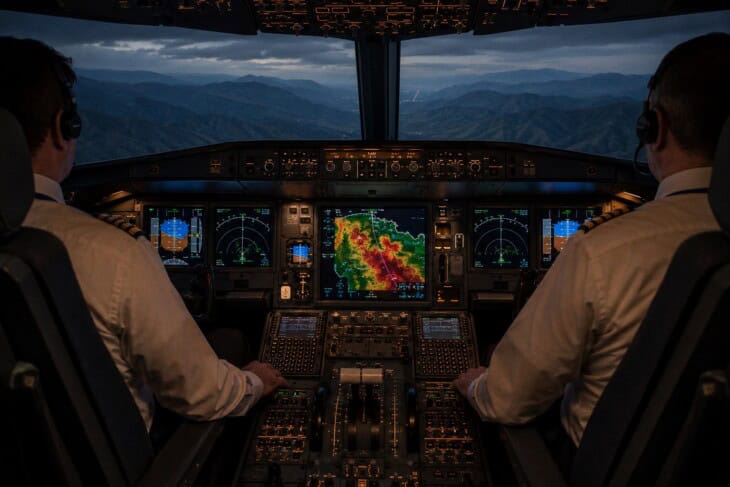
The controlled flight into terrain problem had killed more airline passengers than almost any other category of accident for decades. Crews flew fully functional aircraft into mountains, hillsides, and ocean because the terrain was invisible in darkness or cloud and the systems available to warn them were inadequate. Flight 965 was not the first CFIT accident and it was not the worst, but it came at the exact moment that a technological solution was achievable, and the regulatory response was clear enough and fast enough to deploy it widely. The TAWS-equipped cockpit that is now standard on every commercial jetliner in the world is a direct consequence of what happened over the Andes on December 20, 1995.
The accident also speaks to a second problem that aviation has not fully solved: what happens when automation becomes a primary source of confusion rather than a tool for clarity. The crew of Air France Flight 447 faced a similar dynamic: automation that behaved unexpectedly, crew members who struggled to understand their situation through the degraded data the system was showing them, and a failure to fall back to the basic flying skills and raw instruments that could have provided clarity. The crew of Colgan Air Flight 3407 showed what happens when pilots follow a system’s outputs without the situational awareness to question them. In each case the answer involves the same two things: better technology where it is achievable, and better training for when technology fails or misleads. This series continues at The Flights That Changed Aviation.
FAQ
Sources and references used for research and fact-checking.
- Aeronáutica Civil Final Report: American Airlines Flight 965 - Aeronáutica Civil de Colombia
- Boeing 757-223 Lessons Learned: N651AA - Federal Aviation Administration
- NTSB Safety Recommendations A-96-90 through A-96-106 - National Transportation Safety Board
- Federal Register: Terrain Awareness and Warning System Final Rule (65 FR 16736) - Federal Aviation Administration
- Terrain Awareness and Warning System - Wikipedia
- American Airlines Flight 965 - Wikipedia
- SE001: Terrain Awareness Warning System (TAWS) Final Report - SKYbrary / Flight Safety Foundation
Get the Newsletter
The latest aviation news and stories sent to your inbox.
About the Author

Tim is the owner and lead editor of AeroCorner since 2019, overseeing aviation content covering aircraft, airlines, airports, and the broader aviation industry. Through years of researching, writing, editing, and publishing aviation-focused content, he has developed extensive practical knowledge of commercial aviation and air travel. Based in Asia and a frequent traveler himself, Tim also brings firsthand passenger experience to AeroCorner’s coverage. Outside of publishing, he has also explored aviation firsthand through hands-on flight training in New Zealand.