Fighter Jets
Supersonic carrier fighter, the "Last of the Gunfighters"
Updated: by Tim de Vries
The latest aviation news and stories sent to your inbox.
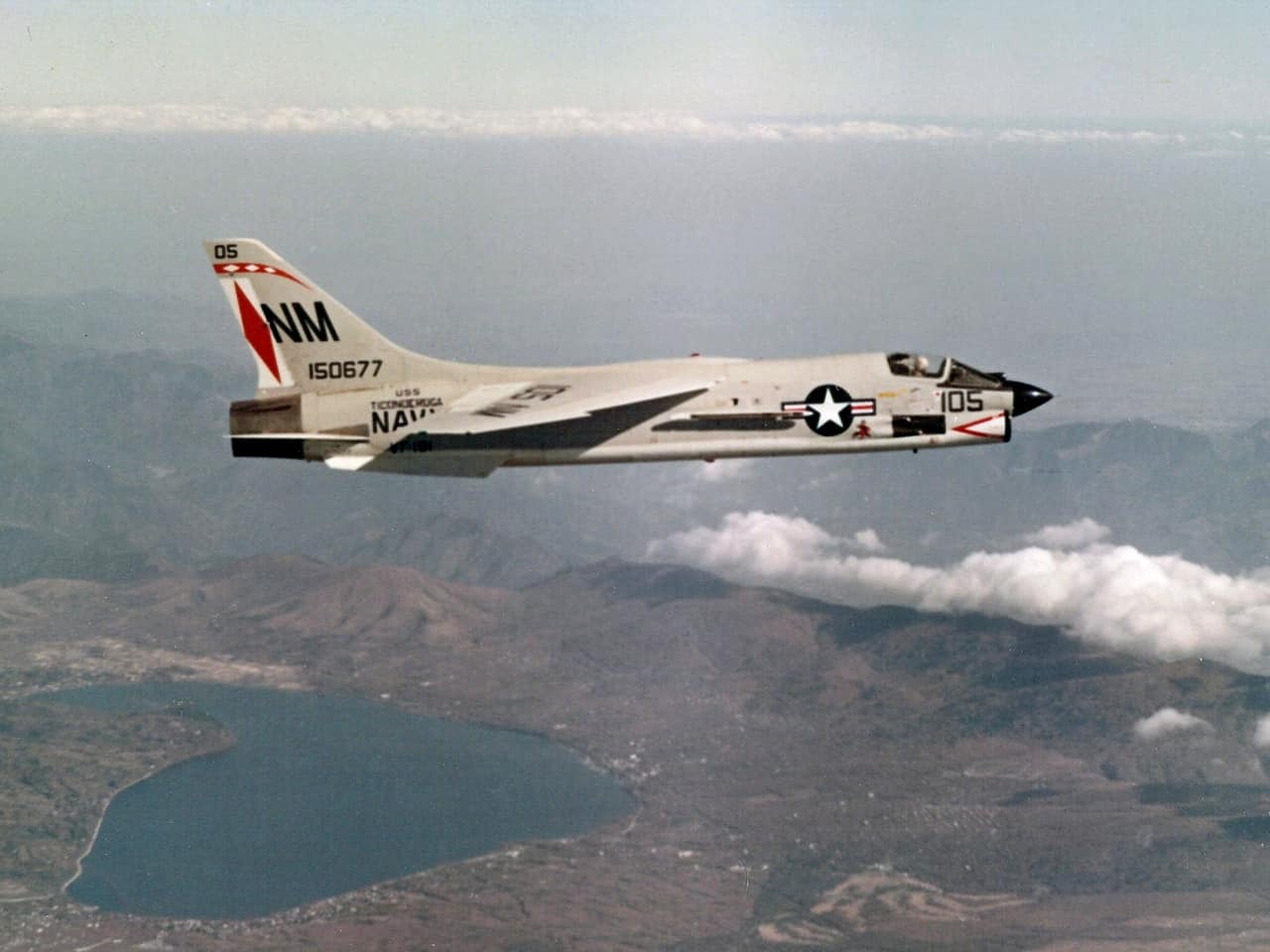
The Vought F-8 Crusader is a single-engine, supersonic, carrier-based fighter that entered U.S. Navy service in 1957 as the first carrier aircraft to exceed 1,000 mph. Called the “Last of the Gunfighters” for its four 20 mm cannon, it flew the low-level photo runs that exposed Soviet missiles in Cuba, and its pilots claimed 19 kills for three losses in air combat over Vietnam. France flew the last Crusaders in military service until December 1999.
Live Fleet Activity (F8)
Fetching live data…


The Crusader began with a U.S. Navy requirement issued in September 1952. It asked for a carrier fighter that could reach Mach 1.2 at 30,000 feet and climb at 25,000 feet per minute, yet land at no more than 100 mph (160 km/h).
The Navy also wanted 20 mm cannon. Korea had shown that .50 caliber machine guns were no longer enough to bring down a jet.
Vought’s V-383 design, led by John Russell Clark, beat the Grumman F-11 Tiger, a McDonnell F3H Demon development, and a navalized F-100 Super Sabre in May 1953. The Navy ordered three XF8U-1 prototypes a month later.
The first prototype flew on 25 March 1955 with John Konrad at the controls, and it went supersonic on that first flight. Development went so smoothly that the second prototype and the first production F8U-1 both made their first flights on the same day, 30 September 1955.
On 21 August 1956, Commander R.W. “Duke” Windsor flew an F8U-1 to 1,015.428 mph (1,634 km/h) over a 15 km course. The U.S. national speed record won the Navy its first Thompson Trophy, and it made the Crusader the first carrier-based aircraft to exceed 1,000 mph, which earned Vought and the Navy the Collier Trophy.
It was not a world record. Britain’s Fairey Delta 2 had already flown 1,132 mph (1,822 km/h) that March.
The first Crusaders reached the Navy’s VX-3 test squadron in December 1956, and the type entered regular service in March 1957. VF-32 at NAS Cecil Field, Florida, was the first fleet squadron, and it took its jets to the Mediterranean aboard USS Saratoga late that year.
The aircraft was ordered as the F8U. In 1962 the unified Tri-Service designation system renamed it the F-8, and the original F8U-1 became the F-8A.
The Crusader’s signature feature is its variable-incidence wing. For takeoff and landing, an internal piston raised the entire wing by 7 degrees, pivoting it about its rear spar.
That increased the wing’s angle of attack without pitching the whole fuselage nose-up. The pilot could still see the deck over the nose, and the aircraft could approach slowly on short, light landing gear. Leading-edge flaps drooped 25 degrees and the inboard flaps dropped 30 degrees for extra lift.
It is not a swing wing. The sweep never changes, unlike on the F-14 Tomcat that later replaced Crusaders in some Navy squadrons. The whole wing simply tilts up and back down.
The rest of the airframe was just as advanced for 1955: an area-ruled fuselage, all-moving tailplanes, dog-tooth notches at the wing folds for yaw stability, and titanium wherever possible. The outer wing panels folded for stowage on the carrier.
More than one pilot took off with the wings still folded. On 23 August 1960, a Crusader left Naples in full afterburner with its outer wings up, climbed to 5,000 feet (1,500 m), and landed safely.
The F-8 carried four 20 mm Colt Mk 12 cannon with 125 rounds per gun, at a time when radar-guided missiles were becoming the standard fighter weapon. That made it the last U.S. fighter designed with guns as its primary armament, and its pilots called it the “Last of the Gunfighters.”
In combat, the nickname was more romance than record. The guns tended to jam under high g in a dogfight, and F-8 pilots scored only four of their victories with cannon.
The rest came from AIM-9 Sidewinder missiles, carried on Y-shaped pylons on the fuselage sides. The Crusader is also the only aircraft to have used the AIM-9C, a radar-guided Sidewinder the Navy shelved in 1969.
Some of the Crusader’s most important missions were flown with cameras, not guns. An unarmed photo-reconnaissance version, the F8U-1P (later RF-8A), could fly low and fast enough to bring back detail no other aircraft of the time could get.
From 23 October 1962, during the Cuban Missile Crisis, pairs of RF-8As flew twice a day from Key West across Cuba at low level. The crews came from Navy squadrons VFP-62 and VFP-63 and Marine squadron VMCJ-2.
Over about six weeks they returned some 160,000 images. The photos confirmed that the Soviet Union was setting up medium-range ballistic missiles on the island, then tracked the missiles’ withdrawal.
The photo Crusader had already made history. On 16 July 1957, Marine Major John Glenn flew an F8U-1P from Los Alamitos, California, to Floyd Bennett Field, New York, in about 3 hours and 23 minutes, the first supersonic flight across the United States.
Navy Crusaders from USS Hancock fought the first air battle with North Vietnamese MiG-17s on 3 April 1965. Over the next three years the F-8 became one of the defining fighter jets of the Vietnam War.
It was the fighter of the smaller Essex-class carriers, such as Hancock, Oriskany, and Bon Homme Richard. The bigger decks flew the F-4 Phantom II.
Crusader pilots claimed 19 aircraft in air combat: 16 MiG-17s and three MiG-21s. Official U.S. sources count three F-8s lost to MiGs, all in 1966 and all to MiG-17 cannon fire.
That 19-to-3 ratio is the best claimed by any American type in the war. The Navy’s own history command credits the F-8 with 18 kills, and North Vietnam claimed 11 Crusaders shot down by its MiGs.
The F-8E scored more of those victories than any other model, 11 by historian Joe Baugher’s count. Air combat was never the Crusader’s main risk, though: 170 F-8s were lost to all causes during the war, mostly to ground fire and accidents.
After Operation Rolling Thunder ended in November 1968, MiG encounters became rare, and the Crusader was increasingly used as a bomb truck. Marine Corps Crusaders flew from land bases in South Vietnam, mostly on close air support and interdiction.
The MiG-21 was a tougher opponent than the MiG-17, and the Crusader never made first contact with a MiG by its own radar in any engagement. F-8 pilots relied on ground controllers to find the enemy and steer them into a firing position from behind.
American surface-to-air missiles usually pushed the MiGs down low, where the F-8 was more maneuverable. On 1 August 1968, North Vietnamese ace Nguyen Hong Nhi fired two missiles at a pair of F-8s and claimed one shot down. He was then downed himself by a Sidewinder fired by Lt. McCoy of VF-51, flying an F-8H.
The Crusader was fast, but it was not forgiving. It recovered poorly from high sink rates on approach, its castering nosewheel made it hard to steer on deck, and carriers had to steam at full speed to offset its high landing speed.
Pilots called it the “Ensign Eliminator,” and deck crews called it “the Gator” because its intake and nozzle sat so low to the ground. Its mishap rate was high compared with the A-4 Skyhawk and the F-4 Phantom II.
Of the 1,261 Crusaders built, 1,106 had been involved in a mishap by the time the type left the fleet. The more powerful J57-P-420 engine fitted later improved the margins.
Five fighter models were built new. The F-8A was the first production version; the F-8B added a limited all-weather radar; and the F-8C brought a stronger engine, ventral fins for yaw stability, and pylons for four Sidewinders.
The F-8D was an all-weather model with the 18,000 pound-force J57-P-20. The F-8E, first flown in June 1961, was the final U.S. production version, with a bigger APQ-94 radar and 286 built.
The F-8E was also the first Crusader with real ground-attack capability. All but the first few carried two underwing pylons, each able to take a 2,000 lb (907 kg) bomb, plus the electronics to fire the AGM-12 Bullpup missile.
Surviving fighters were later remanufactured with new radars and other upgrades as the F-8H (from the F-8D), F-8J (from the F-8E), F-8K (from the F-8C), and F-8L (from the F-8B). A total of 73 photo-reconnaissance RF-8As were rebuilt as RF-8Gs.
Only one two-seat TF-8A trainer was built new. The Crusader design was also developed into the LTV A-7 Corsair II attack jet.
France needed a fighter for its new carriers Clemenceau and Foch, and the F-4 Phantom was too large for their decks. After deck trials by two U.S. Navy F-8s aboard Clemenceau in March 1962, the French Navy ordered 42 F-8E(FN)s, the last Crusaders ever built.
The French jets got blown flaps, leading-edge slats, and a larger tail so they could land roughly 15 knots slower on the smaller decks. Deliveries ran from October 1964 to February 1965.
They carried French Matra R.530 missiles and later the R.550 Magic, escorted Super Étendard strike aircraft over Lebanon in 1983, and flew missions over the former Yugoslavia from 1993 until June 1999. When the Rafale was delayed, 17 were rebuilt as F-8Ps from 1993 to keep flying for another decade.
France retired them in December 1999 and replaced them with the Dassault Rafale M. They were the last Crusaders in military service anywhere.
The Philippine Air Force bought 35 stored U.S. Navy F-8Hs in late 1977 and had 25 of them refurbished by Vought. They intercepted Soviet bombers and escorted presidential flights until a lack of spares grounded them in 1988, and the 1991 Mount Pinatubo eruption ended their service for good.
The last active-duty Navy Crusader fighters retired in 1976 with VF-191 and VF-194 aboard USS Oriskany, after almost two decades of service. Both squadrons moved to the F-4J Phantom II.
Many other Navy and Marine Crusader squadrons had already traded their F-8s for F-4s between 1964 and 1971. A few, including VF-24 and VF-211, went straight to the F-14A Tomcat in 1975.
The photo Crusader lasted longest. VFP-63 flew RF-8Gs on active duty until 1982, and the Naval Reserve’s VFP-206 kept them until the squadron was disestablished on 29 March 1987.
Its RF-8G BuNo 146860, the last operational Crusader in the U.S. Navy, flew to the Smithsonian the next day. It had logged 7,475 flight hours, more than any other F-8, and is on display at the Udvar-Hazy Center in Virginia.
NASA also kept modified F-8s busy in the early 1970s. One proved digital fly-by-wire flight controls using hardware adapted from the Apollo Guidance Computer, and another tested the supercritical wing.
No Crusader is known to have flown since France retired its last F-8Ps in December 1999. A civilian Crusader, N19TB, a mostly F-8C airframe flown by Thunderbird Aviation of Phoenix for weapons testing and airshows, made its last airshow flight at Luke Air Force Base in April 1998.
In November 2024, the Vietnam War Flight Museum in Houston launched a campaign to bring former French Crusader No. 34 (BuNo 151765) to the United States and restore it as an airworthy exhibit. We found no report of it flying as of September 2026.
The surviving Crusaders are museum pieces, including the last Navy RF-8G at the Smithsonian and an F-8A at the National Naval Aviation Museum. For the Navy fighters that followed, see our ranking of the best carrier-based fighter jets.
The full specification table for the F-8 is on this page, and it describes the F-8E. A few of the figures need context.
The speed row is the Crusader’s top speed: 1,066 kt (1,227 mph), about Mach 1.8 at 36,000 feet. Published top speeds run from Mach 1.72 (Baugher) to Mach 1.86 (USS Midway Museum).
A normal cruise was about 495 kt (570 mph).
The 1,238 nm (1,420 mi) in the range row is Baugher’s combat range for the F-8E, flown at 560 mph and 36,000 feet. It is a distance, not a radius. How far a Crusader could fly out, fight, and come back is much shorter: published combat radius figures run from 450 miles (USS Midway Museum) to 600 miles unrefueled (Baugher).
The 18,000 pounds-force of thrust is the J57-P-20A’s afterburning rating. Without afterburner it made about 10,700 to 11,400 pounds-force depending on the source, and the first F8U-1s reached only 16,000 pounds-force in afterburner.
Published lengths differ by more than a foot. The panel uses 54 feet 6 inches (16.6 m), the figure Baugher and the Smithsonian give, while the Navy’s F-8D/F-8E flight manual lists 55 feet 11.6 inches (17.06 m); the F-8E’s bigger radar nose also made it about 3 inches longer than the F-8D.
The climb rate of 27,200 feet per minute is Baugher’s initial-climb figure for the F-8E. It comfortably beat the 25,000 feet per minute the Navy had asked for in 1952.
No Crusader is known to be flying. France retired the last military ones in December 1999, and a civilian F-8 used for testing made its last airshow flight in April 1998. A Houston museum began a campaign in 2024 to fly a former French Crusader again, but we found no report of it flying as of September 2026.
By the numbers that mattered most to fighter pilots, very good. It was the first carrier-based aircraft to exceed 1,000 mph, and over Vietnam its pilots claimed 19 kills for three losses in air combat, the best ratio claimed by any American type. Its weak point was safety: it was hard to land on a carrier and had a high mishap rate.
Official U.S. sources count three F-8s lost in air combat, all in 1966 and all to MiG-17 cannon fire; North Vietnam claimed 11. Counting every cause, mostly ground fire and accidents, 170 F-8s were lost during the war.
Most U.S. Navy and Marine Corps Crusader squadrons that stayed in business moved to the F-4 Phantom II, and a few went to the F-14A Tomcat in 1975. The French Navy replaced its Crusaders with the Dassault Rafale M at the end of 1999.
A single Pratt & Whitney J57 afterburning turbojet. The F-8E’s J57-P-20A produces 18,000 pounds-force of thrust in afterburner.
The F-8E’s top speed was about 1,066 kt (1,227 mph), roughly Mach 1.8 at 36,000 feet. In 1956 an early F8U-1 set a U.S. national speed record of 1,015.428 mph (1,634 km/h).
It was the last U.S. fighter designed with guns, four 20 mm cannon, as its primary weapon. In practice, most of its Vietnam kills came from Sidewinder missiles; only four were scored with the guns.
A total of 1,261. That is 1,219 for the U.S. Navy and Marine Corps, the last delivered on 3 September 1964, plus 42 F-8E(FN)s for the French Navy.
No. U.S. Navy fighter versions retired in 1976, the reserve RF-8G reconnaissance version in 1987, the Philippine Air Force’s in 1991, and the French Navy’s in December 1999.
Sources and references used for research and fact-checking.