Fighter Jets
Vought F8U Crusader
ICAO: F8
The subsonic Navy and Air Force attack jet that traded speed for payload, range and bombing accuracy.
Updated: by Tim de Vries
The latest aviation news and stories sent to your inbox.
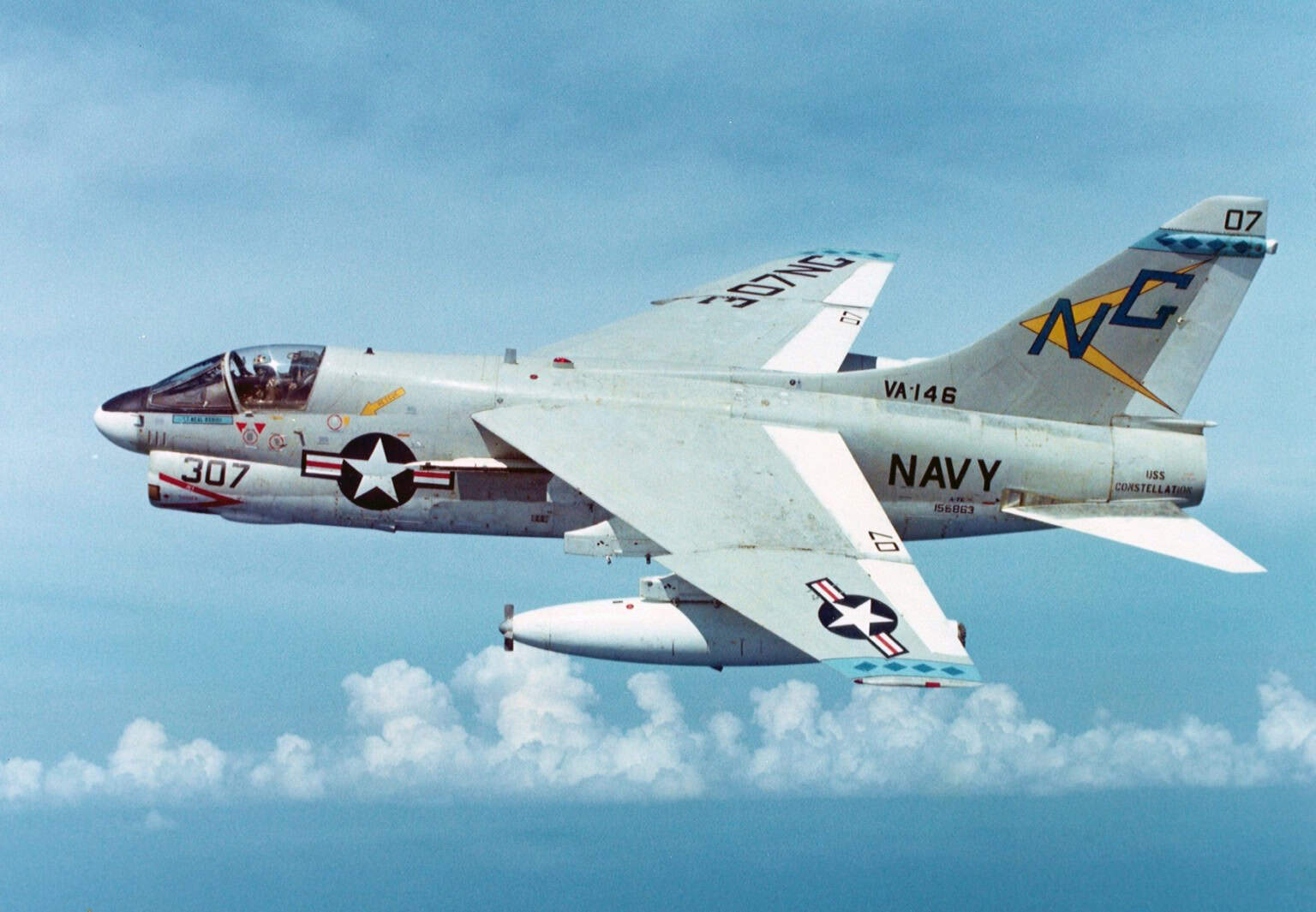
The LTV A-7 Corsair II is a single-seat, subsonic light attack jet developed from the F-8 Crusader for the U.S. Navy and later flown by the U.S. Air Force and Air National Guard. It first flew in 1965, fought from Vietnam to Desert Storm, and 1,545 were built. Greece, its last operator, retired it in 2014.


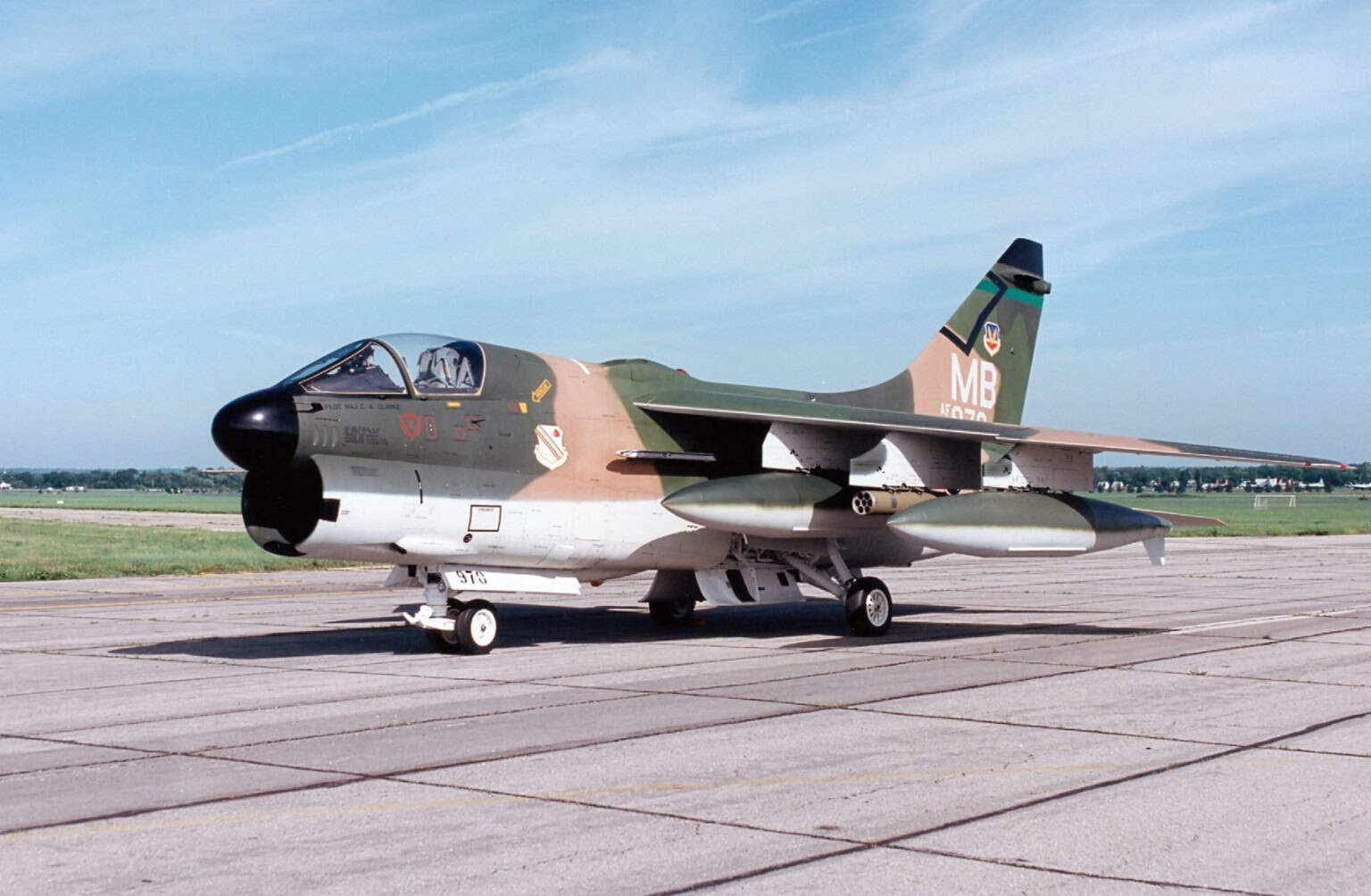


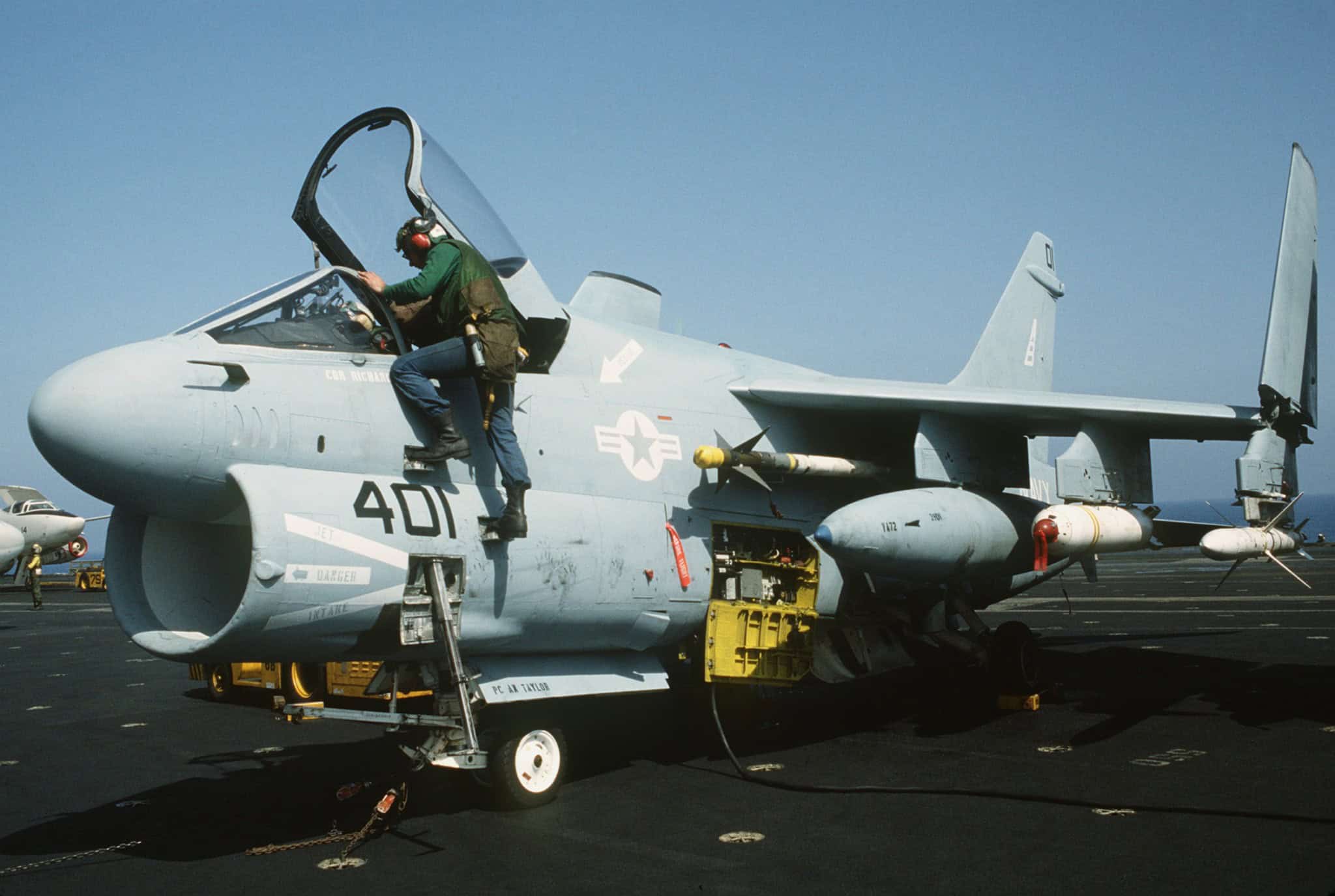


The LTV A-7 Corsair II was a single-seat, subsonic light attack jet built by Ling-Temco-Vought for the U.S. Navy, then adopted by the U.S. Air Force and the Air National Guard. It first flew in September 1965, entered Navy squadron service on February 1, 1967, and was flying combat over Vietnam by the end of that year.
It was never meant to be fast. The Navy wanted a jet that could carry far more than the A-4 Skyhawk, fly farther, and put bombs on target more accurately, and it accepted subsonic speed to get it.
A total of 1,545 were built. The type fought from Vietnam to Operation Desert Storm in 1991, and its last operator, the Hellenic Air Force, retired it in October 2014.
In the early 1960s the Navy began looking for an A-4 replacement, and some officials wanted a supersonic one. A December 1962 study group compared 144 hypothetical designs and concluded that a subsonic aircraft would do the attack job better.
Giving up supersonic speed made the airframe smaller, cheaper and quicker to build, so more could be bought for the same money. The requirement, called VAL (Heavier-than-air, Attack, Light), was issued in 1963, and to save time and cost every bid had to be based on an existing design.
Vought, Douglas, Grumman and North American responded. Vought’s entry, based on its F-8 Crusader fighter, won in February 1964, and a production contract followed on March 19, 1964.
The Corsair II name honored Vought’s earlier Corsairs, most famously the World War II F4U Corsair. According to the Naval History and Heritage Command, the new jet brought no real speed advantage over the A-4 but offered nearly double its ordnance load and more range.
The A-7 looks like a shortened Crusader, with the same gaping nose intake under the cockpit. It is a different airplane underneath: aviation historians Bill Gunston and Peter Gilchrist note that the two share no structural parts.
The A-7 has a shorter, broader fuselage and a larger wing with less sweep. It also dropped the Crusader’s variable-incidence wing and replaced the F-8’s afterburning J57 turbojet with a non-afterburning turbofan.
The wing carries six pylons, with two more fuselage stations for Sidewinder missiles. To survive ground fire, the flight-control hydraulics were triplicated, other systems duplicated, and much of the fuselage armored.
The first A-7As used a Pratt & Whitney TF30-P-6 turbofan rated at 11,350 lbf. It gave the range the Navy wanted but not enough thrust, and pilots flagged the shortfall early.
The A-7B moved to the TF30-P-8 at 12,190 lbf, and surviving B models were re-engined in 1971 with the 13,390 lbf TF30-P-408. The real fix came with the Allison TF41, a license-built version of the Rolls-Royce Spey, fitted first to the Air Force A-7D and then to the Navy’s A-7E.

The turbofan is what made the A-7 efficient. An A-7D carrying twelve 500 lb (227 kg) bombs at 480 mph (770 km/h) and 33,000 feet burned about 3,350 lb (1,520 kg) of fuel per hour.
Heat still hurt it. In the humid air over Vietnam, fully armed A-7s struggled to reach 500 mph (800 km/h), and early A-7A pilots flew long, low departures to build speed before raising the flaps.
The A-7D and A-7E carried more modern avionics than most attack jets of their day. An inertial platform, a Doppler radar, a digital navigation and weapon-delivery computer and a head-up display worked together to aim the weapons.
That let pilots bomb accurately from farther away, which improved survivability compared with faster jets such as the F-4 Phantom II. A projected map display below the radar scope showed the aircraft’s position over a moving chart.
Coupled to the autopilot, the navigation system could fly the jet hands-off through up to nine waypoints. An approach power compensator held speed automatically during carrier landings.

The Corsair II went through seven Navy production versions plus Air Force, trainer and export models. The main ones:
Attack Squadron VA-147 flew the Navy’s first A-7 combat missions over North Vietnam in December 1967. The Spey-powered A-7E followed in May 1970 and took part in the Linebacker strikes and the 1972 mining of North Vietnamese ports.
On October 6, 1972, four A-7Cs from VA-82 attacked the Thanh Hoa Bridge with Walleye guided bombs and 2,000 lb (907 kg) Mk 84s. The span was broken and the bridge was taken off the target list.
The Air Force A-7D reached Korat Royal Thai Air Force Base in 1972 and took over the “Sandy” rescue-escort mission from the A-1 Skyraider. On November 18, 1972, Maj. Colin A. Clarke flew a nine-hour rescue support mission that earned him the Air Force Cross, and his A-7D is now at the National Museum of the U.S. Air Force.
USAF A-7Ds flew 12,928 combat sorties with six losses. The Navy lost 98 A-7s during the war.
On May 15, 1975, Navy A-7Es and Air Force A-7Ds covered the recovery of the SS Mayaguez, often called the last battle of the Vietnam War. For the wider picture, see our guide to the fighter jets of the Vietnam War.
The Air Force took the A-7D largely because Defense Secretary Robert McNamara insisted, as the Army pushed for a dedicated close air support aircraft. The service soon chose its own replacement, the A-10 Thunderbolt II, and began passing A-7Ds to the Air National Guard in 1973.
By 1987 Guard units in 10 states and Puerto Rico flew the type. Guard A-7Ds from South Dakota and Ohio flew combat in the 1989 invasion of Panama, Operation Just Cause.

The A-7 also played a secret role. From 1981 to 1989, about 20 A-7Ds and two-seat A-7Ks served the unit developing the F-117 Nighthawk, as trainers, chase planes and cover.
At Tonopah, F-117s stayed inside hangars in daylight while the A-7s were left out on the ramp for Soviet satellites to photograph. They were retired in January 1989, a few months after the Air Force revealed the F-117.
Navy A-7Es flew close air support over Grenada in October 1983. On December 4, 1983, Syrian surface-to-air missiles shot down an A-7 and an A-6 Intruder over Lebanon; the A-7 pilot ejected over the sea and was rescued.
In March 1986, A-7s from USS Saratoga fired the first AGM-88 HARM anti-radiation missiles used in combat against Libyan air defenses. A month later, A-7Es from USS America suppressed missile sites during Operation El Dorado Canyon.
By Desert Storm only two Navy A-7 squadrons remained, VA-46 and VA-72 aboard USS John F. Kennedy. They struck targets across Iraq and Kuwait with Walleye glide bombs, HARMs and unguided bombs, then retired the type from the fleet in May 1991 as the F/A-18 Hornet took over.
Greece ordered 60 new A-7Hs and five TA-7H trainers in 1974, with deliveries from 1975. In 1993 it added 62 ex-Navy A-7Es and 19 TA-7Cs.
Portugal flew A-7Ps, rebuilt from ex-Navy A-7As, from 1981 to 1999, when F-16s replaced them. Thailand received ex-Navy A-7Es, which have been non-operational since 2007.

The Hellenic Air Force retired its last A-7Es in October 2014, ending front-line service for the type. No air force flies the A-7 today, and most surviving airframes are on museum display.
The full specification table for the A-7 Corsair II is on this page and reflects the Navy’s A-7E with the TF41-A-2. A few of its figures need context, because other sources quote different ones.
Thrust. The panel shows 15,000 lbf, the TF41-A-2’s intermediate rating in the Navy’s 1972 characteristics sheet. The 14,250 lbf figure seen elsewhere is the Air Force A-7D’s TF41-A-1, and the Naval History and Heritage Command also quotes it for the A-7E.
Payload. The 15,000 lb (6,804 kg) figure is total pylon capacity, not what the jet carried on a normal mission. Weapons and fuel shared the same maximum takeoff weight, so a full bomb load meant less fuel, and the Navy’s own museum gives a more typical 10,000 lb (4,536 kg).
Range. The 1,987 nautical mile (2,290 miles, 3,680 km) range is a clean jet on internal fuel at high altitude. With twelve Mk 81 bombs the Navy rated its combat radius at 432 nautical miles, and with four 300 gallon drop tanks the ferry range reached 2,485 nautical miles.
Speed and climb. The 602 knot top speed is clean at sea level, and it fell to roughly 553 to 561 knots with twelve Mk 81 bombs on the pylons, depending on altitude. A much higher climb rate quoted online comes from a museum web page that no longer exists, while the Navy’s 1972 figure is 10,320 ft/min clean at sea level.
The two Vought jets are often confused. The F-8 Crusader was a supersonic carrier fighter with an afterburning J57 turbojet and a variable-incidence wing.
The A-7 kept the Crusader’s layout but traded speed for payload, range and accuracy, and it had no afterburner at all. Despite the family resemblance, the two jets share no structural parts.
For the jets that fly from carrier decks today, see our ranking of the best carrier-based fighter jets.
As an attack aircraft, yes. It was widely regarded as a highly successful attack jet and a stable bombing platform, and USAF A-7Ds flew 12,928 combat sorties in Southeast Asia with six losses. Its weak point was thrust, especially in early models and in hot weather.
Yes. The A-7A and A-7B carried two 20 mm Colt Mk 12 cannons with 250 rounds each. The A-7D and A-7E switched to a single M61A1 Vulcan 20 mm rotary cannon, with up to 1,000 rounds in the Navy’s A-7E.
The A-7 itself was not considered hard to fly. Early pilots praised its handling and forward view, but criticized its crosswind landings, its braking on wet runways without anti-skid, and above all its lack of thrust. The World War II F4U Corsair is a different Vought aircraft.
No. The U.S. Navy and Air Force retired the A-7 in 1991, the Air National Guard in 1993, Portugal in 1999 and Greece, the last operator, in October 2014. Thailand’s A-7Es have been non-operational since 2007.
The Navy rated the A-7E at 602 knots (693 mph, 1,115 km/h) clean at sea level. With twelve bombs on the pylons it dropped to roughly 550 to 560 knots.
The best known is SLUF, which the USS Midway Museum expands as “Short Low Ugly Fellow.” The same museum lists “The Harley” and, among deck crews, “The Gator.”
In the Navy the F/A-18 Hornet replaced it from the mid-1980s. In the Air Force the A-10 replaced the active-duty A-7Ds, and F-16s later replaced the Air National Guard’s jets.
Sources and references used for research and fact-checking.