

Table of Contents
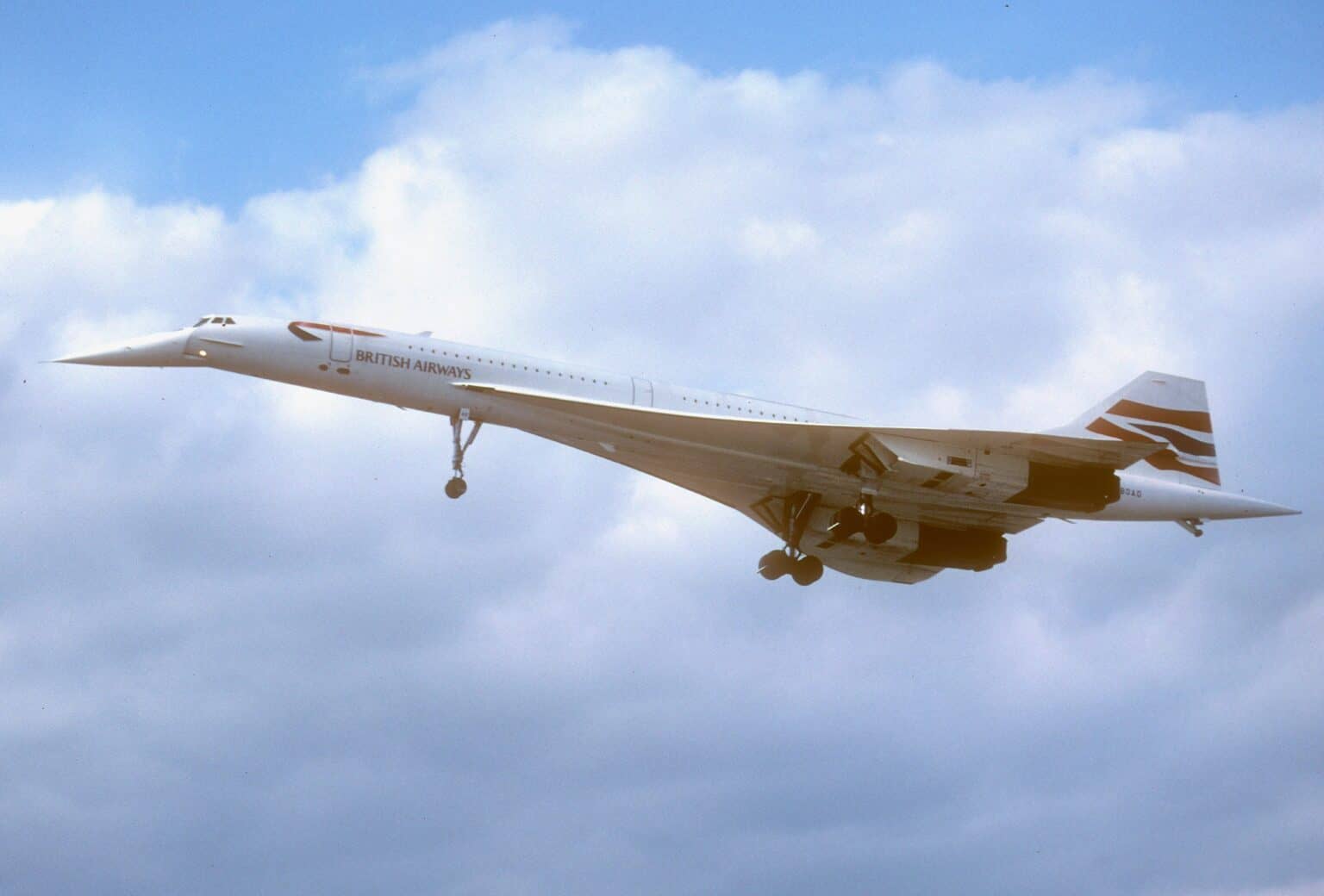
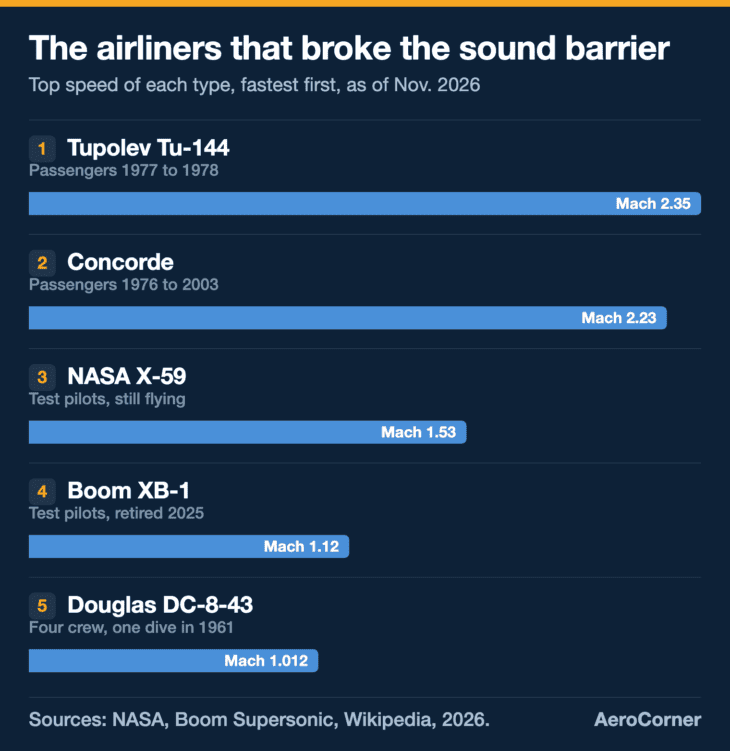
Only five aircraft built as airliners, or to develop them, have flown faster than sound on the record, and only two of them carried paying passengers. The fastest was the Soviet Tupolev Tu-144, with a published top speed of Mach 2.35, just ahead of Concorde’s Mach 2.23.
The other three flew test pilots, not passengers: a Douglas DC-8 airliner that went supersonic in a dive in 1961, Boom Supersonic’s XB-1 demonstrator in 2025, and NASA’s X-59, which is still flying as of November 2026.
This list ranks all five by top speed, then covers the supersonic airliners that were designed, ordered or announced but never flew. Military jets are a separate story with hundreds of entries, so they get one short section at the end.
| Rank | Aircraft | Top speed | First supersonic flight | Who flew in it | Status (Nov. 2026) |
|---|---|---|---|---|---|
| 1 | Tupolev Tu-144 | Mach 2.35, 1,518 mph (2,443 km/h) | June 5, 1969 | Passengers, 1977 to 1978 | Retired, museums |
| 2 | Concorde | Mach 2.23, 1,470 mph (2,370 km/h) | Oct. 1, 1969 | Passengers, 1976 to 2003 | Retired, museums |
| 3 | NASA X-59 | Mach 1.53, about 1,010 mph (1,625 km/h) | June 5, 2026 | One test pilot | Flying |
| 4 | Boom XB-1 | Mach 1.12 | Jan. 28, 2025 | One test pilot | Retired 2025 |
| 5 | Douglas DC-8-43 | Mach 1.012, 668 mph (1,075 km/h) | Aug. 21, 1961 | Four-person test crew | One dive, then airline service |
How this ranking works
To make the list, an aircraft had to be built as an airliner or to develop one, and to have a documented flight faster than Mach 1 with a person on board. Military aircraft, ex-military jets on civil registers and uncrewed vehicles are left out. The measure is top speed: the published maximum for the Tu-144S, and the fastest speed actually flown for the other four. Cruise speeds are given in each entry, because that is the number passengers experienced.
1. Tupolev Tu-144: Mach 2.35
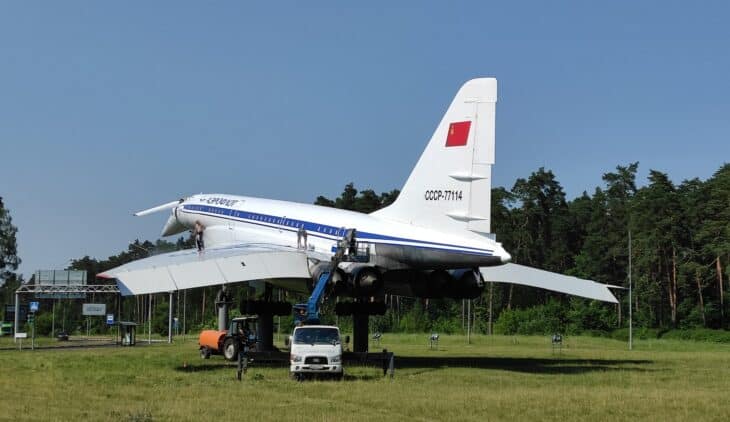

The Tupolev Tu-144 was first into the air and first to every speed milestone. The prototype flew on Dec. 31, 1968, about two months before Concorde, according to NASA.
It went supersonic on June 5, 1969, and on May 26, 1970, became the first commercial transport to pass Mach 2. The production Tu-144S is credited with a maximum speed of Mach 2.35, about 1,518 mph (2,443 km/h), using its afterburners.
NASA gives the later Tu-144D a maximum cruising speed of Mach 2.15, about 1,450 mph, at 59,000 feet. Either way it was the fastest airliner ever built.
Its passenger career was tiny. Aeroflot opened service between Moscow and Alma-Ata on Nov. 1, 1977, and the last scheduled passenger flight came on June 1, 1978.
Wikipedia’s history counts 55 passenger flights among 102 commercial ones, while NASA’s fact sheet describes all 102 as passenger flights. Our full account is in the Tu-144’s seven months of passenger service.
The jet had a second life the passengers never saw. For a NASA-led research program, Tupolev rebuilt the last Tu-144D, tail number 77114, as the Tu-144LL flying laboratory. Engines from the Tu-160 bomber gave it a maximum cruising speed above Mach 2.3.
Two Americans flew the Soviet Concorde
In September 1998, NASA research pilots Robert Rivers of Langley and Gordon Fullerton of Dryden flew the Tu-144LL from Zhukovsky to assess its handling at subsonic and supersonic speeds. The program was enabled by a 1994 agreement signed by Al Gore and Viktor Chernomyrdin.
2. Concorde: Mach 2.23
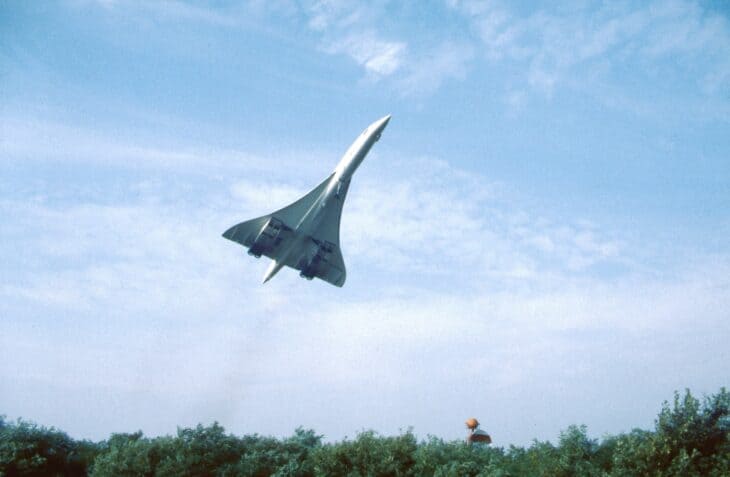

Concorde was slower on paper and far more successful in practice. Its fastest flight came on March 26, 1974, when a test aircraft reached Mach 2.23, about 1,470 mph (2,370 km/h), at 63,700 feet.
In airline service it cruised at an average of Mach 2.02, about 1,330 mph, at up to 60,000 feet (18,300 m), with 92 to 128 passengers in four-abreast seats. The prototype first flew from Toulouse on March 2, 1969, and went supersonic on Oct. 1 that year.
Air France and British Airways began service on Jan. 21, 1976, and flew seven aircraft each. Twenty Concordes were built in total, and the last commercial flight landed on Oct. 24, 2003.
That is 27 years against the Tu-144’s seven months, which is why Concorde is the supersonic airliner people remember. Air France Flight 4590, the crash of July 25, 2000, killed all 109 people on board and four on the ground, but it was not the main reason Concorde stopped flying.
3. NASA X-59: Mach 1.53
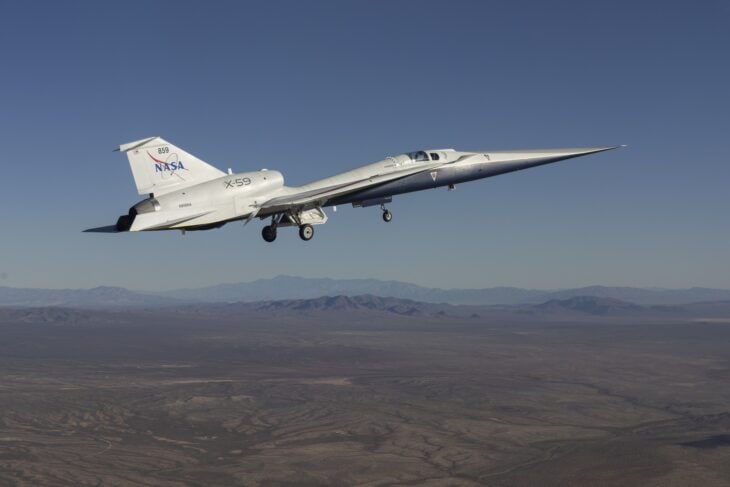

NASA’s X-59 is the only plane on this list still flying. It carries one pilot and no passengers, and its job is to prove a supersonic jet can make a quiet thump instead of a boom.
It first flew on Oct. 28, 2025, and went supersonic on June 5, 2026, reaching about Mach 1.1 (713 mph) at 43,400 feet with NASA test pilot Jim “Clue” Less at the controls. Its planned cruise for the research flights is Mach 1.4, about 925 mph, at around 55,000 feet.
Its fastest flight so far came in the week of Sept. 21, 2026, at Mach 1.53, about 1,010 mph (1,625 km/h). By NASA’s Oct. 28 update it had made 40 more flights since the first and climbed above 56,000 feet.
The phase that measures the thump on the ground was still ahead as of NASA’s latest updates. The cockpit is unusual too: as we covered in the X-59’s trip to Florida, it has no front window.
Same day, 57 years apart
The X-59 first went supersonic on June 5, 2026. The Tu-144, the first airliner built to cruise faster than sound, went supersonic for the first time on June 5, 1969.
4. Boom XB-1: Mach 1.12
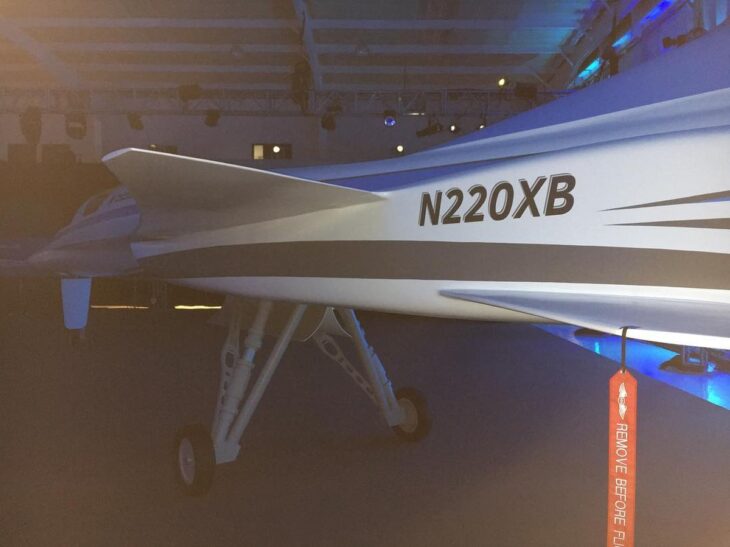
The XB-1 was Boom Supersonic’s demonstrator for its planned Overture airliner, powered by three General Electric J85-15 turbojets. Test pilot Bill Shoemaker made its first flight from the Mojave Air and Space Port on March 22, 2024.
On Jan. 28, 2025, with Tristan Brandenburg flying, it broke the sound barrier three times on one flight, which Wikipedia describes as the first supersonic flight by a privately developed jet. Boom says it reached a top speed of Mach 1.12.
Boom also says microphones on the ground heard no boom, because the shock waves bent upward in the atmosphere before reaching the surface, an effect called Mach cutoff. After a second supersonic flight on Feb. 10, 2025, the test program ended and the XB-1 was retired.
5. Douglas DC-8-43: Mach 1.012
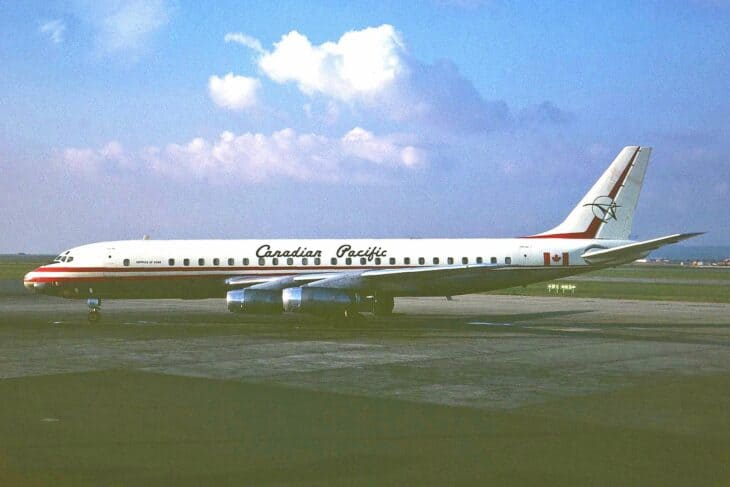

The first airliner to break the sound barrier was not Concorde or the Tu-144. It was a Douglas DC-8, eight years before either of them went supersonic.
On Aug. 21, 1961, a DC-8-43 registered CF-CPG, built for Canadian Pacific Air Lines, dived through 41,088 feet (12,524 m) and held Mach 1.012, about 668 mph (1,075 km/h), for 16 seconds. The purpose was to collect data on a new wing leading-edge design.
The crew was Captain William Magruder, First Officer Paul Patten, Flight Engineer Joseph Tomich and Flight Test Engineer Richard Edwards. The jet was then delivered to Canadian Pacific and went into ordinary service as one of 556 DC-8s built.
One of its chase planes was a Lockheed F-104 Starfighter flown by Chuck Yeager. Fourteen years earlier, on Oct. 14, 1947, Yeager had flown the Bell X-1 to Mach 1.06, about 700 mph, the first time a pilot went faster than sound in level flight. That X-1, Glamorous Glennis, now hangs in the Smithsonian’s National Air and Space Museum.
Concorde was not the first, the fastest or the only supersonic airliner
The usual story makes Concorde all three. A Douglas DC-8 went supersonic first, in 1961. The Tu-144 flew first, broke Mach 2 first and had the higher top speed. What Concorde can claim is the only record that matters to passengers: it was the only supersonic airliner that lasted, with 27 years of service.
The Supersonic Airliners That Never Flew
For every supersonic plane that flew, several were drawn, funded or sold on paper and then abandoned. These are the main ones.
| Design | Seats | Design speed | What happened |
|---|---|---|---|
| Boeing 2707 | About 300 | Near Mach 3 | US funding cut by Congress in March 1971; never flew |
| Lockheed L-2000 | N/A | N/A | Lost the US SST contest to the 2707; never flew |
| Tupolev Tu-244 and Sukhoi-Gulfstream S-21 | N/A | N/A | Proposed, never built |
| Aerion AS2 | 12 | Mach 1.4 | Aerion shut down in May 2021 |
| Exosonic | 70 | Mach 1.8 | Company announced closure in November 2024 |
| Spike S-512 | 22 | Mach 1.6 | Still listed as in development |
| Boom Overture | 60 to 80 | Mach 1.7 | In development; 130 orders and pre-orders |
The Boeing 2707 came closest to being America’s Concorde. It was a swing-wing design for about 300 passengers at nearly Mach 3, and it died when Congress dropped US supersonic transport funding in March 1971.
The Boom Overture is the live candidate. Boom lists it at Mach 1.7 over water with 60 to 80 seats and a range of 4,250 nautical miles, and counts 130 orders and pre-orders from United, American and Japan Airlines.
It has not flown, and its schedule is slipping. United CEO Scott Kirby said on a podcast published Oct. 28, 2026, that Boom will miss its 2029 service target: “It’s not going to happen in ’29. It’s going to take longer.”
Boom finished its first prototype turbine core, called Sprint Core, on Oct. 22, 2026, AeroTime reported. That core is shared with an industrial turbine Boom is now building for data centers, not only with the Overture’s Symphony engine.
Why No Airliner Flies Supersonic Today
The biggest obstacle is legal as much as technical. US rule 14 CFR 91.817 says no civil aircraft may fly faster than Mach 1 in the United States without a specific authorization, a ban in place since 1973.
That limited Concorde to ocean crossings and is why the X-59 exists. On July 2, 2026, the FAA proposed replacing the speed ban with a sonic-boom standard of 0.11 pounds per square foot at ground level, but as of November 2026 it was still a proposal.
Speed is a separate question from supersonic flight. Today’s fastest airliners cruise just below the speed of sound, as our ranking of the fastest passenger planes shows.
What About Military Supersonic Planes?
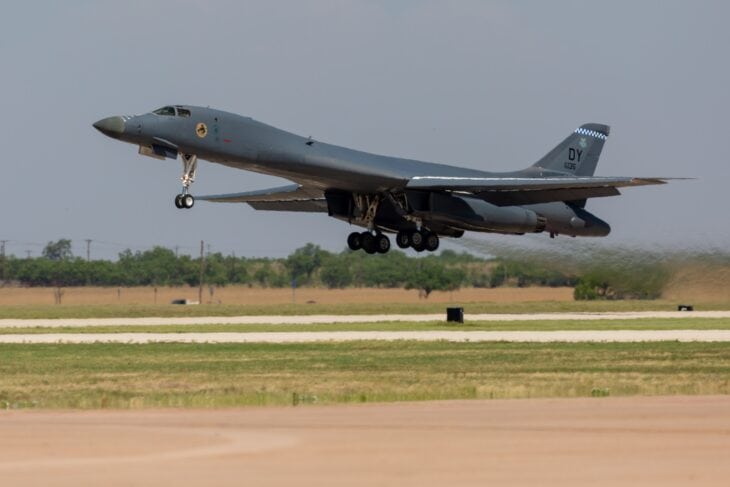

Military aviation broke the sound barrier first, with the Bell X-1 in 1947, and has flown supersonic jets ever since. A list of every military supersonic type would run to hundreds of entries, which is why this one sticks to civil aviation.
The United States also flies a supersonic bomber, the B-1B Lancer, with a top speed of Mach 1.25, about 825 mph (1,325 km/h), at altitude. For the outright speed records, military and experimental included, see our ranking of the fastest aircraft in the world.
FAQ
Sources and references used for research and fact-checking.
- NASA Dryden Flight Research Center, The Tu-144LL: A Supersonic Flying Laboratory (FS-2002-09-062 DFRC)
- Wikipedia, Tupolev Tu-144
- Wikipedia, Concorde
- NASA, NASA's X-59 Aircraft Flies Supersonic for First Time
- NASA, NASA's X-59 Completes Record Six Flights in One Week
- NASA, Quesst blog
- Boom Supersonic, Boom Supersonic Announces Boomless Cruise
- Wikipedia, Boom XB-1
- Boom Supersonic, Overture
- AeroTime, United CEO says Boom's Overture supersonic jet will miss service-entry target
- Wikipedia, Douglas DC-8
- Wikipedia, Bell X-1
- Wikipedia, Supersonic transport
- Cornell Law School Legal Information Institute, 14 CFR 91.817 Civil aircraft sonic boom
- AeroCorner, The FAA's Supersonic Overland Rule Draws Fire Over Its Sonic-Boom Metric
- Wikipedia, Rockwell B-1 Lancer
Get the Newsletter
The latest aviation news and stories sent to your inbox.
About the Author

Tim is the owner and lead editor of AeroCorner since 2019, overseeing aviation content covering aircraft, airlines, airports, and the broader aviation industry. Through years of researching, writing, editing, and publishing aviation-focused content, he has developed extensive practical knowledge of commercial aviation and air travel. Based in Asia and a frequent traveler himself, Tim also brings firsthand passenger experience to AeroCorner’s coverage. Outside of publishing, he has also explored aviation firsthand through hands-on flight training in New Zealand.