

Table of Contents
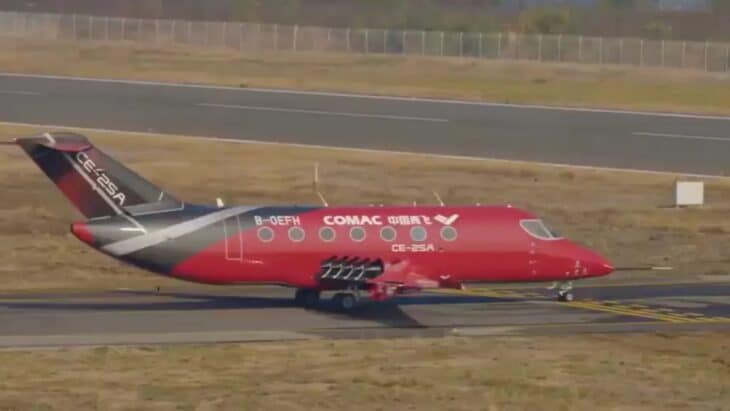
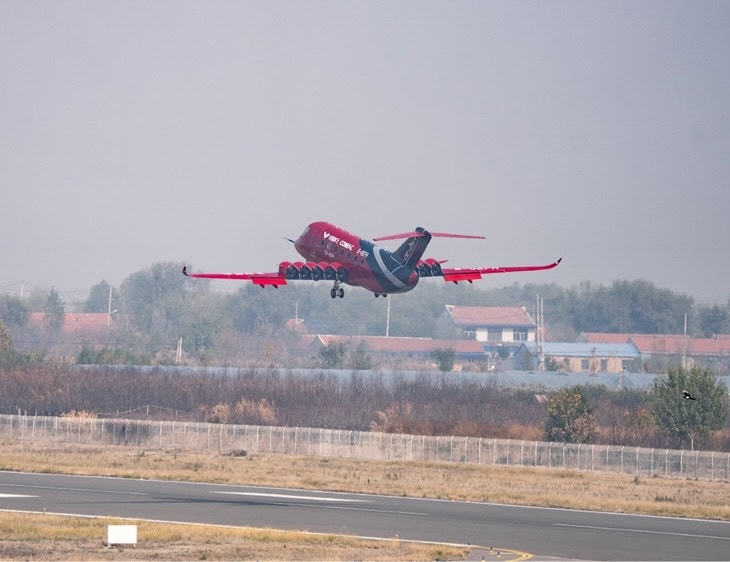
On Nov. 14, 2026, a 19-seat airliner took off from Binzhou in eastern China with two pilots and a flight test engineer aboard. COMAC’s CE-25A runs on batteries, and Chinese state media called it COMAC’s first electric commercial aircraft.
Read enough of those headlines and you could fairly assume an electric flight is something you can book. You can’t, at least not on an airline. The gap between “an electric airliner flew” and “an electric airliner carries passengers” is the whole story, and it comes down to one number about batteries.
Here is what has actually flown, what is certified, what stalled, and why the batteries keep losing to jet fuel.
Are There Electric Passenger Planes Yet?
Not in airline service. As of November 2026, no battery-electric airplane flies passengers on a scheduled airline route anywhere in the world. The largest ones, COMAC’s CE-25A and Heart Aerospace’s X1, are test aircraft.
Electric airplanes have carried passengers, but only on demonstration flights. The best known landed at New York’s JFK Airport in June 2025 with four people aboard. The electric airplanes that do hold a type certificate are two- and four-seat light aircraft built for training and sightseeing.
Electric passenger planes at a glance
Certified: two-seat and four-seat light aircraft (Pipistrel Velis Electro in Europe, 2020; Liaoning RX4E in China, 2025). Carried passengers on a demo: BETA ALIA CX300, East Hampton to JFK, June 2025. Biggest to fly: Heart X1 and COMAC CE-25A, both test aircraft in 2026. On an airline route with paying passengers: none yet.
Every Battery Passenger Plane That Has Actually Flown
Plenty of electric airliners exist as renderings and order books. This table is limited to battery-electric airplanes built to carry people that have actually left the ground, with their status as of November 2026.
| Airplane | Seats | Flew | Status, November 2026 |
|---|---|---|---|
| Pipistrel Velis Electro | 2 | Certified June 10, 2020 | EASA type certificate, day VFR trainer |
| Liaoning RX4E | 4 | Certified January 2025 | CAAC type certificate |
| Harbour Air eBeaver (DHC-2) | 6 (Beaver airframe) | First flight December 2019 | Prototype, certification pending |
| BETA ALIA CX300 | 5 passengers | Passenger demo June 3, 2025 | Seeking FAA type certificate |
| Eviation Alice | 9 passengers | One flight, Sept. 27, 2022 | Program paused since 2025 |
| COMAC CE-25A | 19 passengers | First crewed flight Nov. 14, 2026 | In flight test, type certificate applied for |
| Heart Aerospace X1 | None (demonstrator) | First flight Aug. 12, 2026 | Test aircraft for a hybrid airliner |
The pattern is hard to miss. The airplanes that made it through certification are small, and the airplanes big enough to be called airliners are still test aircraft. For the same group ranked by size, see our list of the largest electric airplanes ever flown.
The certified ones are trainers
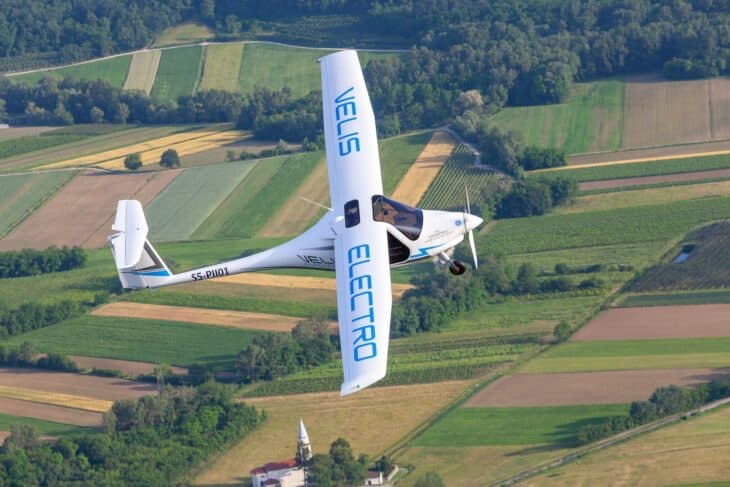
On June 10, 2020, the European Union Aviation Safety Agency certified Pipistrel’s Velis Electro, a two-seat trainer, for daytime visual flying. It flies for up to 50 minutes plus reserves, which suits a flight school doing laps of the airfield.

China’s aviation regulator certified the four-seat Liaoning RX4E in January 2025, after a five-year process, CGTN reported. Its 70 kWh battery gives a maximum flight time of 1.5 hours, and its listed uses are pilot training, sightseeing and aerial photography, not airline service.
The ones that have carried passengers
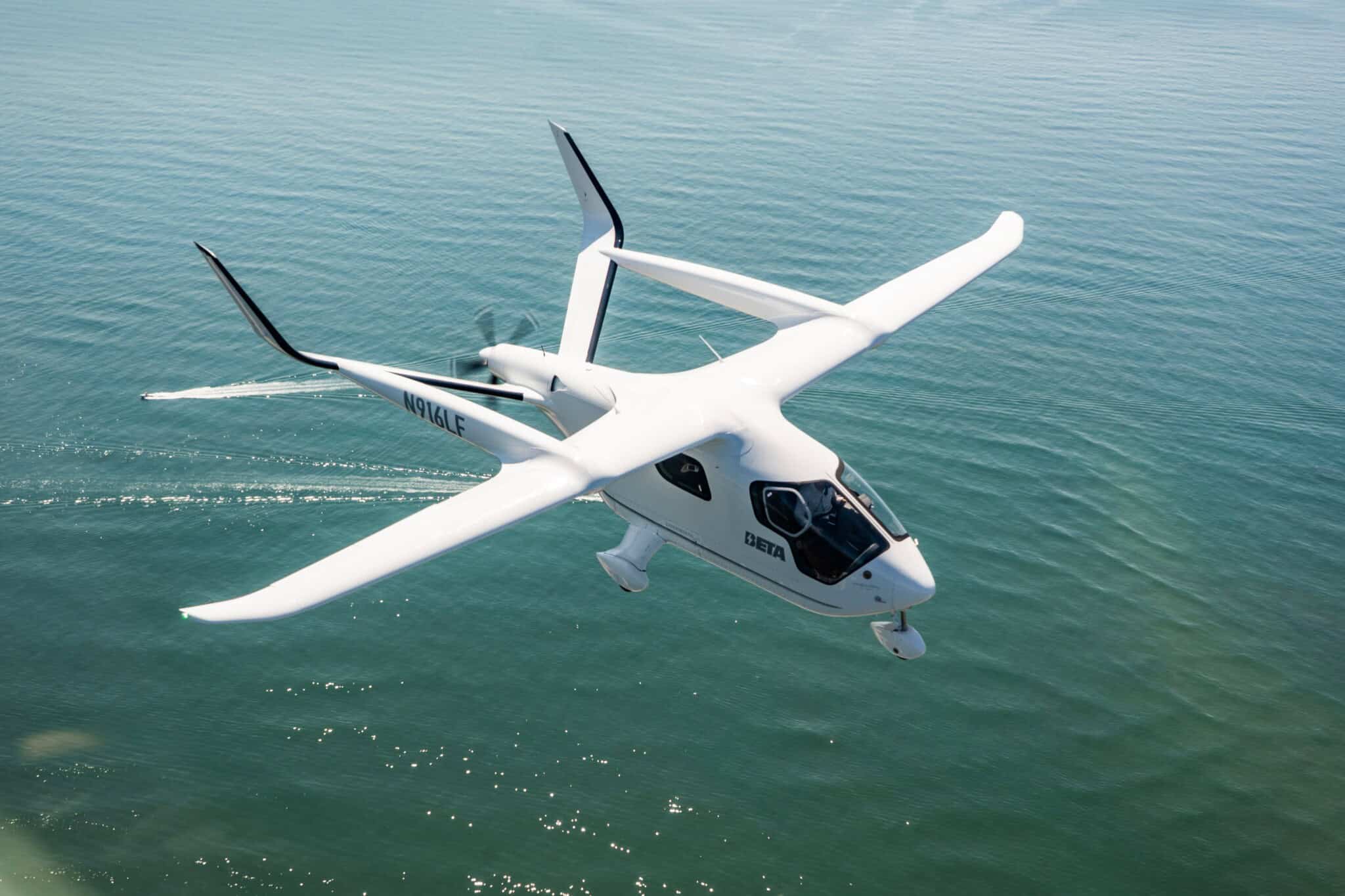
BETA Technologies’ ALIA CX300 flew from East Hampton Airport on Long Island to JFK on June 3, 2025, with a pilot and four passengers, Aviation Week reported. The flight took about 45 minutes and was billed as a passenger-carrying demonstration.
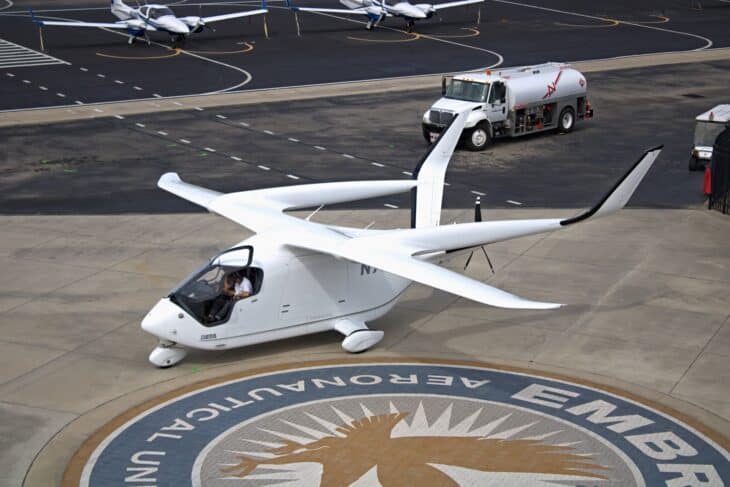

Air New Zealand then leased a CX300 for a four-month demonstrator program that ended on Feb. 17, 2026, after more than 100 flights across 12 airports and aerodromes, CAPA reported. In April 2025, BETA said it expected the CX300’s FAA type certificate by the end of 2026; the FAA had not announced one when we checked in November 2026.
The airliners are still test aircraft
The CE-25A seats 19, weighs 10 metric tons (about 22,000 pounds) at maximum takeoff weight, and is quoted at a range of about 250 miles (400 km), according to Xinhua. China’s regulator has accepted COMAC’s application for a type certificate, which starts certification but does not clear it to carry passengers. Our full story on the CE-25A’s first crewed flight covers its 10 ducted fans.
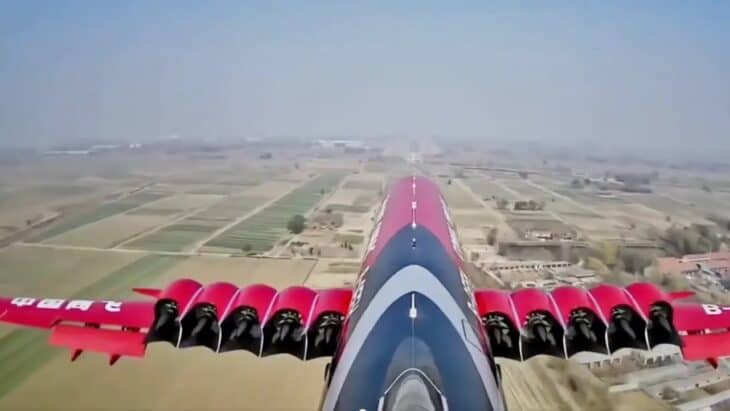
Heart Aerospace’s X1 is even heavier, at more than 25,000 pounds (11,340 kg) when it flew for 27 minutes from Plattsburgh, New York, on Aug. 12, 2026. It carries no passengers. It is a flying test bed for Heart’s ES-30, and the ES-30 will not be all-electric.
Why Batteries Keep Losing to Jet Fuel
The obstacle is energy per pound. Jet fuel stores about 12,000 watt-hours per kilogram, while today’s best lithium-ion batteries store about 250, according to the International Council on Clean Transportation (ICCT). That makes fuel nearly 50 times more energy-dense by weight.
The ICCT calculates that a 250 Wh/kg battery pack is enough to fly 9 passengers about 87 miles (140 km), allowing for reserves.
Batteries were 60% of Alice's weight
Eviation’s nine-passenger Alice carried about 8,200 pounds (3,700 kg) of batteries, roughly 60% of its takeoff weight. Unlike fuel, that weight never burns off: a battery airplane lands exactly as heavy as it took off.
Scale the airplane up and the requirement runs away. The ICCT worked out the battery pack each class of airliner would need to fly a typical trip on electricity alone.
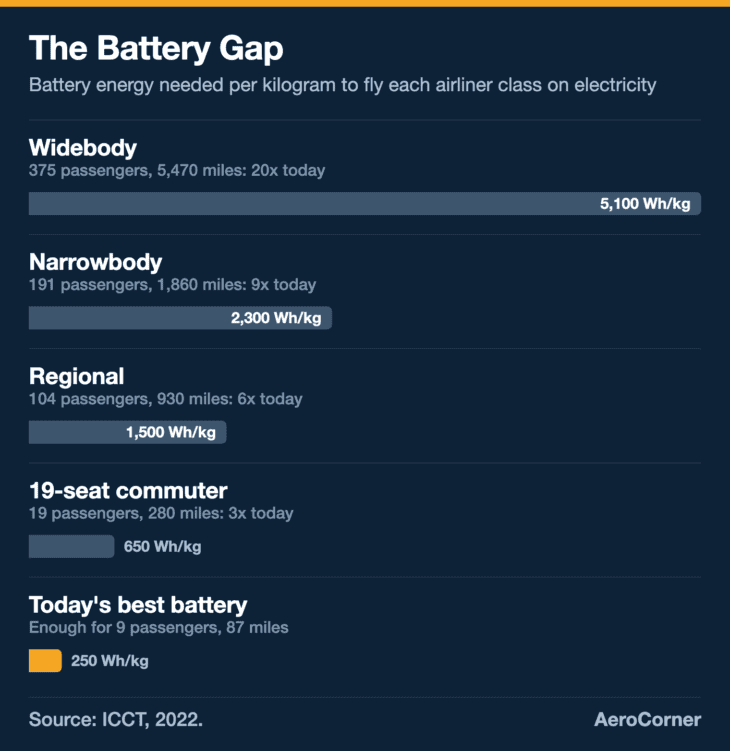
| Aircraft class | Passengers | Trip length | Battery pack needed | vs today’s 250 Wh/kg |
|---|---|---|---|---|
| Commuter | 19 | 280 miles (450 km) | 650 Wh/kg | 3 times better |
| Regional | 104 | 930 miles (1,500 km) | 1,500 Wh/kg | 6 times better |
| Narrowbody | 191 | 1,860 miles (3,000 km) | 2,300 Wh/kg | 9 times better |
| Widebody | 375 | 5,470 miles (8,800 km) | 5,100 Wh/kg | 20 times better |
Even the smallest airliner class needs a battery three times better than the best available. The ICCT adds that lithium-ion and solid-state packs may never exceed 400 to 500 Wh/kg because of the limits of their chemistry, which would rule out anything bigger than a commuter plane without a new kind of battery.
That is why the CE-25A’s numbers matter. When COMAC unveiled it in Shanghai in November 2023, it published a range target of 250 to 310 miles (400 to 500 km), TWZ reported. The figure released with the first crewed flight sits at the bottom of that band.
Why the Big Electric Airliners Stalled or Turned Hybrid
Eviation’s Alice was the best-known all-electric commuter of the early 2020s. Cape Air was its first airline customer and DHL ordered 12 cargo versions. Alice flew once, for about eight minutes on Sept. 27, 2022, and never again.
After that flight, Eviation cut the airplane’s promised range from 440 nautical miles to 250. In February 2025 it laid off most of its staff, and the program has been on indefinite pause since.
Heart Aerospace drew a different conclusion. Its production design, the 30-seat ES-30, will be a hybrid-electric airliner with fuel-burning generators on board. Heart is building a pre-production airplane in Los Angeles, plans flight testing in 2028, and targets service entry in 2031.
The myth: an all-electric airliner is just around the corner
Service dates for electric airliners keep slipping. The nine-seat Alice flew once and stopped. Heart switched its production airliner to a hybrid. The CE-25A’s range shrank between its 2023 reveal and its first crew. The aircraft closest to airline service in 2026 are five- and six-seat airplanes, not 19- or 30-seaters.
Certification is the other wall. Harbour Air’s electric Beaver seaplane first flew in Richmond, British Columbia, in December 2019, and Harbour Air called the day historic.
In 2023 the airline explained the delay to ch-aviation: it was certifying components in an aircraft “where no certification path exists.” Regulators required a new safety analysis for a single electric engine and a different definition of loss of power control than for a piston engine.
The target for certification slid past mid-2025. By 2024, Harbour Air expected the motor and battery to be certified by the end of 2026, and a type-certified eBeaver in commercial service by the end of 2027.
When Could You Actually Fly on One?
The first electric airplane flights you can buy a ticket for will probably be short and small. The ICCT’s own conclusion is that battery aircraft suit commuter flights of 9 to 19 passengers over less than about 124 miles (200 km).
That points to floatplane hops around Vancouver, island links like the Air New Zealand trial routes, and short commuter legs. The candidates nearest to service in late 2026 are BETA’s five-passenger CX300 and Harbour Air’s eBeaver, both still waiting on certification.
China may move fastest at 19 seats, because the CE-25A is now in crewed flight test with a type-certificate application accepted. COMAC has not published a certification or service date.
Battery air taxis are a separate category, with vertical takeoff and much shorter trips. China’s EHang EH216-S has had two certified operators since March 2025, but in June 2026 EHang said they were still running internal trial operations ahead of public ticketed flights. Our ranking of the eVTOL aircraft closest to carrying passengers tracks that race.
So the next time a headline announces an electric airliner, check two things: whether anyone aboard bought a ticket, and how far it went. In 2026 the answer to the first is still no, and the answer to the second is a few hundred miles at best.
Sources and references used for research and fact-checking.
- Xinhua, China's 10-tonne electric commercial aircraft completes maiden piloted flight
- Heart Aerospace, Heart Aerospace completes first flight of world's largest electric aircraft
- Wikipedia, Eviation Alice
- Wikipedia, Pipistrel Velis Electro
- CGTN, China's indigenous electric aircraft RX4E secures 1st type certificate
- Aviation Week, Beta Flies Passengers Into JFK In All-Electric Alia
- Wikipedia, Beta Technologies Alia
- Aerospace America, Site visit: Inside the plant where BETA's electric aircraft are being built
- CAPA - Centre for Aviation, Air New Zealand, BETA Technologies complete demonstrator programme with ALIA CX300 electric aircraft
- International Council on Clean Transportation, What to expect when expecting electric airplanes
- ch-aviation, Certification issues delay Harbour Air's eBeaver debut
- Electrek, World's first electric seaplane takes flight
- Wikipedia, de Havilland Canada DHC-2 Beaver
- HeliHub, EHang reports first quarter 2026 unaudited financial results
- TWZ, China's CE-25A Electric Commuter Airliner Demonstrator Emerges In Photos
Get the Newsletter
The latest aviation news and stories sent to your inbox.
About the Author

Tim is the owner and lead editor of AeroCorner since 2019, overseeing aviation content covering aircraft, airlines, airports, and the broader aviation industry. Through years of researching, writing, editing, and publishing aviation-focused content, he has developed extensive practical knowledge of commercial aviation and air travel. Based in Asia and a frequent traveler himself, Tim also brings firsthand passenger experience to AeroCorner’s coverage. Outside of publishing, he has also explored aviation firsthand through hands-on flight training in New Zealand.