

On August 14, 2026, Earthjustice and the Sierra Club filed comments urging the Federal Aviation Administration to drop its plan to lift the 53-year ban on civil supersonic flight over land. They are not the only critics.
Aviation acousticians have also told the agency that the figure at the center of the rule, sonic-boom overpressure, does not capture how loud or how bothersome a boom actually is.
What the FAA proposed
The FAA published its proposed rule, “Enabling Supersonic Overland Flight,” in the Federal Register on July 2, 2026. It would repeal the 1973 regulation that bars civil aircraft from flying faster than sound over the United States, a speed-based limit written into 14 CFR 91.817.
In its place the agency would set an interim noise standard. A supersonic aircraft could fly overland as long as its sonic-boom overpressure at ground level stays at or below 0.11 pounds per square foot, with operators demonstrating compliance through FAA-approved measurement or modeling.
The FAA calls this the first step of a multi-step process, with later rulemakings to cover airport-area noise and sonic-boom design standards. The effort follows Executive Order 14304, “Leading the World in Supersonic Flight,” signed on June 6, 2025, which gave the agency 180 days to repeal the overland ban.
Why the metric is contested
Overpressure measures only the peak strength of the shock wave that reaches the ground. It does not account for the boom’s frequency content, how quickly the pressure rises, or how long the signature lasts, all of which shape how a person hears it.
The concern is not new. As the International Council on Clean Transportation noted, noise experts convened by ICAO weighed roughly 70 candidate sonic-boom metrics in 2014 and set overpressure aside early. NASA researchers concluded in 2016 that overpressure alone is not adequate to describe “Mach cutoff,” the quiet-boom technique the rule is meant to unlock.
William Crossley, an aeronautics professor at Purdue University, told the agency that a “simple pressure level is not sufficient to determine how annoying” overland supersonic flights will be, FlightGlobal reported. Many acousticians favor perceived level, expressed in PLdB, which weights the sound the way the human ear responds to it.
Earthjustice and the Sierra Club raise a broader objection. They argue booms would still reach communities tens of miles on either side of a flight path, and that supersonic jets burn far more fuel per passenger than subsonic airliners. Sierra Club attorney Andrea Issod called the proposal a “reckless boom-doggle.”
What is at stake
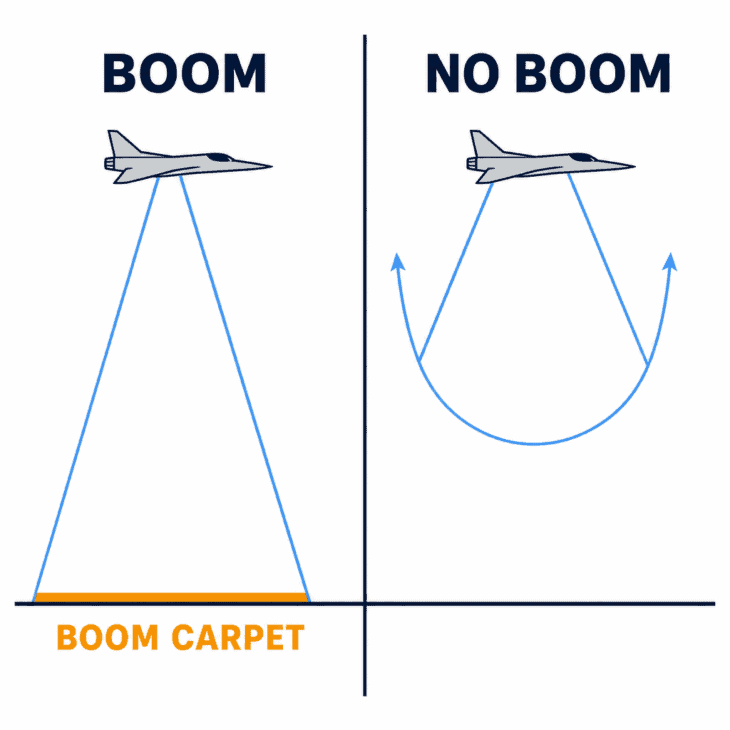
The metric matters because manufacturers are already designing to it. Boom Supersonic has built its Overture airliner around Mach cutoff, in which the right speed and altitude keep the boom from ever reaching the ground. Chief executive Blake Scholl called a supersonic revival “inevitable” after the FAA released the draft.
If the FAA finalizes overpressure now and later shifts to a perceived-loudness standard, aircraft certified under the first rule could face a moving target. The original overland ban existed for the reason critics still cite: the Concorde, retired in 2003, was loud enough over land that regulators never let it go supersonic there.
Still a proposal
The comment period closed on August 17, 2026, and the FAA has not issued a final rule. The 0.11 psf interim standard could be revised, replaced, or kept as written once the agency reviews the filings. No airline has approval to fly supersonic over the United States today.
Sources and references used for research and fact-checking.
Get the Newsletter
The latest aviation news and stories sent to your inbox.
About the Author

Tim is the owner and lead editor of AeroCorner since 2019, overseeing aviation content covering aircraft, airlines, airports, and the broader aviation industry. Through years of researching, writing, editing, and publishing aviation-focused content, he has developed extensive practical knowledge of commercial aviation and air travel. Based in Asia and a frequent traveler himself, Tim also brings firsthand passenger experience to AeroCorner’s coverage. Outside of publishing, he has also explored aviation firsthand through hands-on flight training in New Zealand.