

Table of Contents
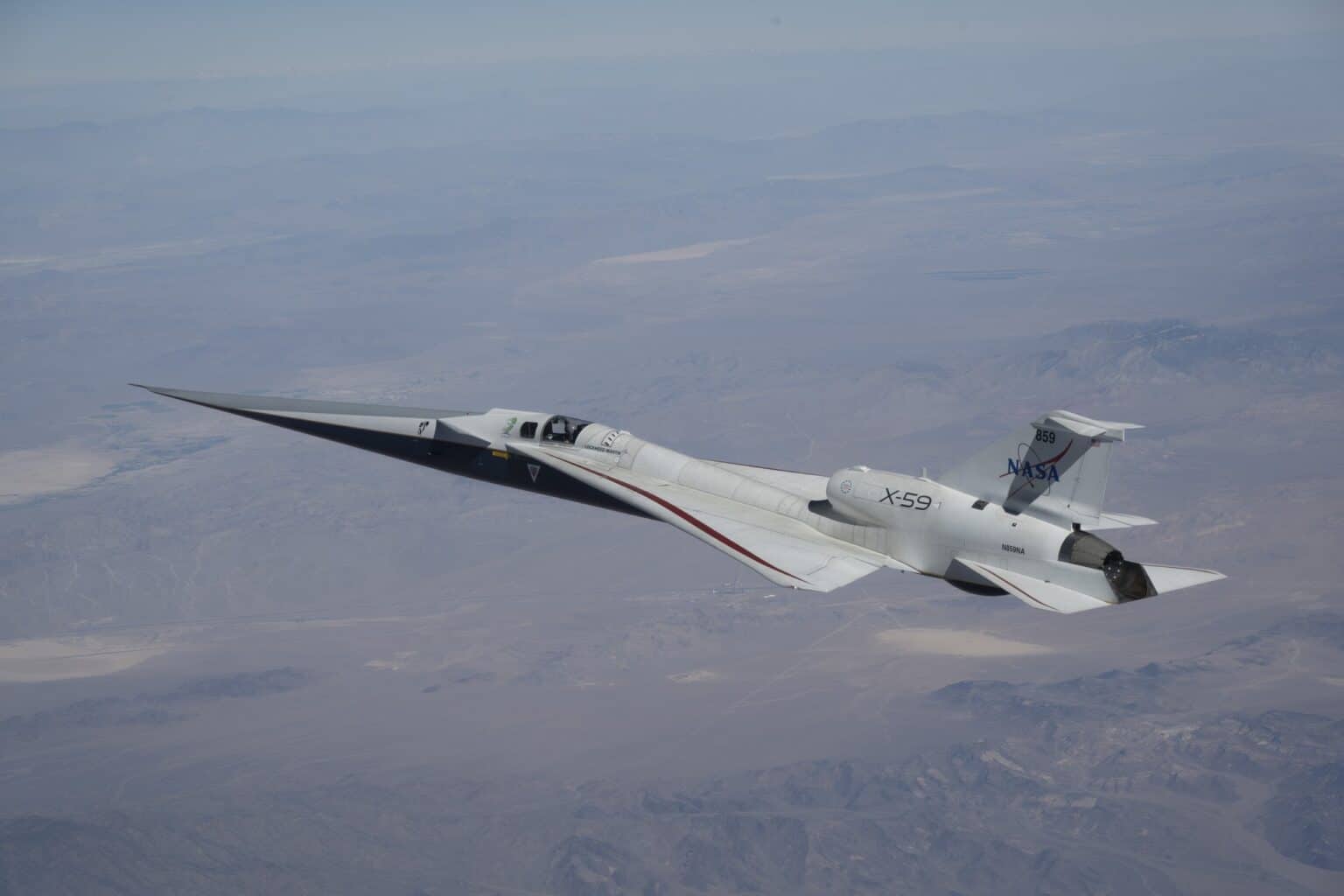
The research jet built to turn a sonic boom into a soft thump is crossing the country on its first cross-country flight, with a screen where the windshield would be.
NASA’s X-59 left Edwards Air Force Base in California on Oct. 28, 2026, one year to the day after its first flight, bound for Kennedy Space Center in Florida. It has no front window. The pilot looks ahead through cameras and a 4K monitor called the eXternal Vision System.
NASA says the jet has made 40 more flights since that first one, climbing above 56,000 feet and reaching Mach 1.53. The one thing it has not done yet is the job it was built for: the phase that measures its sound is still ahead.
The Nose That Took Away the X-59’s Windshield
The missing window is a side effect of the jet’s whole purpose. NASA says the long nose makes up about one-third of the aircraft’s nearly 100-foot length, and it is shaped to break up the shock waves that would otherwise reach the ground as a boom.
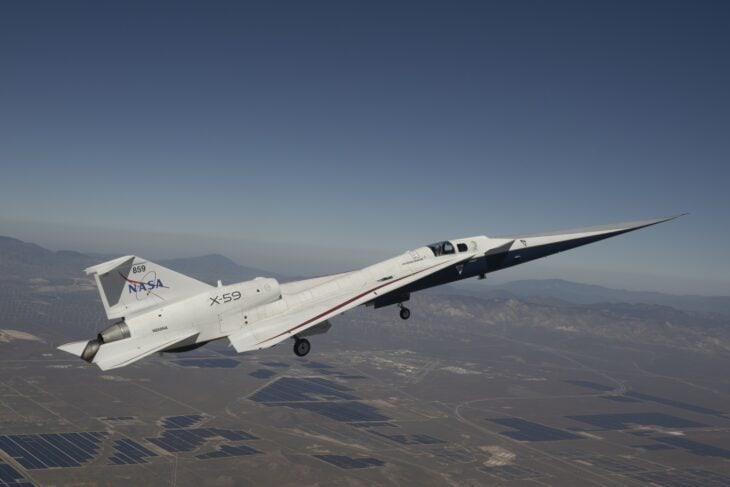

That same nose blocks the forward view, so the design has no traditional windshield, Aerospace America reported in July. The monitor shows images from two cameras, one on top of the nose and one below the fuselage.
Calling the X-59 windowless goes too far, though. It has a canopy and two small windows for backup visibility, just no traditional windshield.
Test pilot Nils Larson, who logged more than 500 hours in the simulator, told the magazine that flying it is “a lot like a video game.” NASA’s Peter Coen, the mission integration manager, went further: “The view is as good as you get with your eyeballs.”
From 230 mph to Mach 1.53 in One Year
The first flight on Oct. 28, 2025, was deliberately gentle: 67 minutes, 12,000 feet and 230 mph (370 km/h), according to AIN. The X-59 first went supersonic on June 5, 2026, reaching about Mach 1.1 at 43,400 feet.
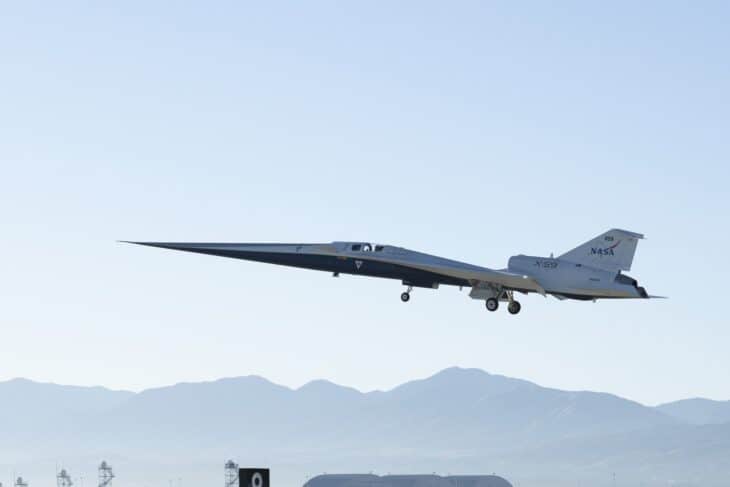

A week later, on June 12, it hit the numbers its whole mission depends on: Mach 1.4, about 924 mph (1,487 km/h), at 55,000 feet. NASA plans to fly those same conditions over US communities when it starts asking people what they heard.
In the week of Sept. 21, the jet flew six times across Sept. 22, 24 and 25, a record for a single week. One of those flights reached Mach 1.53, about 1,010 mph (1,625 km/h), still its fastest as of NASA’s Oct. 28 update.
All of that comes from a single modified F414 engine making 22,000 lbf (98 kN). It is a derivative of the F414 in the F/A-18 Super Hornet, which sits on our list of the best fighter jets in the world.
What One Leg of the Florida Trip Reveals
AIN reports that NASA test pilots Nils Larson and Jim “Clue” Less are flying the trip, with F-15 and F/A-18 chase planes alongside. Reported stops so far are El Paso and Fort Worth in Texas, then Birmingham, Alabama.
None of the reports we read gives a speed for the trip, and we found no figure from NASA. But AVweb’s timings offer a clue: the 539-nautical-mile Fort Worth to Birmingham leg ran from 9:48 a.m. to 11:03 a.m. CDT on Oct. 29.
By our math, that averages about 431 knots (496 mph). NASA’s figure of about 924 mph for Mach 1.4 puts Mach 1 near 660 mph (1,062 km/h) at 55,000 feet, so the leg was well short of supersonic on average, though an average cannot rule out a brief faster stretch.
US rules bar civil aircraft from flying faster than sound over land without a specific authorization. That is the restriction this jet exists to help rewrite.
The 75 PLdB Thump Is Still a Target
NASA designed the X-59 for a thump of about 75 PLdB, which a project official in 2021 compared to a car door closing down the street. Some coverage shortens that to 75 decibels, but PLdB is a perceived-loudness scale, so the unit matters.
In 2024, NASA’s Larry Cliatt framed it as an expectation: “as low as about 75 perceived loudness decibels,” against more than 100 for the Concorde. The formal measuring phase has not started, and The Aviationist reports that booms from the chase F-15 obscured any sound from the X-59 on its first supersonic flight.
Washington is not waiting. On July 2, 2026, the FAA proposed replacing the overland ban with a performance-based framework, and our news desk covered the fight over its 0.11 psf sonic-boom limit.
That limit is an overpressure figure, while many acousticians prefer perceived level, the scale NASA uses for the X-59’s target. Comments closed Aug. 17, and a Federal Register search in late October turned up no final rule.
The cockpit raises its own question for regulators. The FAA told Aerospace America that flight deck windows must give an “extensive, clear, and undistorted view” and that it will evaluate new designs against its safety standards, while Cranfield University’s Guy Gratton expects windowless cockpits to become serious “in 10 to 20 years.”
What Happens at Kennedy Space Center, and After
NASA Administrator Jared Isaacman confirmed the destination in a reply on X, writing that the X-59 was “making her way” to Kennedy. Birmingham was the last stop we could confirm as of Oct. 30, when Bham Now said the final leg was expected that day.
What it does in Florida is less settled. NASA’s MAX POWER expo and air show runs Nov. 7 and 8 at Kennedy, and its schedule lists an X-59 talk by Coen and Ron Fehlen of Lockheed Martin’s Skunk Works.
AIN says the jet will be on static display. Flying calls its role in the show rumored, and Aerospace Global News says NASA has not said whether it will fly or simply be parked.
The real work comes afterward. NASA said in September that a new phase later this year will evaluate the thumps, and AVweb reports it will use ground-based and airborne equipment. Then the jet is due to fly over several US communities, where residents get asked what they noticed.
That data goes to regulators. Like the X-planes before it, this jet was built to answer one question, and no camera in its nose can answer it. That part falls to the people on the ground.
Sources and references used for research and fact-checking.
- NASA Quesst blog, NASA Celebrates a Year of Progress Since First X-59 Flight
- NASA Quesst blog, NASA's X-59 Completes Record Six Flights in One Week
- NASA Quesst blog, NASA's X-59 Reaches Speed, Altitude for Future Quiet Supersonic Flights
- NASA, NASA Quesst blog
- NASA, Quesst: The Aircraft
- NASA, Quesst: The Mission
- NASA, NASA Instruments Will Listen for Supersonic X-59's Quiet 'Thump'
- NASA, Small Steps, Giant Leaps, Episode 67: Quiet Supersonic Mission
- NASA, MAX POWER expo and air show
- Federal Aviation Administration, Federal Register, Enabling Supersonic Overland Flight (Notice of Proposed Rulemaking)
- Aerospace America, Flying Blind: How NASA's X-59 Could Bolster the Windowless Cockpit
- AIN, X-59 Heads to Florida as NASA Marks One-year First-flight Anniversary
- The Aviationist, NASA's X-59 QueSST Heads to Kennedy Space Center
- AVweb, NASA X-59 Begins Cross-Country Flight to Florida
- Bham Now, Experimental Supersonic NASA Jet Lands in BHM Along Cross-Country Flight
- Flying, NASA's Supersonic X-59 Heads for Florida Vacation
- Aerospace Global News, NASA's X-59 Supersonic Jet Heads to Florida on One Year Flight Anniversary
- AIAA, NASA's X-59 Supersonic Jet Makes First Cross-Country Flight
Get the Newsletter
The latest aviation news and stories sent to your inbox.
About the Author

Tim is the owner and lead editor of AeroCorner since 2019, overseeing aviation content covering aircraft, airlines, airports, and the broader aviation industry. Through years of researching, writing, editing, and publishing aviation-focused content, he has developed extensive practical knowledge of commercial aviation and air travel. Based in Asia and a frequent traveler himself, Tim also brings firsthand passenger experience to AeroCorner’s coverage. Outside of publishing, he has also explored aviation firsthand through hands-on flight training in New Zealand.