

Table of Contents
The Romanian Air Force (Forțele Aeriene Române) fights with one jet: the F-16 Fighting Falcon. As of October 2026 it has 38 operational F-16s in three combat squadrons, all bought second-hand from Portugal and Norway.
It also owns 18 more F-16s that train NATO and Ukrainian pilots, and it has 32 F-35A stealth fighters on order. Its last Soviet-era fighter, the MiG-21 LanceR, retired in May 2023.
This guide ranks every type Romania flies by its weight in Romanian air power as of November 2026, then covers what is on order, the drones its pilots now shoot down, its bases and the NATO forces it hosts.
| Rank | Aircraft | Role | In service | Status |
|---|---|---|---|---|
| 1 | F-16AM/BM Fighting Falcon | Multirole fighter | 38 | 11 more owed by Norway |
| 2 | F-16AM/BM (training center) | Fighter pilot training | 18 | Bought from the Netherlands for €1 |
| 3 | C-130B/H Hercules | Tactical airlift | About 9 | Oldest airframes from the 1960s |
| 4 | C-27J Spartan | Tactical airlift | 7 | In service at Otopeni |
| 5 | IAR 330 Puma and SOCAT | Transport, rescue, armed helicopter | 57 | 12 H225M ordered to partly replace |
| 6 | IAR 99 Șoim | Advanced jet trainer | 21 | Upgrade under way |
| 7 | Yak-52 | Primary trainer | 14 | In service at Boboc |
| 8 | IAR 316B Alouette III | Training helicopter | 7 | In service at Boboc |
How this ranking works
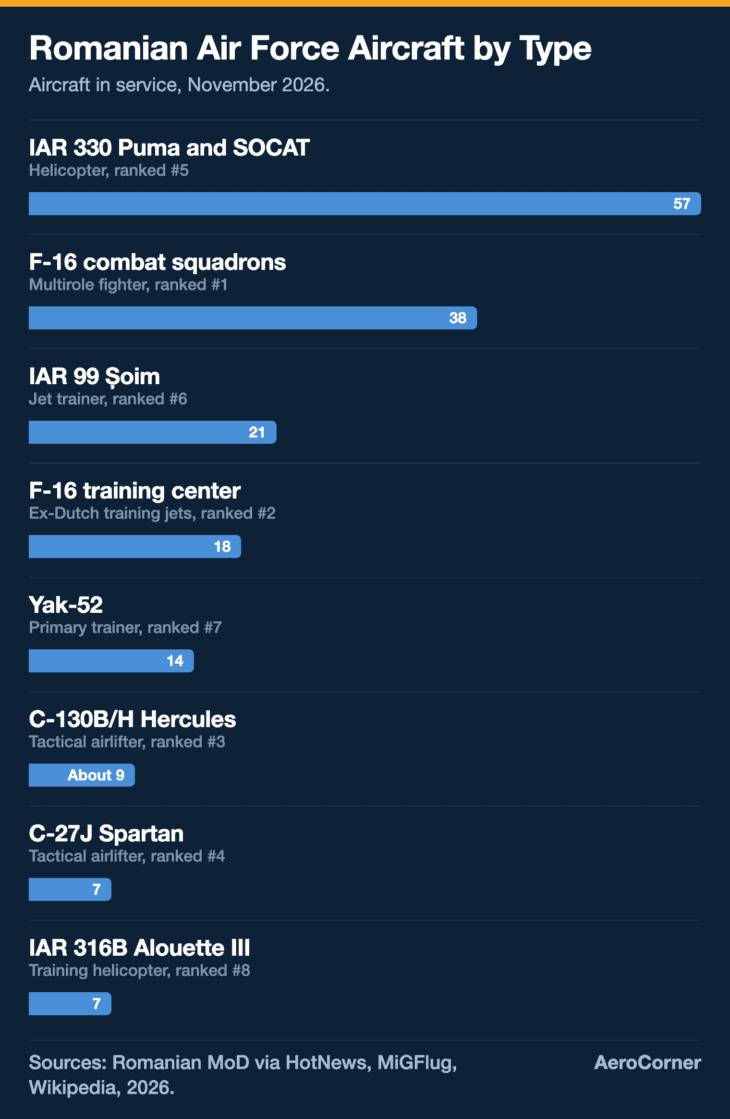
Aircraft are ranked by their weight in Romanian air power in November 2026: the combat fighters first, then the jets that train fighter pilots, then airlift, helicopters and trainers. F-16 numbers come from the Ministry of National Defence. Other counts come from the fleet tables kept by MiGFlug and Wikipedia. Types on order count only once delivered, and the US and Dutch MQ-9 drones based in Romania are left out because Romania does not own them.
1. F-16AM/BM Fighting Falcon: The Whole Fighter Force
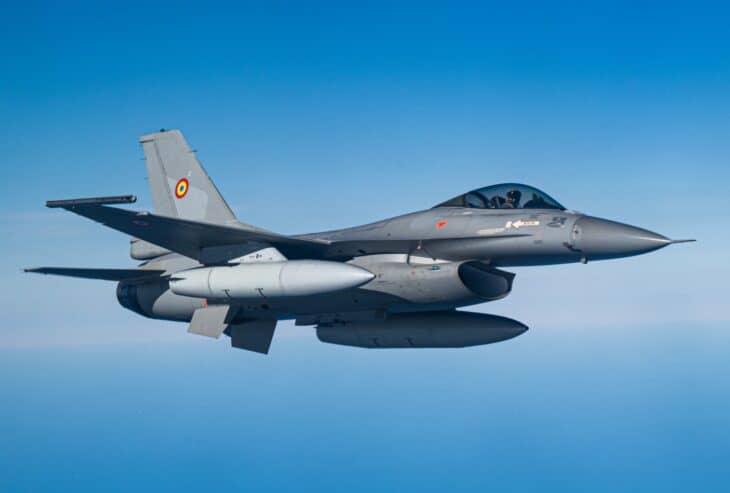

Every Romanian combat jet is an F-16. Romania bought 17 ex-Portuguese F-16AM/BMs, ordering 12 in 2013 and five more in 2019. The first six entered service in September 2016 and the last arrived by March 2021.
In November 2022 it signed for 32 more from Norway, worth €388 million. The first Norwegian jets landed at Câmpia Turzii in April 2024, upgraded to the same M6.5.2 software standard as the rest of the fleet.
Those deliveries have stalled. Norway had handed over 21 by August 28, 2025, and the last 11 were due by the end of that year. Defense Romania reported that suppliers were giving priority to spare parts for Ukraine.
As of October 27, 2026, the ministry counted 38 operational F-16s in three squadrons, at Borcea, Câmpia Turzii and Mihail Kogălniceanu. Because of the delay, Romania negotiated three extra Norwegian airframes for ground training of mechanics, the first due between late 2026 and early 2027.
Romania does not have 64 F-16s
Many fleet lists, Wikipedia included, credit Romania with 64 F-16s in service. That count assumes almost every Norwegian jet has arrived. The ministry’s own figure in October 2026 was 38 operational in the combat squadrons, plus 18 training jets at Fetești. The total reaches 67 only when the last 11 Norwegian jets are delivered.
2. F-16AM/BM Training Jets: Europe’s F-16 School
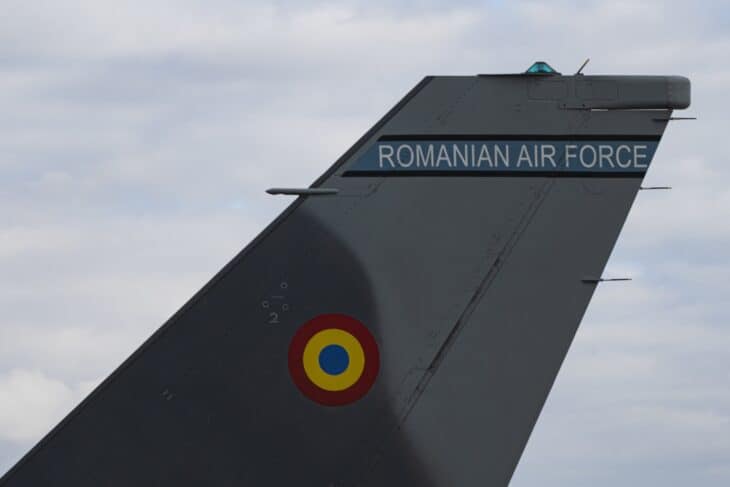

Romania hosts the European F-16 Training Centre (EFTC) at the 86th Air Base near Fetești. It opened in November 2023, when the first Dutch F-16s landed, and it trains both Romanian and Ukrainian pilots.
On November 3, 2025, the Netherlands formally transferred its 18 F-16s at the center to Romania for a symbolic price of €1. Lockheed Martin supplies the instructors and maintainers, and the first pilots graduated in July 2024.
These jets rank second because they build the pilots Romania needs, and they train pilots for the F-16s of the Ukrainian Air Force too.
3. C-130 Hercules: The Heavy Lifters
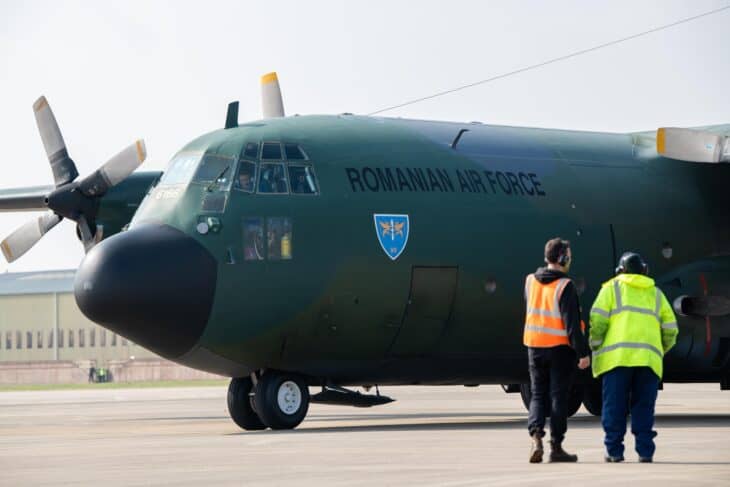

Romania’s largest transports are the C-130 Hercules, flown from the 90th Airlift Base at Otopeni, next to Bucharest’s main airport. Wikipedia lists nine, four C-130Bs and five C-130Hs, while MiGFlug counts up to eight.
The C-130B was built in the late 1950s and early 1960s, which makes those four the oldest airframes Romania flies. The fleet has been topped up with surplus C-130Hs donated by the United States, the latest in 2023.
4. C-27J Spartan: The Tactical Twin
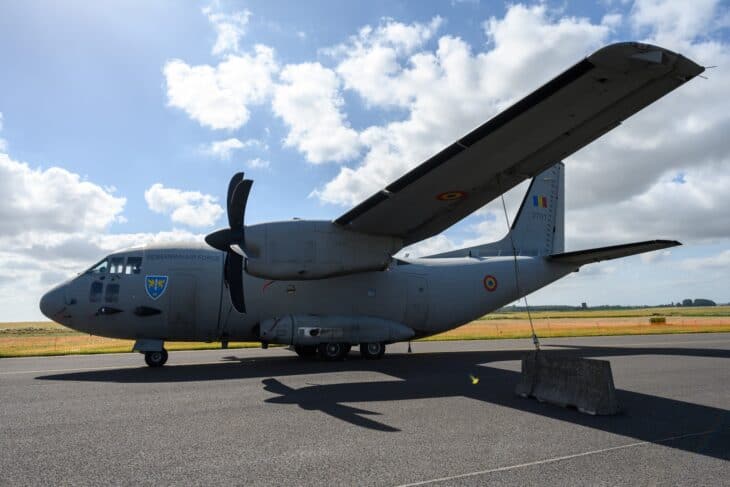

Seven Italian-built C-27J Spartans share Otopeni with the Hercules. The twin-turboprop Spartan carries smaller loads into shorter, rougher strips than the C-130 can use.
Two An-30 survey aircraft, used for Open Skies treaty flights, and one An-26 transport are the last Soviet-built airplanes left in the Air Force.
5. IAR 330 Puma and SOCAT: The Helicopter Fleet
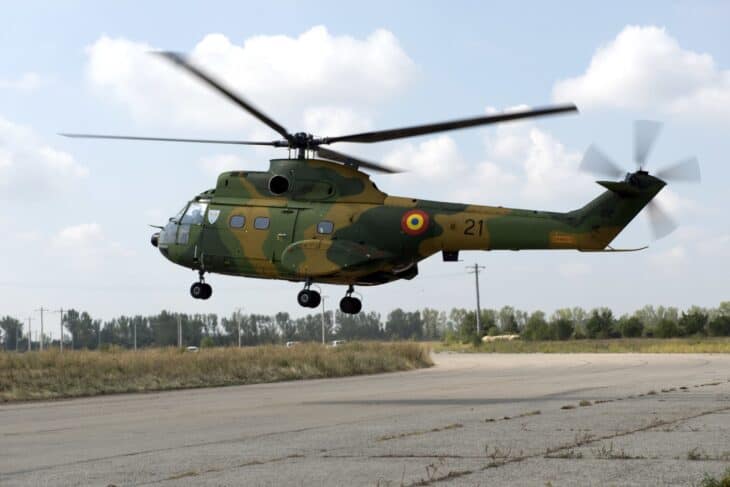

Romania’s biggest fleet by number is the IAR 330, a licence-built version of the French Puma made by IAR at Ghimbav, near Brașov. Romania has flown it since 1975 and has 57, including 22 armed SOCAT gunships.
They fly transport, search and rescue and special operations from bases across the country. On March 2, 2022, an IAR 330 searching for a crashed MiG-21 went down itself, killing all seven aboard.
Their replacement has started. In 2026 Romania signed for 12 Airbus H225M Caracal helicopters worth about €757 million, funded through the EU’s SAFE defense loans, to partly replace the Pumas in attack, reconnaissance and air assault roles.
6. IAR 99 Șoim: The Homegrown Jet Trainer
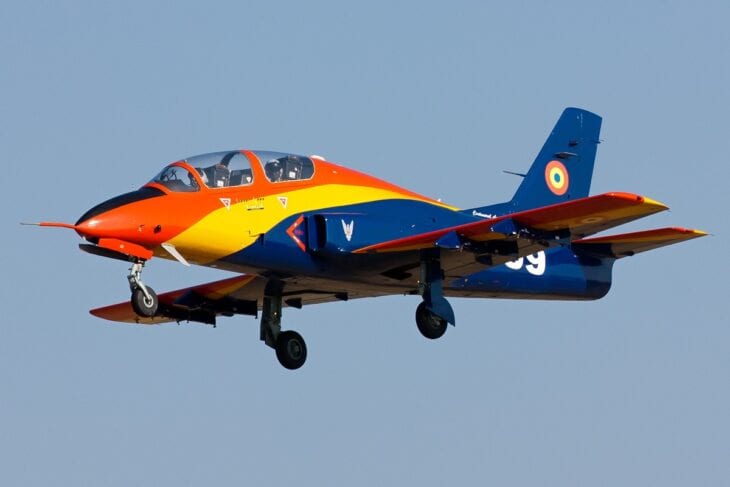

The IAR 99 Șoim (hawk) is a Romanian-designed jet trainer built by Avioane Craiova, in service since 1987. About 21 fly from the 95th Air Base at Bacău, where future F-16 pilots learn to fly jets.
An avionics upgrade with Elbit Systems has run years late. The first modernized aircraft only flew at Craiova in early 2026, and the program’s future is clouded by the manufacturer’s financial trouble.
7 and 8. Yak-52 and IAR 316B: Where Pilots Start
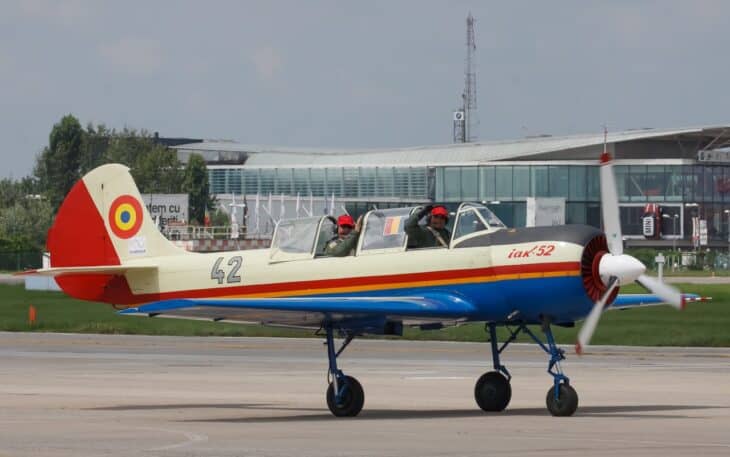

Every Romanian military pilot starts at the Aurel Vlaicu training base at Boboc. Fixed-wing students fly the Yak-52, a Soviet-designed aerobatic trainer that was built in Romania, of which 14 remain.
Helicopter students fly seven IAR 316Bs, a licence-built Alouette III that Romania has flown since 1971.
On Order: 32 F-35As and More
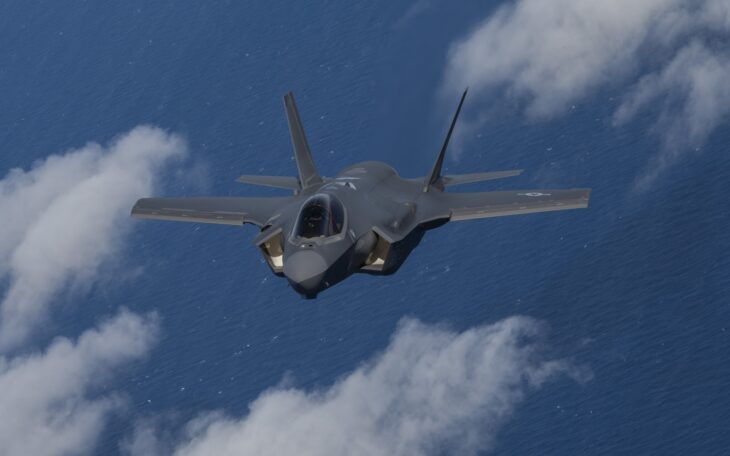

Romania’s Supreme Defence Council approved buying the F-35A on April 11, 2023. The US approved the sale of 32 jets in September 2024, valued at up to $7.2 billion, and Romania signed for them on November 21, 2024.
A second phase would add 16 more for 48 in total, replacing the F-16 between 2034 and 2040. Romanian planning puts the first eight jets in 2032, so the F-16 will carry the load for years yet. For how the two jets compare, see our F-35 vs F-16 comparison.
The 11 Norwegian F-16s still owed and the 12 H225M helicopters complete the order book.
Retired: The MiG-21 LanceR
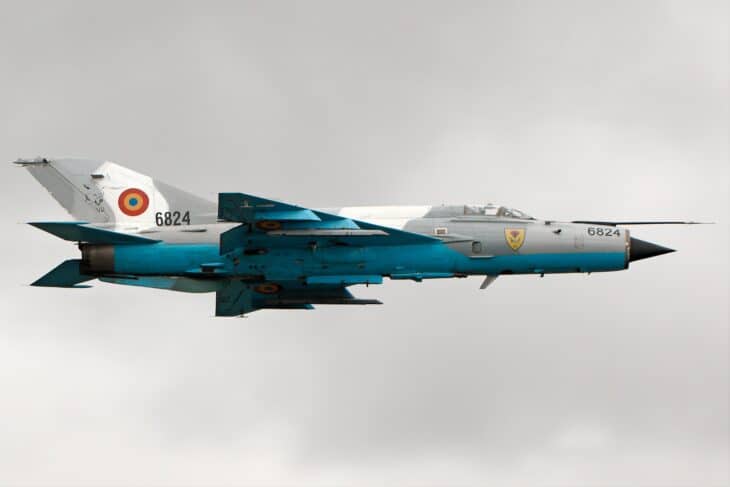
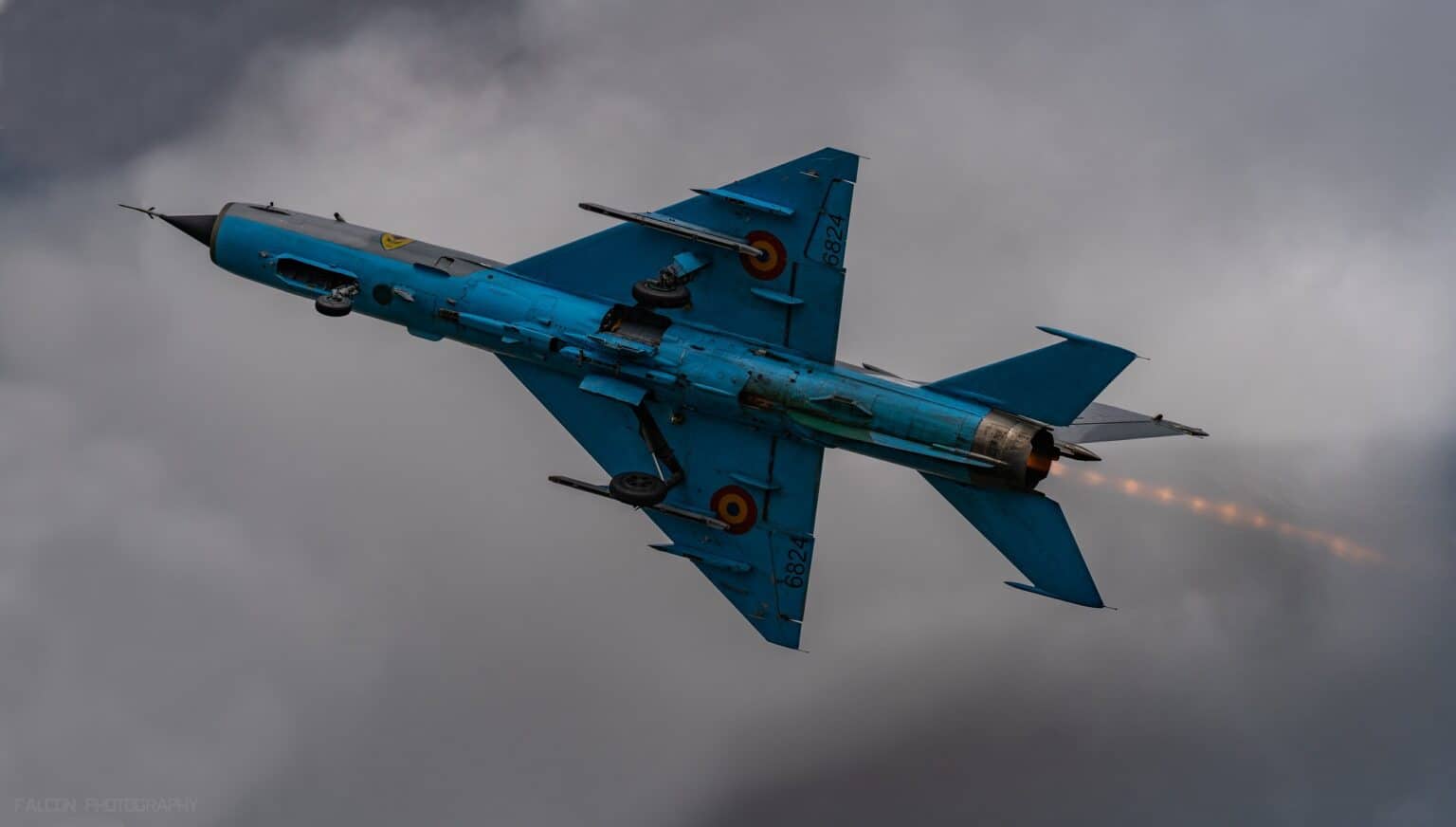
For six decades Romania’s fighter was the MiG-21. Around 400 flew in Romanian service from 1962, and 110 were upgraded with Israeli help to the LanceR standard in the 1990s and early 2000s.
A run of crashes grounded the fleet from April 15 to May 23, 2022. The Air Force retired its last LanceRs on May 15, 2023, with ceremonies at Câmpia Turzii and Borcea, and flew the final jets to Bacău for storage.
Romania’s F-16s in Action: Drones Over the Black Sea and the Baltic
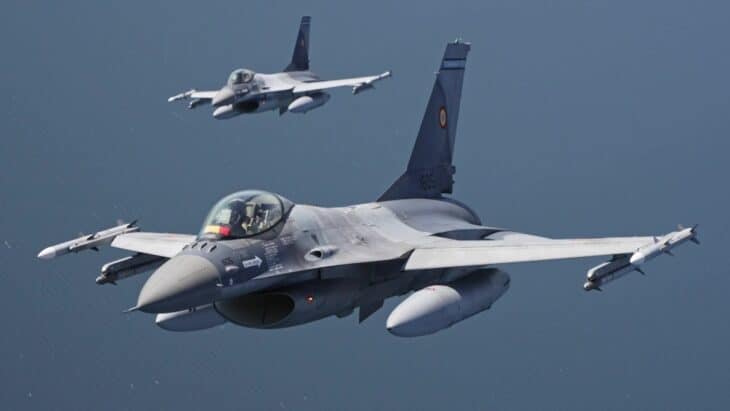

Romania borders Ukraine along the Danube delta, and Russian drones attacking Ukrainian ports have crossed into its airspace. In 2026 its F-16s began shooting them down.
On July 24, 25 and 26, Romanian F-16s shot down a drone on each day, and prosecutors concluded the first was a Shahed-type drone. On July 26 two jets scrambled from Borcea, and one downed the drone with a missile about 7 miles (12 km) northeast of Sulina.
In August an F-16 fired its cannon at a sea drone threatening a gas platform off the coast. On October 17, two F-16s shot down two jet-powered Geran drones four minutes apart near Sulina.
A drone three times faster
The drones Romania met before October 2026 flew at about 93 to 106 mph (150 to 170 km/h). The pair downed on October 17 were tracked at about 280 mph (450 km/h), and the defense minister said they were probably Russia’s new jet-powered Geran-4. It was the first time Romanian forces had shot down that type.
Romanian F-16s also fly NATO air policing abroad. From April to July 2026, six jets and about 100 personnel flew from Šiauliai in Lithuania, and on May 19 they shot down a stray drone over southern Estonia that Estonia said was likely Ukrainian, lost to Russian jamming.
Bases, People and the NATO Forces in Romania


| Base | Location | Main aircraft |
|---|---|---|
| 86th Air Base | Borcea, near Fetești | F-16, European F-16 Training Centre |
| 71st Air Base | Câmpia Turzii | F-16, IAR 330 |
| 57th Air Base | Mihail Kogălniceanu | F-16, IAR 330 |
| 90th Airlift Base | Otopeni, Bucharest | C-130, C-27J, An-30, An-26 |
| 95th Air Base | Bacău | IAR 99, IAR 330 SOCAT |
| Aurel Vlaicu training base | Boboc | Yak-52, IAR 316B |
The Air Force had about 11,700 personnel in 2022, according to the IISS Military Balance. It traces its roots to a law organizing military aeronautics on April 1, 1913, and became an independent arm on January 1, 1924.
By size it is a mid-ranking NATO air force, well off the largest air forces in the world, and it does not make our ranking of the best air forces in the world. Its weight comes from where it sits, on the Black Sea next to Ukraine.
Romania is also a host for NATO air power. The Mihail Kogălniceanu base near Constanța is being expanded at a cost of about €2.5 billion over 20 years, to hold up to 10,000 NATO personnel and their families, which would make it the alliance’s largest base in Europe.
The United States runs an Aegis Ashore missile defense site at Deveselu, operational since 2016 with 24 SM-3 interceptors, and US and Dutch MQ-9 Reaper drones fly from Câmpia Turzii. For how Romania’s fleet compares with its neighbors, see our guide to European fighter jets and the Polish Air Force.
FAQ
Sources and references used for research and fact-checking.
- HotNews, Surpriza din contractul semnat de România pentru 32 de avioane F-16 din Norvegia, care s-au făcut 35
- MiGFlug, Romanian Air Force
- Wikipedia, Romanian Air Force
- Defence Industry Europe, Romania takes delivery of three more F-16 aircraft from Norway
- Militarnyi, Romania misses out on 11 F-16 jets in 2025 due to priority given to Ukraine
- Norwegian Government, Norway signs F-16 contract with Romania
- The Aviationist, The Netherlands transferred 18 F-16s to Romania for the price of a single euro
- The War Zone, Romania just bought 18 F-16s for one euro
- The Aviationist, U.S. State Department approves $7.2B sale of F-35 jets to Romania
- Shephard, Romania signs $7.2 billion deal to buy 32 F-35A jets
- Overt Defense, Romania signs letter of offer and acceptance for 32 F-35As
- The Defense Post, Romania orders H225M helicopters
- The Aviationist, Romanian Air Force retires its MiG-21 LanceR jets
- Euronews, Mission accomplished: Romania says farewell to Soviet-era jet fighters
- Janes, Update: Romania retires MiG-21
- Romanian Ministry of National Defence, Press Information: third drone shot down by a Romanian Air Force F-16 in three days
- Romanian Ministry of National Defence, Press Release - UPDATE (October 17 shoot-down)
- Digi24, Trei premiere absolute în cazul celor două drone doborâte deasupra Mării Negre
- Romanian Ministry of National Defence, The Romanian Air Force: a new Enhanced Air Policing mission in the Baltic airspace
- The Aviationist, Romanian F-16s shoot down rogue drone in Estonian airspace
- Overt Defense, The US donates another C-130 Hercules transport aircraft to the Romanian Air Force
- Shephard, Elbit awarded contracts to refit Romanian helicopters, jet trainers
- The War Zone, Romanian airfield's transformation into a giant NATO base is underway
Get the Newsletter
The latest aviation news and stories sent to your inbox.
About the Author

Tim is the owner and lead editor of AeroCorner since 2019, overseeing aviation content covering aircraft, airlines, airports, and the broader aviation industry. Through years of researching, writing, editing, and publishing aviation-focused content, he has developed extensive practical knowledge of commercial aviation and air travel. Based in Asia and a frequent traveler himself, Tim also brings firsthand passenger experience to AeroCorner’s coverage. Outside of publishing, he has also explored aviation firsthand through hands-on flight training in New Zealand.