

Table of Contents
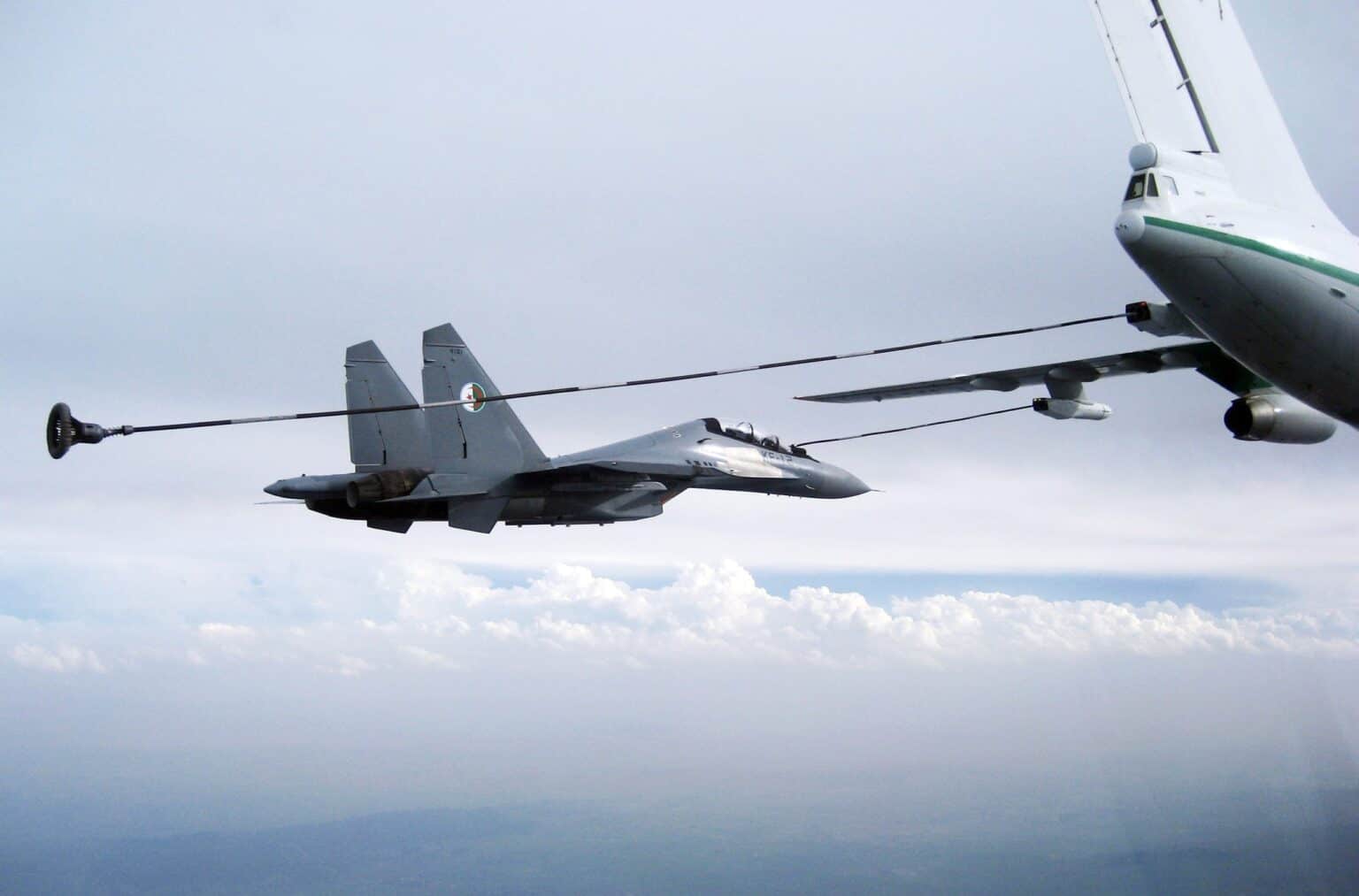
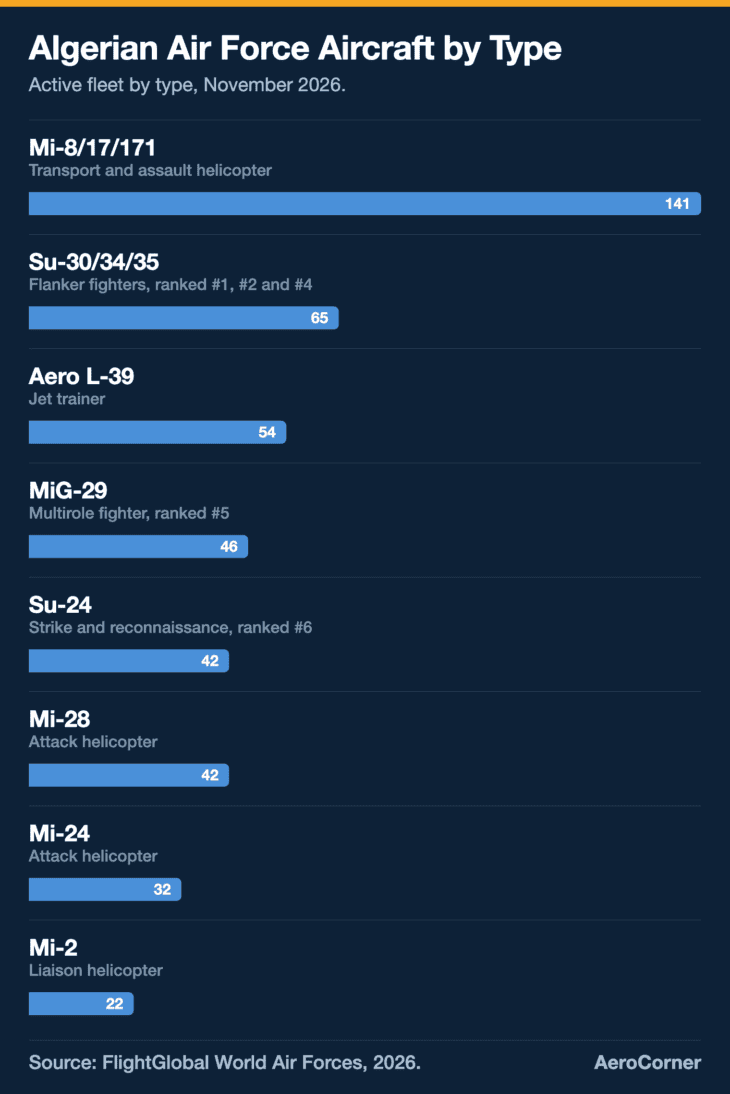
The Algerian Air Force is built around the Sukhoi Su-30MKA, a two-seat Russian fighter it has been buying since 2006. FlightGlobal’s World Air Forces 2026 directory counts 65 Su-30, Su-34 and Su-35 jets in the force, 153 combat aircraft in all, and 602 aircraft of every kind.
No other air force in Africa flies as many Flankers in that count. The headline jet, though, is one Algeria has never officially confirmed it owns: the Su-57 stealth fighter, which FlightGlobal says Algeria ordered as the type’s first export customer.
This guide ranks every combat type the Algerian Air Force flies by its real fighting value as of November 2026: what the jet can do, how many Algeria has, and how much of that is confirmed. The helicopters, the support fleet, the history and the Chinese jets Algeria is reported to be buying follow the ranking.
| Rank | Aircraft | Role | In service | Status |
|---|---|---|---|---|
| 1 | Sukhoi Su-30MKA | Multirole fighter | About 63 to 65 | Ordered in batches since 2006 |
| 2 | Sukhoi Su-35 | Air superiority fighter | At least 5 reported | Seen at Oum El Bouaghi in 2025; never officially confirmed |
| 3 | Sukhoi Su-57E | Stealth fighter | At least 1 seen | 14 ordered per FlightGlobal; delivery unconfirmed |
| 4 | Sukhoi Su-34 | Strike fighter | First batch reported in 2026 | 14 on order per the 2026 directories |
| 5 | Mikoyan MiG-29 and MiG-29M/M2 | Multirole fighter | 46 | Older MiG-29s plus M/M2s delivered from 2020 |
| 6 | Sukhoi Su-24MK2 | Strike and reconnaissance | 42 | Upgraded to M2/MR2 standard in 2020 |
| 7 | Yakovlev Yak-130 | Lead-in trainer and light attack | 18 | Ordered in the 2006 package |
How this ranking works
Each type is ranked by its fighting value in November 2026: radar, weapons and age, weighed against how many Algeria has and how much of that is confirmed. Counts come from FlightGlobal’s World Air Forces 2026 directory, which lists only aircraft in day-to-day use. Algeria publishes no fleet figures and rarely comments on deliveries, so the Su-35, Su-57 and Su-34 entries rest on satellite imagery, footage and press reports, and are labeled that way. Unlike many air forces, Algeria’s flies its own attack helicopters, which are covered after the ranking.
1. Sukhoi Su-30MKA: The Backbone
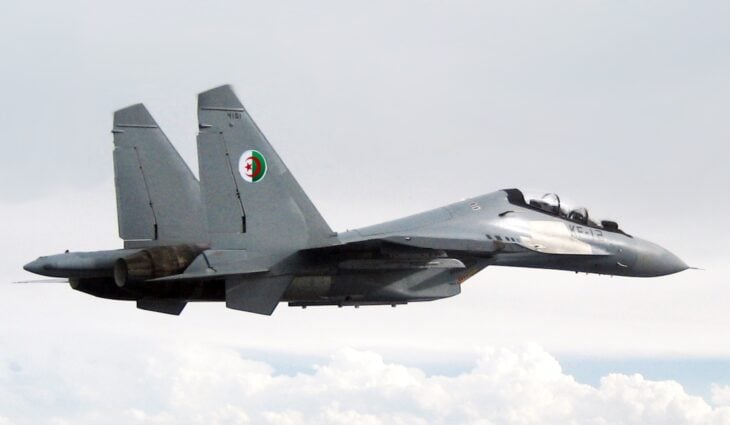

In March 2006, Algeria signed a large Russian arms package that included 28 Su-30MKA fighters and 16 Yak-130 trainers. The MKA is Algeria’s version of India’s Su-30MKI, a two-seat, thrust-vectoring heavy fighter.
The order kept growing. Algeria added 16 more in December 2010, and further batches followed in 2015 and 2019, though published totals for those later orders disagree.
The Aviationist, reading the 2026 directories from FlightGlobal, Scramble and the IISS, puts the fleet at 63 to 65 Su-30MKAs. That makes it the jet that does almost everything in Algeria’s air force, from air defense to strike, and the clear number one.
Algeria sent its new MiGs back to Russia
The 2006 package also included 28 MiG-29SMT fighters and six MiG-29UB trainers. When the first jets arrived, Algeria found they were older airframes modernized to MiG-29 9.19 standard, not new ones, and froze payment. After a meeting of the two heads of state in February 2008, the delivered MiGs went back to Russia, and Algeria was offered more Su-30MKAs at sharply reduced prices instead.
2. Sukhoi Su-35: The Jets Built for Egypt
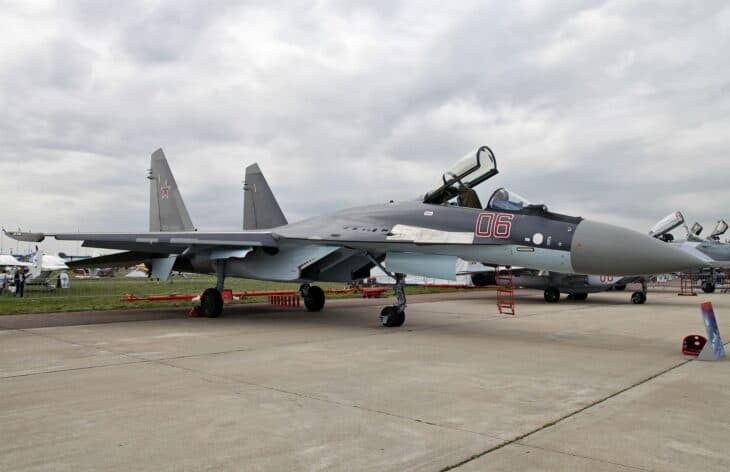

Algeria’s Su-35s were first spotted from space. Satellite imagery dated March 10, 2025, showed Su-35s at Ain Beida, also known as Oum El Bouaghi Air Base, in eastern Algeria, one of them with an Algerian roundel on its wing.
The jets are almost certainly from a batch Russia built for Egypt and never delivered, a batch long linked to a sale to Iran. The IISS reported at least four more jets in Algerian markings at the factory in Komsomolsk-on-Amur, so at least five had been marked for Algeria by April 2025.
The first clear photo of a Su-35 on the ground with an Algerian roundel on its tail circulated in early February 2026. Neither Algiers nor Moscow has confirmed the transfer, and nobody outside them knows the final number. It ranks second because the Su-35 is the most capable Flanker Algeria is known to fly.
3. Sukhoi Su-57E: First Export Customer, on Paper
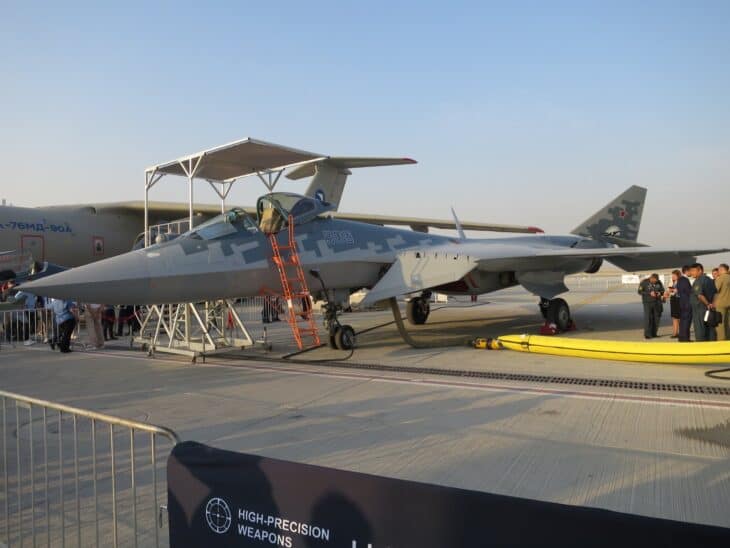

FlightGlobal’s 2026 directory lists Algeria as the first export customer for the Su-57, with an order for 14 of Russia’s fifth-generation fighters. Algerian state media announced the purchase in February 2025.
The order size is not settled. Izvestia, reporting from the Dubai Airshow in November 2025, said Algeria had two airframes and planned a full squadron of 12, while one defense commentator wrote that 14 jets would replace Algeria’s MiG-25PD interceptors.
The first footage surfaced on February 7, 2026: a grainy video, traced to an Algeria-based TikTok account, of one Su-57E flying overhead. The United Aircraft Corporation has confirmed a foreign order without naming the buyer.
Does Algeria have the Su-57? Probably, but nobody official will say so.
Many articles state flatly that Algeria flies the Su-57. The record is thinner. Algerian state media claimed the purchase in February 2025, and one jet has been filmed in Algerian skies, but as of February 2026 neither the United Aircraft Corporation nor officials in Algiers or Moscow had named Algeria as the buyer, and we found no official confirmation since. That is why the Su-57 ranks third here, not first: on paper it is Algeria’s best jet, but no one outside the two governments can say how many fly.
4. Sukhoi Su-34: Russia’s Strike Jet Goes Abroad
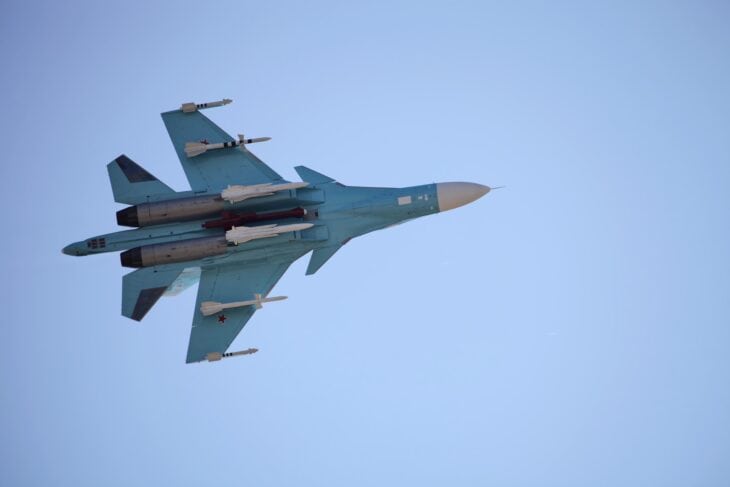

The Su-34 is a twin-engine Russian strike fighter. The Aviationist, citing the 2026 directories, listed 14 Su-34s on order for Algeria and none yet in service.
That has changed. Images of Su-34s in desert colors surfaced in August 2025, footage of Su-34s in Algerian markings was published in May 2026, and Military Watch Magazine reported the first batch delivered in June 2026.
The same magazine says Algeria may eventually buy 36 to 40 Su-34s, an estimate rather than a confirmed figure. If so, it would likely take over the long-range strike role from the aging Su-24.
5. MiG-29 and MiG-29M/M2: The Second Fighter
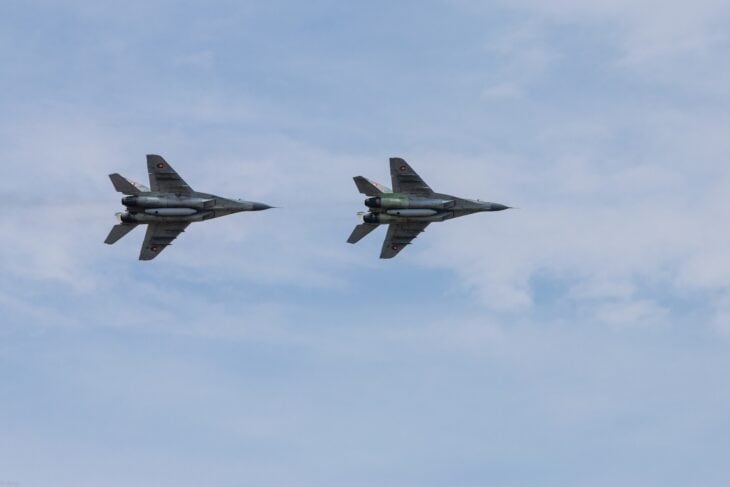

FlightGlobal counts 46 MiG-29s, plus two MiG-29 trainers. The fleet mixes older MiG-29s with the newer MiG-29M/M2.
Algeria signed for 14 MiG-29M/M2s at Russia’s MAKS air show in 2019, and deliveries began in October 2020. Other counts put the M/M2 fleet higher, at 25 to 35 jets, so the split between old and new is not public.
The MiG-29 ranks below the Flankers because it is a lighter, shorter-range fighter. It gives Algeria numbers, not reach.
6. Sukhoi Su-24MK2: The Old Bomber, Upgraded
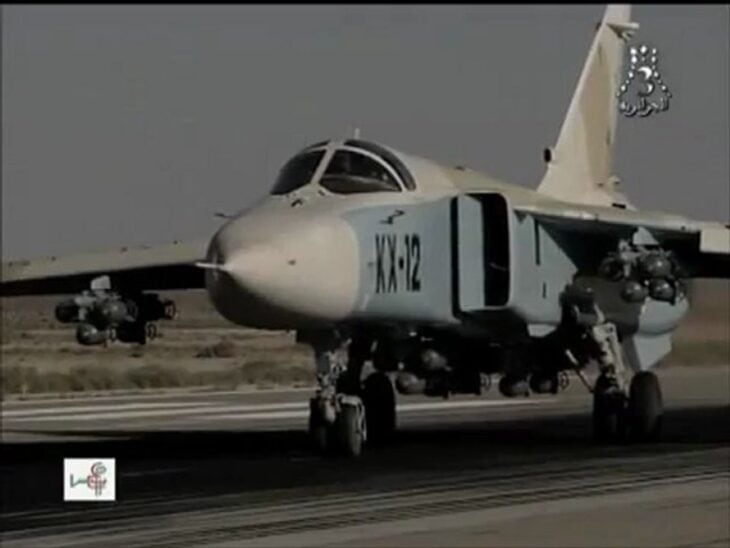

The swing-wing Su-24 is a Soviet-era strike jet, and Algeria still flies 42 of them, by FlightGlobal’s count. In late 2020 the fleet was upgraded to the M2 and MR2 standards, the MR2 being the reconnaissance version.
It ranks sixth because it is an old Soviet design, and the Su-34 now arriving is expected to take over its strike role.
7. Yakovlev Yak-130: The Trainer That Can Fight
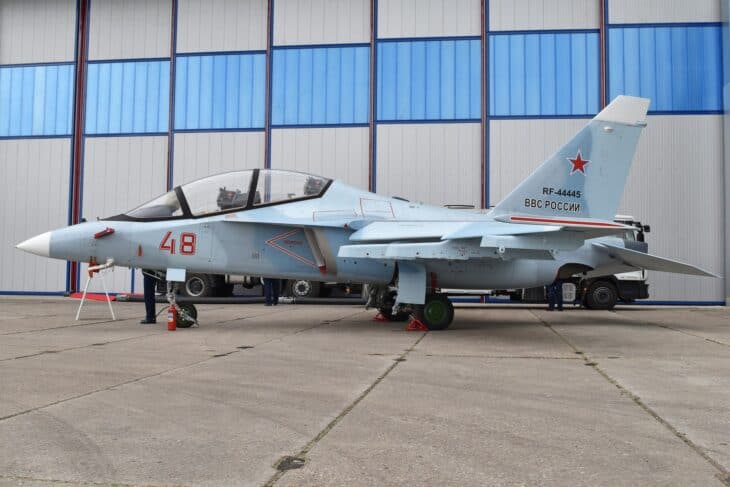

The Yak-130 came in the same 2006 package as the first Su-30MKAs, with 16 ordered. FlightGlobal now counts 18.
It is a lead-in trainer first, preparing pilots for the Flankers, with a light attack role second. Behind it sit 54 L-39 jet trainers, the second-largest fixed-wing fleet in the force.
The Helicopters: Algeria’s Biggest Fleet
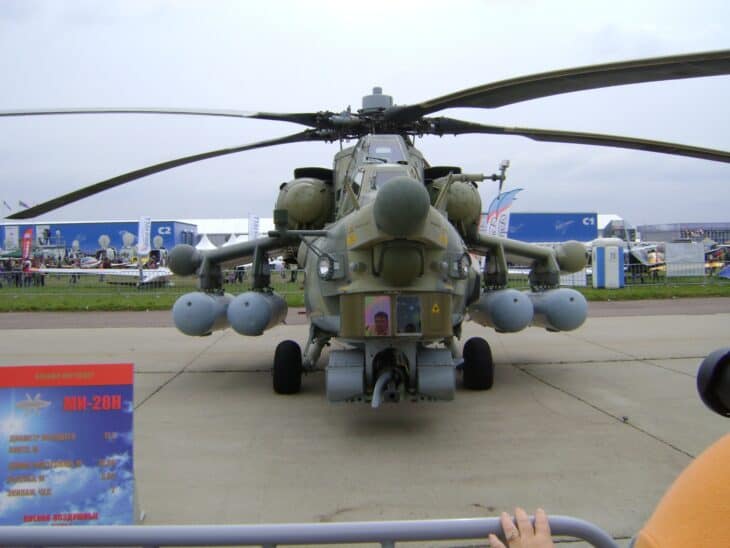

Algeria’s helicopters belong to the air force, not the army, and they outnumber its jets. FlightGlobal lists 298 helicopters, nearly half of the 602 aircraft in the force.
| Helicopter | Role | In service |
|---|---|---|
| Mi-8, Mi-17 and Mi-171 | Transport and assault | 141 |
| Mi-28 | Attack | 42 |
| Mi-24 | Attack | 32 |
| Mi-2 | Liaison | 22 |
| AS355 | Light utility | 14 |
| Mi-26 | Heavy transport | 14 |
| AW139 | Search and rescue | 11 |
| Bell 412, Ka-32 | Utility, search and rescue | 3, 3 |
| AW119, W-3 | Training | 8, 8 |
The 42 Mi-28 Havocs and 32 Mi-24s give Algeria 74 attack helicopters. The 141 Mi-8 family helicopters are the single largest fleet of any kind in the force.
The Support Fleet: Tankers, Transports and Trainers

Algeria has aerial refueling, which Egypt’s much larger air force lacks in FlightGlobal’s count. Four Il-78 tankers stretch the reach of the Flankers.
| Aircraft | Role | In service |
|---|---|---|
| Il-78 | Tanker | 4 |
| C-130H Hercules | Transport | 14 |
| Il-76 | Heavy transport | 11 |
| C-130J Super Hercules | Transport | 4 |
| C295 | Transport | 5 |
| King Air 90/200/350, Beech 1900, PC-6 | Light transport | 20, 6, 3 |
| Beech 1900, King Air 200 | Reconnaissance | 6, 1 |
| King Air 200/350 | Maritime patrol | 3 |
| L-39 | Jet trainer | 54 |
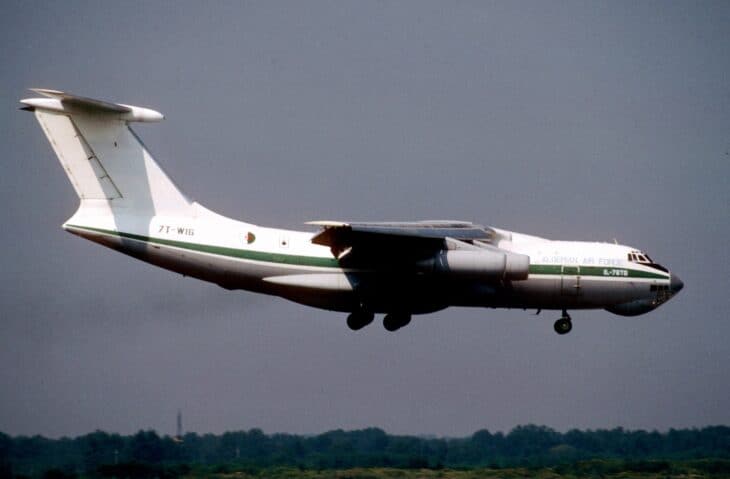
The Il-76 fleet also carries the force’s worst day. On April 11, 2018, an Il-76TD crashed just after takeoff from Boufarik, near Algiers, killing all 257 people aboard, the deadliest aviation disaster in Algerian and African history.
A Short History: From Egyptian MiGs to Russian Flankers
The air force took shape at independence in 1962, when Egypt gave Algeria 12 Gomhouria trainers and five MiG-15s. Within five years it was sending jets to Egypt’s wars with Israel.
1962
Independence. Egypt transfers 12 Gomhouria trainers and five MiG-15s; the USSR supplies Mi-4 helicopters.
1967
Six-Day War. Not yet combat ready, Algeria sends 20 MiG-17Fs, 20 MiG-21s and 12 Il-28s to Egypt without crews.
1973
Yom Kippur War. Two MiG-21 squadrons, a Su-7 squadron and 23 MiG-17s go to Egypt and fly about 500 combat sorties.
March 2006
The Russian package. 28 Su-30MKAs, 16 Yak-130s and 34 MiG-29s are ordered.
February 2008
MiGs returned. Algeria sends the delivered MiG-29s back to Russia.
April 11, 2018
Boufarik crash. An Il-76TD crashes after takeoff, killing all 257 aboard.
March 2025
Su-35s spotted. Satellite imagery shows Su-35s at Oum El Bouaghi.
February 7, 2026
Su-57 on video. The first footage of an Su-57E over Algeria appears online.
In the 1973 war, Algeria lost one MiG-21 and one Su-7, and no pilot was killed or captured. Its current commander, Major General Zoubir Ghouila, took over on February 23, 2025.
The Chinese Jets Algeria May Be Buying
For six decades Algeria’s fighters have come from Moscow. In June 2026, Defence24 reported that Algeria may become the first African operator of China’s J-10C fighter and KJ-500 airborne early warning aircraft, with deliveries starting in 2027 if the deal is confirmed.
Defence Security Asia reported in August 2026 that the package covers about 30 to 40 J-10CE fighters and three to five KJ-500s. It also noted that neither Algiers nor Beijing had confirmed it, so treat every number as reported, not signed.
If it happens, the KJ-500 would give Algeria an airborne radar it does not have today. FlightGlobal’s 2026 entry lists no early warning aircraft.
Is the Algerian Air Force Strong? How It Compares
By FlightGlobal’s count, Algeria’s 153 combat aircraft are well behind Egypt’s air force, which fields 332, led by 168 F-16s. They are almost twice neighboring Morocco’s 84, whose fleet still leans on 46 Mirage F1s.
Algeria’s edge is the heavy end. Its Flankers, tankers and, if the reports hold, Su-57s give it more reach than its neighbors, while Morocco’s 24 new F-16s on order are its answer.
The weakness is the same one its admirers skip: almost everything is Russian, and much of it is unconfirmed. For the full world table, see our ranking of the largest air forces in the world.
FAQ
Sources and references used for research and fact-checking.
- FlightGlobal, World Air Forces 2026 directory (PDF)
- The Aviationist, Algeria's First Su-57E Reportedly Captured in Flight
- The War Zone, Su-35s Once Expected To Arm Iran Are Now In Algeria
- Army Recognition, First visual evidence confirms Algeria has begun receiving Russia's Su-35 multirole fighter
- Military Watch Magazine, Algeria to receive new Su-34 strike fighters
- Defence24, China enters Algeria's air force
- Defence Security Asia, Algeria's Reported J-10CE Deal Could Break Russia's Fighter Monopoly
- Wikipedia, Algerian Air Force
- Wikipedia, Sukhoi Su-30
- Wikipedia, Mikoyan MiG-29M
- Wikipedia, 2018 Algerian Air Force Ilyushin Il-76 crash
Get the Newsletter
The latest aviation news and stories sent to your inbox.
About the Author

Tim is the owner and lead editor of AeroCorner since 2019, overseeing aviation content covering aircraft, airlines, airports, and the broader aviation industry. Through years of researching, writing, editing, and publishing aviation-focused content, he has developed extensive practical knowledge of commercial aviation and air travel. Based in Asia and a frequent traveler himself, Tim also brings firsthand passenger experience to AeroCorner’s coverage. Outside of publishing, he has also explored aviation firsthand through hands-on flight training in New Zealand.