

Table of Contents
The best AWACS aircraft in the world in 2026 is the Boeing E-7 Wedgetail. Its fixed electronically scanned radar sees in every direction at once, it has years of combat use behind it, and it does the job on a twin-engine 737 instead of a four-engine 707.
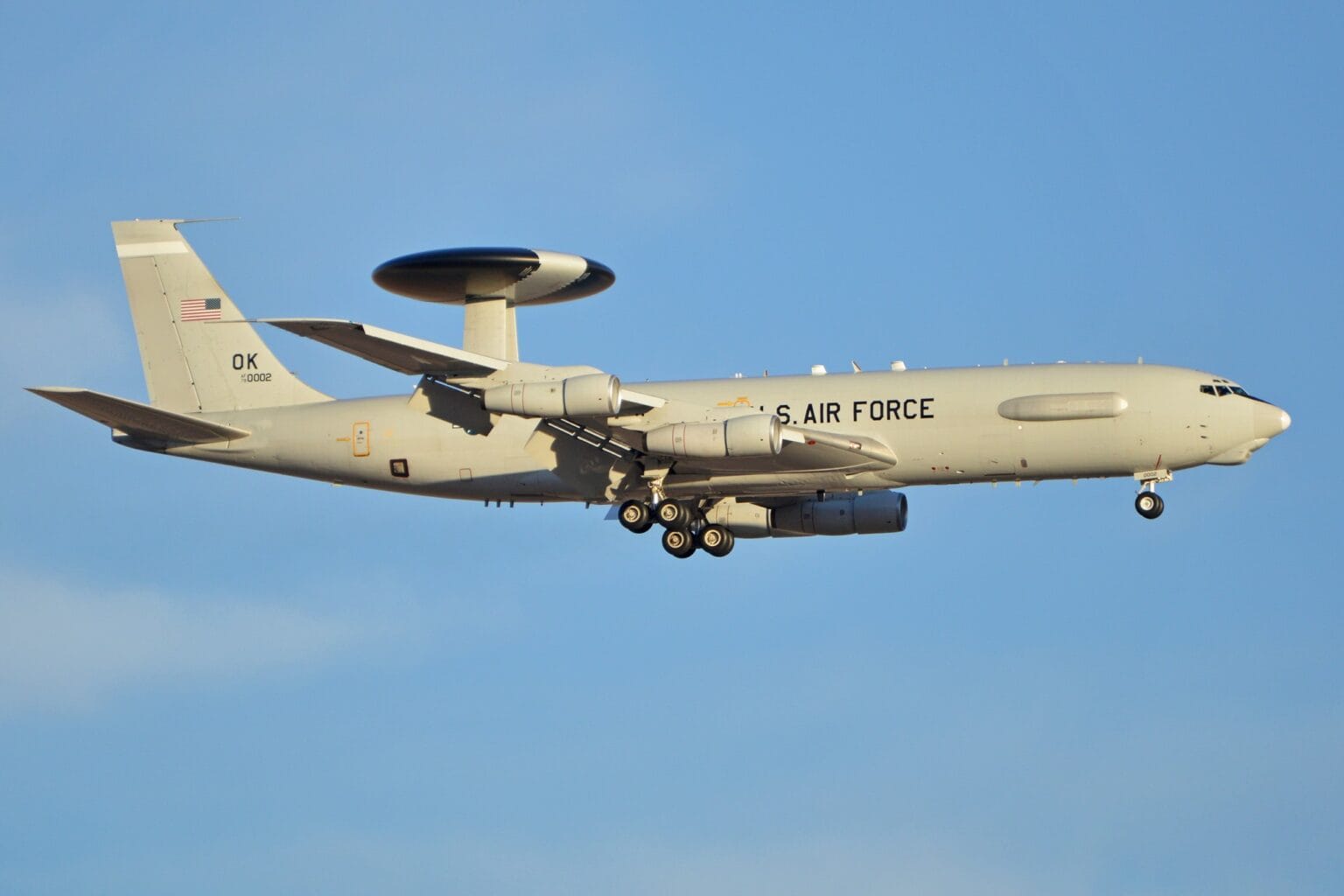
Close behind are Saab’s GlobalEye, which NATO picked in July 2026 to replace part of its E-3 fleet, and the US Navy’s E-2D Advanced Hawkeye. The famous Boeing E-3 Sentry, the aircraft that gave “AWACS” its name, now ranks sixth.
This list ranks the 11 airborne early warning and control types flying or entering service as of November 2026. It covers what each one carries, who flies it, how many exist, and where the ranking is about to move.
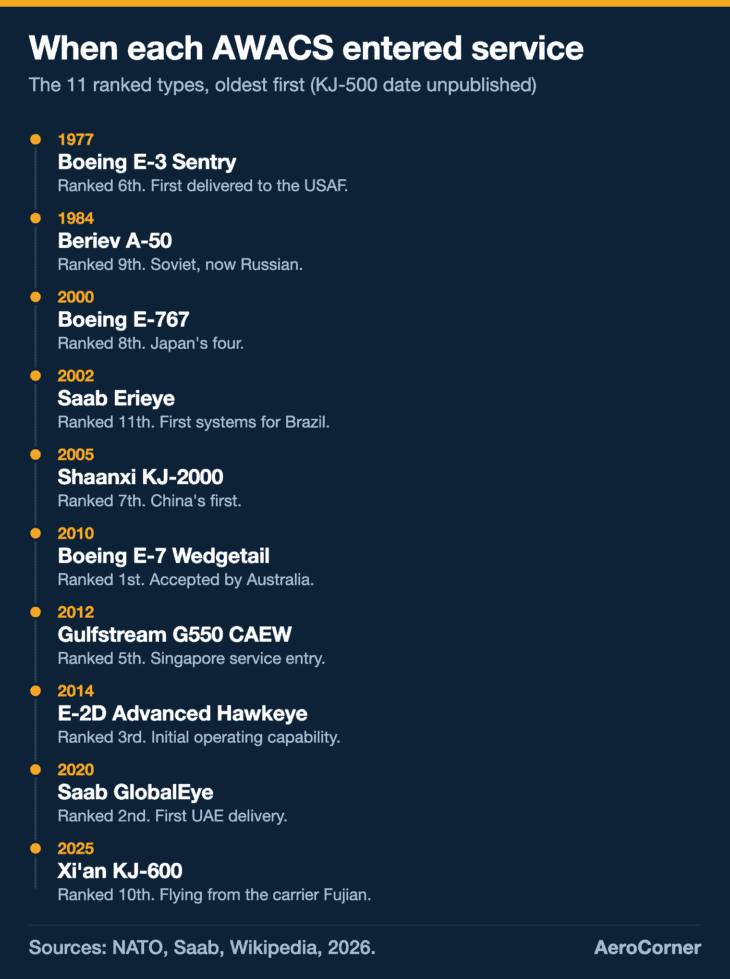
| Rank | Aircraft | Radar type | In service since | Fleet (2026) |
|---|---|---|---|---|
| 1 | Boeing E-7 Wedgetail | Fixed AESA (MESA), 360° | 2010 | 14 with Australia, Turkey and South Korea, plus the RAF’s first |
| 2 | Saab GlobalEye | Fixed AESA (Erieye ER) | 2020 | 5 in the UAE; Sweden, France, NATO and others buying |
| 3 | Northrop Grumman E-2D Advanced Hawkeye | Rotating UHF AESA (APY-9) | 2014 | US Navy and Japan; France from 2027 |
| 4 | Shaanxi KJ-500 | Fixed AESA, three arrays | By 2018 | About 40 air force plus 20+ navy (estimates) |
| 5 | Gulfstream G550 CAEW | Conformal AESA (EL/W-2085) | 2012 | Israel, Singapore (4), Italy |
| 6 | Boeing E-3 Sentry | Rotating rotodome (APY-1/2) | 1977 | 68 built; NATO 14, US 16 before a March 2026 loss |
| 7 | Shaanxi KJ-2000 | Fixed AESA, three arrays | 2005 | About 4 to 5 |
| 8 | Boeing E-767 | Rotating rotodome (APY-2) | 2000 | 4 (Japan) |
| 9 | Beriev A-50 / A-50U | Rotating rotodome | 1984 | A handful in Russia after 2024 losses; 3 in India |
| 10 | Xi’an KJ-600 | Rotating AESA | 2025 | 6+ in use on carriers |
| 11 | Saab Erieye and India’s Netra | Fixed AESA “plank” | 2002 (Brazil) | Pakistan 9, Brazil 5, Greece 4, India 3 Netra |
How this ranking works
AWACS (Airborne Warning and Control System) is strictly the name of the Boeing E-3, but it is now used for any airborne early warning and control (AEW&C) aircraft. We rank each type on four things: radar technology (a fixed electronically scanned array beats a mechanically rotated dish), coverage, endurance and crew, and its operational record. Only types in service or delivering in 2026 are included. Radar ranges are the makers’ own figures and are measured differently, so we quote them but do not rank on them.
1. Boeing E-7 Wedgetail
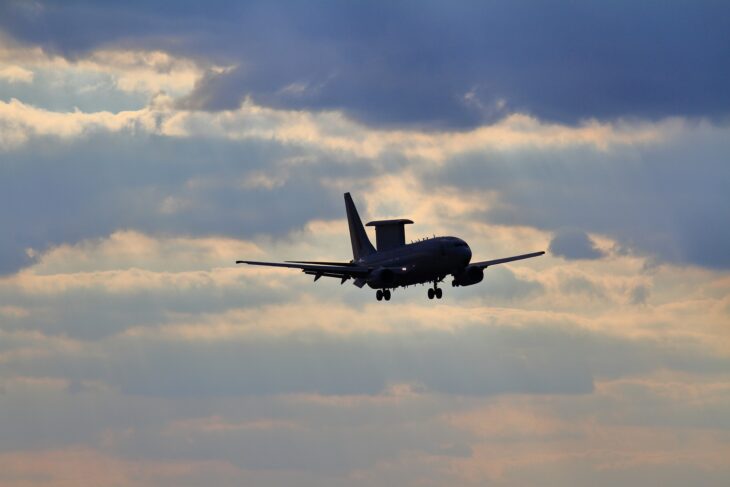

The E-7 puts a Northrop Grumman MESA radar in a flat “top hat” fin on a Boeing 737-700 airframe. The radar never moves: two side arrays each cover 120 degrees and an end-fire array in the top hat covers 60 degrees ahead and behind, so it watches all 360 degrees at once.
The radar’s quoted maximum range is more than 370 miles (600 km) in look-up mode. The cabin carries ten operator consoles in Australian service, and the jet refuels in flight.
It ranks first because it is proven. Australia’s six E-7As flew combat missions over Iraq from 2014, helped coordinate the search for MH370, and deployed to Europe to guard supply routes to Ukraine in 2023 and again in 2025.
Turkey flies four as the Peace Eagle and South Korea four as the Peace Eye. The UK cut its order from five to three, and the first RAF Wedgetail AEW1 arrived in October 2024.
Its US future has been a fight. The Pentagon tried to cancel the USAF’s 26-aircraft plan in June 2025, Congress kept it alive, and by April 2026 the Air Force had seven E-7s on contract: two prototypes and five development aircraft. NATO dropped its E-7 order in November 2025.
17 hours over a war zone
In November 2015 an Australian Wedgetail flew a 17-hour, 6-minute combat mission over the Middle East, refueling twice in the air. It was the longest Australian command and control mission ever flown in a war zone.
2. Saab GlobalEye
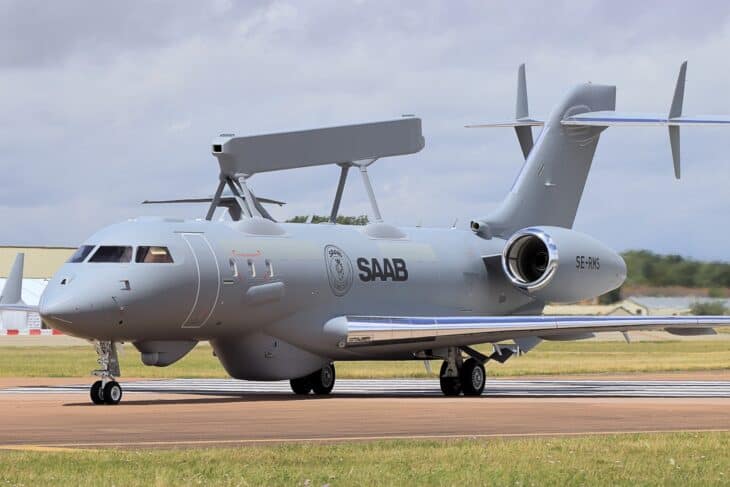

GlobalEye mounts Saab’s Erieye ER radar, a 10-meter “ski-box” antenna, on a Bombardier Global 6000 or 6500 business jet. Saab says it detects low-flying threats more than 216 nautical miles (400 km) away from 35,000 feet.
What sets it apart is the extra sensors. A Leonardo Seaspray 7500E surface radar and a nose-mounted infrared camera let one aircraft watch the air, the sea and the ground together, which normally takes several aircraft.
Saab quotes 12 hours of operational endurance from the Bombardier airframe, and says the jet needs only a 6,500-foot runway. The trade-off is a smaller cabin, with five operator stations against ten on Australia’s E-7s.
Its order book is why it ranks so high. The UAE has flown GlobalEye since 2020 and now has five, Sweden has three on order, France ordered two in December 2025, and an unnamed Middle Eastern country ordered two in July 2026.
The big one came at the NATO summit in Ankara in July 2026, when 11 allies announced they would buy up to 10 GlobalEyes as NATO’s new AWACS. Canada chose it in May 2026, and the Netherlands signed a letter of intent for one in September.
3. Northrop Grumman E-2D Advanced Hawkeye
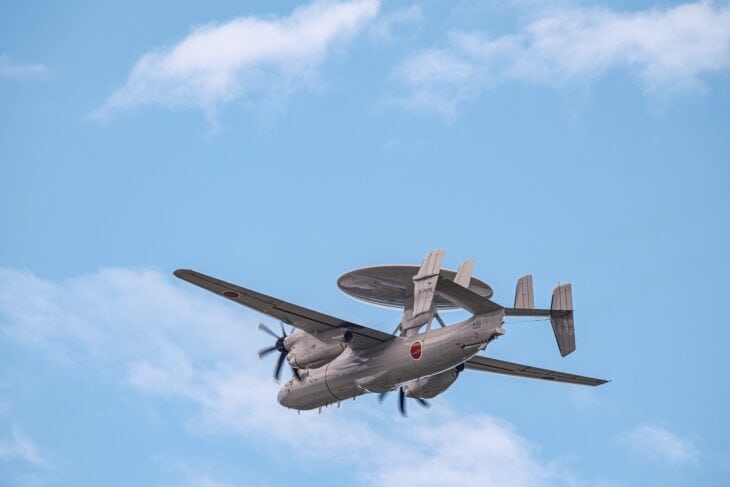
The E-2D is the US Navy’s carrier-borne radar plane. Its APY-9 radar sits in a rotating dome like the older E-2C Hawkeye 2000, but it is an active electronically scanned array that adds electronic steering to the rotation.
The radar works in the UHF band. Stealth fighters are shaped mainly against higher frequencies, so the APY-9 is widely suspected of being able to detect fighter-sized stealth aircraft such as China’s J-20.
It can also guide other ships’ missiles. Under the Navy’s NIFC-CA concept an E-2D can steer an SM-6 or AMRAAM onto a target the launching ship or fighter cannot see.
The E-2D first flew in August 2007 and reached initial operating capability in October 2014. Aircraft from the 46th onward carry an aerial refueling probe, which doubles time on station to five hours.
The Navy planned 75, Japan had six by March 2023 with seven more on order, and France’s first is due in 2027. It ranks below the E-7 and GlobalEye only because a turboprop sized for a carrier deck has less range and fewer consoles.
4. Shaanxi KJ-500
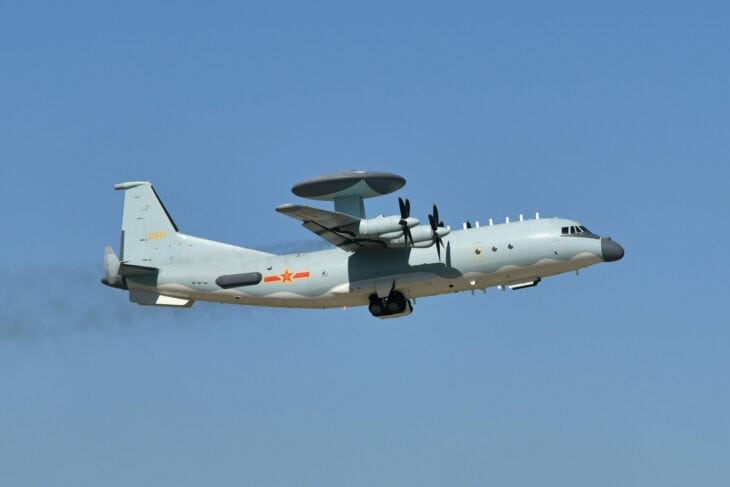

The KJ-500 is the backbone of China’s airborne radar fleet. It puts a fixed dorsal radome with three AESA arrays on the four-turboprop Y-9 transport, giving full 360-degree coverage with no moving parts.
Published figures give it 12 hours of endurance and a range of about 290 miles (470 km) against fighter-sized targets. An improved KJ-500A with an air refueling probe was shown at the 2022 Zhuhai Airshow and has become the production standard.
Numbers are its strength. Published estimates put about 40 in China’s air force and more than 20 KJ-500H in naval service.
In March 2022 the head of US Pacific Air Forces, Gen. Kenneth Wilsbach, named the KJ-500 as a key enabler of China’s long-range air-to-air missiles. Pakistan announced plans to buy it in June 2025.
5. Gulfstream G550 CAEW (EL/W-2085)
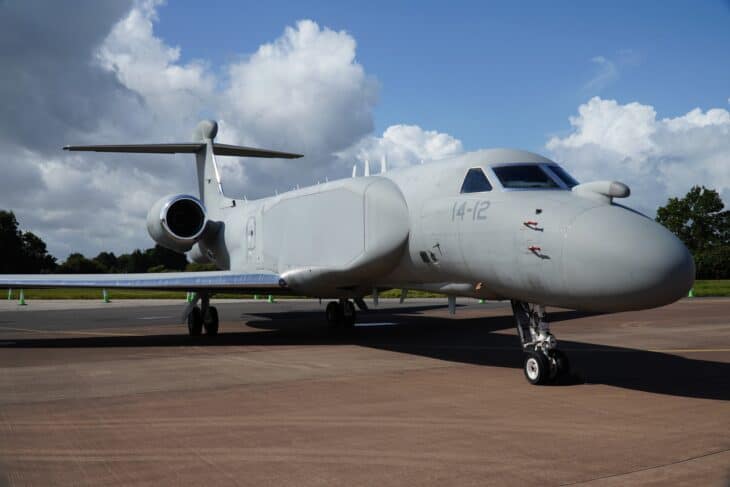

Israel’s answer was to wrap the radar around a Gulfstream G550 business jet. IAI’s EL/W-2085 uses L-band arrays in bulges on each side of the fuselage and S-band antennas in the nose and tail.
The radar is credited with tracking up to 1,000 targets out to 243 nautical miles (450 km). Because the beam is steered electronically, targets on the screen update every 2 to 4 seconds instead of every 10 seconds on a rotodome aircraft.
Israel, Singapore and Italy fly it. Singapore’s four entered service in April 2012, replacing E-2C Hawkeyes, and Italy has ordered two more to add to its first pair.
Its biggest recent win came at the E-7’s expense. In September 2025 South Korea chose an L3Harris business jet carrying the EL/W-2085 for its next four AEW&C aircraft, rather than more Wedgetails.
6. Boeing E-3 Sentry
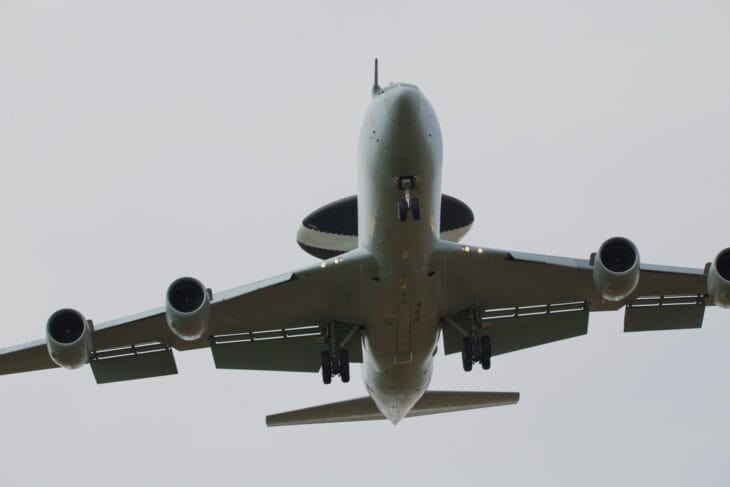

The Boeing E-3 Sentry is the original AWACS. Built on a Boeing 707-320B, it carries a 30-foot (9.1 m) rotodome on two struts, 11 feet (3.4 m) above the fuselage.
Its radar sees low-flying aircraft more than 250 miles (400 km) away. NATO says one E-3 at 30,000 feet covers more than 120,000 square miles (312,000 sq km), about the size of Poland.
Between 1977 and 1992 Boeing built 68. The USAF received its first in March 1977, and NATO, France, Saudi Arabia and the UK followed; Chile has since bought three ex-RAF jets.
It ranks sixth because of age, not ability. The 707 airframe is long out of production, parts are scarce, and the US fleet had shrunk to 16 by early 2026.
On March 27, 2026, an Iranian missile and drone strike hit Prince Sultan Air Base in Saudi Arabia, and images geolocated by CNN and The War Zone showed E-3G 81-0005 with its tail broken off and its rotodome on the ground. US Central Command declined to comment on the loss.
NATO’s 14 E-3As are being upgraded to fly until 2035, and GlobalEye will replace part of that fleet. The jet is a key piece of the balance in our NATO vs Russia air power comparison.
7. Shaanxi KJ-2000
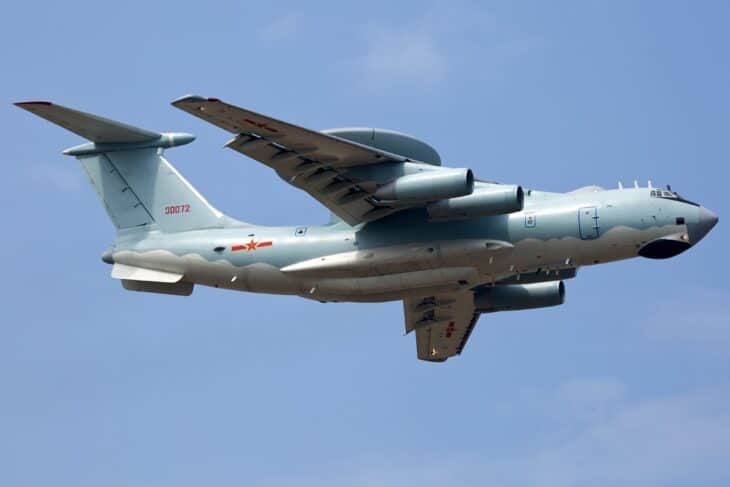

The KJ-2000 exists because a sale fell through. China ordered an Israeli Phalcon radar on an Il-76, and when that deal was cancelled in July 2000 under American pressure, it built its own.
It looks like an E-3 but works differently. The disc on top of its Ilyushin Il-76 airframe does not rotate: three AESA arrays inside it each cover 120 degrees.
The first flew in 2003 and reached its base in 2005. Only four have been identified, limited by the supply of Russian Il-76 airframes, so China moved on to the smaller, cheaper KJ-500.
8. Boeing E-767
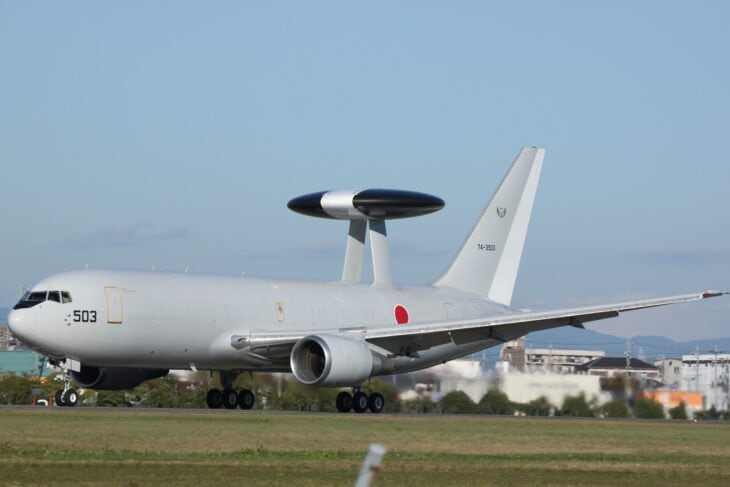

Japan’s E-767 is the E-3’s radar and mission system moved onto a Boeing 767-200. Japan wanted E-3s, but 707 production had ended, so Boeing offered the bigger twin instead.
All four entered service on May 10, 2000, with the 601st Squadron at Hamamatsu. A radar upgrade completed in December 2012 improved their ability to track small targets.
The E-767 has a newer airframe than the E-3. With only four built and a rotodome design, it sits mid-table.
A defector started Japan's AWACS program
In September 1976 Soviet pilot Viktor Belenko flew his MiG-25 low across Japan and landed at Hakodate, and Japanese ground radar lost track of him. That failure is why Japan bought E-2C Hawkeyes in the 1980s and E-767s in the 1990s.
9. Beriev A-50 and A-50U
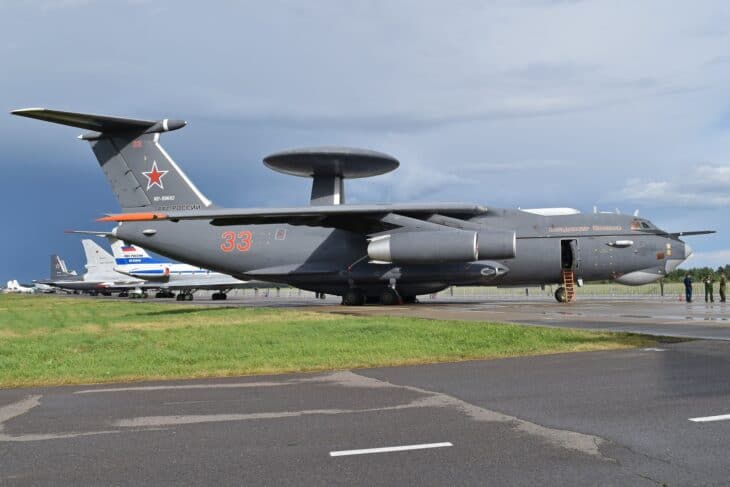
Russia’s A-50 carries a 30-foot (9 m) rotodome on an Il-76. Its radar is credited with detecting air targets about 400 miles (650 km) away, and the modernized A-50U replaces analog systems with digital ones.
The war in Ukraine has cost it dearly. Ukraine shot down an A-50U over the Sea of Azov on January 14, 2024, which a US Army officer later said was hit by a Ukrainian-operated Patriot, and Ukraine says it downed a second on February 23, 2024.
Ukraine’s SBU also claimed damage to A-50s at Ivanovo in the June 2025 Spider’s Web drone attack. Ukraine’s intelligence chief said in February 2024 that the Russian air force had only six operational A-50s left.
India flies three A-50EI, an Il-76 with Israel’s EL/W-2090 radar, the first delivered in May 2009.
10. Xi’an KJ-600
The KJ-600 is China’s carrier-based equivalent of the E-2D, with a folding high wing, four tail fins and a rotating dome holding AESA radars. It first flew on August 29, 2020.
In September 2025 Chinese state TV showed it launched by electromagnetic catapult from the carrier Fujian. At least six were flying from carriers by 2026, and it ranks low only because it is new and little is published about it.
It matters most for what it does to China’s carrier groups, a theme in our ranking of the best aircraft carriers.
11. Saab Erieye and India’s Netra
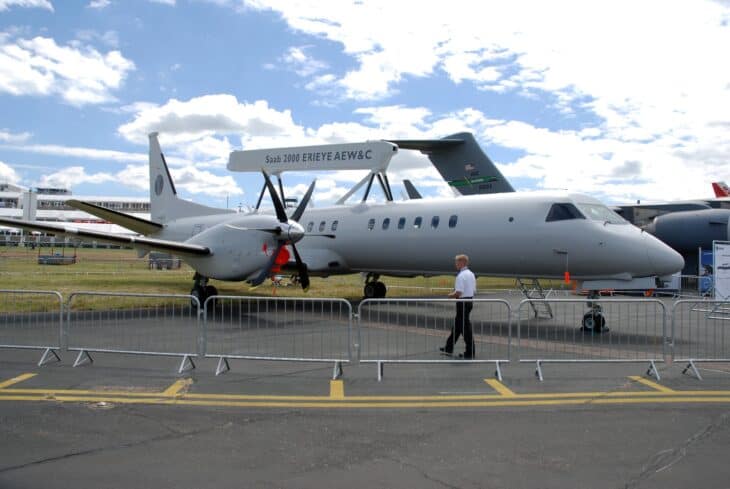

The Erieye “plank” radar is how smaller air forces get airborne early warning. It is a fixed, two-sided AESA on top of a Saab 2000, a Saab 340 or an Embraer ERJ-145.
Pakistan flies nine Saab 2000 Erieyes, Brazil five E-99Ms and Greece four, and Sweden has approved two of its ASC 890s for Ukraine. Pakistan used its fleet in the 2025 conflict with India.
India built its own version, the DRDO Netra, on the EMB-145I with 240-degree coverage. Its three aircraft received final operational clearance in June 2026, and six improved Mk1A aircraft were approved in December 2025.
These aircraft rank last because the plank cannot see straight ahead or behind and the small cabins limit crew. GlobalEye is the same radar idea, grown up.
What about satellites replacing AWACS?
In June 2025 the Pentagon argued that radar jets are too vulnerable and moved to cancel the E-7 in favor of space-based tracking. The E-3 destroyed on the ground in Saudi Arabia in 2026 and the A-50s shot down over the Sea of Azov in 2024 show the risk is real. But no space-based system does the job yet, Congress kept the E-7 funded, and NATO, Canada and France are all still buying aircraft in 2026.
For the aircraft that collect signals rather than direct air battles, see our list of the most important spy planes ever flown.
FAQ
Sources and references used for research and fact-checking.
- NATO, AWACS: NATO's 'eyes in the sky'
- Saab, GlobalEye AEW&C
- The War Zone, Images Show E-3 Sentry Totally Destroyed From Iranian Strike
- Air & Space Forces Magazine, Meink: Air Force Has Five More E-7s Under Contract
- Wikipedia, Boeing E-7 Wedgetail
- Wikipedia, Grumman E-2 Hawkeye
- Wikipedia, GlobalEye
- Wikipedia, Shaanxi KJ-500
- Wikipedia, EL/W-2085
- Wikipedia, Boeing E-3 Sentry
- Wikipedia, Shaanxi KJ-2000
- Wikipedia, Boeing E-767
- Wikipedia, Beriev A-50
- Wikipedia, Xi'an KJ-600
- Wikipedia, Erieye
- Wikipedia, Netra AEW&C
Get the Newsletter
The latest aviation news and stories sent to your inbox.
About the Author

Tim is the owner and lead editor of AeroCorner since 2019, overseeing aviation content covering aircraft, airlines, airports, and the broader aviation industry. Through years of researching, writing, editing, and publishing aviation-focused content, he has developed extensive practical knowledge of commercial aviation and air travel. Based in Asia and a frequent traveler himself, Tim also brings firsthand passenger experience to AeroCorner’s coverage. Outside of publishing, he has also explored aviation firsthand through hands-on flight training in New Zealand.