

Table of Contents
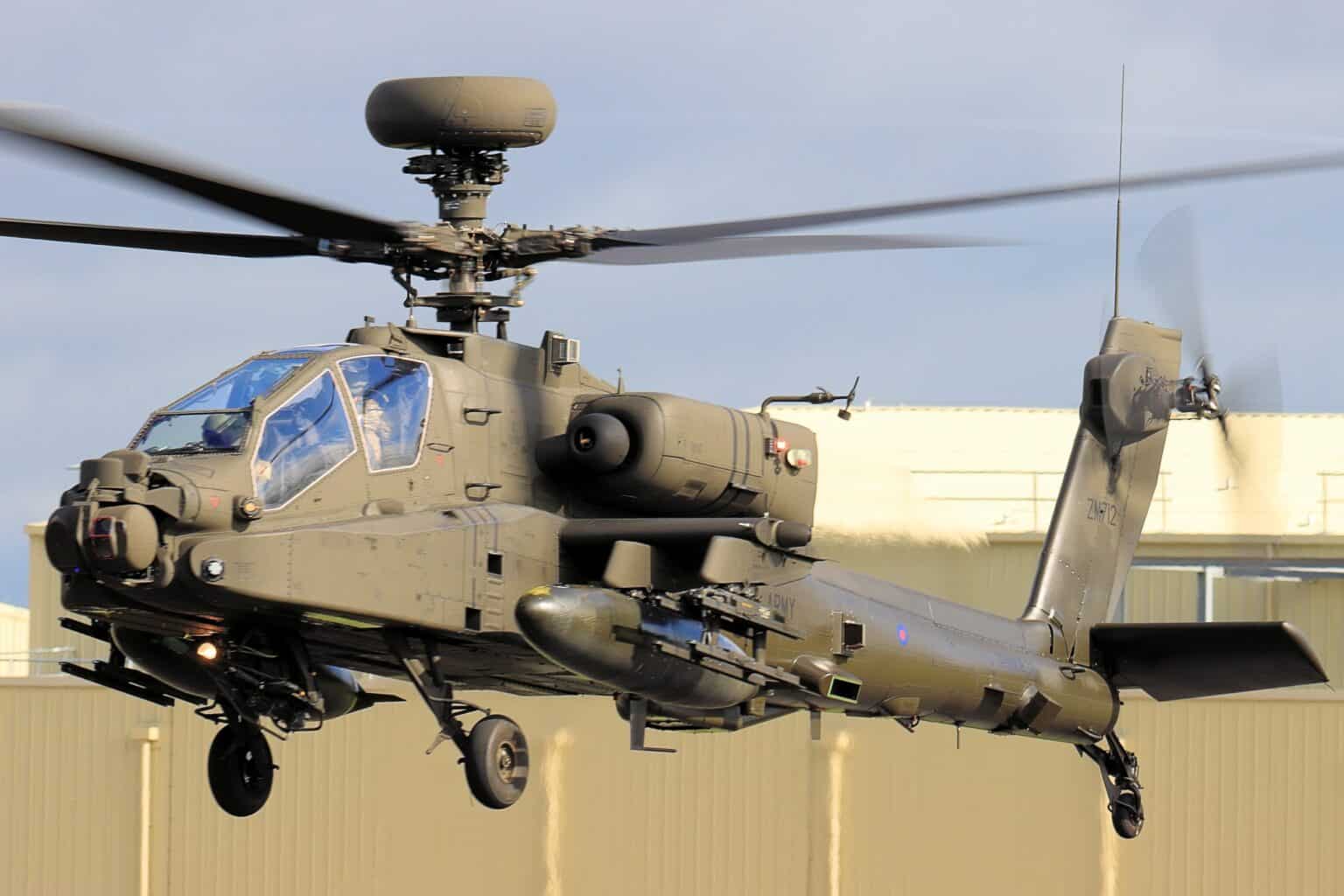
The US Army has 838 AH-64 Apache attack helicopters, according to FlightGlobal’s World Air Forces 2026 directory, which drew its data from Cirium on October 1, 2025. That is the whole US Apache fleet: the Army is the only American service that flies it.
It is also about two of every three Apaches in service anywhere. The same directory counts 1,266 AH-64s across every air arm on Earth.
How Many Apache Helicopters Does the US Have?
FlightGlobal lists 838 AH-64D and AH-64E Apaches in active Army service, plus one more on order. The count leaves out aircraft that Cirium records as not in day-to-day use, so stored and museum airframes are not in it.
The number was already moving when it was printed. In 2025 the Army decided to retire every AH-64D it still had, and by April 2026 it had divested nearly 60 percent of them.

The count at a glance
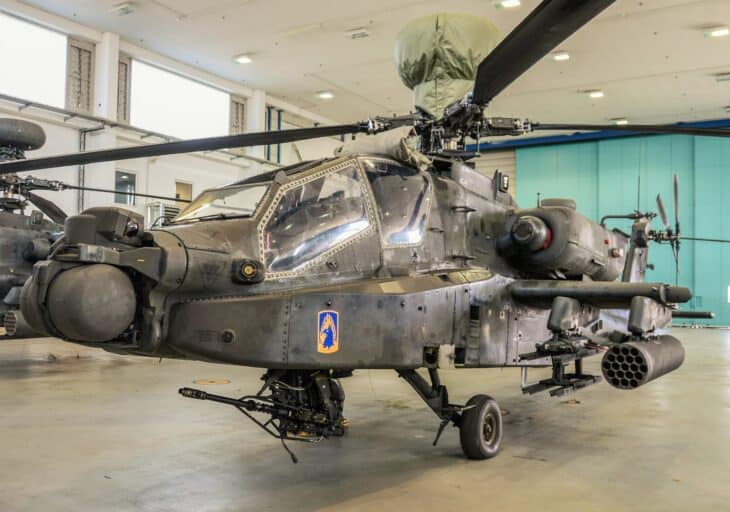
838 AH-64 Apaches in US Army service (FlightGlobal World Air Forces 2026, data from October 1, 2025). About 91 of them were older AH-64D Longbows, now being retired. The rest are AH-64E Guardians. The Army is the only US operator.
The 838 Apaches, by Model
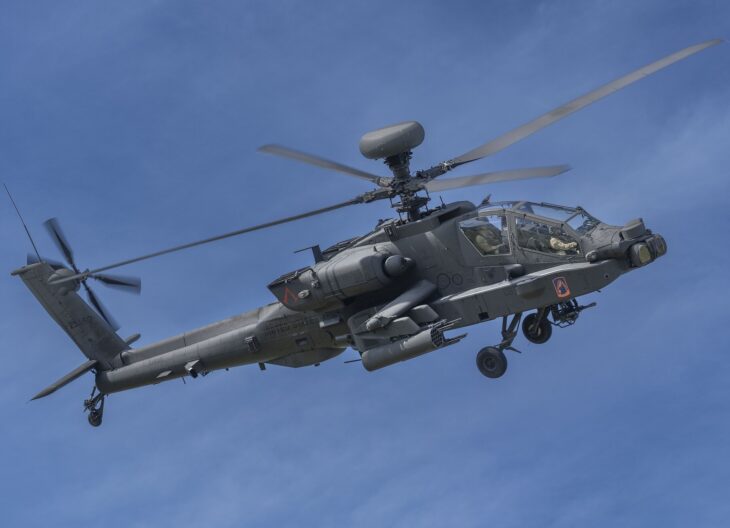
Three generations of the Boeing AH-64 Apache have served in the Army, and only two are left. FlightGlobal does not split its total by model, but Aviation Week reported in May 2025 that the Army planned to retire 91 AH-64Ds, which puts the D-model at about a tenth of the fleet.

| Model | Army fleet | Status |
|---|---|---|
| AH-64E Apache Guardian | About 747 | The future fleet. The Army will fly only this model. |
| AH-64D Apache Longbow | 91 | Being retired. Nearly 60% divested by April 2026. |
| AH-64A Apache | 0 | The last one, Apache 451, retired on July 15, 2012. |
| Total | 838 | Plus 1 on order |
Many of the Army’s Apaches are not new aircraft. Older helicopters go back to Boeing and are rebuilt as the next model: Apache 451, the Army’s last A-model, was retired as an A in 2012 and reconfigured into an AH-64D.
The fleet is organized into 15 attack battalions, 11 in the active Army and four in the National Guard. In May 2025, eight active and three Guard battalions flew the AH-64E, and the rest still flew the D.
For where the Apache sits next to the Black Hawk and the Chinook, see our guide to every type of US Army helicopter.
Why Other Sites Give Different Numbers
Search for this question and you will see 824, 812, about 600, 2,875 and “more than 5,000”. Each one is real, but they count different things.
812 is a target, not a count
The most repeated wrong answer is 812. That is the Army’s acquisition objective for the AH-64E: the number it planned to own. It includes about 115 helicopters for training, 4 for testing and 69 held in reserve, so it was never a count of front-line Apaches.
824 is the older FlightGlobal figure. Earlier editions of the same directory listed 824 AH-64Ds and AH-64Es, and many pages never updated it.
About 600 comes from Congressional Budget Office data on Army aviation from 2000 to 2023, which put the Apache fleet at roughly 600 throughout. It is built from the service’s own aviation data rather than a fleet census, so it does not line up with the directory totals.
2,875 and 5,000 are production numbers, not fleets. Boeing says more than 2,875 Apaches have been produced across the A through E models, while the Army counts more than 5,000 AH-64 deliveries to itself and 18 partners, a figure that can count one rebuilt airframe more than once.
Two smaller things blur any count too. Poland currently leases eight Apaches from the US Army, and in September 2026 the Pentagon’s Lead Inspector General reported that one AH-64 had been shot down over the Strait of Hormuz during the war with Iran. Both happened after FlightGlobal’s October 2025 snapshot.
Where the Number Is Going
Down. The Army Transformation Initiative, announced in spring 2025, set out to retire all of the remaining AH-64Ds and to disband the 11 active air cavalry squadrons, each traditionally equipped with eight Apaches. By late 2025, seven of those squadrons had been deactivated.
In April 2026, Col. Tim Jaeger, the Army’s director of aviation at the G-3/5/7, said the service had divested nearly 60 percent of its D-models in a year. Breaking Defense also reported that Apache procurement funding drops from $361.7 million in fiscal 2026 to $1.5 million in fiscal 2027.
Even the E fleet is shrinking. In May 2026, Aviation Week reported a Pentagon document showing the Army culling AH-64Es in greater numbers the following year, despite its plan to fly the E-model alone.
Some of the retired D-models may fly again elsewhere. Aviation Week reported in 2025 that Boeing could offer them to foreign buyers.
How the US Compares With Everyone Else
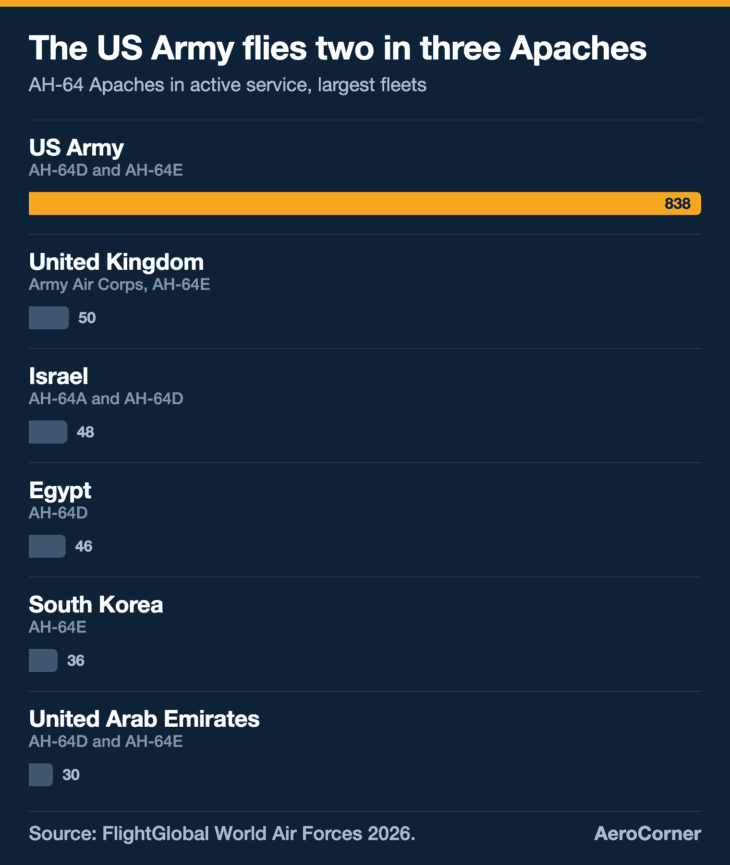
No other country comes close. FlightGlobal’s 2026 directory gives the UK’s Army Air Corps 50 AH-64Es, Israel 48 Apaches and Egypt 46, so the US fleet is more than 16 times the size of the next one.
That gap will narrow. Poland signed a contract worth nearly $4.7 billion for 96 AH-64Es in November 2025, with deliveries expected to begin in 2028, and Boeing says the E-model will stay in production into the 2030s for export customers.
Across all aircraft types, Apaches are a small slice of a much bigger fleet. See how many aircraft the US military has for the full count, and our ranking of the best attack helicopters in the world for how the Apache measures up.
FAQ
Sources and references used for research and fact-checking.
- FlightGlobal, World Air Forces 2026
- Aviation Week, Boeing May Shop U.S. Army's AH-64D For Foreign Sales
- Aviation Week, U.S. Army Retiring Some AH-64Es Despite 'Pure Fleet' Plan
- FlightGlobal, US Army seeks to pure-fleet helicopter inventory by retiring older models
- Defence Industry Europe, U.S. Army plans reduction of AH-64D Apache helicopter fleet amid broader forces reform
- Breaking Defense, Army making 'significant headway' in ATI aviation overhaul, divesting Apache AH-64D fleet
- U.S. Army, Apache Helicopter Celebrates 40 Years
- Boeing, AH-64 Apache
- Boeing, Boeing to Build 96 AH-64E Apache Helicopters for Poland
- Defense News, Report shows a smaller US Army aircraft fleet with fewer flying hours
- Congressional Research Service, U.S. Aircraft Combat Losses in Operation Epic Fury: Considerations for Congress (IN12692)
Get the Newsletter
The latest aviation news and stories sent to your inbox.
About the Author

Tim is the owner and lead editor of AeroCorner since 2019, overseeing aviation content covering aircraft, airlines, airports, and the broader aviation industry. Through years of researching, writing, editing, and publishing aviation-focused content, he has developed extensive practical knowledge of commercial aviation and air travel. Based in Asia and a frequent traveler himself, Tim also brings firsthand passenger experience to AeroCorner’s coverage. Outside of publishing, he has also explored aviation firsthand through hands-on flight training in New Zealand.