


Table of Contents
Yes. In the United States, a bean bag shotgun shell is ammunition in the eyes of federal law, so a civilian can buy one under the same rules as any other shotgun shell. A licensed dealer cannot sell it to anyone under 18, and anyone barred from owning guns is barred from owning it too.
States that control who may buy ammunition, such as California, New York and Illinois, apply those rules to bean bag rounds as well. The one real federal trap is a 37mm flare launcher: load it with bean bags and the ATF treats it as a destructive device that must be registered first.
| Question | Short answer (November 2026) |
|---|---|
| Are bean bag rounds “ammunition” under federal law? | Yes. The ATF says less-than-lethal rounds are still generally ammunition |
| Minimum age to buy from a dealer | 18 for 12-gauge shells (shotgun ammunition), under 18 U.S.C. 922(b)(1) |
| Who cannot own them at all | Anyone prohibited from possessing guns or ammunition under 18 U.S.C. 922(g) |
| Do state ammunition checks apply? | Yes, in states that control who may buy ammunition |
| Is a 37mm launcher with bean bag rounds legal? | Only if registered as a destructive device before getting the rounds (ATF Ruling 95-3) |
| Are they non-lethal? | No. They are “less-lethal”: a 2004 NIJ study counted 8 deaths in 373 incidents |
| Can you fly with them? | In checked bags only, packed in an ammunition box, if the airline allows it |
What Is a Bean Bag Round?
A bean bag round is a shotgun shell that fires a small fabric bag of lead shot instead of a slug or pellets. It is meant to hit hard enough to stop a person without breaking the skin, which is why police call it an impact munition.
Defense Technology’s 12-gauge drag-stabilized round is a typical example. Its spec sheet lists a 1.43 oz (40 g) bag filled with #9 shot, leaving the barrel at 270 feet per second (82 m/s).
The same sheet gives a minimum safe range of 20 feet (6.1 m) and a maximum effective range of 75 feet (22.9 m). It recommends an 18-inch cylinder-bore shotgun with no choke, and that semi-automatic guns or other barrel lengths may change the velocity.
The warning printed on the spec sheet
Defense Technology’s sheet says the round is to be used only by authorized and trained law enforcement, corrections or military personnel, and that it may cause serious injury or death. That is a warning about use, not a law about who may buy it.
Are Bean Bag Rounds Legal Under Federal Law?
Federal law defines ammunition as “ammunition or cartridge cases, primers, bullets, or propellent powder designed for use in any firearm.” A 12-gauge bean bag shell is a loaded cartridge made for a shotgun, so it fits that definition.
The ATF said so directly in a proposed rule published on May 6, 2026. The proposed rule would exempt certain training rounds, but states that “less-than-lethal ammunition, which is distinct from training rounds, will still generally be considered ammunition.”
It names bean bag rounds and rubber pellets used for riot control as the contrast. That is the line the ATF draws: its proposal would take training rounds such as Simunition out of the ammunition definition, while bean bag rounds stay in.
Being ammunition brings three federal rules with it:
- Age: a licensed dealer may not sell any ammunition to someone under 18, or handgun ammunition to someone under 21. Shotgun shells fall under the 18 rule.
- Prohibited persons: anyone in a category listed in 18 U.S.C. 922(g), such as a convicted felon, may not possess ammunition at all.
- No special license: federal law creates no separate permit or law-enforcement-only class for bean bag shells, the same as for ordinary shotgun and rifle ammunition.
The 37mm Launcher Trap
Bean bag rounds are also made for 37mm launchers, not just shotguns. Here federal law changes sharply.
Federal law calls any weapon with a bore over half an inch a destructive device, unless it is a sporting shotgun, was never designed as a weapon, or has been redesigned as a signaling or similar device. The ATF has long treated 37mm gas and flare launchers as exempt signaling devices.
ATF Ruling 95-3, still listed as active, ends that exemption the moment anti-personnel rounds are involved. It holds that 37/38mm launchers “possessed with ‘anti-personnel’ ammunition, consisting of cartridges containing wood pellets, rubber pellets or balls, or bean bags, are destructive devices.”
Register first, buy the rounds second
Under ATF Ruling 95-3, anyone who plans to use anti-personnel rounds in a gas or flare launcher must register the making of a destructive device before getting any of those rounds. The same launcher with flares alone stays a signaling device. That is the same National Firearms Act category that covers grenades.
Our guide to whether civilians can buy grenades covers destructive devices in more detail.
Which States Check Bean Bag Round Buyers?
No special bean bag law is needed for a state to regulate them. Any state that controls who may buy ammunition controls bean bag shells too, because they are ammunition.
| State | Rule for every ammunition buyer | Law |
|---|---|---|
| California | The state Justice Department must approve each purchase electronically before the buyer takes the ammunition (since July 1, 2019), and sales generally go through licensed ammunition vendors | Penal Code 30370, 30312 |
| New York | Sellers must run a background check on every ammunition sale (in effect since September 13, 2023) | Executive Law 228, Penal Law 400.03 |
| Massachusetts | No ammunition may be transferred to anyone without the required license, card or permit | Acts of 2024, Chapter 135 |
| Illinois | No one may acquire or possess ammunition without a Firearm Owner’s Identification (FOID) card | 430 ILCS 65/2 |
| Connecticut | Buyers need a pistol permit, an eligibility certificate or an ammunition certificate, and must be 18; a sale without one is a class D felony | CGS 29-38m |
California’s Penal Code goes further and names the category. It defines “less lethal ammunition” as rounds designed to immobilize, incapacitate or stun a person, including ones fired from a shotgun.
California also makes it a misdemeanor to sell a less lethal weapon to anyone under 18. That rule covers the weapon itself rather than the rounds. Local rules vary, so check your own state and city before buying.
1995
ATF Ruling 95-3 classes 37/38mm gas and flare launchers possessed with bean bag or other anti-personnel rounds as destructive devices.
October 2004
A National Institute of Justice study of 373 police impact-munition incidents counts 8 deaths.
2017
A BMJ Open review of 26 studies finds 53 deaths among 1,984 people hit by impact rounds.
July 1, 2019
California starts approving every ammunition purchase electronically before the buyer takes it.
September 13, 2023
New York starts background checks on every ammunition sale.
July 25, 2024
Massachusetts approves Chapter 135, which rewrites its gun laws and keeps ammunition sales tied to a license, card or permit.
May 6, 2026
An ATF proposed rule on training rounds states that less-than-lethal rounds generally remain ammunition.
Can Bean Bag Rounds Kill You?
Yes. That is why police and makers call them “less-lethal,” not non-lethal.
A 2004 National Institute of Justice study by Ken Hubbs and David Klinger reviewed 373 incidents from 106 law enforcement agencies, in which 969 impact projectiles were fired. Eight people died as a result of being hit.
Counting two more deaths from lethal shells loaded by mistake, at least five of the 10 people who died had been hit by bean bags, sometimes along with other rounds. In the six deaths with enough detail, five people were struck in the chest.
At least three died when a round broke one or more ribs that then pierced the heart or lungs.
One person died after a bean bag hit the neck, and in another case a bean bag went through a person’s chest wall and punctured a lung. Distance mattered: almost 10% of rounds fired from 10 feet (3 m) or less broke bones.
The bean bag that was not a bean bag
The NIJ study records a man killed by a 12-gauge door-breaching round, loaded by an officer who thought the shell held a bean bag. Bean bag shells load into the same 12-gauge guns as live shells, so the two can be mixed up.
A 2017 systematic review in BMJ Open, led by Rohini Haar, pooled 26 studies of rubber bullets, bean bags and other impact rounds used at protests, arrests and other settings. It covered 1,984 injured people, of whom 53 died and 300 were left permanently disabled.
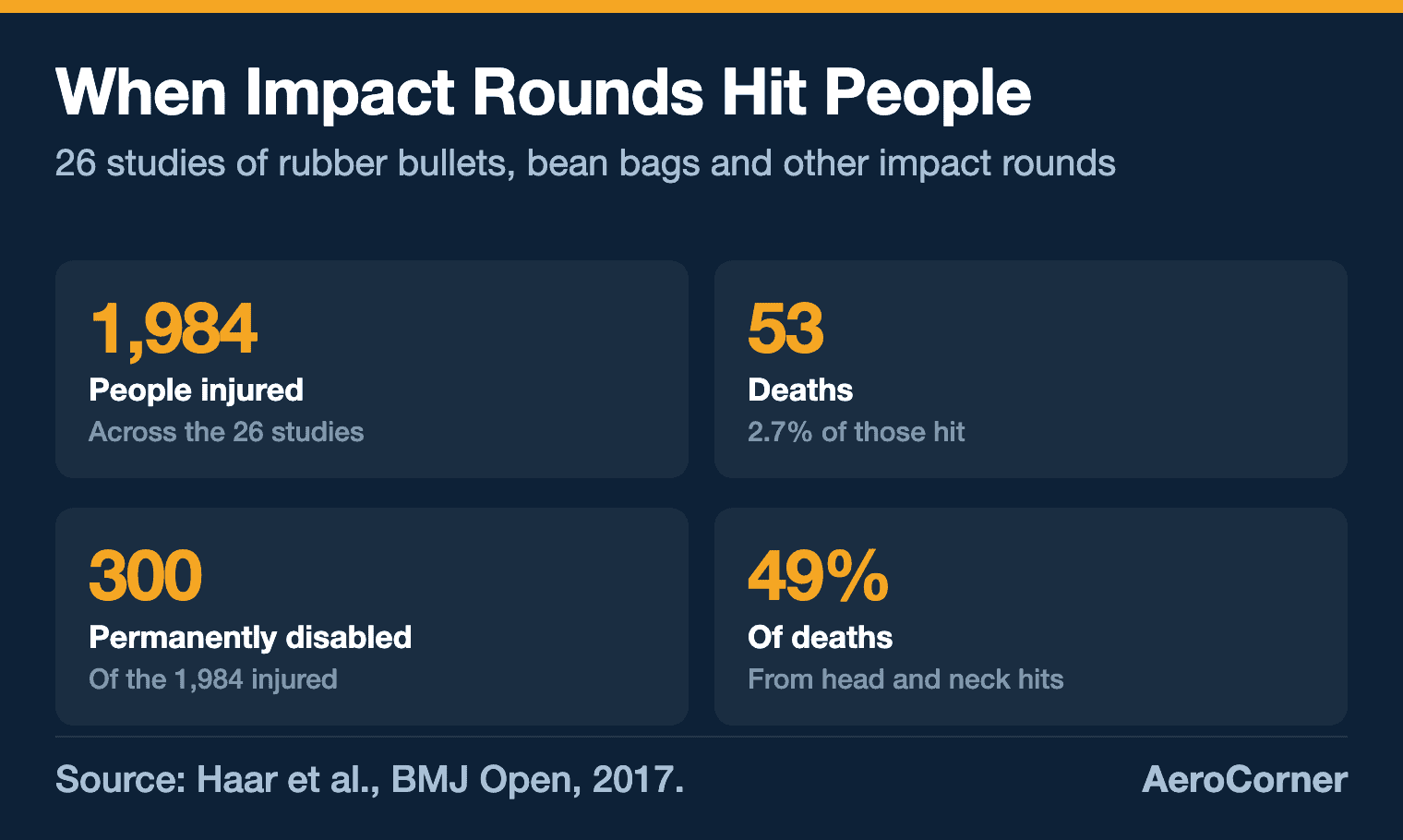
Head and neck hits caused 49.1% of the deaths and 82.6% of the permanent disabilities in that review. The figures cover all impact rounds, not bean bags alone.
Are Bean Bag Rounds Good for Home Defense?
They are a poor fit for the job people imagine. The NIJ study says plainly that less-lethal devices and impact munitions “are not 100 percent effective.”
The maker’s own figures also leave a narrow window. Defense Technology lists 20 feet (6.1 m) as the minimum safe range, which rules out a close-range shot.
Shooting someone with a bean bag round is still a use of force with a weapon, judged under the same assault and self-defense laws as any other. Rules differ by state, so a local criminal defense lawyer is the right person to ask.
Other less-lethal tools come with their own laws. Our guides cover tear gas and flashbangs, each with its own set of laws.
Can You Fly With Bean Bag Rounds?
Only in checked baggage. The TSA lists ammunition as “No” for carry-on bags and “Yes (Special Instructions)” for checked bags, and tells travelers to check with their airline first. Like the item-by-item rules for bringing a razor on a plane, the answer depends on which bag it goes in.
The TSA requires small arms ammunition to be “securely packed in fiber, wood or metal boxes or other packaging specifically designed to carry small amounts of ammunition.” Federal hazardous materials rule 49 CFR 175.10 allows it in checked baggage only, for personal use, on the same packing terms.
The FAA’s PackSafe guidance says shotgun shells count as small arms ammunition and allows a reasonable amount for personal use. It adds that international rules and some U.S. airlines cap it at 11 pounds (5 kg) gross weight per passenger.
Arriving with them is a separate question. Check the ammunition rules of the state you land in, because states such as Illinois also regulate who may possess ammunition there.
FAQ
Sources and references used for research and fact-checking.
- Cornell Law School LII, 18 U.S. Code § 921 - Definitions
- Cornell Law School LII, 18 U.S. Code § 922 - Unlawful acts
- Federal Register (ATF), Importing Training Rounds, proposed rule, May 6, 2026
- ATF, ATF Ruling 95-3: 37/38mm Gas/Flare Guns with Anti-Personnel Ammunition are Defined as NFA Weapons
- California Department of Justice, Ammunition Purchase FAQs
- California Penal Code, Penal Code section 30370
- California Penal Code, Penal Code section 16770: less lethal ammunition
- California Penal Code, Penal Code section 19405
- New York State Senate, Penal Law section 400.03
- New York State Senate, Executive Law section 228
- Spectrum News, New York ammunition background check law takes effect
- Commonwealth of Massachusetts, Acts of 2024, Chapter 135: An Act Modernizing Firearm Laws
- FindLaw, 430 ILCS 65/2: Firearm Owners Identification Card Act
- Connecticut General Assembly, Chapter 529, sections 29-38m to 29-38o
- National Institute of Justice, Impact Munitions Use: Types, Targets, Effects (NCJ 206089, 2004)
- BMJ Open (PubMed Central), Death, injury and disability from kinetic impact projectiles in crowd-control settings: a systematic review
- Defense Technology, 12-Gauge Drag Stabilized Round spec sheet
- TSA, What Can I Bring? Ammunition
- FAA, PackSafe: Ammunition
- Cornell Law School LII, 49 CFR 175.10: Exceptions for passengers and crewmembers
Get the Newsletter
The latest aviation news and stories sent to your inbox.
About the Author

Tim is the owner and lead editor of AeroCorner since 2019, overseeing aviation content covering aircraft, airlines, airports, and the broader aviation industry. Through years of researching, writing, editing, and publishing aviation-focused content, he has developed extensive practical knowledge of commercial aviation and air travel. Based in Asia and a frequent traveler himself, Tim also brings firsthand passenger experience to AeroCorner’s coverage. Outside of publishing, he has also explored aviation firsthand through hands-on flight training in New Zealand.