

Mid Size Passenger Jets
McDonnell Douglas MD-95 / Boeing 717
ICAO: B712
The Mach 2.7 airliner America ordered, mocked up and canceled before it ever flew.
Updated: by Tim de Vries
The latest aviation news and stories sent to your inbox.
The Boeing 2707 was America’s supersonic transport: a titanium airliner designed to carry 298 passengers at Mach 2.7, about 1,800 mph. Boeing won the government design competition on December 31, 1966, and 26 airlines reserved 122 delivery positions. Congress cut off the money in March 1971, before either prototype was finished, and no 2707 ever flew.


The Boeing 2707 was the United States’ government-backed supersonic transport, or SST. It was designed to carry 298 passengers at Mach 2.7, roughly three times the speed of the jets it would have replaced, and it was to be built mostly of titanium.
Boeing won the national design competition on December 31, 1966. Twenty-six airlines went on to reserve 122 delivery positions.
No 2707 ever flew. Congress voted to cut off federal funding in March 1971, while Boeing was still building the first two prototypes, and the program ended with a full-scale mockup and a set of unfinished parts.
Boeing started studying supersonic transports in 1952 and set up a permanent SST project in 1958. The push to build one came from Washington, not from the airlines.
In November 1962, Britain and France announced that they would build Concorde together. The Soviet Union was known to be working on its own design, which became the Tupolev Tu-144.
When Pan Am took options on six Concordes in 1963, the fear in Washington was that American airlines would end up buying their next generation of airliners from Europe. President John F. Kennedy announced the National Supersonic Transport program in a speech at the U.S. Air Force Academy on June 5, 1963.
The government would pay most of the development cost and recover it through royalties on sales. The Federal Aviation Administration ran the competition and estimated a market of 500 SSTs by 1990.
Boeing, Lockheed and North American Aviation submitted airframe proposals in January 1964, and General Electric, Pratt & Whitney and Curtiss-Wright competed for the engine. North American’s entry was a scaled-up airliner derivative of its XB-70 Valkyrie bomber, and it was dropped along with Curtiss-Wright.
Lockheed’s L-2000 was a large double-delta design, close in concept to Concorde. Boeing bet on a swing wing, which could spread wide for takeoff and landing and fold back into a delta for supersonic cruise.
Both companies built full-scale mockups for the final round in 1966. On December 31, 1966, the FAA picked Boeing’s design and General Electric’s GE4 engine, even though Lockheed’s aircraft was judged simpler and less risky to build.
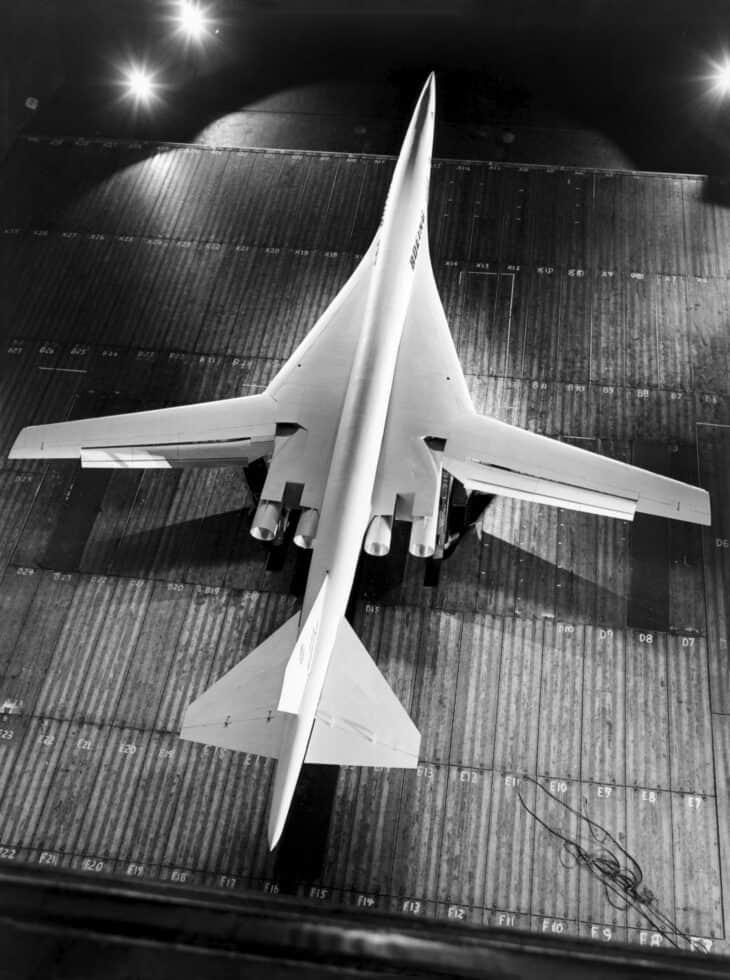
The winning design, known inside Boeing as the Model 733-390 and in public as the 2707, was a monster. Boeing’s published figures for the swing-wing design gave it a length of 306 feet, a wingspan of 180 feet with the wings spread and 106 feet swept to 72 degrees, and a maximum takeoff weight of 675,000 pounds.
The problem was weight. One titanium wing pivot section that Boeing fabricated weighed 4,600 pounds, the pivots and their structure kept growing, and the heavier airplane could no longer fly the range the airlines needed.
Adding canards behind the nose, in a version sometimes called the 2707-200, made the weight worse. In October 1968 Boeing gave up on the swing wing altogether.
The replacement, the 2707-300, used a fixed delta wing with a separate conventional tail, a layout that looked much like the Lockheed design Boeing had beaten. Work on a new full-scale mockup and two flying prototypes began in September 1969, about two years behind the original schedule.
Boeing’s September 1969 design description is the most complete public record of the aircraft that was actually being built. It describes a 298-seat airliner with the passengers six abreast at a 34-inch seat pitch, in seats Boeing said were wider than those in any six-abreast jet then flying.
The cabin carried seven galleys and seven lavatories, and a crew of three flew it: captain, first officer and flight engineer. The whole nose section pivoted down for takeoff and landing, so the pilots could see the runway over the long forebody.
The flight deck was ahead of its time. Boeing specified electronic attitude director indicators, a moving-map navigation display, three inertial navigation systems and satellite communications.
The airframe was titanium alloy because the heat of sustained Mach 2.7 flight called for a metal that could take higher temperatures than aluminum. Boeing designed the structure for a minimum life of 50,000 flight hours.
Four General Electric GE4 afterburning turbojets, each in its own pod under the wing, powered the aircraft. The engines burned the same Jet A kerosene as subsonic airliners.
The typical mission in Boeing’s document climbed to 60,000 feet, cruised supersonically up to 64,000 feet and covered its distance in 2 hours 56 minutes. Boeing put New York to Paris at 2 hours 45 minutes, against 6 hours 45 minutes for a 707.
Boeing expected SSTs to fly supersonic only over oceans and empty land, and it said the 2707 would lose little range when forced to fly subsonic over populated areas.
The full specification table for the aircraft is on this page, and it describes the 2707-300 in Boeing’s September 1969 design document. Figures found elsewhere often differ because they describe another version of a design that changed repeatedly between 1964 and 1969.
The length is the best example. The 306 feet quoted by many sites is the swing-wing design, and the 318 feet on Boeing’s own history page matches no 2707-300 document.
The prototypes would have been shorter still, about 287 feet long with a 142 feet wingspan according to Boeing’s March 1971 backgrounder, because Boeing planned the production aircraft to be somewhat larger.
Seating varies for the same reason. Wikipedia gives 234 seats for the 2707-300, while Boeing’s 1969 document lists 253 to 321 depending on the cabin layout, with 298 as the basic all-economy arrangement shown on this page.
Boeing described the range in plain language as “about 4,000 miles,” Paris to New York, which is the statute-mile version of the nautical-mile mission figure in the panel. Its later backgrounders also rounded the engine thrust down to “more than 60,000 pounds” per engine.
The speed is usually given as Mach 2.7, which is the design Mach number. Boeing chose it because its studies showed operating costs stayed roughly flat up to Mach 2.7 and climbed steeply above it, as the heat demanded more exotic materials and systems.
Airlines did not place firm orders. They paid for delivery positions, a place in the queue for an aircraft that did not exist yet.
By June 1970, 26 airlines held 122 positions. Boeing’s list put TWA, Pan Am, Alitalia and American Airlines at the front of the line, with carriers including BOAC, Japan Air Lines, Qantas, Air France, Lufthansa, KLM, Delta and United further back.
Each position cost the airline a $200,000 deposit paid into the U.S. Treasury. Ten airlines also put up $58.5 million in risk capital toward the prototypes, according to Boeing’s March 1971 summary.
Boeing forecast a minimum market of 540 SSTs by 1990. By the time funding ended, Airways magazine counted 115 unfilled orders from 25 airlines, against 74 Concorde orders from 16 customers.
The 2707 was killed by cost, noise and politics together, and the vote was close.
Money was the first problem. Boeing’s November 1970 financing summary put the prototype phase alone at $1.283 billion through the first 100 hours of flight testing, of which the government would pay $1.051 billion, on top of $308 million already spent on the design competition.
The sonic boom was the second. Air Force sonic boom tests over Oklahoma City in 1964 had produced thousands of complaints and more than 4,600 formal damage claims, and critics argued a fleet of SSTs would do the same along every route.
Boeing’s own environmental backgrounder put the 2707’s boom at 2 to 2.5 pounds per square foot on the ground. That is roughly 18 to 23 times the 0.11 psf limit the FAA proposed in 2026 for the next generation of supersonic aircraft.
Environmental groups also warned that a large fleet flying above 60,000 feet could damage the ozone layer. Senator William Proxmire of Wisconsin attacked the program as wasteful federal spending, and his side won the argument in Congress.
In March 1971, the House voted 215 to 204 against further SST funding. On March 24, 1971, the Senate followed, 51 to 46, despite President Richard Nixon lobbying senators personally.
Nixon called the vote “distressing and disappointing.” In May 1971 the House briefly voted money to restart the program, and the Senate refused, which ended it.
The cancellation landed at the worst possible moment for Boeing, which was also losing government contracts and facing a slump in airline orders. The company cut its workforce by more than 60,000 people across this period.
In 1971 a billboard went up near Seattle-Tacoma International Airport that read “Will the last person leaving Seattle turn out the lights.” The SST became known as the airplane that almost ate Seattle.
The program left one lasting mark on the city. Seattle’s NBA team, founded in 1967, was named the SuperSonics after Boeing’s SST contract win.
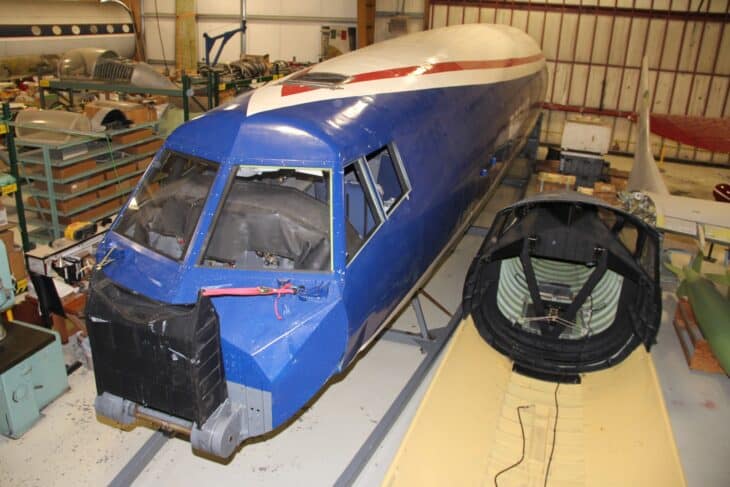
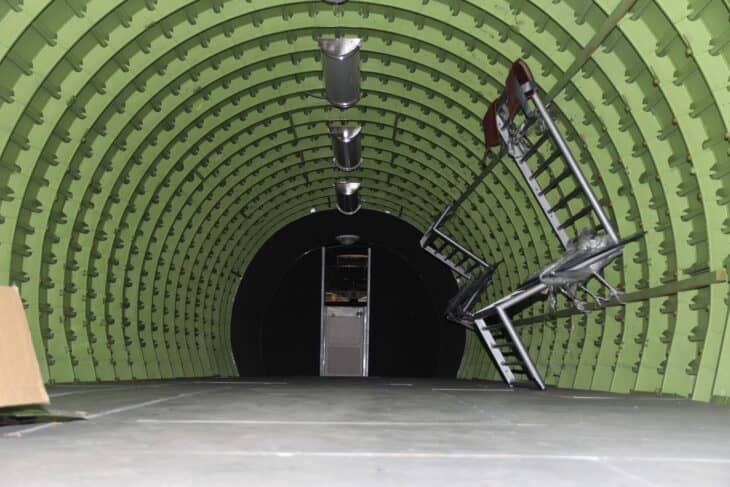
The full-scale mockup survived, though not in one piece. In 1972 it was sold by sealed bid for $31,119 to a buyer who planned an aviation museum in Florida, and it traveled south on seven railroad cars.
It went on show at the SST Aviation Exhibit Center in Kissimmee, Florida, from 1973 to 1981. In 1983 a church bought the building with the mockup still inside and held services beneath it.
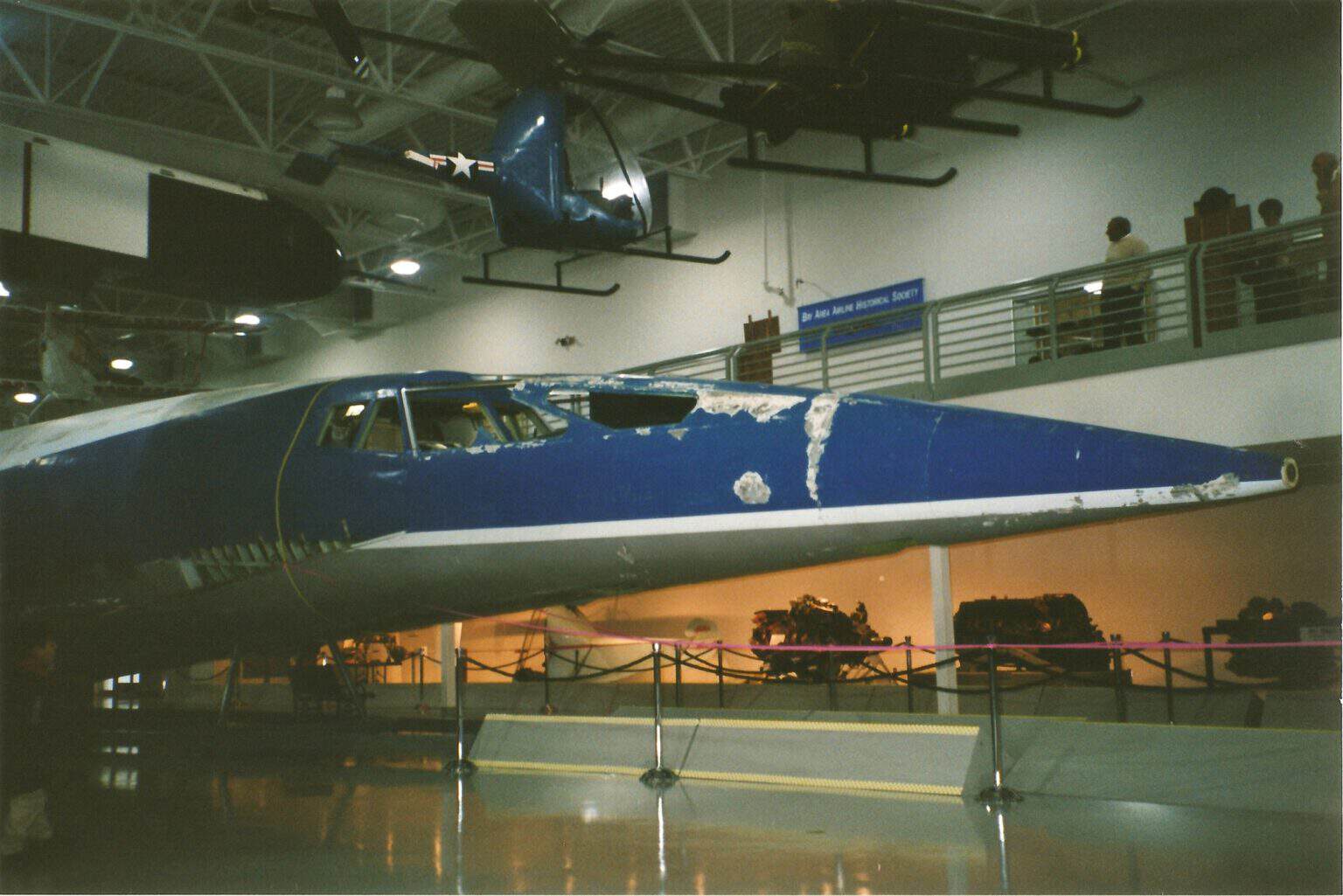
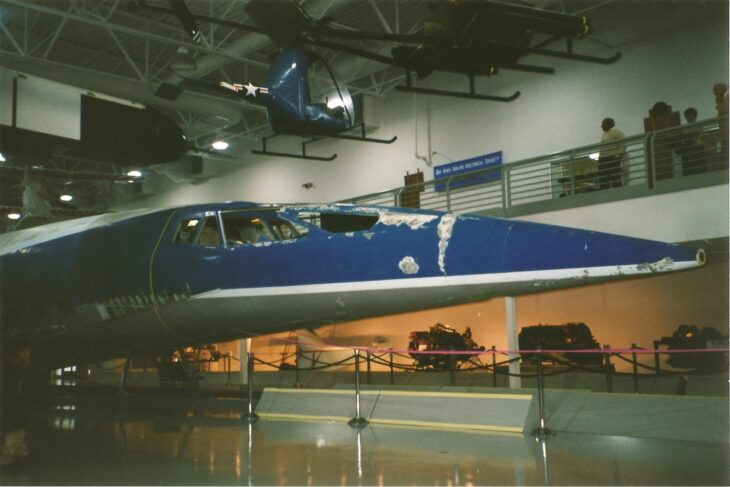
When the congregation needed the space in 1990, aircraft restorer Charles Bell bought the mockup and moved it in pieces to Merritt Island. The forward fuselage later went on display at the Hiller Aviation Museum in San Carlos, California.
In April 2013 that forward section was moved back to Washington state, to the Museum of Flight’s restoration facility at Paine Field in Everett. The latest public report, from 2024, still places it there.
The 2707 was designed to beat Concorde by being bigger and faster, not by getting there first. Boeing’s own June 1970 comparison sheet shows how far apart the two were.
Boeing listed the production Concorde at 385,000 pounds maximum takeoff weight, 193 feet long and 128 passengers, cruising at Mach 2.05 or 1,350 mph. It put the Tu-144 at 330,000 pounds and 120 passengers at Mach 2.35.
The 2707 would have weighed roughly twice as much as Concorde and carried more than twice the passengers. Boeing claimed its productivity, in seat-miles per flight hour, would be three times Concorde’s and more than twice that of an advanced 747.
Concorde flew, and the 2707 did not. But Concorde’s own economics bore out the doubts: sales were forecast at around 150, only 14 aircraft entered airline service, and the type retired in 2003, a story told in why Concorde was beaten on paper, not in the air.
The SST shaped the airliner that outlived it. Boeing designed the 747 in the same years expecting supersonic jets to take over long-haul passenger flying, which is why it put the 747’s flight deck upstairs so the nose could open for freight, as explained in the story of the 747’s hump.
Supersonic work continued at Boeing without a flying product. NASA funded Advanced Supersonic Transport studies in the late 1970s, and Boeing was part of the High Speed Civil Transport project in NASA’s High-Speed Research program from 1990 to 1999.
The rule that grew out of the SST fight has lasted longer than the aircraft. In 1973 the FAA banned civil supersonic flight over the United States, and the ban still stands in 2026.
In July 2026 the FAA proposed replacing the ban with a limit on how loud a sonic boom may be at the ground.
The change is followed closely by developers such as Boom Supersonic, maker of the Boom Overture. As of September 2026 the proposal had not become a final rule, and the debate over its sonic boom metric is still running.
No. Boeing was building two prototypes when Congress ended federal funding in March 1971, and neither was finished. Boeing’s program schedule had planned the first flight for late 1972 or early 1973.
Congress stopped paying for it. The House voted 215 to 204 against further funding in March 1971 and the Senate followed 51 to 46 on March 24, 1971, driven by the rising cost, sonic boom and airport noise concerns, and fears about the ozone layer.
No flying or complete 2707 exists. The forward fuselage of the full-scale mockup is at the Museum of Flight’s restoration facility at Paine Field in Everett, Washington, where it has been since April 2013.
Part of it does. After years in a Florida museum, a church and storage, the forward fuselage survives, including the flight deck section, and it is being restored by the Museum of Flight.
No. Since no 2707 was ever completed or flown, none crashed. Concorde’s only crash, Air France Flight 4590, happened in July 2000.
Its design cruise speed was Mach 2.7, which Boeing gave as about 1,800 mph, at altitudes above 60,000 feet. That is faster than Concorde, and Concorde’s own transatlantic times have never been matched by an airliner since.
Boeing’s basic 2707-300 layout seated 298 passengers six abreast in an all-economy cabin. Mixed-class and denser layouts ranged from 253 to 321 seats.
Only the mockup was ever sold. It went by sealed bid in 1972 for $31,119, and the surviving forward section now belongs to the Museum of Flight.
Sources and references used for research and fact-checking.

.jpg)
_(2).jpg)
_(2).jpg)