Military Aircraft
North American B-45 Tornado
ICAO: B45
The six-engine Mach 3 bomber prototype that became NASA's supersonic research aircraft
Updated: by Tim de Vries
The latest aviation news and stories sent to your inbox.
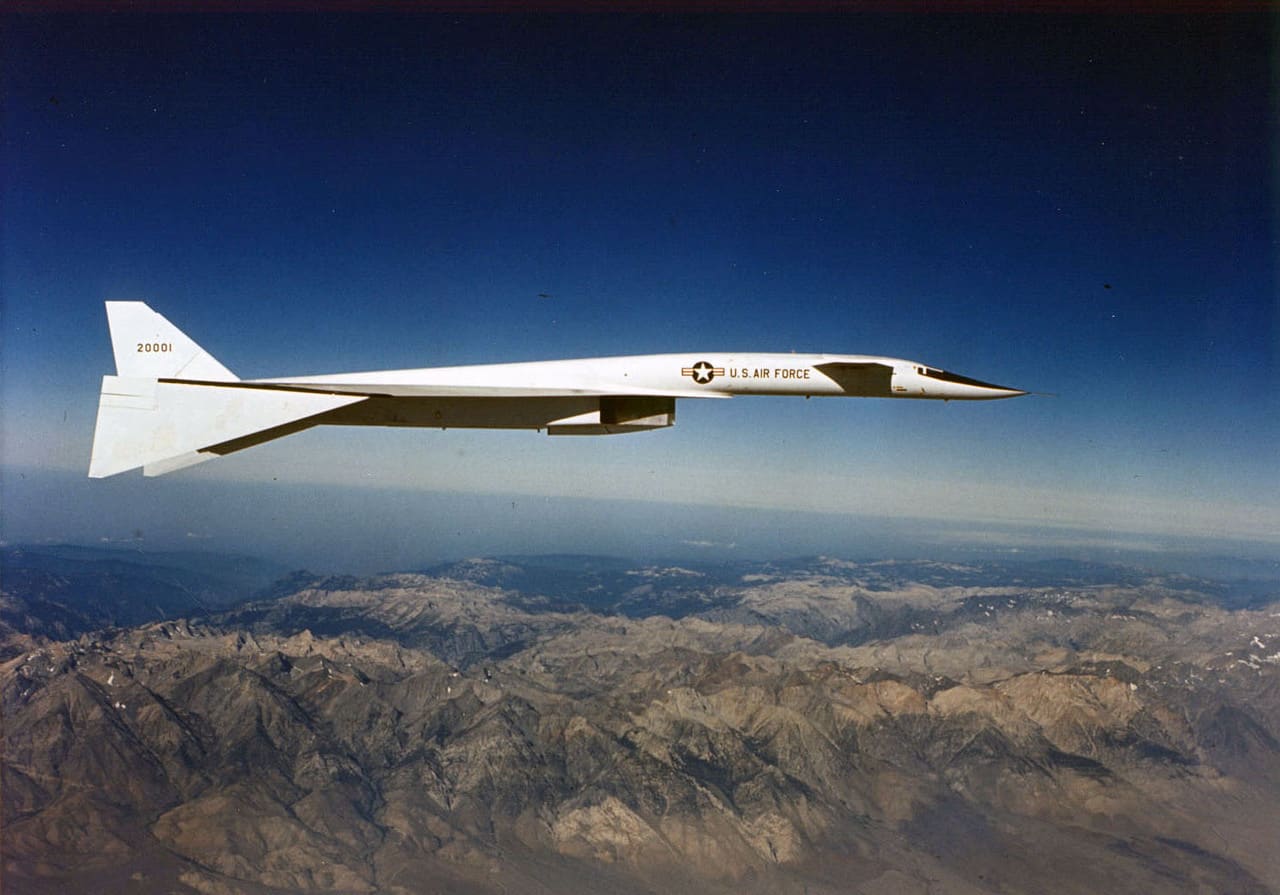
The North American XB-70 Valkyrie was the prototype of the B-70, a six-engine nuclear bomber designed to cruise at Mach 3 and 70,000 feet. The bomber was canceled in 1961 as surface-to-air missiles and ICBMs changed the mission, and only two XB-70A research aircraft were built. They flew 129 times between 1964 and 1969, and the survivor is on display at the National Museum of the United States Air Force.



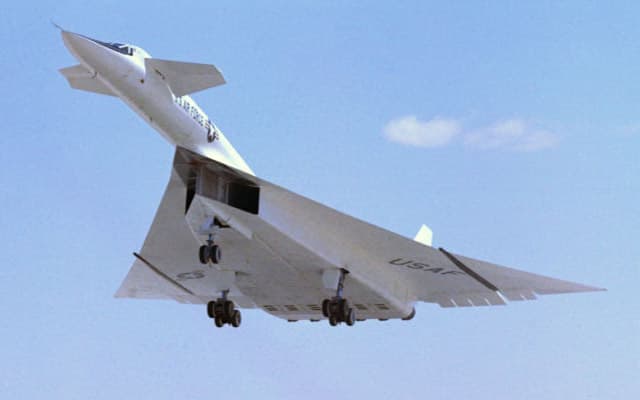
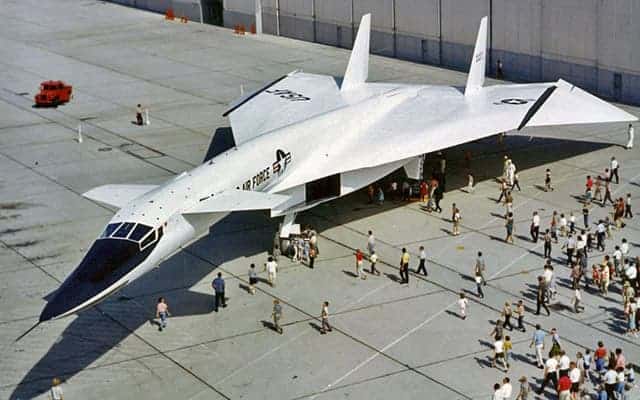
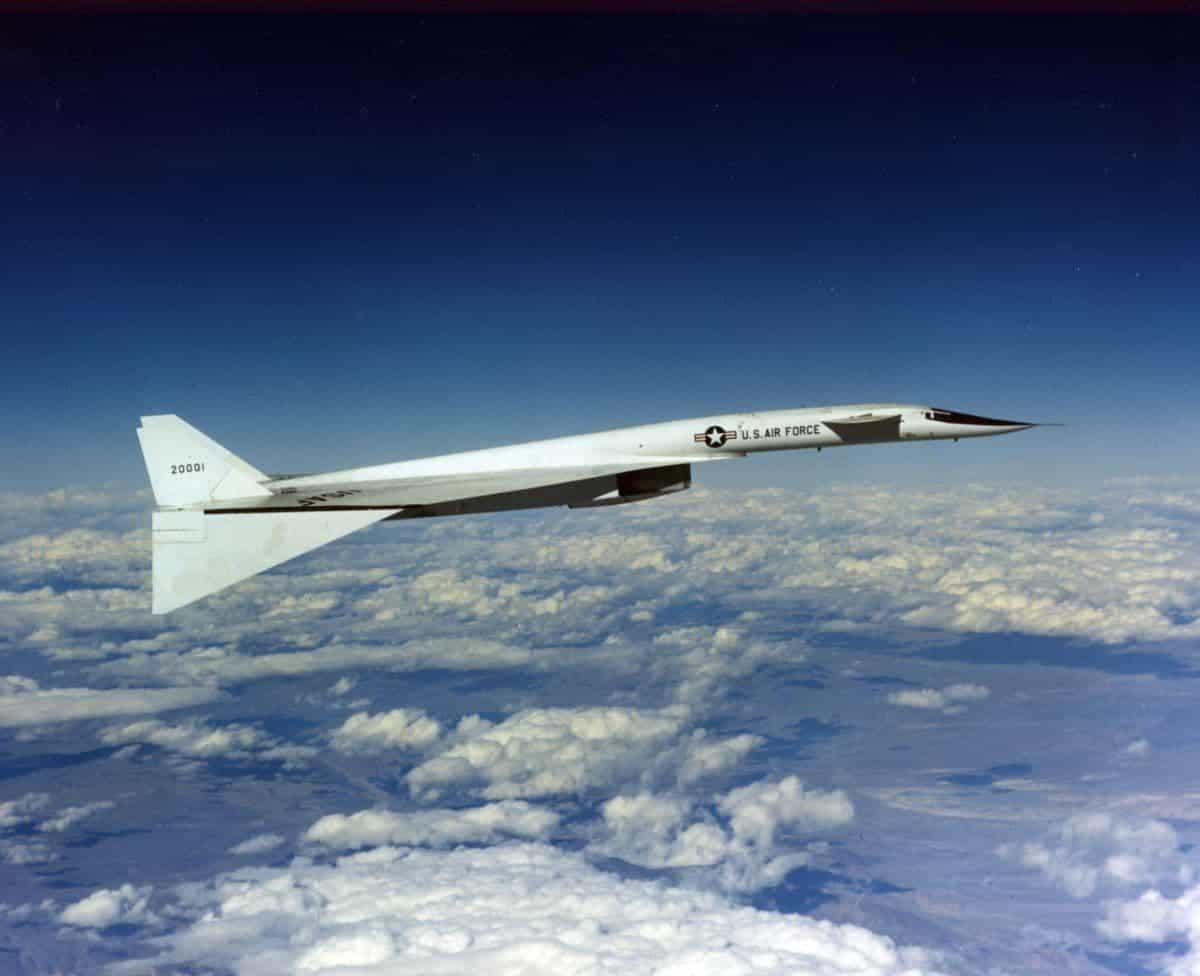
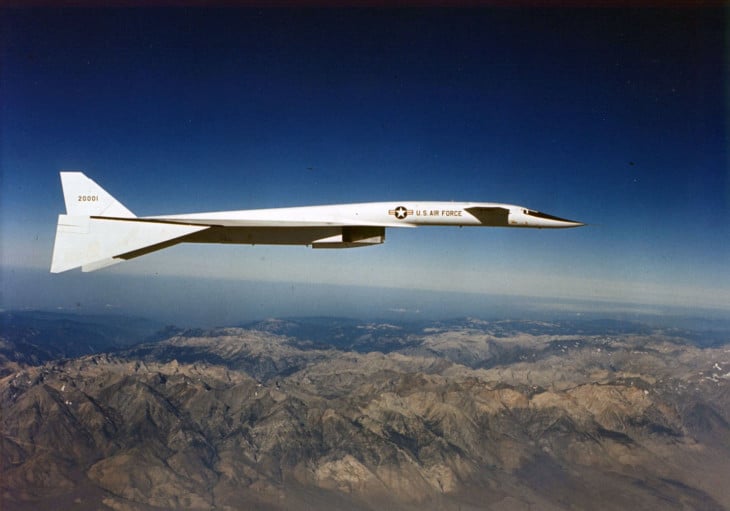
The North American XB-70 Valkyrie was a six-engine, delta-winged prototype of the B-70, a nuclear bomber the U.S. Air Force wanted to cruise at three times the speed of sound at 70,000 feet (21,300 m). It first flew on 21 September 1964.
The bomber never entered production. By the time the first prototype flew, the B-70 program had been cut back to research, and only two aircraft were ever finished.
The pair flew 129 times between 1964 and 1969. One was destroyed in a mid-air collision in 1966, and the survivor is on display at the National Museum of the United States Air Force near Dayton, Ohio.
In 1955 the Air Force issued General Operational Requirement No. 38 for a bomber that combined the payload and intercontinental range of the B-52 Stratofortress with the Mach 2 top speed of the B-58 Hustler. The program was called Weapon System 110A.
Boeing and North American Aviation both won study contracts in November 1955. Their first designs weighed about 750,000 pounds (340,000 kg) and carried huge wingtip fuel tanks meant to be dropped before a supersonic dash, which prompted General Curtis LeMay to say, “This is not an airplane, it’s a three-ship formation.”
Engine and wind tunnel work then changed the math. An engine built for high speed burned roughly twice as much fuel at that speed but moved the aircraft up to four times as fast, so the most economical cruise speed was the top speed, and the design was reworked to fly the whole mission at Mach 3.
North American’s version won on 23 December 1957. The designation B-70 followed in February 1958, and the name Valkyrie came from a “Name the B-70” contest that drew 20,000 entries.
The XB-70 rode its own shock wave. The leading edge of the splitter at the front of the engine intake threw off a shock that North American positioned under the wing, so the high-pressure air behind it pushed up on the aircraft. This effect, called compression lift, supplied about five percent of the total lift at cruise.
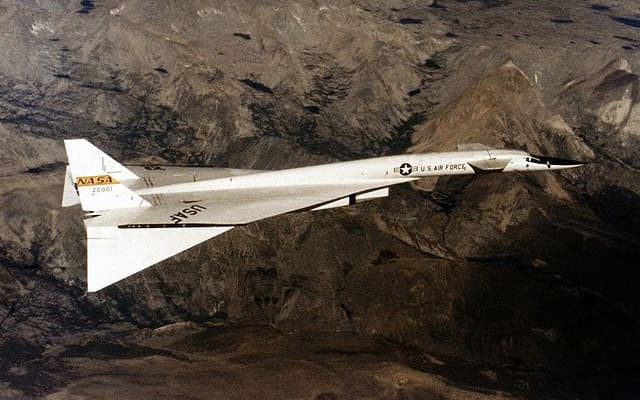
The outer wing panels hinged downward to trap that shock under the wing. They folded as far as 65 degrees at high speed, which also added vertical surface for directional stability and moved the center of lift forward to cut trim drag.
Friction heating was the other problem. At a Mach 3 cruise the skin averaged about 450°F (230°C), and the leading edges reached about 630°F (330°C), so most of the airframe was built from stainless steel honeycomb sandwich panels, with titanium in the hottest areas.
Fuel did double duty as a coolant. The special high-temperature JP-6 was pumped through heat exchangers on its way to the six General Electric YJ93-GE-3 turbojets, and nitrogen was used to fill the space above the fuel to reduce the risk of the hot fuel igniting.
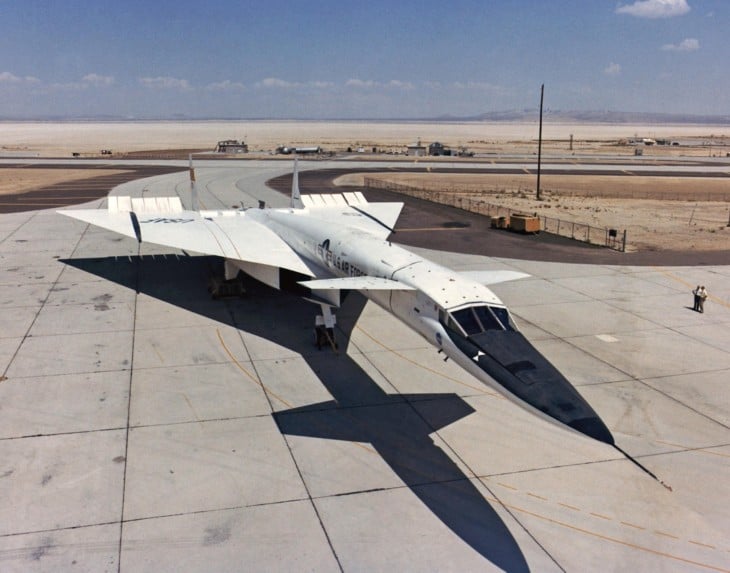
The production B-70 was to carry four people: a pilot, a copilot, a bombardier and a defensive systems operator. The research XB-70s needed only the two pilots, so they flew with a crew of two.
Streamlining the nose for Mach 3 made it hard to see out on landing. The XB-70 solved this with an outer windshield and ramp that lowered for low-speed flight and raised into a smooth wedge at high speed, the same visibility problem that Concorde and the Tu-144 later had to solve.
Each pilot sat in an enclosed, clamshell-style escape capsule rather than a simple ejection seat. North American’s XF-108 Rapier interceptor was to share the capsule and two of the engines with the B-70, until the Rapier was canceled in 1959.
The B-70 was designed to beat fighters, and by the late 1950s the threat was surface-to-air missiles. In 1960 an SA-2 missile shot down Gary Powers’ U-2 over the Soviet Union, showing that altitude alone no longer protected an aircraft.
The Air Force’s answer was to penetrate at low level, below enemy radar. That was the one place the B-70 had no edge: at low altitude it was limited to Mach 0.95, only modestly faster than a B-52, while carrying a smaller bomb load over a shorter range at far higher cost.
Intercontinental ballistic missiles made the case harder still. President Eisenhower called them “a cheaper, more effective way of doing the same thing,” and in December 1959 the program was cut to a single prototype.
The B-70 briefly came back during the 1960 election, when John F. Kennedy endorsed it and the Air Force ordered an XB-70 plus 11 YB-70s. Once in office, Kennedy canceled the bomber on 28 March 1961, after $800 million had been spent, calling it “unnecessary and economically unjustifiable.”
LeMay kept fighting for a reconnaissance-strike version, the RS-70, and Congress pushed to fund it in 1962. A White House agreement in March 1962 ended that effort, and the bomber stayed canceled.
The order shrank to three research aircraft in 1961, then to two. The third, AV-3, was canceled in July 1964 before it was finished.
AV-1 (serial 62-0001) was completed in May 1964 at Palmdale, California. Its first flight on 21 September 1964 went badly: one engine was shut down soon after takeoff, a gear warning kept the landing gear down and the speed to 390 mph (628 km/h), and on landing the rear wheels of the left main gear locked, bursting the tires and starting a fire.
AV-1 first went supersonic on 12 October 1964 and passed Mach 3 on 14 October 1965, reaching Mach 3.02 at 70,000 feet. Its honeycomb panels were the weak point: pieces of skin tore away in supersonic flight twice, and the aircraft was limited to Mach 2.5 afterward.
AV-2 (serial 62-0207) first flew on 17 July 1965 with most of those problems fixed, plus 5 degrees of wing dihedral that AV-1 lacked. On 12 April 1966 it reached Mach 3.08, the highest Mach number any Valkyrie flew, and on 19 May 1966 it held Mach 3 for 32 minutes and covered 2,400 miles (3,860 km) in 91 minutes.
Only seven pilots flew the Valkyrie: Al White, Joe Cotton, Fitzhugh Fulton, Van Shepard, Carl Cross, Don Mallick and Ted Sturmthal. AV-1 finished with 83 flights and AV-2 with 46.
On 8 June 1966, AV-2 was flying in close formation with an F-4 Phantom, an F-5, a T-38 and an F-104N for a General Electric publicity photo shoot. All five aircraft used GE engines.
After the photos, the F-104 drifted into the Valkyrie’s right wingtip, rolled inverted over the top of the bomber and struck both vertical tails before exploding. The XB-70 flew straight for about 16 seconds, then entered a spin and crashed north of Barstow, California.
NASA chief test pilot Joe Walker, flying the F-104, and XB-70 copilot Major Carl Cross were killed. North American pilot Al White ejected in his capsule but was seriously injured when his arm was caught as the capsule’s clamshell doors closed.
The Air Force investigation found that from his position, Walker could not see the XB-70’s wing without looking back over his shoulder, and likely lost his sense of relative motion. It added that the wingtip vortex may have rolled the F-104 into the bomber. The photo shoot had not been authorized by the Air Force: one colonel was removed from his post and three other people were reprimanded.
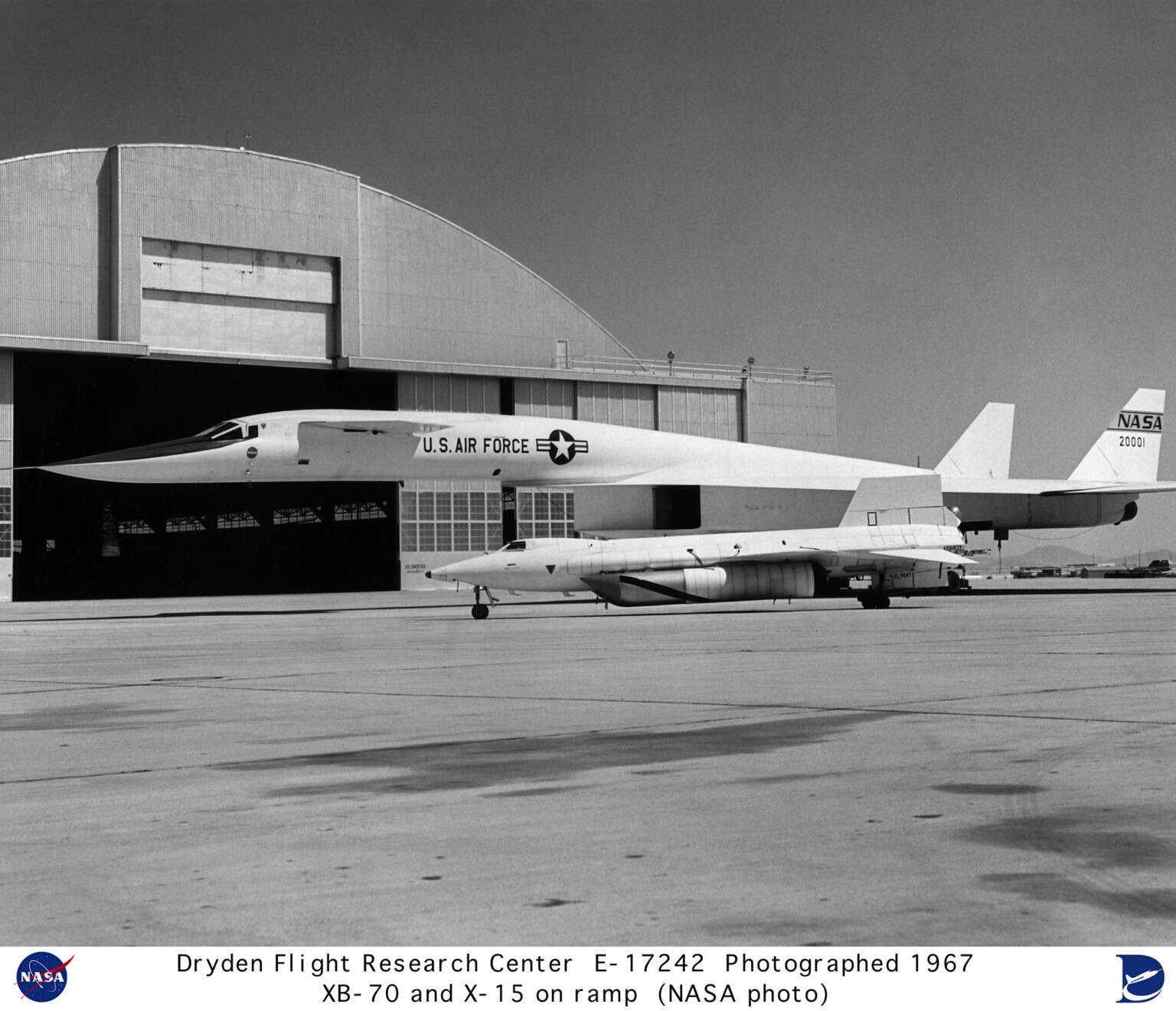
AV-2 had been the better aircraft and the one wired for the National Sonic Boom Program, so its loss hurt. AV-1 took over, and between November 1966 and January 1967 it flew 11 joint Air Force and NASA flights, reaching Mach 2.57.
NASA then used AV-1 as its main aircraft for studying supersonic transport problems: sonic booms, handling, structural flexing and engine behavior at high speed. The data fed the U.S. supersonic transport program, which was canceled in 1971, and the later B-1 bomber program.
The Valkyrie also left a mark abroad. Soviet engineers designed the MiG-25 interceptor in part to catch Mach 3 aircraft like the XB-70 and the SR-71, and XB-70 research is reported to have reached the Soviet Tu-144 airliner program through espionage.
The last supersonic flight came on 17 December 1968. On 4 February 1969, AV-1 flew subsonic to Wright-Patterson Air Force Base, Ohio, and was handed over to the museum.

The full specification table for the XB-70A is on this page. Several of its figures need context, because the numbers quoted for the Valkyrie often disagree.
Thrust. The YJ93 was billed as a “30,000-pound class” engine, and the museum’s fact sheet still gives 30,000 pounds. The engine’s actual maximum afterburning rating, and the figure in the panel, was 28,000 lbf (125 kN). Without afterburner it produced 19,900 pounds.
Speed. The top speed in the panel, 1,787 kt (2,056 mph, 3,310 km/h), is Mach 3.1 at 73,000 feet (22,250 m). The cruise speed is barely lower at 1,738 knots, or about 2,000 mph, because the Valkyrie was designed to spend its whole mission near top speed rather than dash at the end of it.
The fastest either aircraft actually flew was Mach 3.08, by AV-2 in April 1966. Rated maximum and achieved maximum are close, but they are not the same number.
Range. The 3,726 nm range (4,290 mi, 6,900 km) is the design range from the museum’s fact sheet. It is a planning number: the longest XB-70 flight actually flown lasted 3 hours 40 minutes, on 6 January 1966.
Weight and weapons. The panel’s maximum takeoff weight is 542,000 lb (246,000 kg), while the museum quotes a loaded weight of 534,700 pounds. Neither prototype ever carried a weapon, so the panel does not list a payload for the XB-70A.
The two Mach 3 aircraft first flew three months apart, the XB-70 in September 1964 and the SR-71 on 22 December 1964. They could hardly be more different in purpose: one was a bomber prototype built to carry nuclear weapons, the other an operational reconnaissance aircraft.
The SR-71 was faster. Its maximum speed was Mach 3.3, and in July 1976 an SR-71A set a world speed record of 2,193 mph (3,530 km/h), against the XB-70’s best of Mach 3.08.
The Valkyrie was the far bigger machine, at 185 feet 10 inches (56.6 m) long and 542,000 pounds at maximum takeoff weight. The SR-71 went on to an operational career, while the XB-70’s flying days ended in 1969. The story of how no SR-71 was ever brought down is told in why no SR-71 was lost to enemy fire.
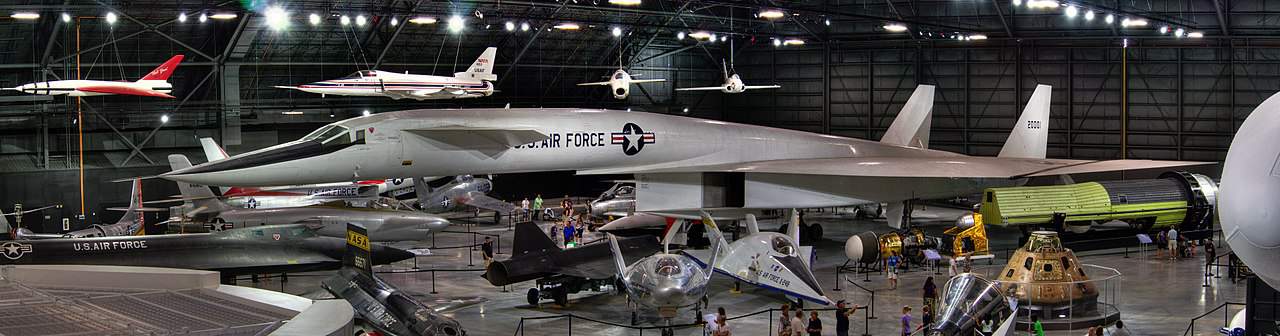
AV-1, serial 62-0001, is the only XB-70 left. It has been at the National Museum of the United States Air Force at Wright-Patterson Air Force Base near Dayton since its final flight in February 1969.
The Valkyrie became the museum’s signature aircraft. In late October 2015 it was moved into the museum’s new fourth building, where it sits in the Research and Development Gallery.

No. The SR-71’s maximum speed was Mach 3.3 and it set a 2,193 mph record in 1976, while the fastest any XB-70 flew was Mach 3.08. The XB-70 was, however, far larger and heavier than the SR-71.
The aircraft largely met its speed and altitude goals, but its mission disappeared. Surface-to-air missiles made high-altitude bombers vulnerable, low-level penetration removed its speed advantage, and ICBMs did the job more cheaply, so Kennedy canceled the bomber in March 1961.
By the public record, yes. Its Mach 3.08 is well beyond any bomber that entered service: the Tu-160 is rated at Mach 2.05 and the B-1B at Mach 1.25. See our ranking of the fastest military aircraft in the world.
The surviving XB-70, AV-1, is on display in the Research and Development Gallery of the National Museum of the United States Air Force near Dayton, Ohio. It flew there on 4 February 1969.
Two. AV-1 flew 83 times and survives in the museum. AV-2 flew 46 times before it was destroyed in a mid-air collision on 8 June 1966, and a third aircraft, AV-3, was canceled before completion.
About $800 million had been spent on the B-70 program when Kennedy canceled the bomber in March 1961. The Federation of American Scientists puts the cost at over $700 million per prototype. As a research aircraft that was never sold, it has no real flyaway price, so the specification panel does not list one.
Six General Electric YJ93-GE-3 afterburning turbojets, mounted side by side in a box under the rear fuselage. Each produced 28,000 pounds of thrust with afterburner and burned a special high-temperature fuel, JP-6.
No. The production B-70 was to carry nuclear and conventional bombs in an internal weapons bay, but both XB-70A prototypes were flown purely as research aircraft and never armed. For the bombers that did reach service, see the best bombers in the world.
Sources and references used for research and fact-checking.