Military Aircraft
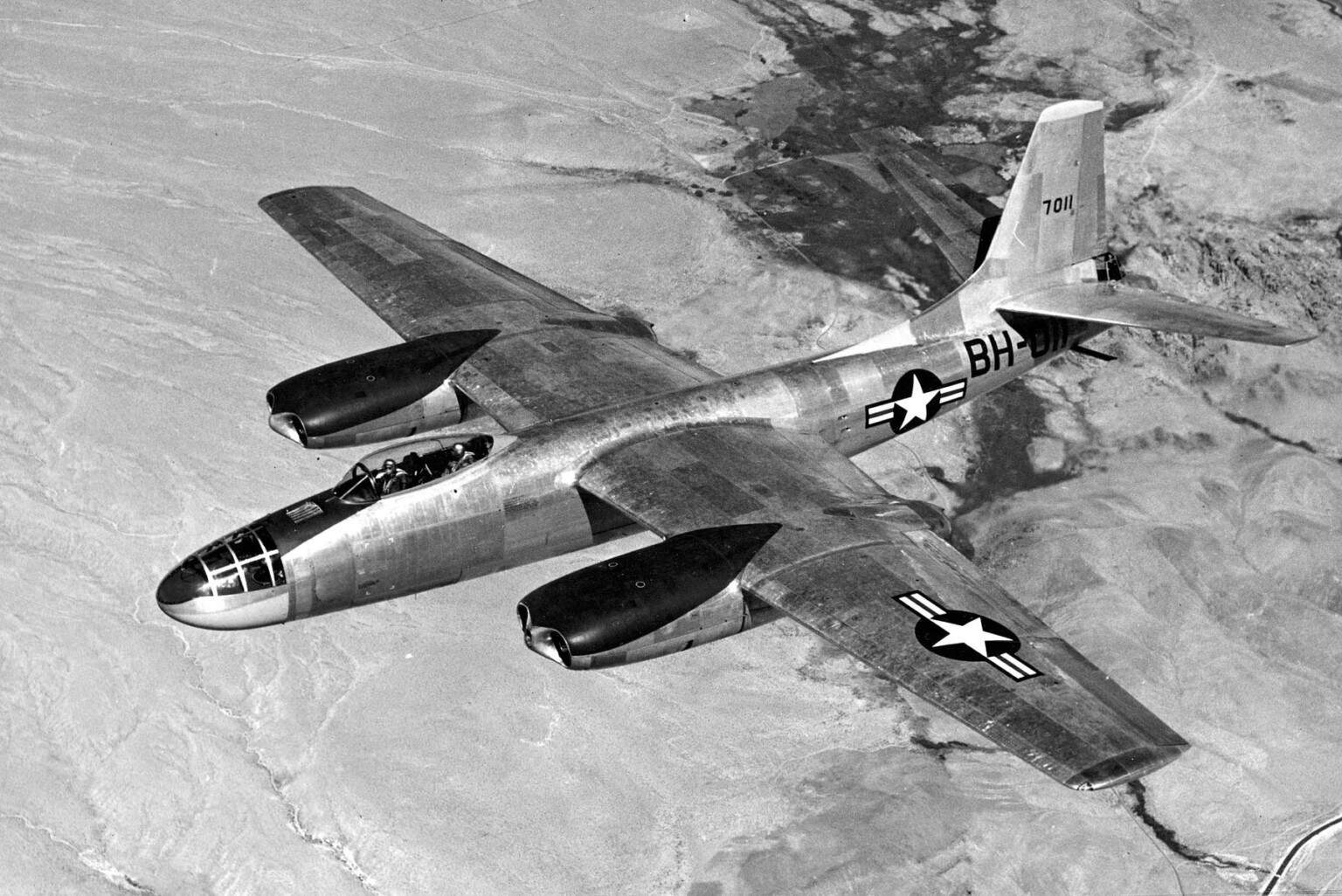
The North American B-45 Tornado was the first American production jet bomber and the first jet bomber able to carry an atomic bomb, a straight-winged pioneer that flew Korean War and Cold War reconnaissance before the B-47 replaced it.
Updated: by Tim de Vries
The latest aviation news and stories sent to your inbox.
The North American B-45 Tornado was the U.S. Air Force’s first operational jet bomber. About 140 were built, first as light bombers for Tactical Air Command and then as RB-45C reconnaissance aircraft that flew over Korea and, in secret, the Soviet Union. Its straight wing and four podded turbojets look dated beside the swept-wing B-47 that followed, but it proved that a jet bomber could be refueled in flight and carry a nuclear weapon.
Live Fleet Activity (B45)
Fetching live data…


The North American B-45 Tornado was the first American jet bomber to go into production and the first able to carry an atomic bomb. It flew in 1947, joined the Air Force in 1948 and was gone from front-line service by 1958.
The Tornado is a B-45 bomber with four jet engines in paired pods under a straight wing. That layout made it a bridge between the piston bombers of World War II and the swept-wing Boeing B-47 Stratojet that replaced it.
The full specification table for the aircraft is on this page, beside the article.
The Army Air Forces issued a requirement for a jet bomber on 17 November 1944, spurred by the German Arado Ar 234. North American’s design, the NA-130, was one of four submitted, and work on three prototypes began on 8 September 1944.
By mid-1946 the Convair XB-46 was nearly finished, while the Boeing XB-47 and Martin XB-48 were at least two years away. The Air Force judged the North American design more advanced and cheaper than the XB-46, and signed the B-45A production contract on 2 January 1947.
Sources disagree on the first flight of the XB-45 at Muroc Army Air Field in California. Some give 24 February 1947 and others 17 March 1947.
The three prototypes and the first 22 B-45As used Allison J35 engines. Later aircraft switched to the General Electric J47.
Production was cut well below the original plan, and about 140 aircraft were built in total. The Air Force announced in 1949 that 51 of 190 aircraft on order were cancelled.
A proposed B-45B with new radar and fire control was never built.

The specification panel on this page shows the B-45’s performance, and a few figures need context.
The weight limits are for the B-45A. The later B-45C was heavier, and the museum fact sheet lists a much higher maximum weight for its aircraft on display.
The panel’s maximum payload of 22,000 lb (10,000 kg) is the bomb load. Armament beyond that was only two .50 caliber machine guns in a tail turret.
The J47 rating on the panel is the B-45C figure of 6,000 lbf per engine. Earlier B-45As were rated lower, at about 5,200 lbf.
The four crew were a pilot, a co-pilot, a bombardier-navigator and a tail gunner. The panel’s Seats row counts all four.
The National Museum of the U.S. Air Force credits the B-45 with several firsts: the first American four-engine jet bomber to fly, the first American production jet bomber and the first jet bomber able to carry an atomic bomb.
Under Operation Fandango, also called Backbreaker, dozens of B-45s were modified for the nuclear mission. Among the changes was an extra bomb bay fuel tank.
Nuclear-capable B-45s of the 47th Bombardment Group deployed to RAF Sculthorpe in England from May 1952. They were part of the early Cold War force that could reach targets in the Soviet bloc from British bases.
The sources reviewed describe the B-45 as nuclear-capable, not as the aircraft that dropped a bomb. Claims that it was the first jet to drop a nuclear weapon are not backed by them.
The B-45C was the first multi-engine jet bomber refueled in midair. Its range was short for a bomber, so the Air Force worked out how to tank jets from propeller-driven tankers.
On 29 July 1952 an RB-45C made the first non-stop trans-Pacific flight, refueled twice by KB-29 tankers. Major Lou Carrington’s crew flew from Alaska to Japan in 9 hours 50 minutes and won the MacKay Trophy.
The RB-45C flew reconnaissance from Japan during the Korean War. On 4 December 1950 a Soviet-flown MiG-15 shot one down over China, the first successful jet-on-jet interception of a jet bomber.
Only one of the four crew, Captain Charles McDonough, parachuted out. He is believed to have died in captivity.
RB-45Cs flew daylight missions until early 1952, then switched to night operations after a close call with a MiG-15.

In July 1951 four RB-45Cs were leased from the 91st Strategic Reconnaissance Wing to a Special Duties Flight at RAF Sculthorpe. The aircraft wore RAF markings and the crews came largely from Nos. 35 and 115 Squadrons.
The unit flew deep reconnaissance over the Soviet Union in 1952 to 1954. On 17 April 1952 three aircraft flew from West Germany toward Kyiv at 36,000 ft, and the lead aircraft was tracked by radar and fired on.
The missions only became public in 1994, under the fifty-year rule. Later flights over Ukraine used English Electric Canberras at far greater altitude.
The B-45 was overtaken almost as soon as it entered service. The swept-wing B-47 flew faster and farther and quickly took over the Strategic Air Command bomber and reconnaissance roles.
The 91st Strategic Reconnaissance Wing had swapped its RB-45Cs for RB-47Es by 1954. RB-45Cs left operational service in spring 1958, and a few B-45s flew on as test aircraft into the early 1970s.
Early B-45As also had a troubled service record. Reported problems included gyrocompass failures at high speed, engine fires and pressurization faults.
For a larger bomber of the same era, see the Convair B-36 Peacemaker.

Three B-45s survive in museums, in California, Ohio and Nebraska. The B-45C at the National Museum of the U.S. Air Force in Ohio was returned by Pratt & Whitney after engine testing and flown to the museum in 1971.
It is painted in the markings of the 47th Bomb Wing (Light).
It was the first American production jet bomber and the first four-engine American jet bomber to fly. Wikipedia notes the Douglas XB-43 was an earlier American jet bomber, but it was only built as a prototype.
Yes. The National Museum of the U.S. Air Force calls it the first jet bomber able to carry an atomic bomb, and dozens of aircraft were modified for the mission under Operation Fandango.
The RB-45C reconnaissance version flew from Japan. A MiG-15 shot one down over China on 4 December 1950, and crews moved to night missions in 1952.
The swept-wing B-47 Stratojet was faster and had greater range. The B-45’s firsts were quickly eclipsed by the newer bomber.
It was a light jet bomber in Tactical Air Command service, with a four-man crew and a bomb load of 22,000 lb. Its reconnaissance version served with Strategic Air Command.
Three survive in museums, in California, Ohio and Nebraska. The Ohio aircraft is a B-45C at the National Museum of the U.S. Air Force.
Sources and references used for research and fact-checking.